Path
At a glance
Contents
Written on 2026-10-26 after checking public pages of the Korea Transportation Safety Authority (K-Pass/모두의카드) and the Seoul city government (Climate Pass FAQ, Ttareungyi fares). No card was registered and no logged-in screens were viewed. Payment dates differ by card issuer and are left out. The only image is a self-made illustration. Nothing here promises income.
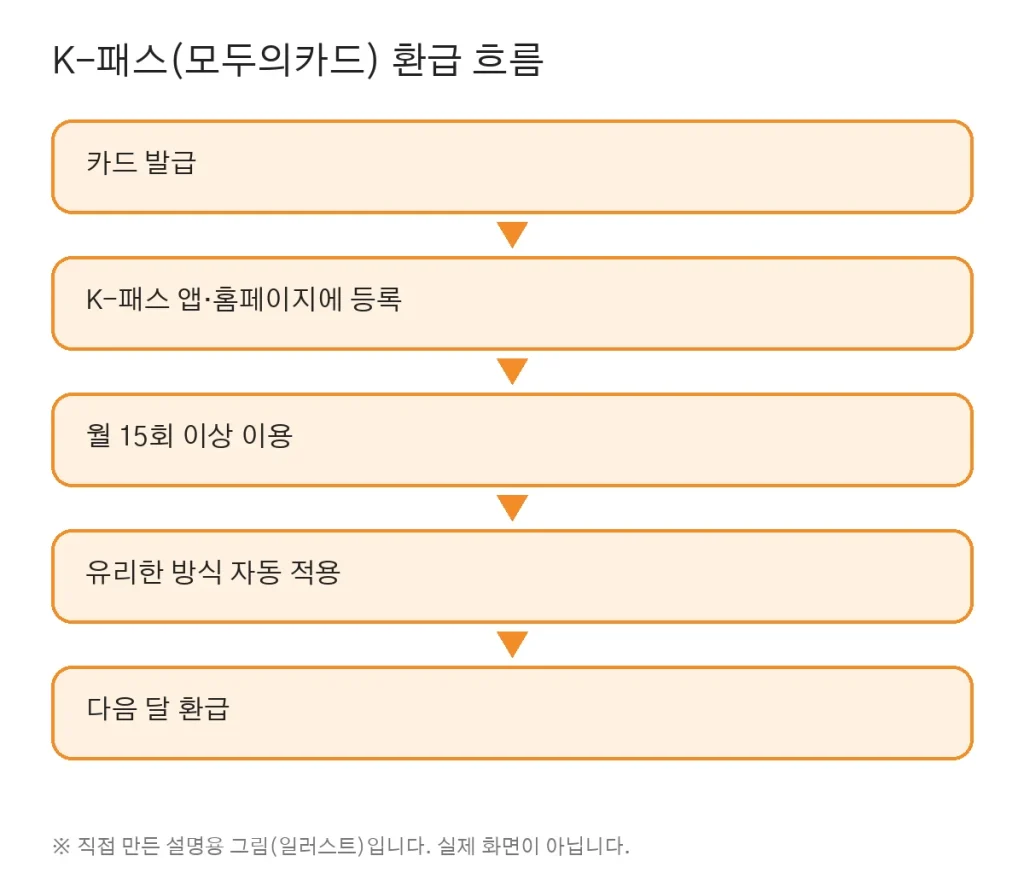
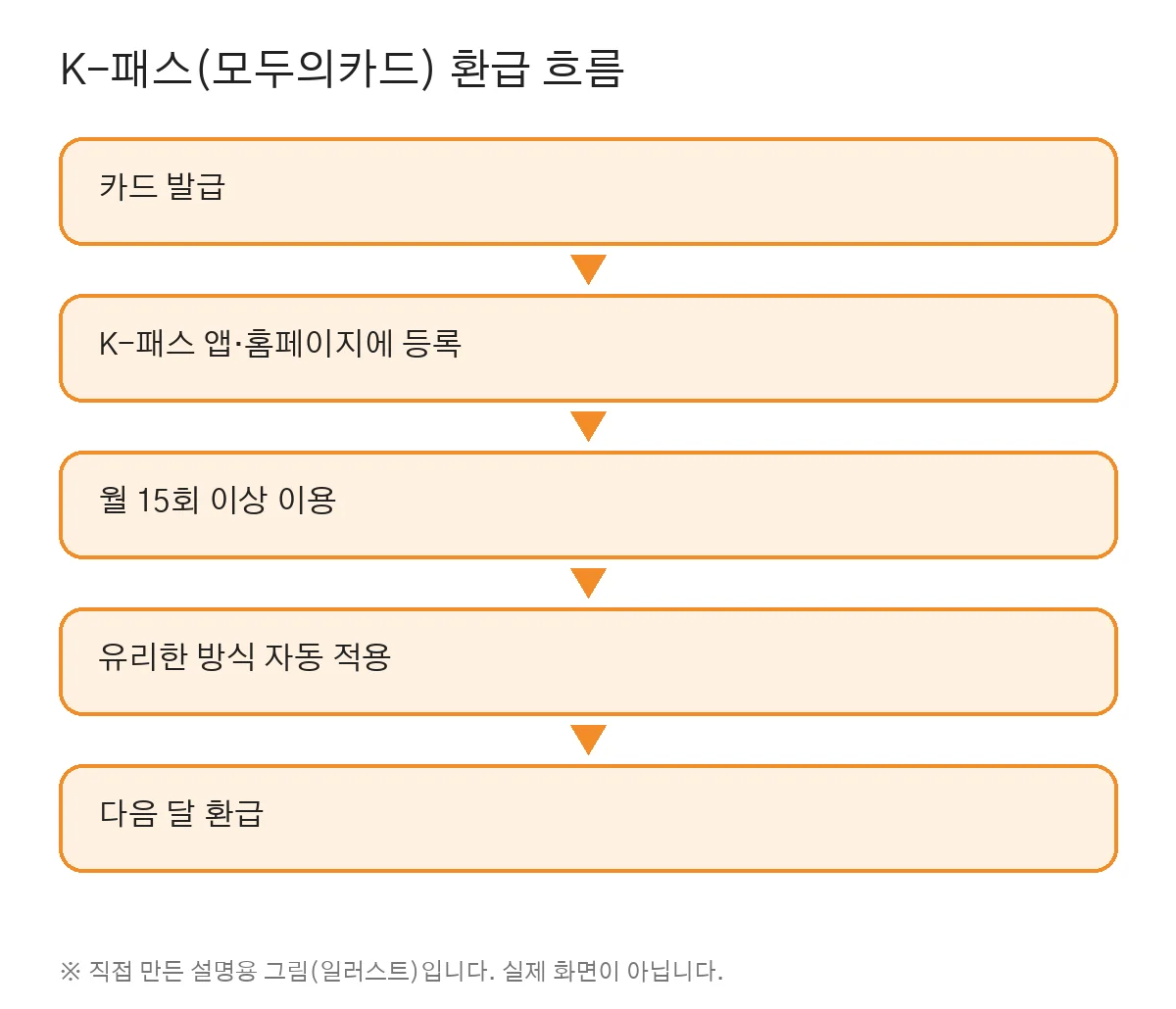
The diagram below is a self-made illustration, not a real screen.
If you ride the bus or subway daily, refund programs give some of it back the next month. This focuses on what changed in 2026.
Who this suits
- Anyone using public transit 15+ times a month
- Anyone biking short trips in Seoul
1. K-Pass (모두의카드): what changed in 2026
From 2026, K-Pass became “모두의카드” (Everyone’s Card). Each month the most favorable of three methods is applied automatically.
- Basic (percentage): general 20%; youth (19–34), seniors, and parents of 2 kids 30%; 3+ kids 50%; low-income (basic livelihood recipients and near-poverty households) 53.3%
- Standard / Plus (fixed threshold): spending above a monthly threshold is refunded. In the capital area: general ₩62,000 (Plus ₩100,000); youth/2 kids/seniors ₩55,000 (₩90,000); 3+ kids/low-income ₩45,000 (₩80,000). Standard counts only rides under ₩3,000 each; Plus counts all. Thresholds are lower outside the capital area.
Eligibility: age 19+ registered in a participating local government, 15+ rides a month (the first month pays even under 15). Which modes count can differ, so check the official K-Pass site; Seoul’s FAQ lists buses, subways, 신분당선, metropolitan buses, GTX, 대경선 and 한강버스 as covered.
How: get a 모두의카드 (K-Pass) card from a card company or bank → sign up on the K-Pass app or website and register the card (after login) → ride → refund the next month.
2. Seoul Climate Pass (기후동행패스)
Seoul is moving its Climate Card into the “Climate Pass,” linked to 모두의카드. Seoul residents already on 모두의카드/K-Pass got the benefits automatically from Sept 1, 2026. Seoul adds a wider youth age range (19–39). A Ttareungyi bike discount is still under discussion. Non-Seoul residents aren’t eligible and should switch to their region’s 모두의카드 service (Gyeonggi: The Gyeonggi Pass).
3. Ttareungyi (Seoul public bike) passes
- Day pass: 1-hour ₩1,000 / 2-hour ₩2,000 / 3-hour ₩3,000
- Season pass (members): 1-hour 7 days ₩3,000, 30 days ₩5,000, 180 days ₩15,000, 365 days ₩30,000; 2-hour 7 days ₩4,000, 30 days ₩7,000, 180 days ₩20,000, 365 days ₩40,000
- Going over the base time costs ₩200 per 5 minutes. Return within the base time and re-rent to keep riding with no extra fee.
Common mistakes
- Getting the card but never registering it on the K-Pass app/site
- Months with fewer than 15 rides
- Riding past the base time and paying extra
Checklist
- ☐ Know your type (general, youth, senior, multi-child, low-income)
- ☐ Register the card with K-Pass
- ☐ 15+ rides a month
- ☐ Return bikes within the base time
For more money you may be missing, see our guide to finding hidden money.
We also have a $4.99 PDF guide that collects more everyday money-saving tips. Take a look if it’s useful →
FAQ
Is Cutting transit costs: K-Pass (모두의카드), Ttareungyi bikes, Climate Pass a legit way to make money?
Yes, it is legal and used worldwide. Written on 2026-10-26 after checking public pages of the Korea Transportation Safety Authority (K-Pass/모두의카드) and the Seoul city government (Climate Pass FAQ, Ttareungyi fares). No card was registered and no logged-in screens were viewed. Payment dates differ by card issuer and are left out. The only image is a self-made illustration. Nothing here promises income. Results depend on your time, skills and consistency; never pay upfront fees to unknown "opportunities".
What are the main pros and cons of Cutting transit costs: K-Pass (모두의카드), Ttareungyi bikes, Climate Pass?
Pros: Anyone using public transit 15+ times a month, Anyone biking short trips in Seoul. Cons: Basic (percentage): general 20%; youth (19–34), seniors, and parents of 2 kids 30%; 3+ kids 50%; low-income (basic livelihood recipients and near-poverty households) 53.3%, Standard / Plus (fixed threshold): spending above a monthly threshold is refunded. In the capital area: general ₩62,000 (Plus ₩100,000); youth/2 kids/seniors ₩55,000 (₩90,000); 3+ kids/low-income ₩45,000 (₩80,000). Standard counts only rides under ₩3,000 each; Plus counts all. Thresholds are lower outside the capital area..
How do I start Cutting transit costs: K-Pass (모두의카드), Ttareungyi bikes, Climate Pass step by step?
The full step-by-step guide is free to read on this page.
🎁 Free: 7-day side-hustle starter checklist
Leave your email and get the free checklist now. No spam, unsubscribe anytime.
Popular guides
- Top 10 Ways to Make Money Starting This Week (Free Checklist)
- How to Make Money as a Student: Legit Ideas (2026)
- Passive Income Ideas: Realistic Options for 2026
- Make Money Online Without Investment: 20 Free Ways
- How to Make Money with AI: 50 Practical Ways (2026)
- How to Make Money From Home: 20 Legit Ways
- Make Money Online for Beginners: 15 Easy Ways to Start
- How to Make Money as a Mom: 16 Flexible Ideas (Work Around Nap Time)
- 16 Legit Ways to Make Money Fast (This Week)
- How to Make Money as a Teenager: 16 Safe Ideas
- 14 Remote Jobs With No Experience Needed
Next method: Using trade-in programs for appliances and laptops →