Start cost $100+ · First income ~1–4 weeks · ~$360–$1,790/mo
Path
Contents
🧭 At a glance: is it for you?
As more people in Korea live alone, there is demand for short, frequent cleaning of small rooms. A one-room apartment (wonroom) or studio usually takes about two hours, so you can visit several in one day. You need little equipment, and customers cluster in university and officetel neighbourhoods.
- Who it suits: People who like physical work, keep appointments and can cover one neighbourhood consistently
- Start-up cost: $95–$410 (KRW 130k–570k; $95–$230 if you already own a vacuum, estimate)
- Time to first income: 1–4 weeks: practise on friends’ rooms, promote locally, land the first regular client
- Difficulty: Easy to medium (trust and thoroughness matter more than skill)
👍 Pros
- About two hours per room, so 3–4 rooms a day is possible
- Weekly or bi-weekly regulars make income steadier
- Low equipment cost; you can start from home
👎 Cons and cautions
- Physically tiring for back and knees
- You enter clients’ homes, so you need to prevent loss/damage disputes
- No work means no income (nothing is guaranteed)
📘 What the full guide below covers: single-household statistics, market prices, equipment budget, service types (regular, move-out, vacant room), pricing, finding clients, tax and insurance, safety rules, step-by-step start, FAQ
💰 Realistic earnings range
- Assuming 3–15 weekly regulars at about KRW 40,000 per visit: roughly KRW 0.5–2.5 million a month ($360–$1,790, at about KRW 1,400 per USD)
- Price reference: Cleaning Lab (Chyeon) one-time cleaning for 8 pyeong or less (2 hours) from KRW 42,900, regular from KRW 41,900 (official site, Oct 2026)
- Benchmark: 2026 minimum wage KRW 10,320 per hour
This is an example calculation, not guaranteed income. Travel time, supplies, tax and insurance reduce what you actually keep.
🪜 Basic steps (summary)
- Practise on 2–3 friends’ rooms for free or at a discount and take before/after photos
- Make a price list (one-time, regular, move-out)
- Register a business on Hometax and get liability insurance quotes
- Create a Karrot (Danggeun) business profile and Naver Smart Place listing
- Turn your first clients into regulars
1. Why studio cleaning? (the numbers)
According to “Single-Person Households in Statistics 2025”, released by Statistics Korea’s successor agency (National Data Office) on 9 December 2025, Korea had 8.045 million single-person households in 2024, 36.1% of all households. Seoul’s share is higher at 39.9%, and 42.7% of single-person households live in Seoul or Gyeonggi. Busy single workers and students often want to outsource cleaning but find services designed for large family homes too much. Being a “small-room specialist” is your selling point.
General house cleaning for larger homes is covered in How to Make Money with House Cleaning Service. This guide covers only one-room apartments, studios and officetels.
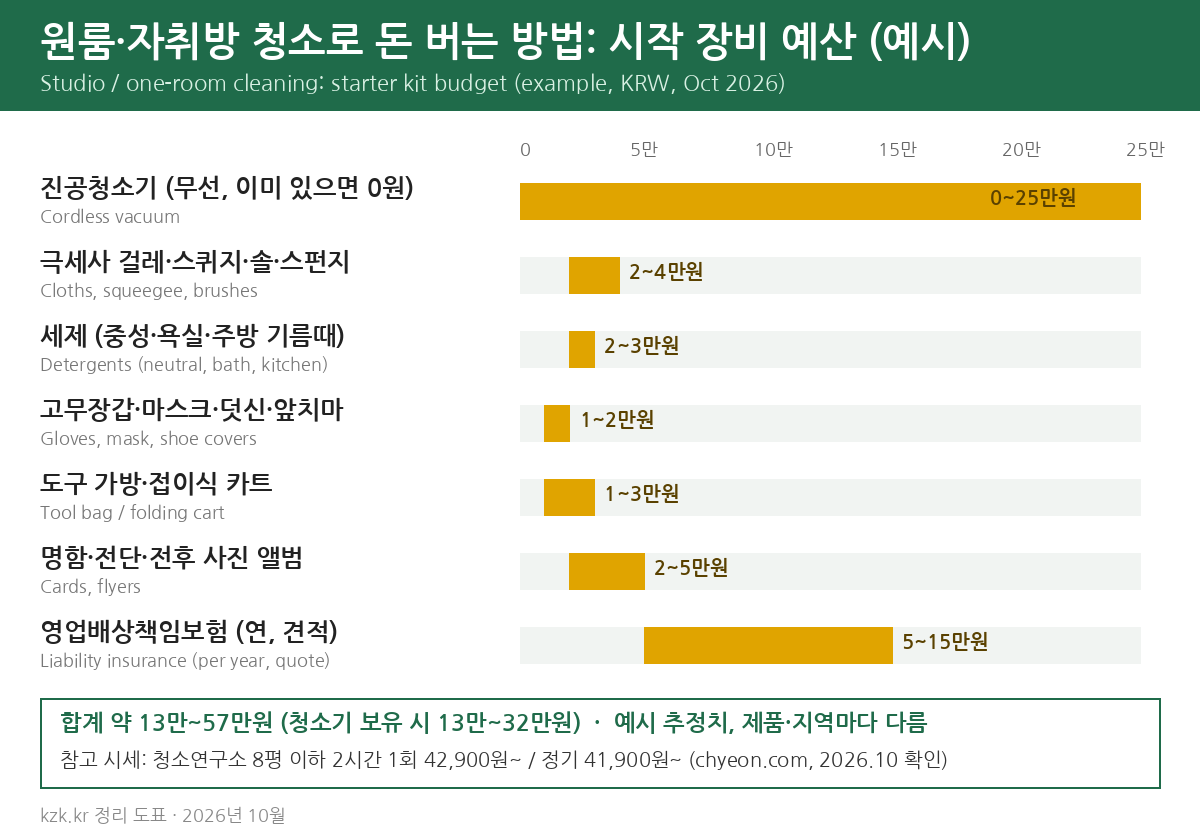
2. Starter equipment and budget
| Item | Example budget (KRW) | Note |
|---|---|---|
| Cordless vacuum | 0–250,000 | 0 if you have one; you can also use the client’s |
| Microfiber cloths, squeegee, brushes, sponges | 20,000–40,000 | Colour-code for bathroom, kitchen and room |
| Detergents (neutral, bathroom, kitchen degreaser) | 20,000–30,000 | Use the client’s products if they prefer |
| Gloves, mask, shoe covers, apron | 10,000–20,000 | Shoe covers protect clients’ floors |
| Tool bag / folding cart | 10,000–30,000 | Handy on public transport |
| Business cards, flyers, before/after photos | 20,000–50,000 | A phone camera is enough |
| Business liability insurance (per year) | 50,000–150,000 | Depends on the insurer’s quote |
These are example estimates as of October 2026; prices vary by product and seller. Buy only the essentials first.
3. Services you can sell
- Regular cleaning (weekly or bi-weekly): floors, bathroom, kitchen sink, recycling and rubbish, bed-making. A studio usually takes about two hours, and repeat visits get faster.
- Pre-move-out cleaning: Korea’s Civil Act requires a tenant to restore the property to its original condition when the lease ends, so tenants who want their deposit back without disputes look for this. Large move-in/move-out jobs for whole apartments need more people and equipment, so stick to small rooms.
- Vacant-room cleaning (for landlords and estate agents): one-room buildings change tenants often. Offer to clean empty rooms before viewings.
- Add-ons: fridge interior, balcony, window frames, folding laundry, priced in KRW 10,000 steps.
Do not take on air-conditioner disassembly, mould removal or specialist cleaning at first; these need special equipment and training.
4. How to set prices
- Check the market: Cleaning Lab (Chyeon)’s official price table lists from KRW 42,900 for one-time cleaning of 8 pyeong or less (2 hours), from KRW 41,900 regular, and from KRW 56,800 for 19 pyeong or less (3.5 hours) (checked October 2026). App prices vary by region and size.
- Work out your costs: split travel time, supplies, tax and insurance per visit.
- Floor: the 2026 minimum wage is KRW 10,320 per hour. If your rate including travel time falls below that, rethink your prices.
- Regular discount: charge regulars slightly less than one-time clients.
- Quote from photos: ask new clients for room photos and confirm time and price in advance.
5. Finding clients
- Karrot (Danggeun) business profile: shown to people nearby. Post before/after photos (with permission).
- Naver Smart Place: free listing so you appear in map search.
- University and officetel areas: inquiries peak at semester starts (Feb–Mar, Aug–Sep) and moving seasons. Get the building manager’s permission before posting notices.
- Landlords and estate agents: vacant-room cleaning lets you do several rooms at once.
- Reviews and referrals: a referral discount (e.g., KRW 5,000 per visit) spreads the word.
6. Tax, insurance and safety
- Business registration: free on the National Tax Service’s Hometax. With annual sales under KRW 104 million you can usually start as a simplified taxpayer (exceptions apply; check with the tax office).
- Income tax: file every May; keep receipts for supplies and tools.
- Industrial accident insurance: self-employed people with no staff can join voluntarily through the Korea Workers’ Compensation and Welfare Service’s special scheme for small business owners.
- Business liability insurance: covers breakage of clients’ belongings. Photograph the room before you start.
- Chemical safety: never mix chlorine bleach with acidic cleaners; it releases toxic gas. Keep windows open.
- Keys and door codes: never write down clients’ door codes, and suggest they change them after you finish.
7. Step-by-step start
- Week 1 – Practise: clean 2–3 friends’ or family members’ studios, time yourself and take before/after photos.
- Week 2 – Prepare: make a checklist (room, kitchen, bathroom, entrance) and a price list; register your business on Hometax.
- Week 3 – Promote: set up Karrot and Naver Smart Place, and offer vacant-room cleaning to 2–3 local estate agents.
- Week 4 – First clients: go through the checklist together afterwards and suggest regular cleaning if they are happy.
- Next: cluster clients in one area to cut travel time, and find a partner when work grows.
Sources
- National Data Office – Single-Person Households in Statistics 2025 (9 Dec 2025)
- Cleaning Lab (Chyeon) – house cleaning price table
- Minimum Wage Commission – 2026 minimum wage
- Korea Law Information Center – Civil Act Articles 615 and 654 (restoration)
- NTS Hometax – business registration
- National Tax Service – simplified taxation
- Ministry of Employment and Labor FAQ – industrial accident insurance for small business owners
📚 Related guides
- How to Make Money with House Cleaning Service
- How to Make Money with Professional Home Organizing
- How to Make Money with Wash-and-Fold Laundry Service
- How to Make Money with Airbnb Co-Hosting
- How to Make Money with Pet Sitting & Dog Walking
Last updated: October 29, 2026. Based on official sources; rules and prices can change.
❓ FAQ
Do I need a licence to clean studio apartments in Korea?
No national licence is required for cleaning private homes such as studios. If you run it as a business, register on Hometax and ask your district office whether a building-cleaning business report applies to you.
How long does one studio take?
A studio of 8 pyeong or less usually takes about two hours; Cleaning Lab’s price table also uses two hours for that size. It takes longer at first and gets faster with repeat visits.
How much can I earn per month?
There is no fixed amount. For example, 10 weekly regulars at KRW 40,000 per visit is about KRW 1.6 million a month before travel, tax and supplies, and with no clients there is no income.
How do I make clients who live alone feel safe?
Share your name, photo and the scope of work in advance and visit only at agreed times. For your own safety, tell a family member the address and time of each visit.
What if I break something?
Take photos before you start and carry business liability insurance to reduce disputes and losses. Ask clients to put away valuable items beforehand.
🎁 Free: 7-day side-hustle starter checklist
Leave your email and get the free checklist now. No spam, unsubscribe anytime.
Popular guides
- Top 10 Ways to Make Money Starting This Week (Free Checklist)
- How to Make Money as a Student: Legit Ideas (2026)
- Passive Income Ideas: Realistic Options for 2026
- Make Money Online Without Investment: 20 Free Ways
- How to Make Money with AI: 50 Practical Ways (2026)
- How to Make Money From Home: 20 Legit Ways
- Make Money Online for Beginners: 15 Easy Ways to Start
- How to Make Money as a Mom: 16 Flexible Ideas (Work Around Nap Time)
- 16 Legit Ways to Make Money Fast (This Week)
- How to Make Money as a Teenager: 16 Safe Ideas
- 14 Remote Jobs With No Experience Needed
Next method: How to Make Money as a Forest Fire Watcher in Korea (Seasonal Public Job: How to Apply) →