Path
Contents
🧭 At a glance: is it for you?
Oyster mushrooms are one of Korea’s most eaten mushrooms. They grow indoors in a mushroom house, so small farms and people moving to the countryside can start. But small mistakes in temperature, humidity or hygiene can ruin a whole crop.
- Who it suits: People preparing to move to a rural area who can log and manage temperature and humidity every day
- Start-up cost: No official figure (varies greatly with building, renting or converting a house; return-to-farm loan up to KRW 300M)
- Time to first income: 3–6 months: training and practice, prepare a growing house, harvest the first crop
- Difficulty: Hard (needs skills, facilities and buyers)
👍 Pros
- Indoor growing means less weather risk
- Several flushes per crop
- Public support such as the return-to-farm start-up loan
👎 Cons and cautions
- Garak Market prices swing a lot day to day
- Contamination from poor sterilization or ventilation is costly
- High fixed costs such as power and fuel
📘 What the full guide below covers: production statistics, start-up cost items, 8 shelf-cultivation steps, bottle cultivation, income data (2014), October 2026 auction prices, sales channels, step-by-step start, scam warnings, FAQ
💰 Earnings from official data
- RDA regional income data (2014): per 330 m² per year, gross KRW 25,083,691, costs KRW 12,486,970, income KRW 12,596,721 (50.2% income ratio)
- Garak Market 2 kg top-grade auction price (2026): KRW 14,088 on Oct 1, 7,694 on Oct 21, 13,831 on Oct 29
- 2024 national output: 662 farms, 151 ha, 58,115 tonnes (MAFRA)
The 2014 income data is more than ten years old and does not reflect today’s labour, power and fuel costs. Prices are volatile, so real income varies a lot between farms.
Oyster mushrooms (neutari) are one of Korea’s most eaten mushrooms. They grow indoors in a mushroom house, so they suit small farms and people moving to the countryside. This guide explains how to make money with oyster mushroom farming using official sources from the Rural Development Administration (RDA) and the Ministry of Agriculture, Food and Rural Affairs (MAFRA).
Short version: success depends on “temperature, humidity and hygiene control + stable buyers.” Prices change daily, so income varies a lot between farms.
1. What is oyster mushroom farming?
You make a substrate (the “soil”) from cotton waste, rice straw or sawdust, then add spawn (the “seed”). There are two main methods:
- Shelf (bed) cultivation: substrate is spread on shelves inside a growing house; common on small farms.
- Bottle cultivation: sawdust substrate in plastic bottles; needs automated equipment and suits large farms.
According to MAFRA’s 2024 Special Crops Production Report, 662 farms grew oyster mushrooms on 151 ha and produced 58,115 tonnes in 2024 (down 1.3% from 58,879 t in 2023). Total mushroom output was 152,671 t.
2. Start-up cost
Costs vary greatly depending on whether you build, rent or convert a greenhouse. There is no official start-up figure; get quotes for each item.
| Item | Details |
|---|---|
| Growing house | Insulated house or greenhouse with shading/insulation |
| Climate control | Heating/cooling, ventilation fans, humidifiers (80–95% RH) |
| Sterilization | Steam boiler (substrate sterilization, house disinfection) |
| Substrate | Cotton waste/straw, about 50–60 kg per 3.3 m² of bed |
| Spawn | About 10–15 bottles per 3.3 m² |
| Packing | 2–4 kg boxes, 100–200 g packs, cold storage |
| Training | Agricultural technology centers, agriedu.net (some free courses) |
The government’s return-to-farm start-up loan offers up to KRW 300 million per household in 2026, with 5 years’ grace then 10 years of repayment, at a fixed 1.5% or variable rate; the actual amount depends on review.
Under the Farmland Act Enforcement Decree, a mushroom house built on farmland still counts as farmland, so no farmland-conversion permit is needed. Check building-permit rules with your city/county office.
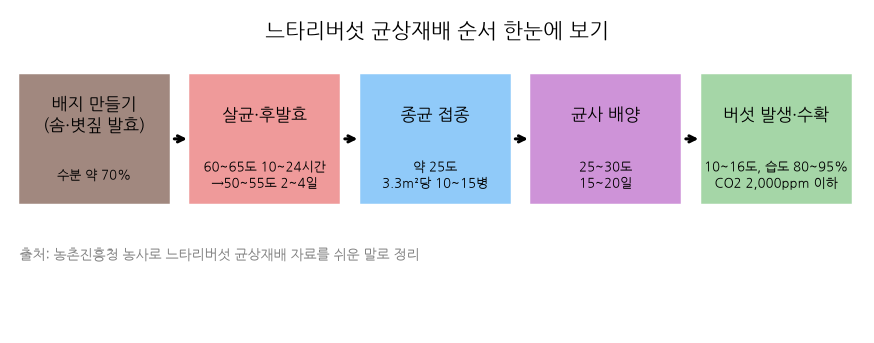
3. Equipment and growing method (shelf cultivation)
Summarised in plain words from RDA’s Nongsaro materials:
- Make substrate: wet cotton or straw to about 70% moisture (2–3 drops when squeezed). Compost outdoors, turning about 3 times once it heats above 60 °C.
- Fill beds: about 20 cm deep.
- Pasteurize and post-ferment: steam at 60–65 °C for 10–24 h, then 50–55 °C for 2–4 days.
- Spawn: at about 25 °C, 10–15 spawn bottles per 3.3 m².
- Mycelium growth: 25–30 °C for 15–20 days; above 32 °C invites contamination.
- Fruiting: drop to 10–16 °C with light; humidity 90–95% at first, then 80–90%; ventilate to keep CO₂ at or below 2,000 ppm; water about 800 ml per 3.3 m² a day.
- Harvest and pack: pick before caps flatten; pack in 2–4 kg boxes or 100–200 g packs.
- Disinfect: after the crop, steam the house at 70 °C for about 7 hours.
Bottle cultivation typically mixes sawdust 70 : rice bran 30 at 62–65% moisture in 850 ml bottles, sterilized at 121 °C for 90 minutes. Because of equipment costs, most beginners start with shelves.
Buy spawn from suppliers registered under the Seed Industry Act to reduce quality problems.
4. How much can you earn?
Official income data (old)
RDA regional income data (posted by Jeju Agricultural Research and Extension Services) for 2014, per 330 m² per year:
- Yield 5,708 kg at KRW 4,360/kg
- Gross income KRW 25,083,691; operating costs KRW 12,486,970
- Income KRW 12,596,721 (50.2% income ratio)
This is more than ten years old and doesn’t reflect today’s labour, power and fuel costs. Use it as a reference only; newer figures are in RDA’s Agricultural Income Data book on Nongsaro.
2026 wholesale prices (very volatile)
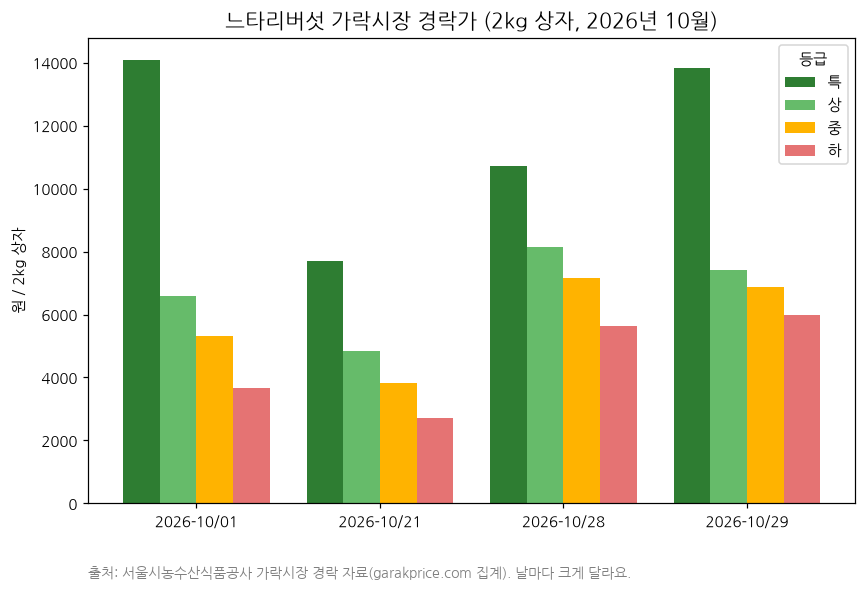
Garak Market auction prices per 2 kg box (Seoul Agro-Fisheries & Food Corporation data):
| Date (2026) | Top | High | Mid | Low |
|---|---|---|---|---|
| Oct 1 | 14,088 | 6,603 | 5,307 | 3,662 |
| Oct 21 | 7,694 | 4,849 | 3,824 | 2,712 |
| Oct 28 | 10,729 | 8,138 | 7,149 | 5,632 |
| Oct 29 | 13,831 | 7,421 | 6,877 | 5,990 |
(KRW.) Top grade reached KRW 48,231 on Feb 13 and 37,618 on Sep 23, 2026, then fell to about 7,193 on Oct 16. Because prices swing so much, real income varies by yield, grade, sales channel and costs.
5. Where to sell
- Wholesale market auctions (e.g., Garak): high volume, volatile prices.
- Nonghyup / joint markets: easier shipping and settlement.
- Local food direct stores: you set your own price.
- Online direct sales: small packs via online stores; needs chilled delivery.
- Restaurants and side-dish shops: regular supply deals smooth out price swings.
6. Step-by-step start
- Take training at your local agricultural technology center or agriedu.net.
- Visit and practise on a real farm for one full crop cycle.
- Register as an agricultural business entity with NAQS to access support programs.
- Prepare a small growing house; check farmland and building rules with the local office.
- Plan funding: look into the start-up loan and budget a full year including power and fuel.
- First crop: log temperature, humidity and CO₂ daily; remove contaminated substrate quickly.
- Secure at least two sales channels.
Watch out for these scams
Some ads sell pricey kits promising “millions of won a month from home.” Nobody can guarantee income. Others charge fees to “get your farm subsidy for you,” or take deposits for building a growing house and never finish. Check support programs directly with official sites and pay builders in stages under a written contract.
Sources
- MAFRA – 2024 Special Crops Production Report
- RDA Nongsaro – oyster mushroom shelf cultivation video
- RDA Nongsaro – oyster mushroom work schedule
- RDA Nongsaro – bottle cultivation video
- RDA regional income data (2014, via Jeju ARES)
- RDA Nongsaro – Agricultural Income Data book
- Garak Market oyster mushroom prices
- KAMIS wholesale prices
- Gov24 – return-to-farm start-up support
- Easy Law – farmland conversion
- Agricultural education portal
📚 Related guides
- How to Make Money Selling Houseplant Cuttings & Propagations
- How to Make Money with Lawn Care & Gardening
- How to Make Money as a Forest Fire Watcher in Korea (Seasonal Public Job: How to Apply)
Last updated: October 29, 2026. Based on official sources; rules and prices can change.
❓ FAQ
Can I start with no farming experience?
Yes, but training and hands-on practice are essential; small mistakes in temperature or hygiene can ruin a crop.
How many harvests per year?
Several flushes come per crop; crops per year depend on facilities and management.
Can I grow at home or in a warehouse?
Small amounts, yes; commercial production needs a house with climate control.
Most common failure?
Poorly sterilized substrate, too-high spawn-run temperature (over 32 °C) and poor ventilation (too much CO₂).
Where do I find support?
Return-to-Farm Center, local agricultural technology centers and Gov24 subsidy search.
🎁 Free: 7-day side-hustle starter checklist
Leave your email and get the free checklist now. No spam, unsubscribe anytime.
Want to run Oyster Mushroom Farming in Korea as a 30-day plan? The PDF guide (one-time .99) compares 30 methods with steps and income estimates. All steps above stay free.
See full guide →Popular guides
- Top 10 Ways to Make Money Starting This Week (Free Checklist)
- How to Make Money as a Student: Legit Ideas (2026)
- Passive Income Ideas: Realistic Options for 2026
- Make Money Online Without Investment: 20 Free Ways
- How to Make Money with AI: 50 Practical Ways (2026)
- How to Make Money From Home: 20 Legit Ways
- Make Money Online for Beginners: 15 Easy Ways to Start
- How to Make Money as a Mom: 16 Flexible Ideas (Work Around Nap Time)
- 16 Legit Ways to Make Money Fast (This Week)
- How to Make Money as a Teenager: 16 Safe Ideas
- 14 Remote Jobs With No Experience Needed
Next method: How to Make Money with Signboard Cleaning in Korea →