Path
At a glance
Contents
Up front: this guide is a process for starting and testing a side job in 30 days. It does not promise income. Results vary from person to person. Platform fees, tax and health-insurance details were checked on official pages as of Oct 2026. They change, so re-check the linked sources before you act.
The setup
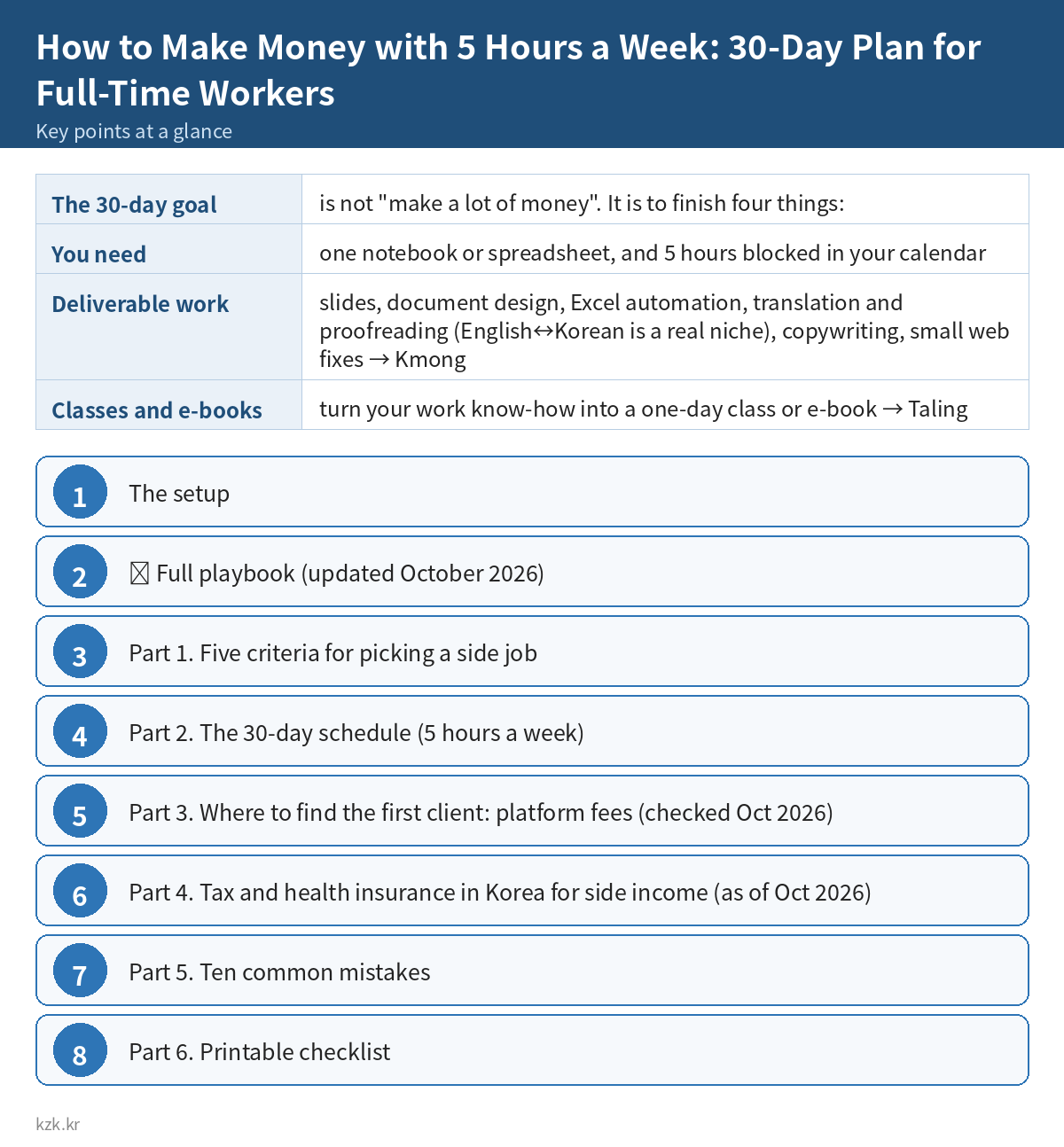
- Time: two weekday evenings × 1 hour + one weekend block × 3 hours = 5 hours a week
- The 30-day goal is not “make a lot of money”. It is to finish four things:
- Pick one side job that fits your situation
- Confirm your employer’s rules and, if you are not Korean, your visa rules
- Publish one service page or profile
- Get a first inquiry or quote out, or attempt a first deal, and know how it will be taxed
- You need: one notebook or spreadsheet, and 5 hours blocked in your calendar
📘 Full playbook (updated October 2026)
Part 1. Five criteria for picking a side job
Write down three candidates and score each from 1 to 5 on the criteria below. Don’t just pick the highest total. Pick one with no deal-breaking zero.
| Criterion | Ask yourself | What suits a 5-hour-a-week worker |
|---|---|---|
| 1. Time structure | Can I set my own deadlines? Do clients expect calls during weekday office hours? | Asynchronous, message-based or deliverable-based work |
| 2. Startup cost | Equipment, stock, ads: can I afford to lose this? | Close to zero; no inventory |
| 3. Existing skills | Is it a skill I already use at work or as a hobby? | Docs, design, translation, Excel, coding, tutoring, photography |
| 4. Rules | Does my employment contract ban or require approval for outside work? Does my visa allow it? | Work that doesn’t overlap with your employer’s clients or know-how |
| 5. Risk | Refunds, defects, personal data, legal liability, licences? | Clear deliverables with a defined revision scope |
Check your employer’s rules
- Search your employment rules (취업규칙), contract and code of conduct for “겸업” / “겸직” (outside employment), “영리” (for-profit activity) and “conflict of interest”.
- If there is an approval process, follow it. If unclear, email HR describing the work: outside hours, no company resources, not a competing field.
- Public officials and public-sector staff face statutory limits on for-profit work (e.g. 국가공무원법 Art. 64) and need their agency’s permission.
- Don’t assume a side business stays invisible to your employer. It may come to light through health-insurance premiums on non-salary income or year-end tax and withholding records, so check your company’s rules first.
- Never use your company laptop, work hours, internal files or client data for the side job.
Check your visa (foreign residents)
Your stay status (E-7, E-2, D-10, F-2, F-5 and so on) decides what work you may do. Many work visas are tied to a specific job. Under the Immigration Act (출입국관리법) Art. 20, doing activities that belong to a different status of stay requires prior permission from the Minister of Justice (체류자격 외 활동허가). Before you take a single paid gig, confirm with the Immigration Contact Center (1345, English available) or HiKorea. Holders of some statuses, such as F-5 permanent residents, usually have broad freedom to work, but confirm your own case.
This is general information, not legal or immigration advice.
Types that fit 5 hours a week
- Deliverable work: slides, document design, Excel automation, translation and proofreading (English↔Korean is a real niche), copywriting, small web fixes → Kmong
- Local in-person services: tutoring (check visa rules for teaching!), lessons, photography, assembly → Soomgo, Danggeun
- Classes and e-books: turn your work know-how into a one-day class or e-book → Taling
- Avoid within the first 30 days: anything with inventory, instant weekday replies, or licensing requirements
Part 2. The 30-day schedule (5 hours a week)
Each week has three blocks: Weekday A (1h) · Weekday B (1h) · Weekend (3h). Thirty days = 4 weeks plus a 2-day wrap-up.
Week 1: Choose, check, decide
| Block | Task | Deliverable |
|---|---|---|
| Weekday A (1h) | List 3 candidates; fill in the 5-criteria scorecard | Scorecard |
| Weekday B (1h) | Check employment rules; check your visa; draft an HR or 1345 question if needed | Rules note / question draft |
| Weekend (3h) | Pick one (30m). Study 10 top sellers in that category on Kmong, Soomgo, Taling and Danggeun: price, scope, turnaround, repeated praise and complaints in reviews (2h). Write your one-line offer (30m) | 10-row research sheet, one-line offer |
One-line offer formula: “I deliver [what] to [whom] in [time], as [format].”
E.g. “I proofread English business emails and slides for Korean professionals within 48 hours, with one revision.”
Week 2: Samples and pricing
| Block | Task | Deliverable |
|---|---|---|
| Weekday A (1h) | Build sample #1 on a made-up topic, using no company material | Sample 1 |
| Weekday B (1h) | Build sample #2 or polish #1 | Sample 2 |
| Weekend (3h) | Write a 3-tier price list with scope, revisions and turnaround (1h). Calculate take-home after fees (30m, see Part 3). Write 5 FAQs (1h). Write your process: order → work → delivery → revisions (30m) | Price list, net calc, FAQ, process |
Pricing tip: start below the median of the sellers you studied, but do it by narrowing scope, not by doing the same work for less.
Week 3: Publish and tell people
| Block | Task | Deliverable |
|---|---|---|
| Weekday A (1h) | Sign up on one platform and write your profile | Profile |
| Weekday B (1h) | Create the listing (offer, samples, prices, FAQ, process) and submit it for review | Listing in review |
| Weekend (3h) | Fix anything the review rejected. Ask 3–5 friends for feedback on the page, not purchases. On Soomgo, send 1–3 quotes to matching requests. Write 3 reply templates: first inquiry, quote, delivery | Live page, feedback, templates |
Many Korean platforms are Korean-language first. A clear bilingual listing can be a selling point.
Week 4: Attempt the first deal and log everything
| Block | Task | Deliverable |
|---|---|---|
| Weekday A (1h) | Reply to inquiries and send 2–3 quotes. If you get views but no messages, rewrite the opening lines | Reply log |
| Weekday B (1h) | Work on a job if you have one; otherwise prepare a second channel | Work or channel #2 |
| Weekend (3h) | Deliver and handle revisions. Ask for a review within platform rules. Log revenue, fees and hours. Write down how your income is taxed (Part 4) | Revenue and time log, tax note |
Days 29–30: Review
- Look at three numbers: views (if available) → inquiries → deals.
- Make one decision: continue, adjust scope, or switch candidates.
- No deal yet is not failure. The goal was to reach a state you can test. Choose one variable to change next month: price, copy, or channel.
Part 3. Where to find the first client: platform fees (checked Oct 2026)
| Platform | Good for | Seller cost (per official pages) | Source |
|---|---|---|---|
| Kmong (크몽) | Design, IT, documents, translation | Fee = tiered service fee + 3.3% payment-network fee + 10% VAT on both. Official example tiers: 16.4% up to KRW 700k, 9.4% for KRW 700k–2M, 4.4% above KRW 2M (may differ by category) | Fee policy, Earnings calc |
| Soomgo (숨고) | Lessons, tutoring, photography, installation, cleaning | Each quote you send costs Soomgo Cash, which varies by service, region and demand and is shown before you send. Refunded as bonus cash if the client doesn’t open the quote within 48h. No commission on the final deal. With Soomgo Pay, the 3.5% fee is paid by the client | Pro info, Terms, Soomgo Pay |
| Taling (탈잉) | One-day and multi-session classes, e-books, VOD | Commission: one-day 15%, multi-session 14%, e-book 20%, membership 11%, VOD B2C 20%, VOD B2B 50%. Payout = price − taxes and dues (10% of supply value) − commission − 3.3% withholding. No listing fees | Commission, Payout |
| Danggeun (당근) | Neighborhood lessons, repairs, workshops | Business profile and posts are free; ads are paid per click from ad cash | Business profile, Ads guide |
Kmong example (one KRW 500,000 sale, official formula):
– service fee 82,000 + network fee 16,500 + VAT 9,850 = 108,350
– net KRW 391,650, about 78%, before income tax
Taling example (KRW 55,000 one-day class):
– 5,000 taxes and dues, 7,500 commission, about 1,402 withholding
– about KRW 41,098 paid out
Common rules: don’t move clients off-platform (most platforms sanction it), state revisions and scope clearly, and reply fast. These improve your odds; nothing guarantees a client.
Note that Taling settles as personal business income under a resident registration number, so foreign residents need their alien registration number and a Korean bank account.
Part 4. Tax and health insurance in Korea for side income (as of Oct 2026)
If you live in Korea for 183 days or more, you are generally a Korean tax resident and taxed on your income here. The rules below then apply to you just as they do to Korean citizens. Official English help: the NTS English site and the 126 helpline (English service available).
1. Business income vs other income
The NTS distinguishes (NTS):
| Type | Meaning | Withholding |
|---|---|---|
| Business income (사업소득) | Independent services provided continuously | 3% + local tax = 3.3% of the payment |
| Other income (기타소득) | One-off services | 20% of (payment − expenses) |
The NTS’s own example: a one-off guest lecture is other income, while lecturing repeatedly and independently is business income. A side job you plan to keep selling is usually business income.
2. What 3.3% withholding means
The platform or client deducts 3.3% and pays it to the tax office for you. It is a prepayment, not your final tax. You settle up in May.
3. If it really is one-off “other income”
- 60% of the payment counts as expenses, so withholding is typically 8.8% of the payment (NTS).
- No tax if the income amount per case is KRW 50,000 or less, i.e. a payment up to KRW 125,000.
- If your total other-income amount is KRW 3M or less a year, you may choose separate taxation instead of filing (NTS).
4. May filing: comprehensive income tax
- With business income, you file a comprehensive income tax return May 1–31 of the following year. Your salary goes on it too, even though year-end settlement already covered it (NTS filing guide). In 2026, May 31 fell on a Sunday, so the deadline was June 1.
- File on Hometax, which has an English interface for some menus, or the Sontax app. You can see what platforms reported under your name there.
- Keep receipts and monthly payout statements. Bookkeeping duties depend on revenue and industry (NTS).
5. Do you need a business registration?
- In principle, you apply within 20 days of starting a business (NTS).
- However, certain personal services provided independently, with no fixed business premises and no employees, are VAT-exempt. Many “3.3% freelancers” work without registering. Whether your service qualifies depends on the type, so ask 126.
- Selling goods, running your own online store, or providing VAT-taxable services may require registration and a mail-order business report (통신판매업 신고). Who must file that report, and the exemptions, can change, so check the current rules with the Fair Trade Commission or Gov24 (search “통신판매업 신고”). Kmong also says sellers must register when certain conditions apply (Kmong).
- Simplified taxpayer (간이과세자): individuals whose prior-year supply value is under KRW 104M can qualify (lower threshold for some sectors). Below KRW 48M in a period, VAT payment is exempt, but you still file (NTS Q&A).
- For foreigners, registration may involve your visa status. Confirm with immigration before registering a business.
6. Health insurance impact
- As an employee member, if your non-salary income (business, other, interest, dividends and so on) exceeds KRW 20M a year, you pay an extra premium on the excess yourself (NHIS; NHIS English).
- Formula: ((annual non-salary income − KRW 20M) ÷ 12) × evaluation rate × 7.19% (2026 rate). The evaluation rate is 100% for business and other income and 50% for wage and pension income. Long-term care insurance is added on top (2026 rates).
- The figure is income after expenses, not revenue, and premiums are based on income data from 1–2 years earlier, so a jump shows up later.
Part 5. Ten common mistakes
- Starting without checking employer rules and visa permission
- Making samples from company files or on a company laptop
- Cutting price without cutting scope
- Not stating revisions and turnaround
- Pricing before fees (a Kmong seller nets about 78% on a KRW 500k sale)
- Taking clients off-platform
- Thinking 3.3% withholding means you’re done. You still file in May
- Not keeping receipts and payout statements
- Ignoring the KRW 20M health-insurance threshold
- Launching on four platforms at once. With 5 hours a week, start with one
Part 6. Printable checklist
Week 1
– [ ] Scorecard: 3 candidates × 5 criteria
– [ ] Employer rules checked (HR asked in writing if unclear)
– [ ] Visa permission checked (1345 / HiKorea)
– [ ] One side job chosen
– [ ] 10 competing sellers researched
– [ ] One-line offer written
Week 2
– [ ] Two samples (no company material)
– [ ] Three-tier price list with scope, revisions and turnaround
– [ ] Net take-home calculated after fees
– [ ] 5 FAQs and a process note
Week 3
– [ ] One platform profile
– [ ] Listing submitted
– [ ] Feedback from 3–5 people
– [ ] 3 reply templates
Week 4
– [ ] Inquiries answered and quotes sent
– [ ] First job done, or second channel ready
– [ ] Revenue, fees and hours logged
– [ ] Income type confirmed (business vs other) and withholding confirmed
– [ ] Registration need checked (within 20 days if required)
Days 29–30
– [ ] Views → inquiries → deals recorded
– [ ] One decision: continue, adjust or switch
– [ ] Next May’s tax filing added to your calendar
– [ ] Monthly receipts folder created
More
- kzk.kr premium guides: /premium/
- 한국어판: /ko/premium-ko/
Results vary from person to person. This guide does not guarantee income. Tax, health-insurance and visa notes summarise official sources as of Oct 2026 and are general information. For your own case, contact the NTS (126), NHIS (1577-1000, foreign-language service available), Immigration (1345) or a licensed tax accountant.
Last updated: October 2026.
Results vary from person to person. Want the full step-by-step playbooks for every method? See Premium.
Want to run 5 Hours a Week as a 30-day plan? The PDF guide (one-time .99) compares 30 methods with steps and income estimates. All steps above stay free.
See full guide →FAQ
Is How to Make Money with 5 Hours a Week: 30-Day Plan for Full-Time Workers a legit way to make money?
Yes, it is legal and used worldwide. Up front: this guide is a process for starting and testing a side job in 30 days. It does not promise income. Results vary from person to person. Platform fees, tax and health-insurance details were checked on official pages as of Oct 2026. They change, so re-check the linked sources before you act. Results depend on your time, skills and consistency; never pay upfront fees to unknown "opportunities".
What are the main pros and cons of How to Make Money with 5 Hours a Week: 30-Day Plan for Full-Time Workers?
Pros: Time: two weekday evenings × 1 hour + one weekend block × 3 hours = 5 hours a week, The 30-day goal is not "make a lot of money". It is to finish four things:, Pick one side job that fits your situation, Confirm your employer's rules and, if you are not Korean, your visa rules, Publish one service page or profile, Get a first inquiry or quote out, or attempt a first deal, and know how it will be taxed, You need: one notebook or spreadsheet, and 5 hours blocked in your calendar. Cons: .
How do I start How to Make Money with 5 Hours a Week: 30-Day Plan for Full-Time Workers step by step?
The full step-by-step guide is free to read on this page.
🎁 Free: 7-day side-hustle starter checklist
Leave your email and get the free checklist now. No spam, unsubscribe anytime.
Popular guides
- Top 10 Ways to Make Money Starting This Week (Free Checklist)
- How to Make Money as a Student: Legit Ideas (2026)
- Passive Income Ideas: Realistic Options for 2026
- Make Money Online Without Investment: 20 Free Ways
- How to Make Money with AI: 50 Practical Ways (2026)
- How to Make Money From Home: 20 Legit Ways
- Make Money Online for Beginners: 15 Easy Ways to Start
- How to Make Money as a Mom: 16 Flexible Ideas (Work Around Nap Time)
- 16 Legit Ways to Make Money Fast (This Week)
- How to Make Money as a Teenager: 16 Safe Ideas
- 14 Remote Jobs With No Experience Needed
Next method: How to Make Money with Coupang Partners: Sign-Up, Commissions and Payouts →