Path
Contents
Restaurant kitchen drains, shop restrooms and apartment sinks clog often because grease and food waste build up. When a drain clogs, people can’t use water, so they call a company right away. This guide explains how to make money with drain cleaning in Korea in plain words, based on official legal interpretations and statistics from the Korea Consumer Agency (KCA). The key points are to show the cause on camera, set prices in advance, and stay away from jobs that need a permit you don’t have.
In one line: With the right equipment you can start this call-out service on your own. But cleaning the inside of private sewage treatment facilities such as septic tanks needs a separate permit, and most complaints about drain services are about “no effect” and “extra charges demanded on site” (KCA).
1. What it is
- You visit customers and unclog and flush sinks, toilets, washbasins, floor drains and building pipes. The KCA calls this “sewer sanitation service” and describes it as a service that fixes clogged or backed-up sewer pipes and cleans or repairs the pipes.
- This guide covers unclogging and flushing blocked pipes. It is a different job from whole-house cleaning, move-in cleaning, mattress cleaning or signboard cleaning.
- The registration or permit you need depends on the type of work.
| Type of work | What you need | Legal basis |
|---|---|---|
| Unclogging sinks, toilets and drains; flushing pipes | Business registration (within 20 days of starting) | Value-Added Tax Act, Art. 8 |
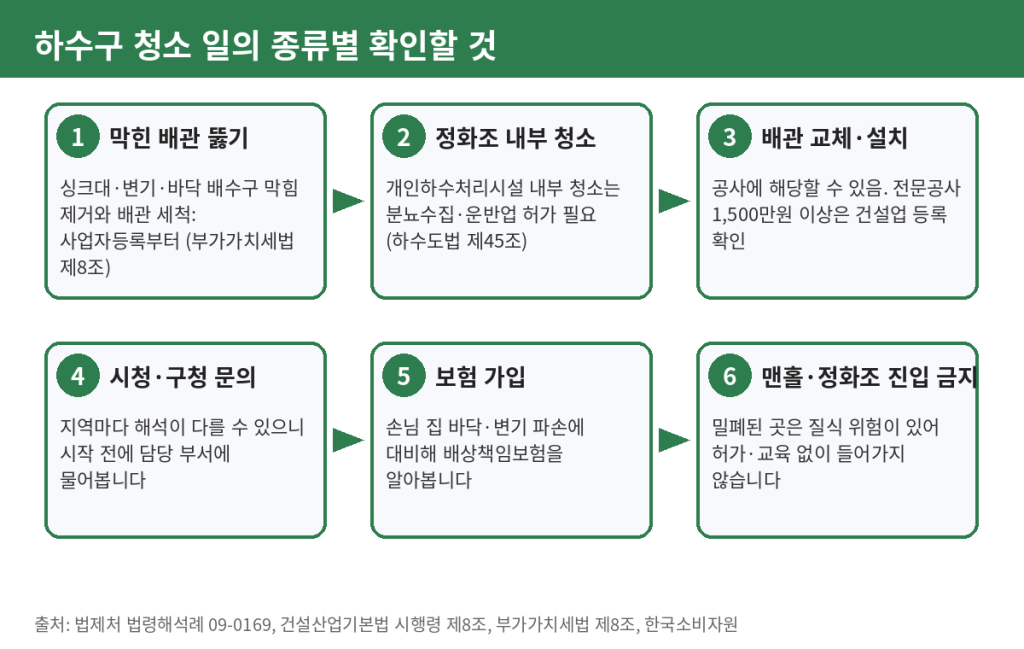
| Cleaning the inside of septic tanks or other private sewage treatment facilities; collecting and transporting night soil | A night-soil collection and transport business permit from the city/county/district head (standards for facilities, equipment and technicians, including at least one suction truck with a deodorizing unit) | Sewerage Act Art. 45 and Enforcement Decree Annex 1 (Ministry of Government Legislation interpretation 09-0169) |
| Construction work such as replacing or installing pipes | Check whether construction business registration is needed for the size of the job. A specialty job under KRW 15 million is treated as “minor work” (gas and heating work and some others excluded) | Framework Act on the Construction Industry Art. 9; Enforcement Decree Art. 8 |
- In this research we did not find a nationwide permit just for unclogging pipes. Interpretations can differ by area, so always ask your city or district office before you start.
- According to the Ministry of Government Legislation, a company registered as a private sewage treatment facility management business (Sewerage Act Art. 53) also cannot do internal cleaning of septic tanks. Its work is limited to inspections and water-quality checks.
2. Start-up costs
There are no official average figures. Costs vary greatly with the level of equipment and whether you buy used.
| Item | Description | Note |
|---|---|---|
| Drain snake (spring/cable machine) | Spins a long steel spring to break up blockages | Core tool, price varies |
| High-pressure water jetter | Washes grease out of pipes with high-pressure water | For greasy restaurant and shop drains; varies |
| Pipe inspection camera | Shows the inside of the pipe on a screen; finds the cause and location; records before and after | Builds trust; varies |
| Extra tools | Pressure pump, plunger, wet/dry vacuum, floor protection sheets | varies |
| Safety gear | Waterproof gloves, safety glasses, mask, work shoes | varies |
| Vehicle | To carry the equipment | No extra cost if you already have one |
| Business registration | Apply on Hometax or at a tax office | Within 20 days of starting |
| Liability insurance | Covers damage to customers’ property | Varies by insurer |
3. Tips for choosing equipment
- Drain snake: Use a thin cable for household sinks and washbasins and a thick cable for building pipes. Start with one size that fits the jobs you’ll get most (homes and restaurant kitchens).
- High-pressure jetter: Where hardened grease blocks the drain, as in restaurant kitchens, just poking a hole lets it clog again soon. Jetting washes the grease off the pipe walls, so clogs come back less often.
- Inspection camera: You can show the customer on screen whether the cause is grease, a foreign object, or a bent or broken pipe. Before-and-after video helps prevent “it didn’t work” disputes.
- Caution: Going inside enclosed spaces such as septic tanks or manholes carries a risk of suffocation. Don’t go in without a permit and safety training. Don’t mix different drain chemicals, and follow the product instructions.
4. How much can you earn?
We found no official average income figures. Income varies with area, building type, number of regular customers and equipment (varies by region and conditions).
- For reference, the KCA analysis mentions companies that advertised a basic toilet-unclogging fee of around KRW 50,000 on their websites. That is an advertised base price, not income.
- The way to grow income is to add regular maintenance contracts (scheduled kitchen drain cleaning for restaurants, shared-pipe checks for building management offices), not just one-off visits.
- Set item-by-item prices in advance, such as “basic work / toilet removal / high-pressure jetting / camera inspection”, and show them to the customer first.
5. Finding customers and selling
- Restaurants and shops: Kitchen drains clog often because of grease. Visit restaurant streets with business cards and a price list, and offer a “regular cleaning” plan.
- Apartment and villa households: Sink and toilet clogs are often urgent. Register your business on map apps and list accurate hours, phone number and pricing rules.
- Building management offices and property management companies: When shared pipes clog or back up, they need a reliable company. Bring a sample before-and-after photo and video report.
- Interior and real-estate businesses: They can refer post-renovation clogs and pre- or post-move checks.
- Reviews and photos: With the customer’s consent, post before-and-after photos (with no personal information visible) on a blog or map app so the next customer feels safe.
6. Start steps 1-2-3
- Define your scope: Decide to do only unclogging and flushing. Don’t take jobs that need a permit, such as septic-tank internal cleaning; refer them to licensed companies. Ask your city or district office first whether your work needs a permit.
- Business registration and insurance: Register your business on Hometax within 20 days of starting (VAT Act Art. 8) and look into liability insurance.
- Practice and make a price list: Practice enough with the drain snake and inspection camera, then make an itemized price list and a work confirmation form (scope, amount, extra-charge conditions) before taking your first customer.
Watch out for these scam and damage cases
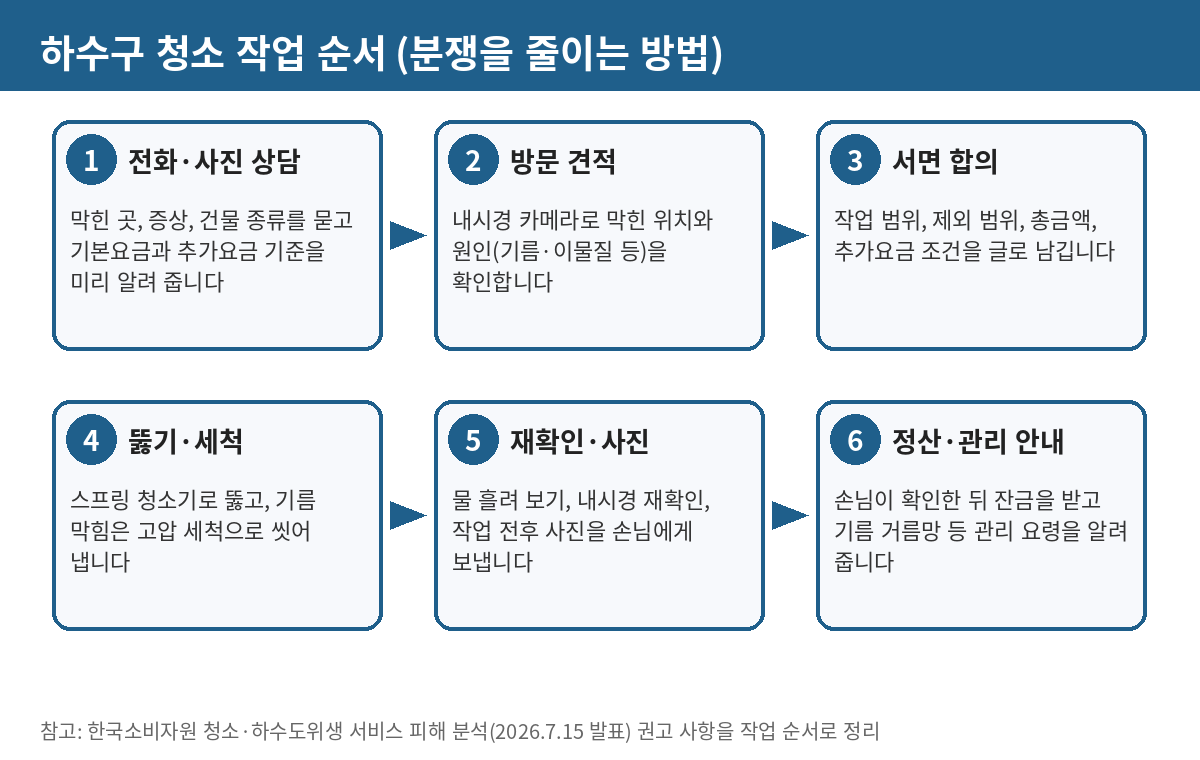
According to an analysis released by the KCA on July 15, 2026, of 1,204 relief cases about cleaning and sewer sanitation services over the past three years (2023 to Q1 2026), 292 (24.3%) involved extra charges demanded on site, and such cases in Q1 2026 were about 3.3 times higher than a year earlier. Sewer sanitation relief cases rose sharply: 56 in 2025 and 49 in Q1 2026 (vs 7 in Q1 2025). Some companies listed a basic toilet-unclogging fee of about KRW 50,000 on their websites, then demanded hundreds of thousands of won more on site after they had already removed the toilet or opened the sewer. Customers find it hard to say no at that point, but it leads to complaints and bad reviews. If you do this work, always follow on-site estimate → explain reasons and amounts of any extra charges in writing before the contract → before-and-after photos. Customers can also get an on-site estimate, compare two or three quotes, check business registration and reviews, and contact the 1372 Consumer Counseling Center if a problem occurs.
Sources
- Korea Consumer Agency (Yonhap News report) – Extra on-site charges in cleaning, pipe and sewer services surge (2026.7.15)
- Korea Consumer Agency (Kyeonggi Ilbo report) – Statistics by type for cleaning and sewer service extra-charge cases (2026.7.15)
- Ministry of Government Legislation – Legal interpretation 09-0169 (Sewerage Act Art. 45 night-soil collection and internal cleaning of private sewage facilities)
- National Law Information Center – Enforcement Decree of the Framework Act on the Construction Industry, Art. 8 (minor construction work)
- National Tax Service Hometax – Business registration
- Korea Consumer Agency – Consumer relief procedure
7. FAQ
Do I need a permit just to unclog drains?
In this research we did not find a nationwide permit just for unclogging pipes. However, internal cleaning of septic tanks and other private sewage treatment facilities needs a night-soil collection and transport permit (Sewerage Act Art. 45), and pipe replacement work may need construction business registration. Always ask your city or district office before you start.
Can I clean septic tanks too?
Internal septic-tank cleaning must be done by a licensed night-soil collection and transport business. The permit has standards for facilities, equipment and technicians, such as a suction truck with a deodorizing unit. If you don't have the permit, refer customers to a licensed company.
Which equipment should I buy first?
We suggest starting with one drain snake that fits the jobs you'll get most, plus a pipe inspection camera. You can add a high-pressure jetter as restaurant and shop customers grow. Prices vary by product.
What if a customer says, "You unclogged it, but it clogged again"?
Show the before-and-after camera video and the water-flow test. In the KCA data, 48.9% of sewer service complaints were about poor quality such as "no effect". Tell customers your rules for repeat clogs in writing in advance (for example, a free return visit within a set number of days) to reduce disputes.
What if a toilet or floor breaks during the work?
Take photos of the condition before work, and explain risky work such as removing a toilet and get consent first. Liability insurance also reassures customers. The KCA also advises consumers to check whether a company has liability insurance.
Last updated: October 30, 2026. Based on official sources; rules and prices can change.
🎁 Free: 7-day starter checklist for earning extra income
Leave your email and get the free checklist now. No spam, unsubscribe anytime.
Popular guides
- Top 10 Ways to Make Money Starting This Week (Free Checklist)
- How to Make Money as a Student: Legit Ideas (2026)
- Passive Income Ideas: Realistic Options for 2026
- Make Money Online Without Investment: 20 Free Ways
- How to Make Money with AI: 50 Practical Ways (2026)
- How to Make Money From Home: 20 Legit Ways
- Make Money Online for Beginners: 15 Easy Ways to Start
- How to Make Money as a Mom: 16 Flexible Ideas (Work Around Nap Time)
- 16 Legit Ways to Make Money Fast (This Week)
- How to Make Money as a Teenager: 16 Safe Ideas
- 14 Remote Jobs With No Experience Needed
Next method: How to Make Money with Mattress Cleaning in Korea →