Path
At a glance
Contents
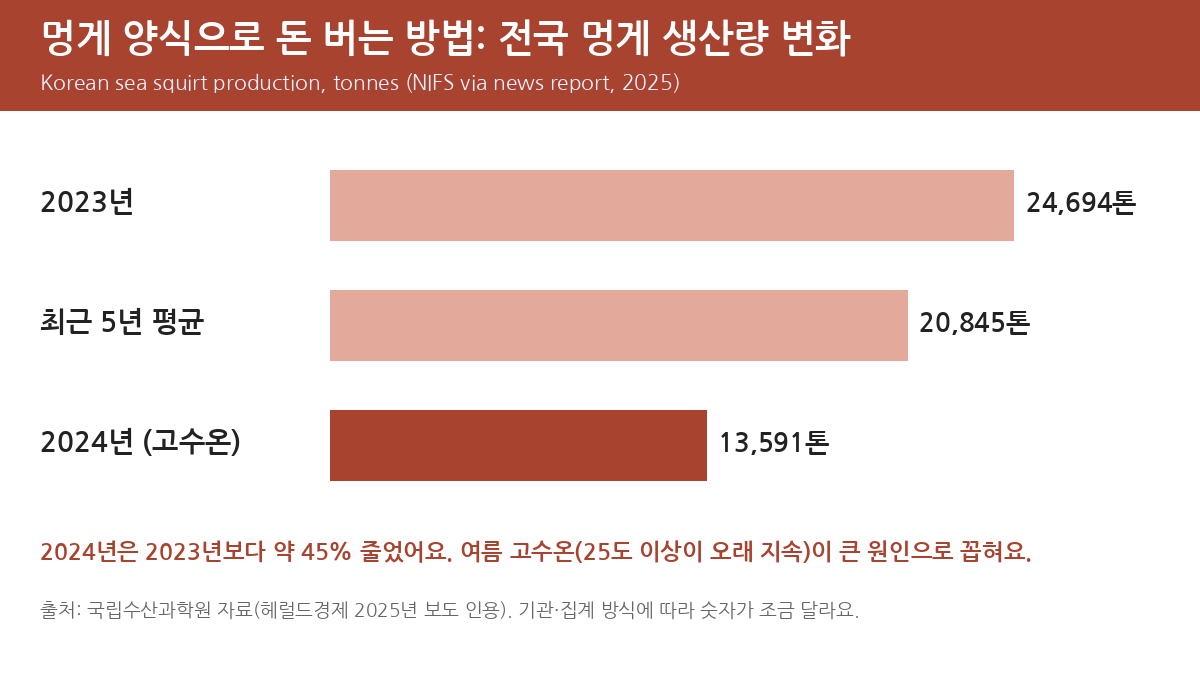
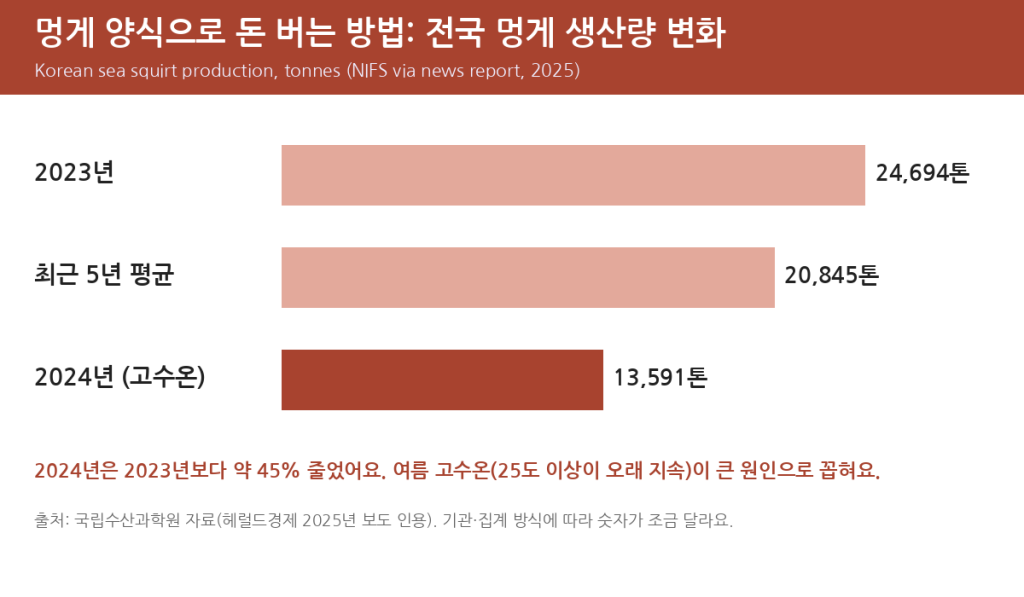
Sea squirt (meongge) is a classic Korean aquaculture product grown on ropes hung in the sea. About 70% of domestic output comes from the waters off Tongyeong and Geoje in South Gyeongsang Province. But in summer 2024, high water temperatures killed most of the stock and national production fell about 45% from the year before. This guide explains how to make money with sea squirts using data from the Ministry of Oceans and Fisheries (MOF), the National Institute of Fisheries Science (NIFS), the Aquaculture Industry Development Act and regional news reports.
One-line summary: Sea squirt farming needs an aquaculture license (or fishing village cooperative membership). Stock is grown about 2 years and sold from February to June. With heat damage increasing, aquaculture disaster insurance and temperature management matter most. Income varies greatly year to year.
1. What is sea squirt farming?
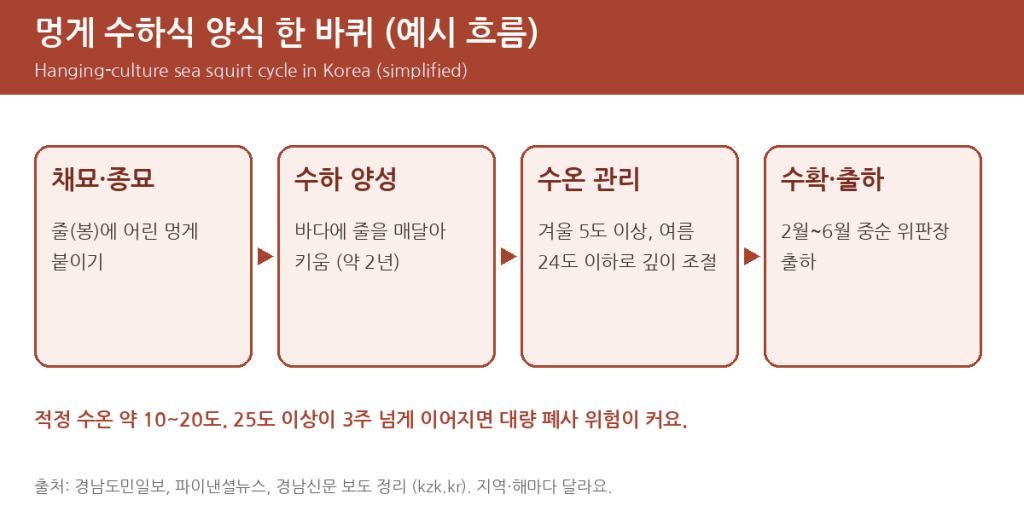
- Hanging culture: Young sea squirts (larvae) attach to ropes (about 5 m long) that hang from floating lines. In South Gyeongsang waters they grow at about 3–15 m depth for around 2 years until fist-sized (Gyeongnam Domin Ilbo, JoongAng Ilbo).
- Water temperature is key: They grow best at about 10–20°C. If 25°C or higher lasts over 3 weeks, mass deaths can occur (Financial News). Farmers move ropes to depths staying above 5°C in winter and below 24°C in summer.
- After harvest: They are kept in clean water for about a day to purge waste before shipping. One kilogram is usually about 8–9 sea squirts.
- Who it suits: People preparing to move to a fishing village who can work on boats and do physical labor.
2. How much does it cost to start?
I could not find an official average startup cost, so costs vary by scale and region.
| Item | Details | Cost |
|---|---|---|
| Aquaculture license (farm site) | New license, license transfer, or using a cooperative site | Varies |
| Boat | Small boat for site work and harvesting | Varies |
| Farm equipment | Buoys, ropes, anchors, seed ropes | Varies |
| Seed (young sea squirts) | Collect or buy | Varies |
| Work shed | Washing, sorting, shipping space | Varies |
| Aquaculture disaster insurance | Government pays 50% of the premium | Varies by site |
| Housing | Home in a fishing village | Varies by region |
Government support: The return-to-fishing startup loan offers up to KRW 300 million (1.5% a year, 5-year grace, 10-year repayment), and up to KRW 75 million for housing. These are loans with conditions such as training, so first contact the Return-to-Fishing Center (1899-9597).
3. What you need: license and cooperative
- Aquaculture license: Farming sea squirts at sea requires a license under the Aquaculture Industry Development Act (Article 10). Licenses last 10 years (Article 17).
- Transfer and no leasing: Licenses can only be transferred as the law allows (Article 30), and leasing a license to someone else is prohibited (Article 32).
- Fishing village cooperative (eochongye): Many farm sites are held in the cooperative’s name. According to Suhyup, members must live in the area, qualify as Suhyup members (fishing 60+ days a year), and pass a general meeting review.
- Aquaculture disaster insurance: According to MOF, sea squirts are covered, with 50% of the premium paid by the government. The 2024 sign-up deadline for sea squirts was October 31, and a lower-cost plan was introduced. Sign up through Suhyup member cooperatives.
- Skills: Temperature monitoring, rope depth control, harvesting and sorting must be learned on site.
4. How much can you earn?
I could not find official average income for sea squirt farms, so income varies. Reference numbers:
| Item | Figure | Source |
|---|---|---|
| National production | 24,694 t (2023) → 13,591 t (2024), about −45% | NIFS (Herald Economy) |
| 2024 losses in Tongyeong | About 95% of seed ropes, 97%+ of whole sea squirts | Gyeongnam Domin Ilbo |
| Shelled sea squirt price | About KRW 16,000 per kg (2024 report) | JoongAng Ilbo |
| First auction price | About KRW 250,000 per 10 kg on average (Feb 2026) | Kyeongnam Shinmun |
- In 2024 so many died that the season’s first auction was canceled for the first time since the market opened in 2011. It resumed in February 2026.
- Even with the same stock, summer water temperature alone can push income close to zero. Prepare insurance and emergency funds.
5. Where and how to sell
- Suhyup auction markets: Sea squirts from South Gyeongsang are mainly sold at the sea squirt cooperative’s auction market, usually from February to mid-June.
- Shelled product: Selling shelled sea squirts changes the price. Processing and sales may need a food business report; check with your city/county office.
- Direct sales / delivery: You can sell to direct customers, but freshness (cold shipping) is critical.
- Local festivals and restaurants: Supplying local raw-fish restaurants is another option.
6. Step-by-step start
- Step 1 – Training and counseling: Take courses at the Return-to-Fishing Center (sealife.go.kr) and visit sea squirt areas such as Tongyeong and Geoje.
- Step 2 – Work on site: Work for a year or more on a sea squirt farm to learn seeding, temperature control and harvesting. Building trust with the cooperative also matters.
- Step 3 – Check license and cooperative: Officially confirm cooperative membership conditions and license transfer options with the city/county office and Suhyup.
- Step 4 – Start small and insure: Begin with a small site and sign up for aquaculture disaster insurance.
- Step 5 – Track temperatures: Check NIFS water temperature data daily and lower ropes when high-temperature alerts are issued.
8. Watch out for these real damage cases
In 2012 the Donghae Coast Guard said it had booked the head of a fishing village cooperative in Samcheok, Gangwon Province, for illegally transferring the cooperative’s sea squirt farming right (10 ha) for about KRW 70 million. Buyers in such deals may pay and still not have their rights recognized. When buying or selling a farm site or license, always confirm the license details and transferability at the city/county office, and never trade privately in cash only. Also be careful of offers like “invest in sea squirt farming and get monthly returns.”
Sources
- National Law Information Center, Aquaculture Industry Development Act
- Suhyup, fishing village cooperative guide
- MOF, aquaculture disaster insurance (2024-06-26)
- MOF, fishery production press release
- Herald Economy, NIFS sea squirt production data
- Gyeongnam Domin Ilbo, 2024 mass deaths
- Gyeongnam Domin Ilbo, how sea squirts are farmed
- JoongAng Ilbo, heat deaths and stabilization measures
- Financial News, optimal temperatures and heat damage
- Kyeongnam Shinmun, 2026 first auction
- Haesa News, illegal transfer of a cooperative sea squirt farming right (2012)
- Return-to-Fishing Center
7. FAQ
Can anyone start sea squirt farming right away?
No. You need an aquaculture license (Act Article 10), and many sites belong to fishing village cooperatives. Often you must live locally and pass a membership review.
How long until sea squirts can be sold?
Usually about 2 years. After the 2024 mass deaths, some farmers shipped 1-year-old stock instead.
Can heat damage be prevented?
Not completely. Move ropes to cooler depths and get disaster insurance (50% premium support) to reduce losses. A sea squirt farming stabilization task force was formed in October 2024 (JoongAng Ilbo), and in May 2025 NIFS signed an agreement with six organizations to find solutions (Herald Economy).
Can I rent someone's fishing right (license)?
Leasing aquaculture licenses is prohibited by law (Article 32). Offers to "rent you a farm site" may be illegal.
Is return-to-fishing support free money?
No. The startup loan (up to KRW 300 million) and housing loan (up to KRW 75 million) must be repaid.
Last updated: October 30, 2026. Based on official sources; rules and prices can change.
🎁 Free: 7-day starter checklist for earning extra income
Leave your email and get the free checklist now. No spam, unsubscribe anytime.
Popular guides
- Top 10 Ways to Make Money Starting This Week (Free Checklist)
- How to Make Money as a Student: Legit Ideas (2026)
- Passive Income Ideas: Realistic Options for 2026
- Make Money Online Without Investment: 20 Free Ways
- How to Make Money with AI: 50 Practical Ways (2026)
- How to Make Money From Home: 20 Legit Ways
- Make Money Online for Beginners: 15 Easy Ways to Start
- How to Make Money as a Mom: 16 Flexible Ideas (Work Around Nap Time)
- 16 Legit Ways to Make Money Fast (This Week)
- How to Make Money as a Teenager: 16 Safe Ideas
- 14 Remote Jobs With No Experience Needed
Next method: How to Make Money with Blueberry Farming (Korea) →