Path
At a glance
Contents
Blueberries are shrubs that bear small dark-blue berries. In the Rural Development Administration (RDA) farm income survey, blueberries had one of the highest incomes per 10a (about 1,000 m², roughly 300 pyeong) among open-field fruits. But you must make the soil acidic, and real harvests take 2–3 years after planting. This guide explains how to make money with blueberries using data from the RDA, Nongsaro and the Ministry of Agriculture, Food and Rural Affairs (MAFRA).
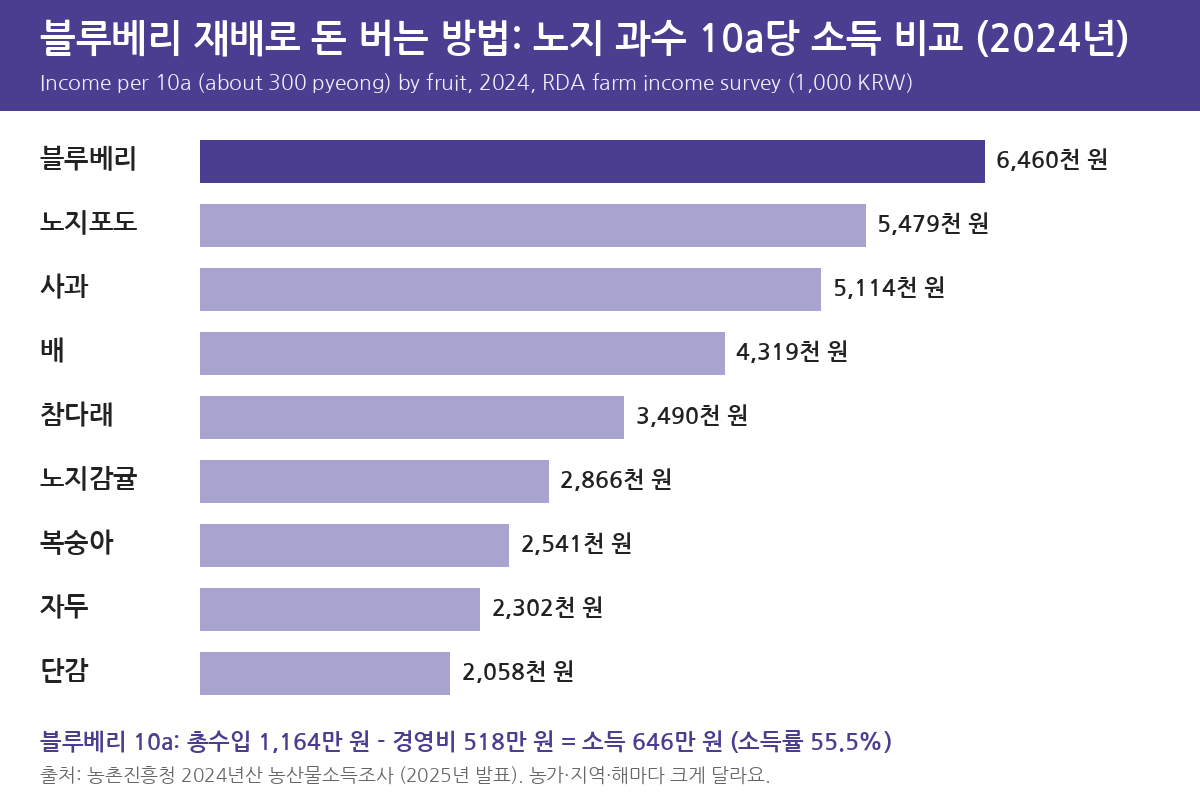
One-line summary: In 2024 blueberry income per 10a was KRW 6.46 million (55.5% income ratio), and KRW 7.41 million in 2025. Preparing acidic soil, waiting 2–3 years, and securing buyers come first.
1. What is blueberry farming?
- The plant: Likes acidic soil (pH 4.2–5.2) rich in organic matter (5%+) (Nongsaro).
- Types: Northern highbush for cold areas (800–1,200 chilling hours), southern highbush (200–600 hours) and rabbiteye (400–800 hours).
- Growing systems: Open field, unheated greenhouse and heated greenhouse. Greenhouses allow earlier, higher-priced harvests but cost more.
- Who it suits: People preparing to move to farming, or who want direct sales or a pick-your-own farm on small land.
2. How much does it cost to start?
According to the RDA 2024 survey, the annual operating cost for 10a is KRW 5.18 million (materials, labor, etc.). Initial planting costs (seedlings, soil improvement, greenhouse, irrigation) vary by scale and method.
| Item | Details | Cost |
|---|---|---|
| Land | Own or rent | Varies by region |
| Seedlings | Dormant plants 2+ years old (3 years is best), several varieties | Varies |
| Soil improvement | Peat moss etc. for acidity/organic matter, 10–15 cm mulch | Varies |
| Irrigation | Drip irrigation etc. | Varies |
| Greenhouse (optional) | Unheated or heated | Varies |
| Bird netting | Prevents bird damage | Varies |
| Packaging | 100 g / 500 g containers, 1 kg boxes | Varies |
| Annual operating cost | Per 10a (2024 survey) | KRW 5.18 million |
Government support: The return-to-farm startup loan offers up to KRW 300 million per household (2.0% a year, 5-year grace, 10-year repayment), plus up to KRW 75 million for housing. Young farmers aged 18 to under 40 with 3 years or less of independent farming can apply for settlement support (up to KRW 1.1 million a month for up to 3 years). Conditions change yearly, so always check before applying.
3. What you need
- Soil test: Get a soil test at your city/county Agricultural Technology Center to check pH and organic matter.
- Spacing: Northern highbush 1.5–2.0 m between plants and 2.5–3.0 m between rows; rabbiteye 2.0–2.5 m and 3.0–3.5 m. Dig holes 50–60 cm wide and 30–40 cm deep (Nongsaro).
- Several varieties: Blueberries set fruit better with pollen from another variety, so plant two or more. Honeybees are often used for pollination.
- First 1–2 years: Remove flowers so the plants grow instead of fruiting.
- Diseases: Stem blight, gray mold and anthracnose can occur. Take training at the Agricultural Technology Center.
- Return-to-farm training: Required for the startup loan.
4. How much can you earn?
RDA farm income survey figures (per 10a):
| Year | Gross revenue | Operating cost | Income | Notes |
|---|---|---|---|---|
| 2024 crop | KRW 11.64 million | KRW 5.18 million | KRW 6.46 million | Yield 491 kg, KRW 23,651/kg, income ratio 55.5% |
| 2025 crop | – | – | KRW 7.41 million | Announced Sept 2026 |
- In the same survey, 2024 income was KRW 5.11 million for apples, KRW 4.32 million for pears and KRW 2.54 million for peaches. Blueberries ranked high among open-field fruits.
- In the 2025 survey, average income across all crops fell 7.7% while operating costs rose 9.2%. Costs are rising, so careful cost control matters.
- These are averages. Harvests are small in the first 2–3 years, and results vary greatly with weather, variety and sales channel.
5. Where and how to sell
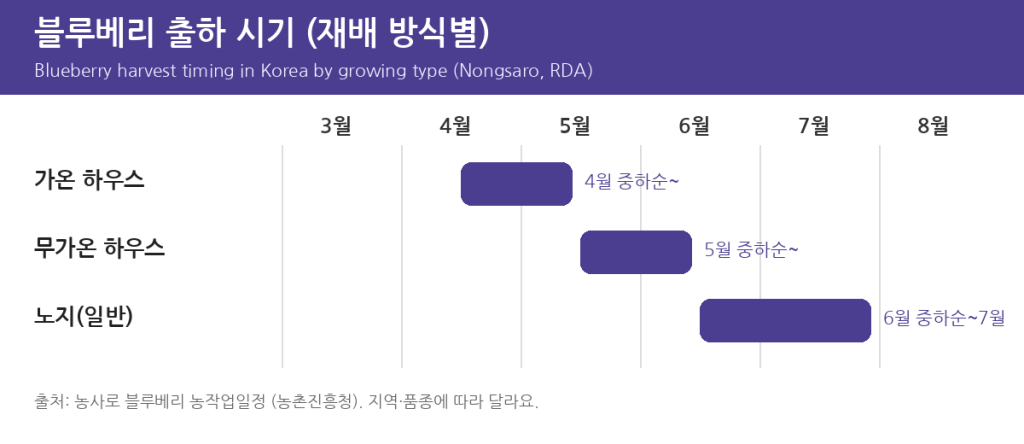
- Harvest timing: Heated greenhouse from mid-to-late April, unheated greenhouse from mid-to-late May, open field from mid-to-late June (Nongsaro). Wonye Sanup Shinmun reported that Korean blueberries in March–April traded at 2–3 times the price of imports.
- Wholesale markets: Ship to public wholesale markets such as Garak in 1 kg boxes (100 g × 10).
- Local food stores / NH Hanaro Mart: Ask your local cooperative.
- Direct sales: Sell to regular customers by text and parcel delivery. Blueberries soften easily, so packaging and cold storage matter.
- Pick-your-own farm: Near cities you can host family visitors.
- Processing: Frozen blueberries, jam, etc. Processed foods may need a food business report; check with your city/county office.
6. Step-by-step start
- Step 1 – Learn: Take courses at the Return-to-Farm Center and Agricultural Technology Center, and work on a blueberry farm to learn the yearly cycle.
- Step 2 – Land and soil: Choose land, test the soil and make it acidic with peat moss etc. Pick varieties suited to your local winter.
- Step 3 – Plant and wait: Plant 2–3-year-old seedlings during dormancy (late autumn to early spring) and remove flowers for 1–2 years.
- Step 4 – Build buyers first: Before the first harvest, line up local food stores, direct customers and pick-your-own visitors.
- Step 5 – Insurance and records: Ask your local cooperative whether crop disaster insurance is available, and record costs and yields.
8. Watch out for these real damage cases
In May 2010 Korea’s Financial Supervisory Service issued a warning about blueberry seedling investment schemes. One company sold 338 five-year-old blueberry seedlings for KRW 14.8 million, promising KRW 110 million (744%) over 18 years — suspected of being illegal fund-raising. Be careful of offers like “just buy the trees, we manage them and pay you monthly or quarterly returns.” Blueberry income comes from managing the land and plants yourself. Buy seedlings from trustworthy nurseries and check the variety name and age.
Sources
- RDA, 2024 farm income survey press release
- 2024 farm income survey tables (attachment)
- Nongup Times, 2025 farm income survey (blueberry KRW 7.41 million)
- Nongsaro, blueberry work schedule
- Agrinet, blueberry area and farm numbers
- Wonye Sanup Shinmun, blueberry shipping and packaging
- Easy-to-find Legal Information, return-to-farm support
- MAFRA, 2026 young farmer settlement support
- MAFRA, crop disaster insurance guidelines
- Newspim, FSS warning on blueberry seedling schemes (2010)
7. FAQ
Can blueberry farming make money in the first year?
Unlikely. Nongsaro advises not letting plants fruit for 1–2 years after planting. Expect real income from around year 3.
Can I grow them in my region?
Northern highbush suits cold-winter areas; southern highbush or rabbiteye suit the warm south. Ask your local Agricultural Technology Center.
Haven't blueberry prices dropped?
As imports rose under FTAs, blueberries became an FTA closure-support item in 2016, and the growing area fell from 4,270 ha (2016) to 3,326 ha (2022). Still, the 2024–2025 surveys showed relatively high income. Timing and sales channels matter.
Is there disaster insurance?
Crop disaster insurance has a blueberry item, but under the 2026 guidelines it is limited to certain cities/counties. Check availability and timing with your local cooperative.
Can I start on small land?
Even 10a averaged about KRW 6.46 million income (2024). On small land, raise your price per kg through direct sales and pick-your-own.
Last updated: October 30, 2026. Based on official sources; rules and prices can change.
🎁 Free: 7-day starter checklist for earning extra income
Leave your email and get the free checklist now. No spam, unsubscribe anytime.
Popular guides
- Top 10 Ways to Make Money Starting This Week (Free Checklist)
- How to Make Money as a Student: Legit Ideas (2026)
- Passive Income Ideas: Realistic Options for 2026
- Make Money Online Without Investment: 20 Free Ways
- How to Make Money with AI: 50 Practical Ways (2026)
- How to Make Money From Home: 20 Legit Ways
- Make Money Online for Beginners: 15 Easy Ways to Start
- How to Make Money as a Mom: 16 Flexible Ideas (Work Around Nap Time)
- 16 Legit Ways to Make Money Fast (This Week)
- How to Make Money as a Teenager: 16 Safe Ideas
- 14 Remote Jobs With No Experience Needed
Next method: How to Make Money with Strawberry Farming (Korea) →