How to Make Money

Category: Livestock Farming Income

  • How to Make Money with Hanwoo Cow-Calf Breeding in Korea

    How to Make Money with Hanwoo Cow-Calf Breeding in Korea

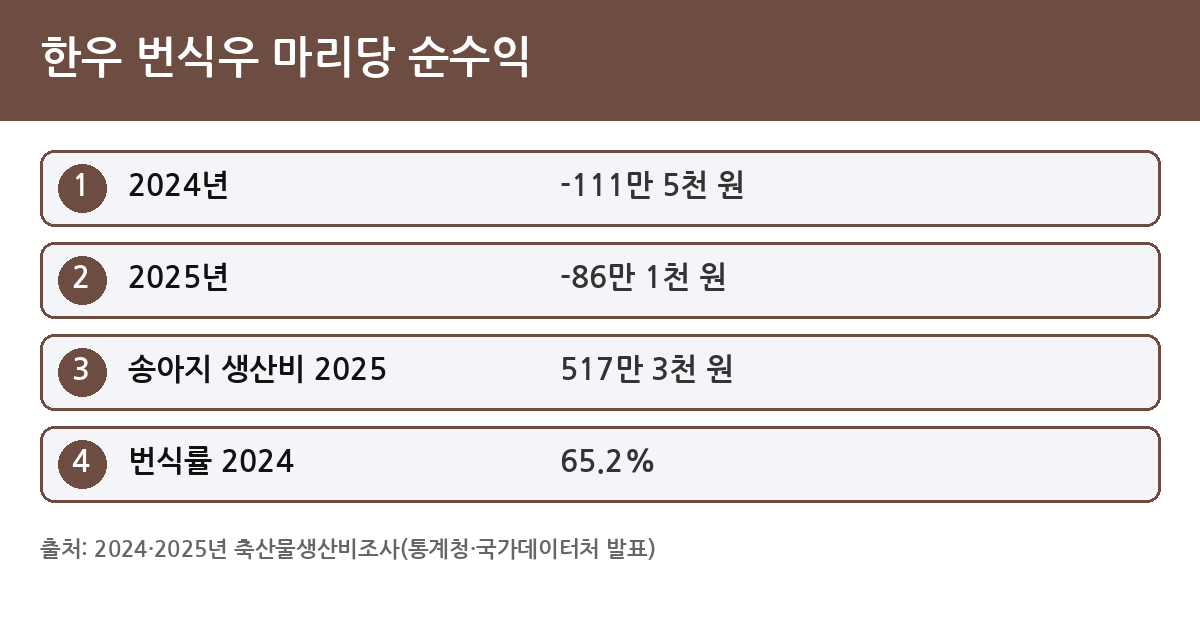
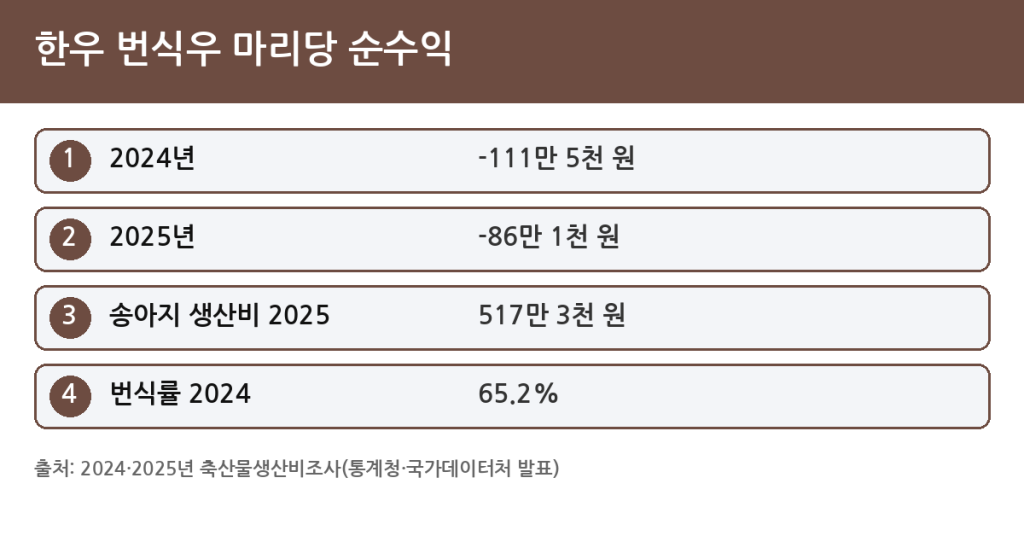
    Hanwoo breeding cow net profit per head: 2024 -KRW 1.115M, 2025 -KRW 0.861M, calf production cost - how to make money with Hanwoo breeding

    A Hanwoo (Korean native cattle) breeding farm keeps cows, breeds them, raises the calves for about 6–7 months and sells them at livestock markets. That is different from “finishing” farms, which buy calves and raise them for beef. This guide uses national statistics, the Livestock Industry Act and government program reports. One fact first: according to national statistics, breeding farms have lost money per head on average in recent years. Making money here means keeping costs low, raising the breeding rate and selling calves when prices are good.

    In one line: in 2025 it cost KRW 5,173,000 to produce one calf, and net profit per breeding cow was −KRW 861,000 (Statistics Korea). That is better than 2024 (−KRW 1,115,000) but still a loss on average. Depending on barn size you need a permit or registration plus training first.

    1. What does a breeding farm do?

    • Cows are bred by artificial insemination; calves are raised for about 6–7 months, then sold.
    • Statistics Korea reports calf prices for 6–7-month-old bull calves. In 2024 that price was KRW 3,541,000.
    • In 2025, bull calf prices rose 16.2% year on year, which improved breeding-farm results.
    • The key number is the breeding rate. It fell from 68.0% to 65.2% in 2024, meaning only about 65 of 100 cows calved that year.

    2. Start-up costs

    Item Reference figure Source
    One cow Hanwoo cow (600 kg) farm-gate price KRW 4,748,000 (2024) Statistics Korea
    Cost to produce one calf KRW 5,173,000 (2025) Statistics Korea
    Breeding feed KRW 518/kg (2024) Statistics Korea
    Barn and manure facilities Depends on land, size, region varies
    New-farmer training 24 hours for permit holders (KRW 40,000 in person, free online) farmedu.kr

    Building a new barn changes costs a lot (varies). Many beginners lease an existing barn or start small.

    3. Facilities and equipment

    • Barn: resting space, feeding and water systems.
    • Disinfection and biosecurity facilities, required for a livestock permit.
    • Manure handling: manure facility report or permit and a treatment plan; compost it yourself or contract a processor.
    • Calf care tools: calving tools, warmth for calves, ear tags for traceability.

    4. Permits and training (check first)
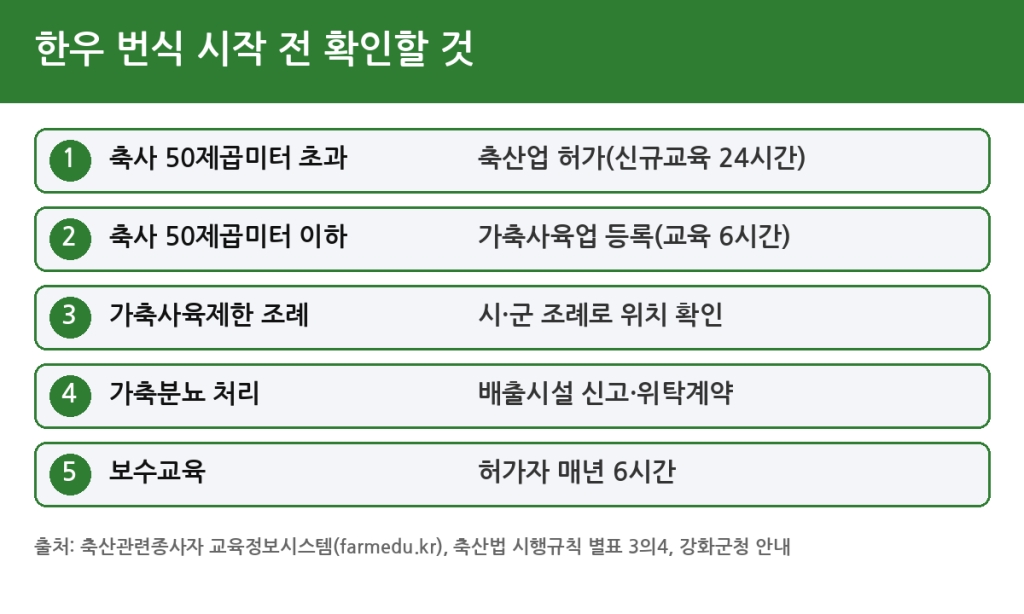
    Checklist before starting Hanwoo breeding: livestock permit, registration, 24-hour training, manure handling - how to make money with Hanwoo breeding
    • If the cattle facility is over 50 m², you need a livestock business permit; 50 m² or less needs registration.
    • Permit applicants must complete 24 hours of new-farmer training within 2 years before applying (KRW 40,000 in person, free online). Registration requires 6 hours (KRW 10,000 in person, free online).
    • Permit holders take 6 hours of refresher training every year; registered farms every 2 years.
    • Applications need facility standards, a manure facility report, building permits, training certificates and a manure/odor plan (Ganghwa and Gimpo county guides).
    • Cities and counties have livestock restriction zone ordinances, so ask the local office before buying land.

    5. How much can you earn?

    • The national average is a loss: −KRW 1,115,000 per head in 2024 and −KRW 861,000 in 2025.
    • These averages include the farmer’s own labor and land costs. Real results vary widely with breeding rate, feed cost and calf prices (varies).
    • Calf prices are forecast to stay in the KRW 4 million range for the next 2 years (Korea Rural Economic Institute, via Nongmin Shinmun).
    • The Calf Production Stabilization Program pays KRW 100,000–400,000 per head when calf prices fall below a reference. From 2026 the reference rises from KRW 1.85M to 2.7M, but payouts are seen as unlikely for several years because of the breeding-cow-count condition. Only about 6,000 of 76,000 Hanwoo farms had joined by end-2025.

    6. How to sell calves

    1. Local cooperative livestock auctions: most calves are sold at auction; weight, pedigree and health set the price.
    2. Direct sales to finishing farms: keep traceability records and a written contract.
    3. Genetics: use good semen and record cow performance to raise calf value.

    7. Step-by-step start

    1. Training first at farmedu.kr (24 or 6 hours; online is free).
    2. Hands-on experience with a neighboring farm or cooperative: calving, calf care, insemination timing.
    3. Check land and barn with the city/county office: restriction zones, manure handling, building approval.
    4. Get the permit or registration.
    5. Start small with a few cows, record breeding rate and feed costs, and look into the stabilization program.

    9. Watch out for these scams

    In June 2026 in Gimje, a “Hanwoo consignment investment” promised a 10% return after 2 years for KRW 5.5 million per head and raised over KRW 1.3 billion for 250 head. The same cattle were double-contracted with a cooperative and 47 head were secretly sold; one investor lost about KRW 380 million and filed a complaint (JMBC). A separate frozen-beef investment scam reportedly raised KRW 240 billion (Yonhap). Be careful with offers to “just invest in cattle,” and always check the cattle traceability number, ownership and contract.

    Sources

    8. FAQ

    Do I need a permit for just one cow?

    The rule is based on facility area, not head count: over 50 m² needs a permit, 50 m² or less needs registration. Confirm locally.

    Is breeding really unprofitable?

    National average net profit was negative in 2024 and 2025, but that includes the farmer's own labor; individual results differ.

    What about future calf prices?

    The Korea Rural Economic Institute reportedly forecasts the KRW 4 million range for 2 years. Forecasts change.

    Where do I take the training?

    At farmedu.kr; online courses are free.

    What changes in 2026?

    The stabilization program is revised, and the Hanwoo industry support act takes effect in July 2026, according to reports. Check official notices after it starts.

    Last updated: October 30, 2026. Based on official sources; rules and prices can change.
  • How to Make Money with Black Goat Farming in Korea

    How to Make Money with Black Goat Farming in Korea

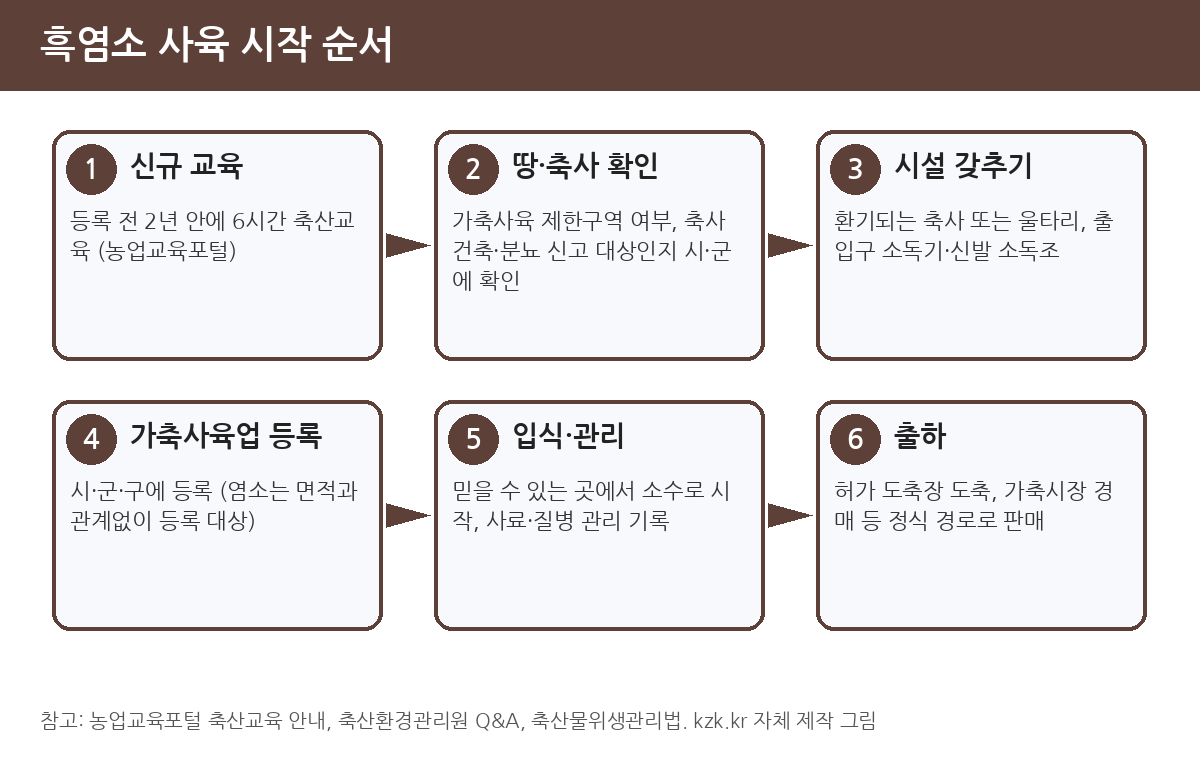
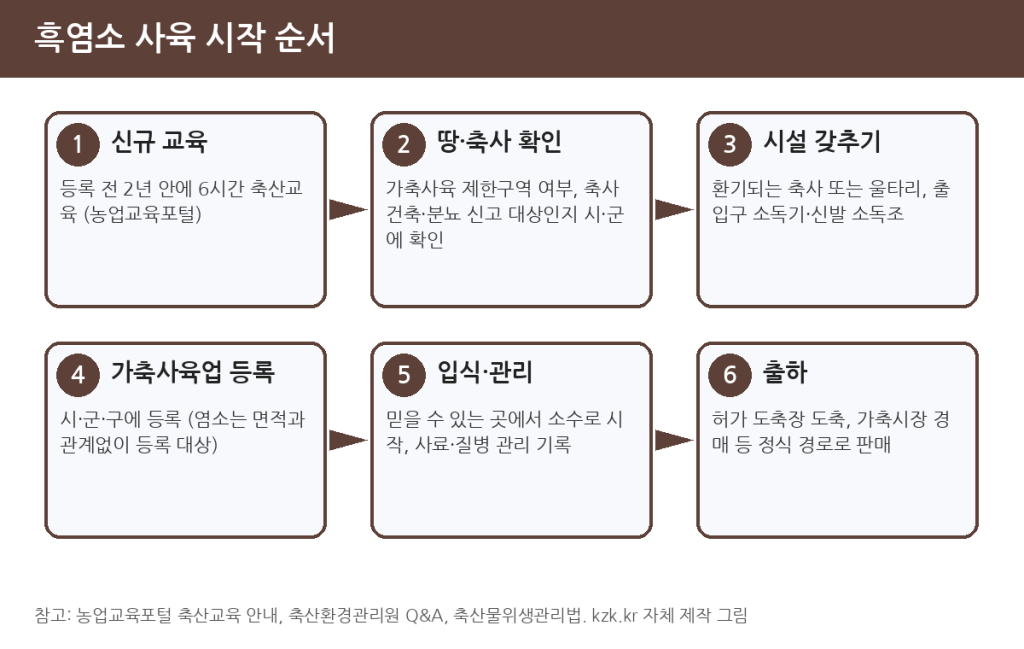
    Steps to start black goat farming: new-farmer training, checking land and barn, facilities, livestock farming registration, stocking, shipping - How to make money with black goat farming

    Black goats are small and eat grass well, so they can be raised even on a small farm. But goat farming also legally requires livestock farming business registration, and the meat can only be sold after slaughter at a licensed slaughterhouse. This guide explains how to make money with black goat farming in Korea in plain words, based on the Ministry of Agriculture, Food and Rural Affairs (MAFRA), an analysis by the National Institute of Animal Science, and guidance from the Livestock Environment Management Institute. The key to making money with black goats is: “register first, start small, manage feed costs, and sell through official channels.”

    In one line: Goats must be registered as a livestock farming business regardless of farm size, and 6 hours of training are required before registration. In a 2024 National Institute of Animal Science analysis, farms with fewer than 300 goats earned 1.7 times more income per head than large farms, but feed-cost increases and imported goat meat make profits vary greatly from farm to farm.

    1. What it is

    • You raise black goats (such as native Korean black goats), breed them, and sell grown goats for meat through livestock markets or slaughterhouses.
    • In February 2026 MAFRA announced a “Goat Industry Development Plan,” including recognizing the native black goat as an indigenous livestock breed, developing a new meatier breed (from 50 kg at 13–15 months to a target of 55 kg at 12 months), dedicated regional slaughterhouses, and more livestock-market auctions.
    • This guide covers raising black goats for meat. It does not cover health-food claims.
    What to do Details Basis
    Livestock farming registration Goats (including dairy goats) must be registered with the city/county/district regardless of area Livestock Industry Act Art. 22(3), Agricultural Education Portal guide
    Livestock training 6 hours of new-farmer training within 2 years before registration (in person KRW 10,000, online free), then 6 hours of refresher training every 2 years Agricultural Education Portal
    Facility requirements A ventilated housing facility (a fence if raised without buildings), an entrance disinfector and a footbath Livestock Environment Management Institute Q&A
    Livestock manure discharge facility A report may be required depending on size (e.g., Wonju City guide: sheep housing of 200㎡ or more, or 50 or more grazing sheep/deer) Livestock Manure Act, Wonju City guide (check with your local government whether and how it applies to goats)
    Slaughter and sales Only meat slaughtered at a licensed slaughterhouse may be distributed Livestock Products Sanitary Control Act (Incheon City enforcement notice)
    • The Livestock Industry Act has no standard for adequate housing area for goats. For reference, the (optional) animal welfare certification standard is 2.5㎡ per adult goat, 0.5㎡ per growing goat, and 3.0㎡ per doe with kids (Livestock Environment Management Institute).

    2. Start-up costs

    We did not find official average start-up cost figures. Costs vary greatly with whether you own land, whether you build a new barn, and how many goats you start with (varies).

    Item Description Note
    Land and barn A ventilated barn or fenced pasture Check building and manure permits/reports, varies
    Disinfection facilities Entrance disinfector, footbath Registration requirement, varies
    Buying goats (stocking) Does and bucks Depends on livestock-market prices, varies
    Feed and hay Compound feed, hay, roughage One of the largest costs, varies
    Water and feeding equipment Waterers, feed troughs, hay racks varies
    Training 6 hours of new-farmer training In person KRW 10,000, online free

    3. Facilities and management tips

    • Barn: the registration requirement is “a ventilated facility,” so choose a barn with good airflow.
    • Fence: if you only graze without a barn, a fence is a registration requirement. Goats jump well, so build it sturdy and high.
    • Disinfection: set up an entrance disinfector and a footbath, and record outside vehicles and visitors.
    • Disease: MAFRA said it is pushing to develop vaccines for goat diseases. If you see signs of illness, consult a veterinarian and use medicines only as directed.
    • Records: keep records of birth dates, dams, weights, feed amounts and sales so you know your real income and costs. The government is also considering a goat traceability system.
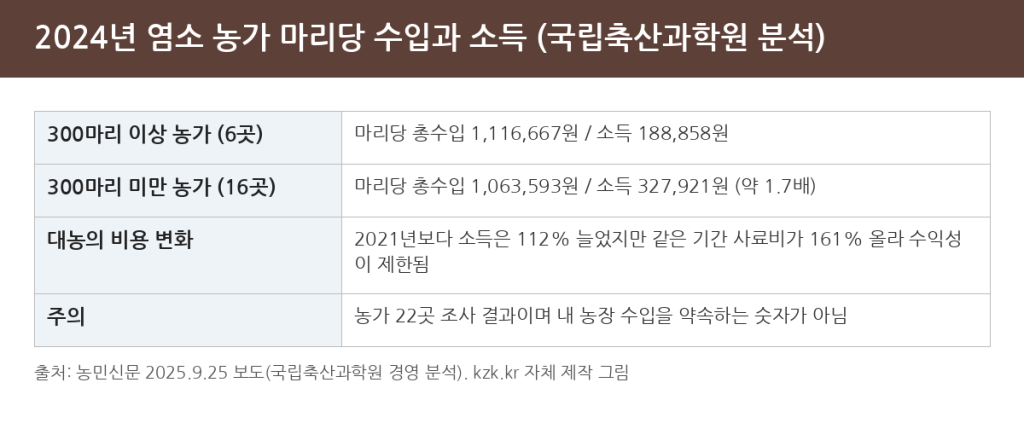
    2024 goat farm total revenue and income per head, farms with 300+ vs fewer than 300 goats, National Institute of Animal Science - How to make money with black goat farming

    4. How much can you earn?

    Results of the National Institute of Animal Science’s analysis of 22 goat farms in 2024 (reported by Nongmin Shinmun on Sept. 25, 2025) are below. These are averages of the surveyed farms, not a promise of your farm’s income.

    • Farms with 300+ goats (6 farms): total revenue per head KRW 1,116,667; income per head (revenue minus operating costs) KRW 188,858
    • Farms with fewer than 300 goats (16 farms): total revenue per head KRW 1,063,593; income per head KRW 327,921 (about 1.7 times the large farms)
    • Reasons cited for small and mid-size farms: lower feed costs by using local by-products and wild grass (roughage), and lower labor costs through family labor.
    • Large farms’ income rose 112% compared with 2021, but feed costs rose 161% over the same period, limiting profitability.
    • Risks: Australian goat meat enters tariff-free under the Korea–Australia FTA, and it was pointed out that many goat farms are unlicensed or unregistered.

    5. How to sell

    1. Livestock-market auctions: MAFRA said it will expand auctions at livestock markets and provide online price information. Check your local market’s schedule and prices first.
    2. Licensed slaughterhouse → meat sales: to sell meat yourself, it must be slaughtered at a licensed slaughterhouse. Incheon City announced it caught a case of unlicensed goat slaughter. Ask your local government whether you need a separate business license or report (such as a livestock products sales business) to process or sell meat.
    3. Follow country-of-origin labeling: when selling to restaurants or shops, domestic/imported labeling must be accurate. False labeling is a criminal offense.
    4. Regular buyers: steady deals with goat restaurants and local butchers can reduce price swings. Agree on shipping schedules and weight standards in advance.

    6. Getting started, step by step

    1. Training and field study: take the 6-hour new-farmer livestock training on the Agricultural Education Portal, and visit nearby goat farms and livestock markets to see real management and prices.
    2. Check land and register: ask the city/county office whether the land is in a livestock-restricted zone and whether you need barn building permits or a manure discharge facility report, then set up the facilities (barn/fence/disinfection) and register as a livestock farming business.
    3. Start small and keep records: start with a few goats, record feed costs, deaths and sales for a year, check whether you earn income per head, then expand.

    Watch out for these reported problems

    In an enforcement campaign from April 20 to May 20, 2026, the National Agricultural Products Quality Management Service caught 73 businesses violating country-of-origin labeling, of which 17 involved goat meat (12 false labeling, 5 no labeling). 26 were criminally charged, and KRW 13.7 million in fines were imposed on those that failed to label. False origin labeling is punishable by up to 7 years in prison or a fine of up to KRW 100 million, and failure to label by a fine of KRW 50,000 to 10 million. Businesses passing off imported meat as domestic can shake prices for honest farmers, so be careful when choosing buyers. The Financial Supervisory Service has also warned about illegal fundraising scams that pose as farming associations, promise “30–70% annual returns, principal guaranteed,” pay dividends at first, and then disappear. If someone invites you to invest in “goats we raise for you, with high returns,” contact the Financial Supervisory Service (1332) before putting in money.

    Sources

    7. FAQ

    Do I need to register even if I keep only a few goats?

    Yes. According to the Agricultural Education Portal, goats (including dairy goats) must be registered as a livestock farming business regardless of facility area. You must complete 6 hours of new-farmer training within 2 years before registering.

    Where do I take the training?

    The Agricultural Education Portal (farmedu.kr) provides livestock training information. New-farmer training costs KRW 10,000 in person and is free online; after registration you take 6 hours of refresher training every 2 years.

    How many ㎡ of barn do I need?

    The Livestock Industry Act has no adequate-area standard for goats. For (optional) animal welfare certification, you must meet standards such as 2.5㎡ per adult goat. Check manure discharge facility report thresholds with your local government.

    Can I slaughter my goats myself and sell the meat?

    No. Goat meat may be distributed only if slaughtered at a licensed slaughterhouse (Livestock Products Sanitary Control Act). Incheon City caught a case of 13 goats being slaughtered without a license.

    Is black goat farming profitable?

    It differs by farm. In the 2024 analysis, farms with fewer than 300 goats earned KRW 327,921 per head, but feed costs rose sharply and you compete with imported goat meat. Start small and check your own farm's numbers.

    Last updated: October 30, 2026. Based on official sources; rules and prices can change.
  • How to Make Money with Edible Insect (Mealworm) Farming in Korea

    How to Make Money with Edible Insect (Mealworm) Farming in Korea

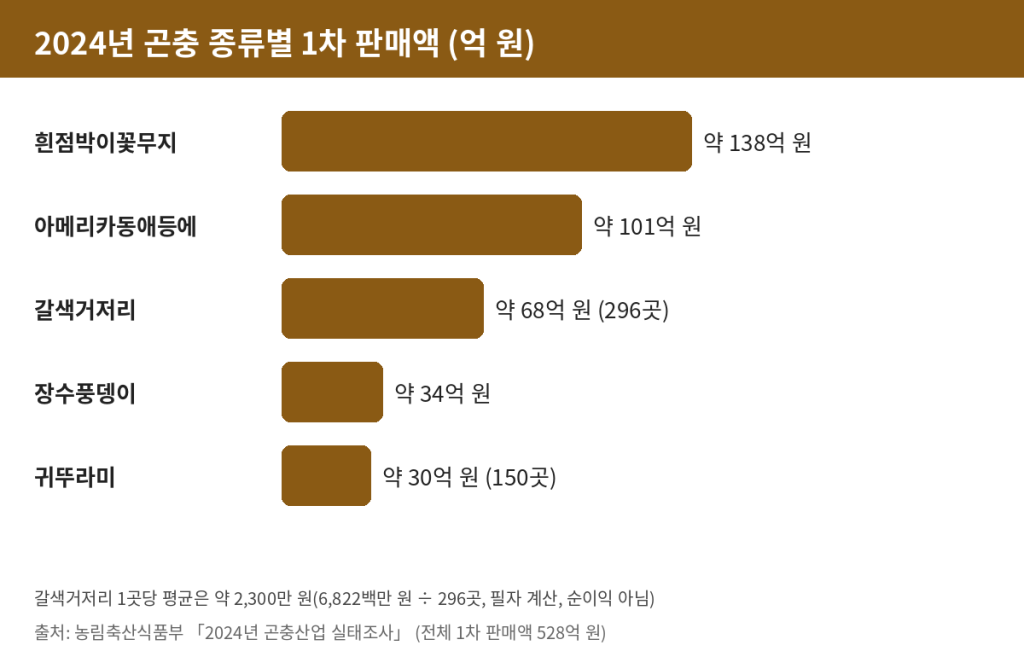
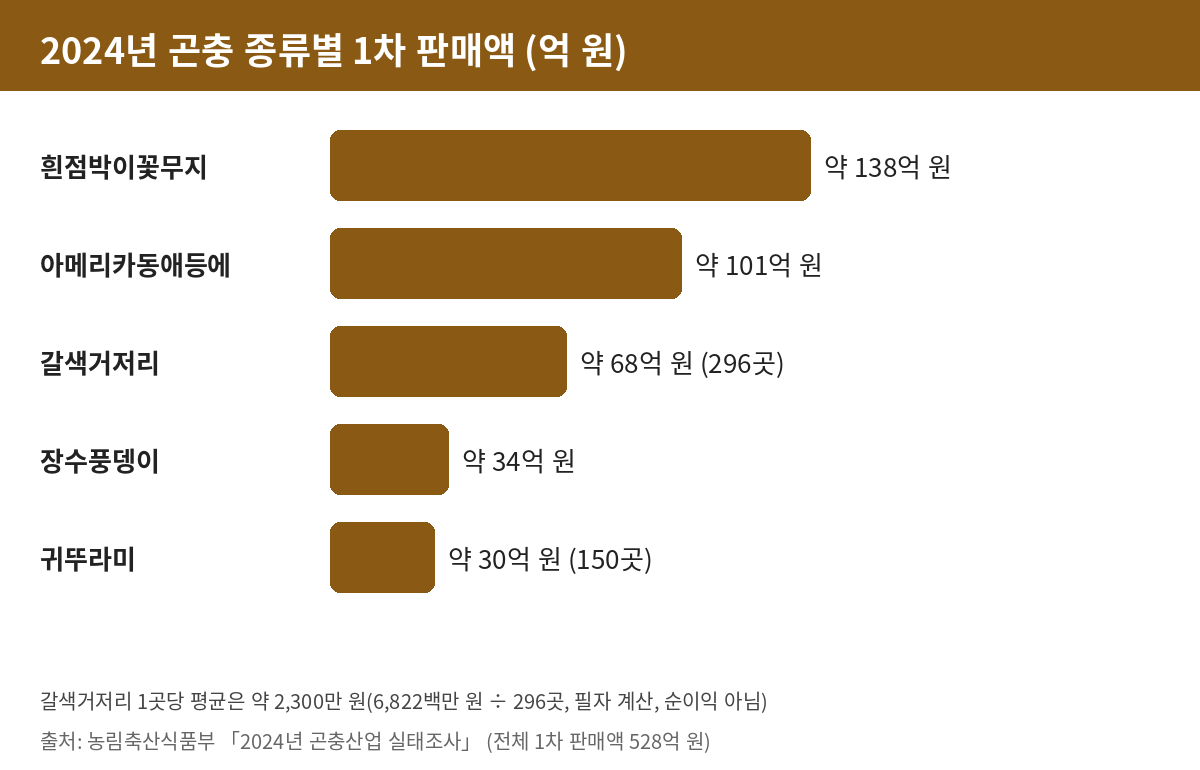
    2024 first-stage insect sales by species: mealworm about KRW 6.8 billion from 296 farms - How to make money with edible insect farming

    Mealworms, the larvae of the yellow mealworm beetle (갈색거저리), are sold as food ingredients, animal feed and pet treats. Based on data and legal guidance from the Ministry of Agriculture, Food and Rural Affairs (MAFRA) and the Rural Development Administration (RDA), this guide explains in plain words how to make money with edible insect farming in Korea. The key points are to file the report first, decide where you will sell before you start, and keep temperature and humidity steady.

    In one line: To raise and sell insects you file an “insect production business” report with your city, county or district (a report, not a permit). In 2024, first-stage mealworm sales were about KRW 6.8 billion across 296 farms, but income differs a lot between farms.

    1. What it is

    • You raise edible insects in boxes and sell them as food ingredients, feed (animal food) or pet food.
    • According to the RDA, 10 insects are approved as food ingredients: grasshopper (메뚜기), white muscardine silkworm (백강잠), edible silkworm (larva and pupa), mealworm larva, two-spotted cricket, white-spotted flower chafer larva, rhinoceros beetle larva, superworm (아메리카왕거저리) larva, drone bee pupa, and migratory locust (풀무치).
    • Mealworm larvae were added to the Korean Food Code as a general food ingredient in March 2016 (Nongsaro).
    • According to MAFRA’s 2024 insect industry survey, there were 2,949 insect business reports (2,766 production, 562 processing, 1,386 distribution; one business can file more than one), and first-stage insect sales were KRW 52.8 billion, up 11.6% from the previous year.
    • Insects are one of the protein sources being studied. This guide makes no health claims.

    2. Start-up costs

    We found no official average start-up cost. It varies with scale and facilities.

    Item Description Note
    Insect production business report File with the city/county/district head Insect Industry Act Art. 12; you are told whether it is accepted within 5 days
    Rearing room Space that can keep 25-27°C and 60-70% humidity Heating, cooling and ventilation costs vary
    Rearing boxes and shelves Plastic boxes (e.g. 22 L) and shelves varies
    Feed Wheat bran dried to 10% moisture or less, plus vegetables varies with volume
    Sieve (separator) Separates frass and shed skins from larvae Hand sieves are cheap; machines vary
    Starter stock Healthy larvae and adults varies
    Processing and sales setup Food manufacturing/processing registration to sell as food; feed manufacturing registration to sell as feed Feed manufacturing registration fee KRW 30,000 (Gov24)

    3. Equipment and rearing tips

    Based on a Nongsaro (RDA) video guide.

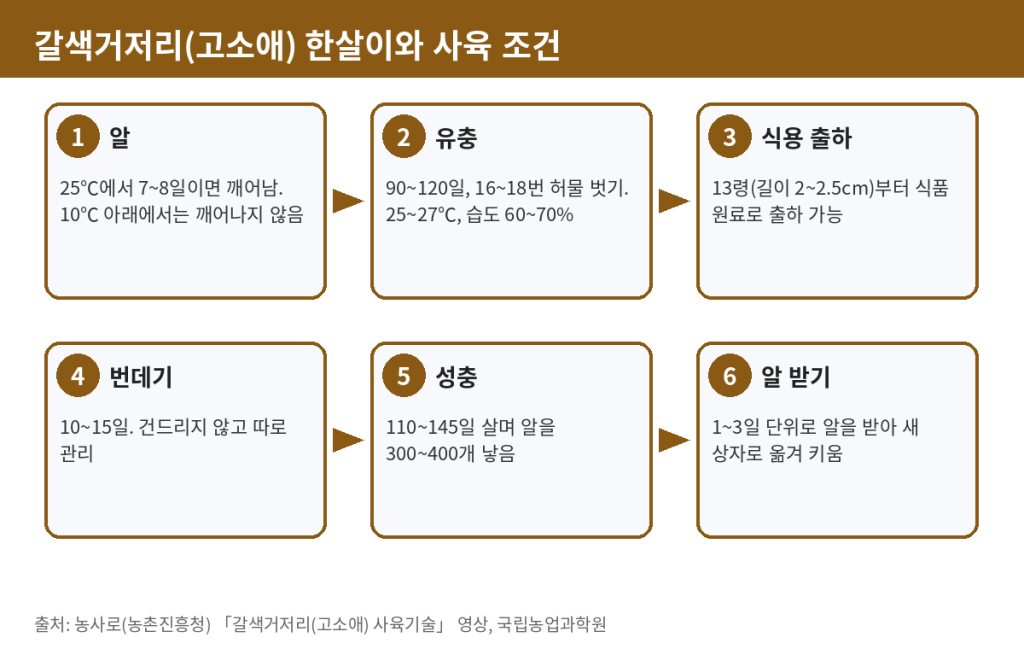
    • Environment: 25-27°C and 60-70% humidity. Under these conditions you can raise 3-4 generations a year; one generation takes about 4 months.
    • Life cycle: Eggs hatch in 7-8 days at 25°C. The larval stage lasts 90-120 days with 16-18 molts. The pupal stage lasts 10-15 days. Adults live 110-145 days and lay 300-400 eggs.
    • Feed: Dry the wheat bran so its moisture stays at 10% or less. Damp feed easily grows mold and mites.
    • Density: In a 22 L box, keep about 100 g, 600 g or 1,000 g of larvae depending on their size. Don’t pack them too tightly.
    • Shipping: For food, larvae are shipped from the 13th instar (about 2-2.5 cm long).
    • Separating: Sieve out frass and shed skins. Use a separator machine as you grow.
    • MAFRA’s notice “Standards for Rearing Insects” also sets facility and management standards; read it before filing.

    4. How much can you earn?

    • In MAFRA’s 2024 survey, first-stage mealworm sales were about KRW 6.822 billion from 296 selling farms. Simply dividing gives about KRW 23 million per farm (author’s calculation). This is average sales, not net profit. Large and small farms are mixed together, so real income differs (varies by region and conditions).
    • In the same survey, sales of pet and educational insects were about KRW 5.388 billion.
    • What’s left after feed, electricity, labor, and whether you have buyers changes a lot.

    5. Finding customers and selling

    1. Feed and animal food: Reptile, bird and fish keepers, pet shops, zoos and petting farms. To process and sell as feed, register a feed manufacturing business with the provincial governor under Article 8 of the Feed Management Act (Gov24: 15 days to process, KRW 30,000 fee).
    2. Food ingredients: To make insects into powder or roasted products and sell them as food, you need a business registration under the Food Sanitation Act. Registering as a food manufacturing/processing business counts as filing the insect processing report (Nongsaro Q&A). If you can’t process yourself, supply processors with raw material.
    3. Pet treat companies: Look for companies that use dried mealworms as an ingredient and ask about contract farming.
    4. Education and experiences: Sell life-cycle observation sets to schools and experience centers.
    5. Local insect associations and agricultural technology centers: Get sales-channel information and training. To get government support you need to register as an agricultural business entity (Nongsaro Q&A).

    6. Start steps 1-2-3

    1. Learn and pick buyers: Take insect courses at your agricultural technology center and decide first whether you’ll sell for feed, food ingredients or pets. Don’t start big without buyers.
    2. File the report and test small: File an insect production business report with your city, county or district, and raise one generation (about 4 months) in a few boxes to learn temperature, humidity and feed management.
    3. Prepare sales and grow: Check feed manufacturing registration if you sell feed, or food business registration if you sell food. Grow the number of boxes slowly, based on your first sales records.
    Mealworm life cycle: egg, larva, pupa, adult, food shipping from 13th instar - How to make money with edible insect farming

    Watch out for these problems

    In 2018 the RDA warned that some companies were misusing the RDA’s name and exaggerating how much money insect farming makes to attract investors and would-be farmers. Be careful with ads that take money for starter stock or facilities first while saying things like “we’ll buy back everything you raise” or “this is a government-approved business” (the author’s examples). Before signing, ask your city or county agricultural technology center, and get any buy-back promise (purchase contract) in writing with the company details, period and price. If you are harmed, you can contact the 1372 Consumer Counseling Center.

    Sources

    7. FAQ

    Do I need a permit to raise insects?

    It's a report, not a permit. Under Article 12 of the Insect Industry Act, you report to the city/county/district head to produce, process or distribute insects, and the office tells you within 5 days whether it is accepted.

    Which insects can be sold as food?

    According to the RDA, 10 insects are approved as food ingredients: grasshopper, white muscardine silkworm, edible silkworm, mealworm larva, two-spotted cricket, white-spotted flower chafer larva, rhinoceros beetle larva, superworm larva, drone bee pupa and migratory locust.

    How long until mealworms can be shipped?

    The larval stage is 90-120 days, and for food they are shipped from the 13th instar (about 2-2.5 cm). You must keep 25-27°C and 60-70% humidity (Nongsaro).

    Can I raise them at home?

    Small test batches are possible, but to sell you must file the report and check the "Standards for Rearing Insects" notice. Smell, dust and mites can occur, so ventilation and cleaning matter.

    Is eating insects good for health?

    This guide makes no health claims. Insects are just one of the protein sources being studied; follow food regulations for labeling such as allergens.

    Last updated: October 30, 2026. Based on official sources; rules and prices can change.
  • How to Make Money with Beekeeping in Korea

    How to Make Money with Beekeeping in Korea

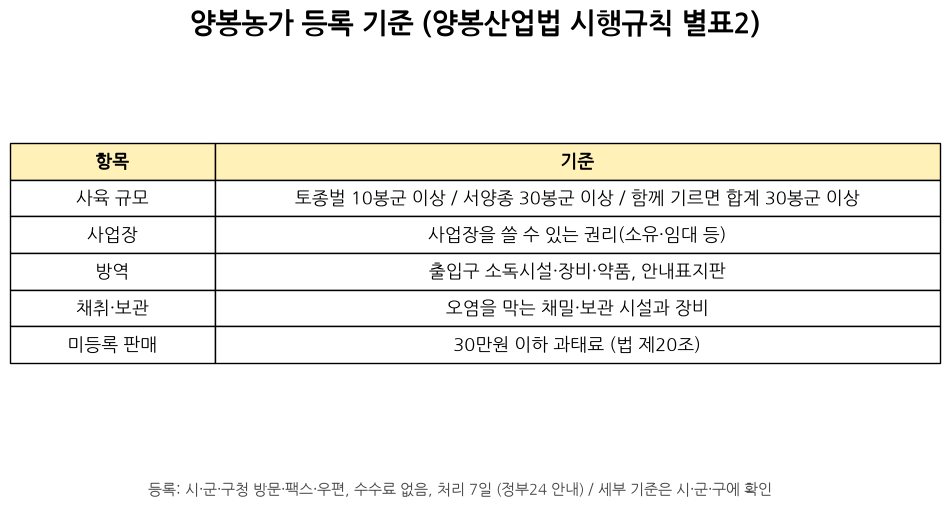
    Beekeeping farm registration criteria: colony size, site, biosecurity, honey extraction and storage - How to make money with beekeeping

    Beekeeping means raising honeybees to get products such as honey, pollen, propolis and royal jelly, or to help with pollination. You can start without owning much land, but you must learn about legal registration, bee pest control and sting safety. This article explains how to make money with beekeeping in Korea, based on official sources.

    One-line summary: Making money with beekeeping follows this order: “learn the basics through training → register as a beekeeping farm → manage varroa mites and hornets → sell honey with quality grading and direct sales.”

    1. What is beekeeping?

    • It is a type of livestock farming in which you keep honeybee colonies in hives to get honey and other products. One hive (one queen plus a group of worker bees) is counted as “1 colony.”
    • In Korea, people keep Western honeybees and native Korean bees (Asian honeybees).
    • There is migratory beekeeping, where hives are moved to follow flowering seasons, and stationary beekeeping, where hives stay in one place.

    Beekeeping in Korea today

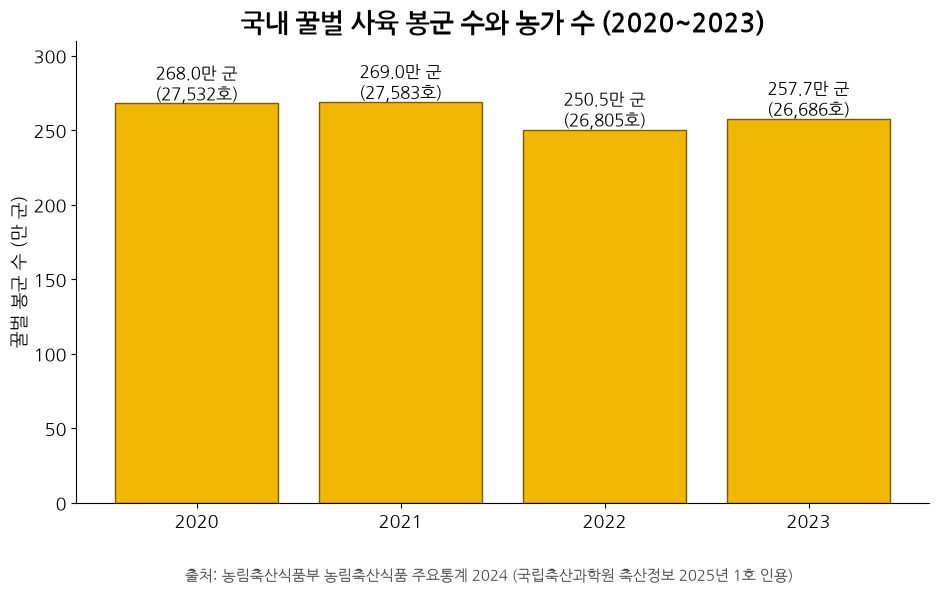
    According to the Ministry of Agriculture, Food and Rural Affairs’ key statistics (cited in the National Institute of Animal Science’s livestock information), the number of bee colonies and farms was:

    Number of honeybee colonies and beekeeping farms in Korea, 2020-2023 - How to make money with beekeeping
    Year Colonies Farms
    2020 2.680 million 27,532
    2021 2.690 million 27,583
    2022 2.505 million 26,805
    2023 2.577 million 26,686

    According to Rural Development Administration (RDA) material (2023 policy briefing), Korea’s colony density is high at 21.8 colonies per km², and honey production in 2021 was about 16,000 tonnes.

    2. Laws you must know: the Beekeeping Industry Act and the Livestock Industry Act

    • Beekeeping farm registration (Beekeeping Industry Act, Art. 13): If you keep bees above a certain scale, you must register as a beekeeping farm with the mayor, county head or district head. The criteria are in Annex 2 of the Enforcement Rule (see the image above).
    • Colony size: 10+ native-bee colonies, 30+ Western-bee colonies, or 30+ in total if keeping both
    • Right to use the site (ownership, lease, etc.), biosecurity facilities (disinfection facility, equipment, chemicals, signboard), and contamination-preventing extraction and storage facilities
    • How to apply: According to Gov24, you apply at the city/county/district office in person, by fax or by mail. It is free, and processing takes 7 days.
    • Succession report (Art. 14): If you take over a beekeeping farm, you must report within 30 days.
    • Fines (Art. 20): Selling bee products without registering, or failing to report changes or succession, can lead to a fine of up to 300,000 won.
    • Relation to the Livestock Industry Act: Honeybees are excluded from livestock-raising business registration under the Livestock Industry Act. Instead, you register as a beekeeping farm under the Beekeeping Industry Act.
    • Agricultural business entity registration: According to the National Agricultural Products Quality Management Service, you can register as an agricultural business entity if you hold a beekeeping farm registration certificate or sell at least 1.2 million won of farm/livestock products a year. Local government support programs are often available only to registered farms (e.g., Jangsu County’s provincial subsidy notice).

    ※ Laws can change. Check the latest details at the National Law Information Center and your city/county/district livestock department.

    3. How much does it cost to start?

    I could not find official statistics on start-up costs for beekeeping. Costs vary widely with the number of colonies, the level of hives and equipment, and whether you rent land. Items you need:

    Item Details Note
    Bees (colonies) Western or native bees Registration threshold is 30+ Western colonies
    Hives and frames Hive boxes, foundation, covers One set per colony
    Protective gear Veil, bee suit, gloves, smoker Safety essential
    Extraction equipment Extractor, bee brush/blower, strainer, storage containers Contamination-prevention standards apply
    Biosecurity Mite treatments, hornet traps, disinfection Regular expense
    Site Apiary land (owned or leased) Migratory beekeeping needs a vehicle
    Training Agricultural Technology Center or association courses Varies by region

    4. What equipment do I need?

    • Hives and frames: Where the bees live.
    • Smoker: Calms bees with smoke.
    • Veil, bee suit, gloves: Basic gear to reduce stings.
    • Hive tool: For prying open lids and frames.
    • Extractor, strainer, storage containers: For extracting, filtering and storing honey.
    • Hornet traps and control tools: Reduce hornet damage from summer to autumn.

    5. What does the yearly schedule look like?

    According to the RDA’s Nongsaro beekeeping work schedule, tasks change by season. Roughly (varies by region and climate):

    • Spring: Check colonies after winter, add feed, build up colonies
    • Late spring to early summer: Main flowering season (e.g., black locust), honey extraction
    • Summer: Varroa mite control — the RDA stresses treatment in July and intensive control from June to October
    • Summer to autumn: Prepare for hornet damage
    • Autumn to winter: Prepare for wintering, check food stores

    6. How much can I earn?

    Beekeeping income varies greatly each year depending on the number of colonies, that year’s flowering and weather, bee losses, and sales method (wholesale vs. direct). This article does not list unverified amounts. Look up crop-specific income data in the “income information” menu on the RDA’s Nongsaro and consult your local Agricultural Technology Center.

    7. How to sell honey

    • Honey quality grading: The Korea Institute for Animal Products Quality Evaluation grades honey as 1+, 1 or 2. You submit a 500 g sample, and the process goes through participating businesses such as food repackaging businesses. A grade label builds customer trust.
    • Direct sales: Local food stores, farmers’ markets, online shops.
    • Wholesale: Sell to beekeeping cooperatives or buyers.
    • Check before selling: If you repackage honey into jars to sell, you may need a food-business report. Check with your city/county/district hygiene department first.
    • Careful with ads: Don’t claim honey cures diseases.

    8. Step-by-step start

    Step 1 – Learn
    1. Find out whether your local Agricultural Technology Center or the Korea Beekeeping Association runs beekeeping courses (courses and schedules vary by region).
    2. Help out at an experienced beekeeping farm to see a full year’s cycle.

    Step 2 – Start small
    1. Choose an apiary site and check whether there are many homes or pesticide-sprayed fields nearby.
    2. Start with a few colonies and learn how to manage them.

    Step 3 – Register
    1. Once you meet the criteria (e.g., 30+ Western colonies), register as a beekeeping farm at the city/county/district office.
    2. Look into agricultural business entity registration too.

    Step 4 – Manage and sell
    1. Put mite and hornet control dates on a calendar and stick to them.
    2. After extracting honey, try quality grading and build direct sales channels.

    Watch out for these damage cases

    Some people may tell would-be beekeepers that “just buy hives and the honey comes by itself and makes money,” pushing them to buy expensive hives and colonies all at once or collecting management fees up front. Honey production changes a lot from year to year with weather and pests, so don’t trust anyone who promises a fixed return. When buying colonies, open the hive yourself to check its condition (queen, pests and diseases), and keep the contract and receipts. If you suffer damage, you can get advice from the 1372 Consumer Counseling Center.

    Sources

    9. FAQ

    How many colonies before I must register?

    Under Annex 2 of the Enforcement Rule, 10+ native-bee colonies, 30+ Western-bee colonies, or 30+ in total when keeping both.

    What happens if I sell honey without registering?

    Under Article 20 of the Beekeeping Industry Act, you may be fined up to 300,000 won.

    What are varroa mites and why do they matter?

    They are parasites that live on honeybees and weaken colonies. The RDA has warned about resistance to some treatments (such as fluvalinate) and advises rotating treatments and doing intensive control in summer.

    I'm worried about bee stings.

    Always wear a veil, bee suit and gloves, and avoid working alone. If you are worried about bee allergies, talk to a medical professional before starting. This article does not give medical advice.

    Can I keep bees in a city?

    It depends on the location and neighbors. Rules and complaint handling differ by local government, so ask your city/county/district office first.

    Last updated: October 30, 2026. Based on official sources; rules and prices can change.
How to Make Money
Add to Home Screen