Path
At a glance
Contents
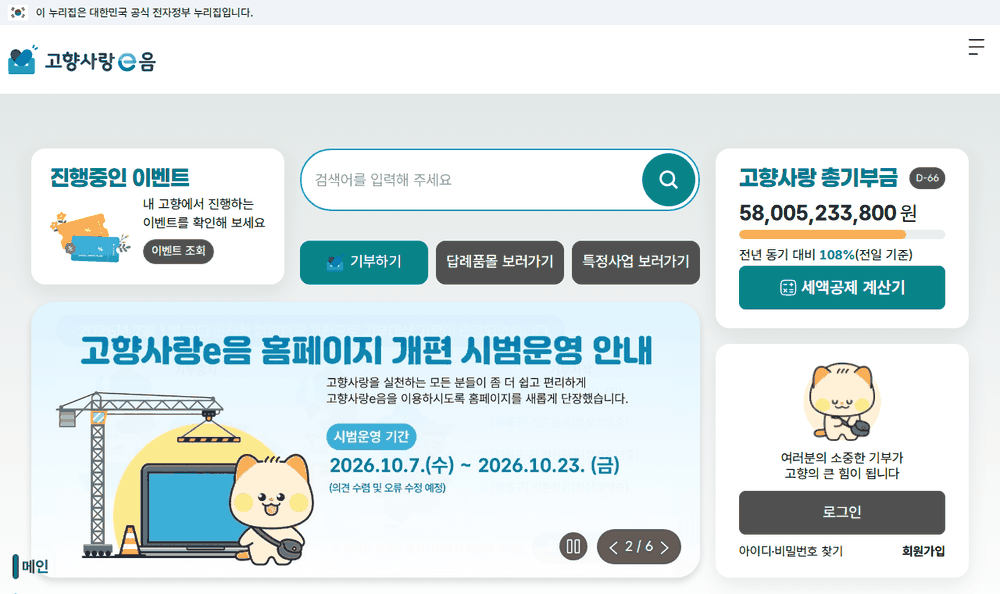
Written on 2026-10-26 after checking public pages from the National Tax Service, the National Election Commission, Gohyang Sarang e-eum, the Ministry of the Interior and Safety and law.go.kr. This is not tax advice or a request to donate; your actual credit depends on your own tax. No logged-in screens were viewed. The only image is a self-made illustration. Nothing here promises income.
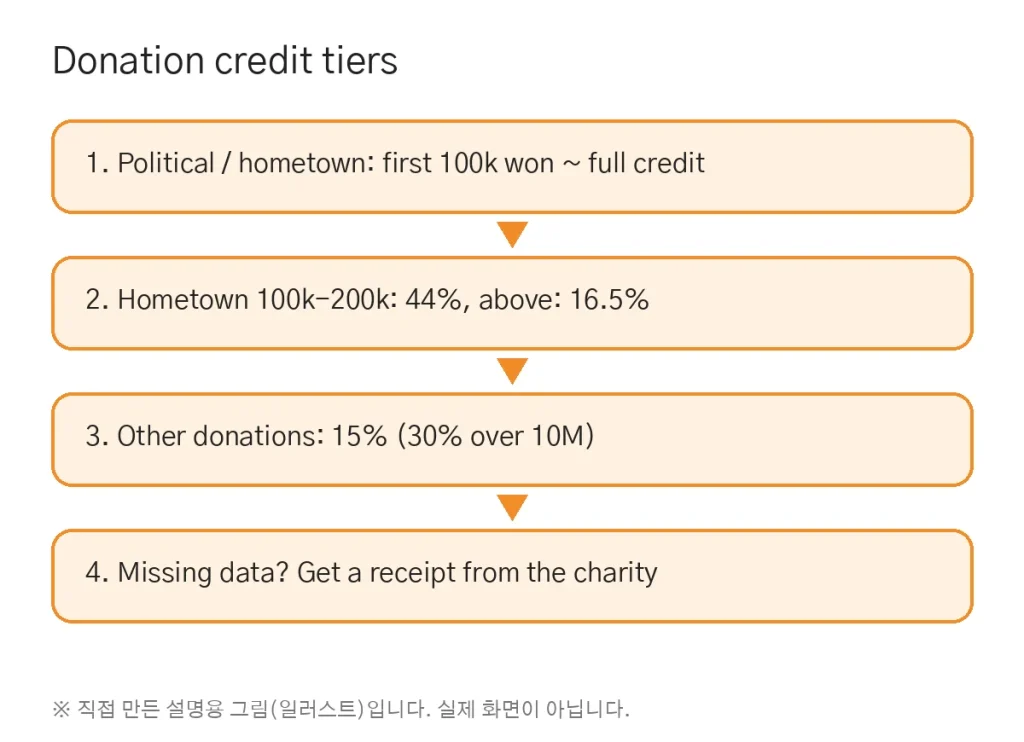
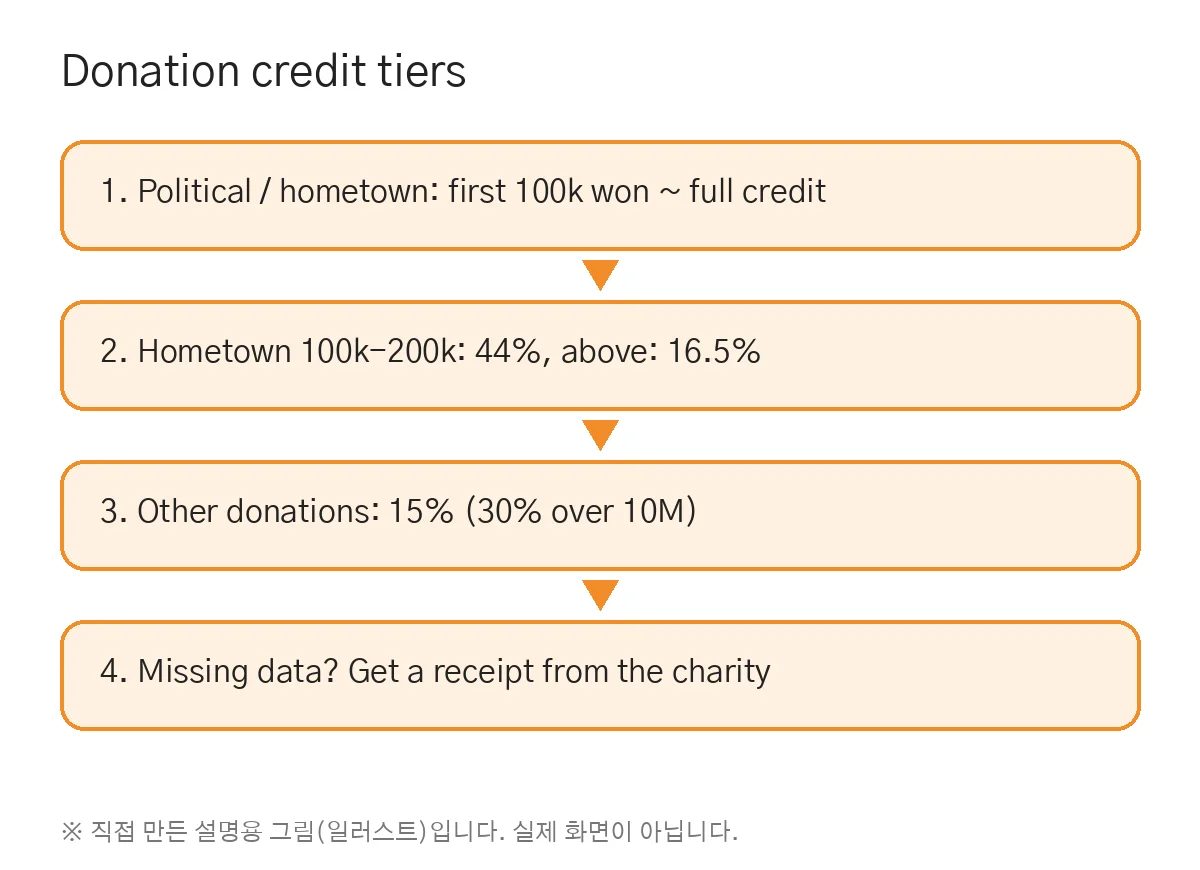
The diagram below is a self-made illustration, not a real screen.
This guide explains how the donation tax credit in Korea is calculated and how the Hometown Love Donation credit and gifts work, for 2026. It sets out the rules and doesn’t encourage you to donate. For claiming a missed deduction later, see the tax correction claim guide.
Who this suits
- Employees claiming donation credits in the year-end tax settlement
- Anyone curious how the Hometown Love Donation credit is calculated
1. What are the 2026 donation tax credit rates?
- Special, general and employee stock ownership association donations: 15% up to 10 million won, 30% on the part above
- Special and general donations by dependents count too (income test only, no age limit).
- Unused special and general donation credits can be carried forward for 10 years.
- Donations count regardless of how long you worked, even ones made before you started your job.
2. How much credit for a 100,000 won political donation?
- Up to 100,000 won: credit of 100/110 (per the National Tax Service; the National Election Commission says “full credit up to 100,000 won”, so check with each agency)
- 15% on the part above 100,000 won, 25% on the part above 30 million won
- Only your own donations count, not your spouse’s or parents’.
- If your tax due is under 100,000 won, the difference is not refunded.
- Example (illustrative numbers): a 1.2 million won donation gives 100,000 × 100/110 = 90,909 won plus 1.1 million × 15% = 165,000 won, for 255,909 won in total.
3. How do the Hometown Love Donation credit and gifts work?
- Who and where: individuals only. You can give to any local government except the metropolitan and basic ones where you are registered as living.
- Limit: 20 million won per person a year
- Credit rates: agencies state them differently, so check with each agency.
– Gohyang Sarang e-eum: 100% up to 100,000 won, 44% from 100,000 to 200,000 won, 16.5% above 200,000 won (33% in special disaster areas)
– Restriction of Special Taxation Act (national tax): 100/110 up to 100,000 won, 40% from 100,000 to 200,000 won, 15% above 200,000 won
– The details below follow e-eum’s figures.
– The 100,000 to 200,000 won tier is new for donations made from 2026, and the 33% disaster-area rate applies within 3 months of the declaration.
– Example (illustrative numbers): a 1 million won donation gives 100,000 + 44,000 + 800,000 × 16.5% = 276,000 won.
- Only the donor can claim it, and it can’t be carried forward.
- Thank-you gifts: you get donation points worth up to 30% of the donation. They last 5 years and can only be spent on gifts from the area you donated to.
- Where to donate: the official Gohyang Sarang e-eum platform, some banks and other private platforms, or any NH NongHyup Bank branch
- Note: the government has proposed region-based rates for the part above 100,000 won from 2027. The National Assembly has not reviewed it yet.
4. What if a donation is missing from the simplified data?
- If a donation doesn’t show up in the year-end tax simplified service, get a donation receipt directly from the charity and give it to your employer.
- For political donations, submit the NEC-issued receipt from the supporters’ association, or an electronic receipt from the NEC or its political donation center.
- Past donation credits, including amounts carried forward, can be checked on Hometax after login.
Common mistakes
- Adding a spouse’s political donation to your own claim
- Trying to give a Hometown Love Donation to the area where you live
- Forgetting donations that are missing from the simplified data
Checklist
- ☐ All donations show in the simplified data
- ☐ Receipts obtained for any that are missing
- ☐ Political and hometown donations are in your own name
- ☐ Hometown donation is not to your registered area
- ☐ Any carried-forward donations checked
Related guides
FAQ
Ordinary donation credit rate?
15% up to 10 million won and 30% above that, for special and general donations.
Do family members’ donations count?
Special and general donations by dependents (income test only, no age limit) do. Political and Hometown Love donations count only for the donor.
Rate above 100,000 won for Hometown Love?
The Gohyang Sarang e-Eum site says 44% up to 200,000 won and 16.5% above; the tax law text says 40% and 15%. Check with each agency.
Can I donate to where I live?
No. Any local government except the ones of your registered address.
Can unused credit carry over?
Special and general donations: 10 years. Hometown Love: no.
Read next
- Earned income tax credit late application guide
- Local currency and Onnuri gift certificate guide
- Find hidden money guide
We also have a $4.99 PDF guide that collects more everyday money-saving tips. Take a look if it’s useful →
🎁 Free: 7-day side-hustle starter checklist
Leave your email and get the free checklist now. No spam, unsubscribe anytime.
Popular guides
- Top 10 Ways to Make Money Starting This Week (Free Checklist)
- How to Make Money as a Student: Legit Ideas (2026)
- Passive Income Ideas: Realistic Options for 2026
- Make Money Online Without Investment: 20 Free Ways
- How to Make Money with AI: 50 Practical Ways (2026)
- How to Make Money From Home: 20 Legit Ways
- Make Money Online for Beginners: 15 Easy Ways to Start
- How to Make Money as a Mom: 16 Flexible Ideas (Work Around Nap Time)
- 16 Legit Ways to Make Money Fast (This Week)
- How to Make Money as a Teenager: 16 Safe Ideas
- 14 Remote Jobs With No Experience Needed
Next method: Korea Basic Pension Eligibility and Amount (2026): Helping Your Parents Apply →