Path
At a glance
Contents
Maple syrup, the kind poured on pancakes, is made by boiling down the sap of maple trees (mainly sugar maple) for a long time. In Canada and the northeastern United States, many farms drill small holes in trees every spring, collect the sap, and sell it as syrup. It is somewhat like collecting gorosoe (painted maple) sap in Korea in spring. This guide explains how to make money with maple syrup overseas, based on data from Statistics Canada (StatCan), the Quebec Maple Syrup Producers (PPAQ), USDA NASS, Cornell University and the University of Vermont.
In one line: making money with maple syrup comes down to “number of taps × yield per tap × price.” Canada produced about 113.43 million kg in 2025, worth C$840.5 million (about KRW 804.3 billion). Quebec harvested about 4.04 lb per tap; at the 2025 minimum bulk price, that is about KRW 13,000 of sales per tap. Weather changes the harvest a lot.
Note: KRW amounts in this guide are calculated with the Bank of Canada daily average exchange rates for 28 October 2026 (C$1 ≈ KRW 957, US$1 ≈ KRW 1,343). If exchange rates change, so do the KRW amounts.
1. What is maple syrup production?
- In late winter to early spring you drill small holes (taps) in maple trees, collect the sap that flows out, and boil it into syrup.
- Sap is only about 2% sugar, so about 43 gallons of sap make 1 gallon of syrup (Cornell Cooperative Extension). Syrup is finished at 66% sugar.
- Sap flows best when nights are below freezing and days are above freezing. So the season is short, usually late February to April, about 6–8 weeks (UVM Proctor Maple Research Center).
- Canada makes over 75% of the world’s maple syrup, and the US about 25% (Agriculture and Agri-Food Canada). Within Canada, Quebec makes 90.0% (StatCan, 2025).
- Canada has 6,364 maple farms (2021 Census of Agriculture), and Quebec has more than 13,500 producers in 7,902 enterprises (PPAQ 2025).
2. How much does it cost to start?
Start-up costs for an overseas maple farm vary too much with forest size, equipment and region for an official average. Here are the essential items.
| Item | Details | Notes |
|---|---|---|
| Maple forest (sugarbush) | Owned or leased sugar maple woods | Land prices and lease terms differ by region |
| Taps (spiles) and drill | Small spouts in the tree; 7/16 or 5/16 inch bit | Hole depth about 1.5–2.5 inches |
| Sap collection | Buckets or a tubing network | Larger operations use tubing + vacuum pump |
| Concentrating | Reverse osmosis (RO) unit | Can cut boiling time and fuel by over 90% (UVM) |
| Evaporator | Large pans and firebox to boil sap | Needs wood, oil or other fuel |
| Finishing tools | Filter, thermometer, hydrometer, bottles | Filter hot; bottle at 180°F (82°C) or above |
| Sales rules | Food sales rules differ by country and state | Quebec has a production quota system |
3. Equipment and how to work
Guidance from Cornell and UVM, in simple words:
- Which trees to tap: only healthy trees at least 10 inches (about 25 cm) in diameter at breast height (about 4.5 ft). 10–17 inches: 1 tap; 18–24 inches: 2 taps; 25 inches or more: 3 taps (Cornell).
- Hole size: drill with a 7/16 or 5/16 inch bit about 1.5–2.5 inches deep. With vacuum tubing, UVM advises shallower holes (about 1.5 inches or less).
- Vacuum tubing: high vacuum can roughly double yield compared with gravity flow (UVM).
- Reverse osmosis (RO): removes water from sap first, greatly cutting boiling time and fuel.
- Boiling and finishing: syrup is done at about 7.1°F (about 4°C) above the boiling point of water. Filter while hot and bottle at about 180°F (82°C) or higher.
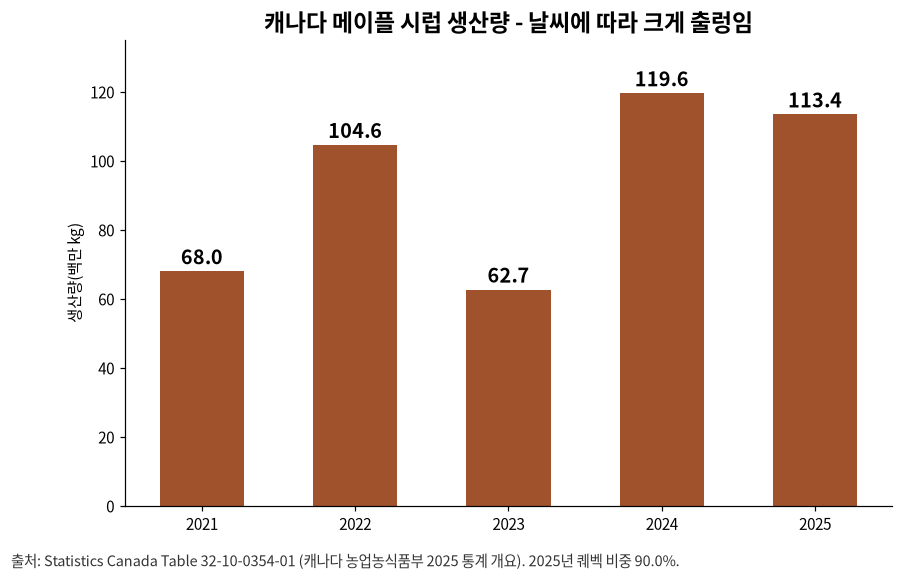
- Weather risk: in 2012 and 2021, early spring warmth cut crops by more than 20% (UVM).
Comparison with Korea: gorosoe sap
- In Korea, collecting sap from gorosoe and similar trees requires a permit from the city mayor or county head and training every year, and collectors must wear a sap-collector ID (Korea Forest Service).
- Holes must be within 2 m of the ground, no wider than 0.8 cm and no deeper than 1.5 cm into the wood. Trees under 10 cm in breast-height diameter may not be tapped; 10–19 cm: 1 hole, 20–29 cm: 2 holes, 30 cm or more: 3 holes. Hoses must be double-walled drinking-water pipe and not used for more than 5 years (Korea Forest Service Sap Collection and Management Guideline).
- Maple and gorosoe share the same principle: “tap only thick trees, with a fixed number of holes.” Gorosoe is mostly sold as raw sap rather than syrup, and the Korea Forest Service describes it as an off-season income source for mountain villages. Check the latest rules with the Korea Forest Service and local governments.
4. How much can you earn?
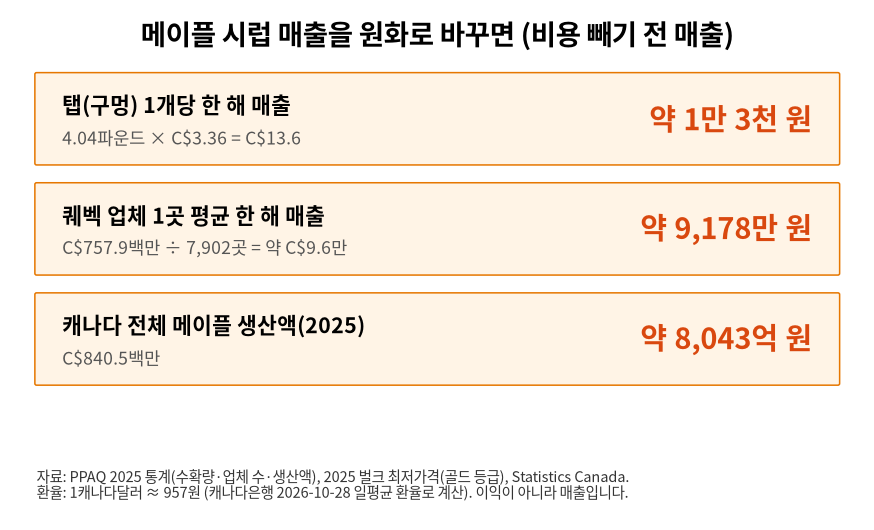
Real profit differs from person to person with forest size, equipment debt, labor and fuel costs. Below are sales figures (before costs) calculated from official statistics.
- All of Canada: 2025 value C$840.5 million (about KRW 804.3 billion). Volume fell 5.1% from the 2024 record but was the second-highest ever (StatCan, AAFC).
- Quebec minimum bulk price: the 2025 minimum set by PPAQ and buyers is C$3.36 per lb for Golden (Doré) grade (C$3.40 in 2026), about KRW 7,100 per kg. Organic syrup earns an extra C$0.18 per lb.
- Per tap: Quebec’s 2025 average of 4.04 lb × C$3.36 ≈ C$13.6, about KRW 13,000.
- Average Quebec enterprise: C$757.9 million ÷ 7,902 enterprises ≈ C$96,000, about KRW 91.78 million. Enterprise sizes vary widely, so this is only an average.
- United States: US maple syrup production was worth about US$206.26 million in 2024 (about KRW 277 billion). Vermont produced 3.06 million gallons in 2025, 53.1% of US output, and Vermont’s 2024 average retail price was US$58.30 per gallon (about 3.8 L), about KRW 78,000.
- Exports: in 2025 Canada exported C$844.2 million (about KRW 807.9 billion) of maple products to 69 countries, 64.2% to the US. Korea imported about 800 tonnes of Canadian maple products worth C$9.717 million (about KRW 9.3 billion) in 2025.
5. How do you find customers?
- Bulk sales (Quebec): in Quebec, the producers’ organization (PPAQ) manages production quotas, barrel sales and a strategic reserve. A set minimum price keeps prices relatively stable.
- Direct sales: bottled syrup sold at farm stores, farmers’ markets and online. You can charge more than bulk, but bottles, packaging and selling take time.
- Value-added products: maple cream, sugar and candy can earn higher prices.
- Agritourism: some farms sell farm tours and meals during the spring season.
- For Korea: Korea imports Canadian maple products every year. Importing and selling food requires registration and reports, so check with the Ministry of Food and Drug Safety first. Gorosoe sap is sold by permitted collectors at local festivals, directly and online.
6. Start steps 1-2-3
- Learn: use free materials and courses from university extension services such as Cornell and UVM to learn tapping, boiling and hygiene. In Korea, ask your city or county office about gorosoe collection permits and training.
- Try it small: overseas, run one season at a small scale with a few dozen buckets and record your yield per tap. For gorosoe, collect only within your permit.
- Choose buyers and grow: once yields are stable, add vacuum tubing and RO, and decide between bulk and direct sales. To sell bulk in Quebec, check quota rules with PPAQ.
8. Watch out for these real cases
- Quebec maple syrup heist (2012): about 9,600 barrels of maple syrup worth C$18.7 million (about KRW 17.9 billion) were stolen from the Quebec producers’ strategic reserve warehouse, and people were charged (CBC). The lesson: large inventories need careful storage and records.
- Fake gorosoe sap (2014): a group mixed cheap sap with groundwater and saccharin and sold it as “Gwangyang Baegunsan gorosoe sap.” About 15,000 cans of 18 L, worth KRW 510 million, went to some 30 inns and restaurants, and the group was booked for violating the Food Sanitation Act (Maeil Business News). Buyers should check for permitted collectors and origin; sellers should sell only honest, unmixed products.
- Beware of maple farm investment pitches: for offers of shares in overseas farms or “guaranteed high returns,” check the actual land, permits and production records first. If in doubt, contact Korea’s Financial Supervisory Service (1332).
Sources
- Statistics Canada, Production and value of maple products, 2025 (The Daily, 2025-12-11)
- Agriculture and Agri-Food Canada, Statistical overview of the Canadian maple industry 2025
- Producteurs et productrices acéricoles du Québec (PPAQ), Statistiques acéricoles 2025
- PPAQ, Convention de mise en marché 2025-2026-2027 (minimum prices)
- Vermont Agency of Agriculture, 2025 Vermont maple season production
- Cornell Cooperative Extension Warren County, Maple Syrup Production
- University of Vermont Proctor Maple Research Center, Maple Outreach
- Bank of Canada, Valet API daily average exchange rates (FXUSDCAD, FXKRWCAD, 2026-10-28)
- Korea Policy Briefing, Korea Forest Service gorosoe sap collection rules (2012-02-21)
- Korea Law Information Center, Korea Forest Service Sap Collection and Management Guideline
- CBC News, Quebec maple syrup heist charges
- Maeil Business News, fake gorosoe sap sales caught (2014-02-18)
7. FAQ
Can I make maple syrup in Korea?
Forests rich in sugar maple and similar syrup trees are mainly in Canada and the northeastern US. The similar work in Korea is gorosoe sap collection, which needs a permit and training every year.
Why does production swing so much from year to year?
Sap flows well only with "freezing nights and thawing days." An early warm spring cuts the harvest sharply. Canadian output nearly doubled from about 62.67 million kg in 2023 to about 119.56 million kg in 2024.
Can I earn more by drilling more holes?
No. The number of taps is set by tree size, and too many holes damage the tree. The same principle applies to maple and gorosoe.
How much sap do I need to boil?
About 43 gallons of sap make 1 gallon of syrup. That is why fuel costs are high and large farms remove water first with RO.
Can I advertise maple syrup or gorosoe sap as healthy?
This guide does not cover health effects. Exaggerating that a food cures illness or is good for the body can break advertising rules, so honestly describe taste, production method and origin only.
Last updated: October 30, 2026. Based on official sources; rules and prices can change.
🎁 Free: 7-day starter checklist for earning extra income
Leave your email and get the free checklist now. No spam, unsubscribe anytime.
Popular guides
- Top 10 Ways to Make Money Starting This Week (Free Checklist)
- How to Make Money as a Student: Legit Ideas (2026)
- Passive Income Ideas: Realistic Options for 2026
- Make Money Online Without Investment: 20 Free Ways
- How to Make Money with AI: 50 Practical Ways (2026)
- How to Make Money From Home: 20 Legit Ways
- Make Money Online for Beginners: 15 Easy Ways to Start
- How to Make Money as a Mom: 16 Flexible Ideas (Work Around Nap Time)
- 16 Legit Ways to Make Money Fast (This Week)
- How to Make Money as a Teenager: 16 Safe Ideas
- 14 Remote Jobs With No Experience Needed
Next method: How to Make Money with Abalone Farming in Korea →