How to Make Money

Category: Making Money Overseas

  • How to Make Money with Kiwifruit Farming (Overseas Case: New Zealand)

    How to Make Money with Kiwifruit Farming (Overseas Case: New Zealand)

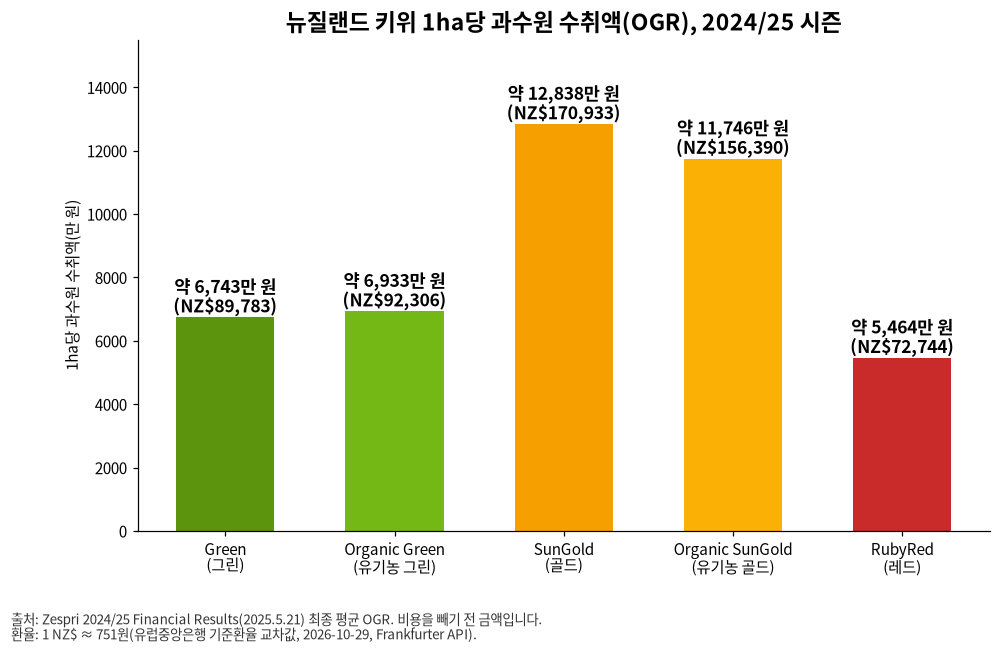
    New Zealand kiwifruit orchard gate return per hectare, 2024/25: Green about KRW 67.43M, SunGold about KRW 128.38M - how to make money with kiwifruit farming

    Much of the green and gold kiwifruit sold in Korean supermarkets comes from New Zealand. Kiwifruit is one of New Zealand’s signature exports: orchards grow the fruit, and the marketer Zespri sells it around the world. This guide explains how to make money with kiwifruit farming overseas, using Zespri’s official results, New Zealand government sources (Te Puni Kōkiri’s tupu.nz, Land Information New Zealand, Immigration New Zealand) and the kiwifruit biosecurity agency KVH.

    In one line: kiwifruit income is “trays per hectare × price per tray − operating costs.” In the 2024/25 season, the orchard gate return (OGR) per hectare was about KRW 67.43 million for Green and about KRW 128.38 million for SunGold. But developing an orchard costs about KRW 113–300 million per hectare, and a SunGold licence cost about KRW 421 million per hectare at the 2025 auction, so break-even usually takes 12–15 years.

    ※ KRW figures use a cross rate from European Central Bank reference rates on 29 October 2026 (NZ$1 ≈ KRW 751). KRW amounts change with the exchange rate.

    1. What is kiwifruit farming in New Zealand?

    • Kiwifruit is a vine grown on pergola trellises; fruit is harvested around May and exported. Flowering is November to early December, and most fruit is picked in May (tupu.nz).
    • Kiwifruit has separate male and female vines, so it needs bees or artificial pollination.
    • 81% of New Zealand kiwifruit is grown in the Bay of Plenty. Northland, Waikato, Nelson and Gisborne grow it too.
    • Zespri sold 220.9 million trays in 2024/25, and fruit and service payments to New Zealand growers topped NZ$3 billion (about KRW 2.25 trillion) for the first time.
    • The main varieties are Green (Hayward, no licence), SunGold (licence required) and RubyRed (licence required).

    2. How much does it cost to start?
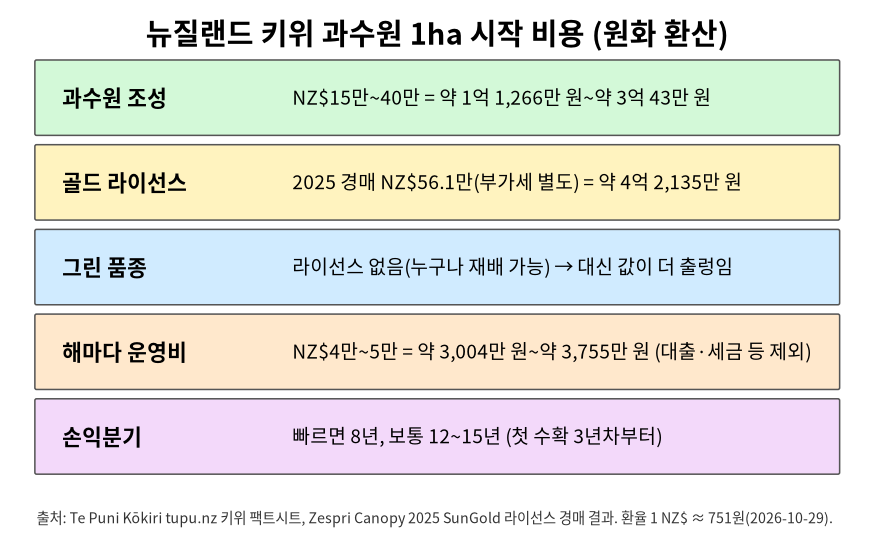
    New Zealand kiwifruit orchard start costs per hectare in KRW: development, licence, operating costs - how to make money with kiwifruit farming
    Item Amount (per hectare) Source / note
    Orchard development NZ$150,000–400,000 (about KRW 113–300 million) Site preparation, shelter, trellis, plants. Hail cover, bores and irrigation push it to the top of the range (tupu.nz)
    SunGold licence 2025 auction closing price NZ$561,000 (about KRW 421 million), excl. GST Zespri auction result. It was NZ$290,000 in 2019
    Green variety No licence Anyone can plant it, so prices can swing as supply grows
    Yearly operating costs NZ$40,000–50,000 (about KRW 30–38 million) Labour, orchard work and overheads; excludes debt, lease, depreciation and tax (tupu.nz)
    Land varies No official average
    Water consent From the regional council Irrigation water is getting harder to secure in some areas

    tupu.nz says a commercial orchard with staff needs at least 25 ha, while an owner-operator orchard of about 5 ha can be profitable.

    3. Equipment and growing tips

    • Land: flat (under 8 degrees of slope recommended), fertile, well-drained soil. Windy, cold and wet sites are weak spots and more prone to Psa disease.
    • Climate: 8–9 frost-free months, and over 600 hours below 7°C in winter for good spring budbreak.
    • Water: kiwifruit can’t handle drought and needs about 35–40 mm of water per canopy hectare per week in the growing season. Water is also used for frost protection.
    • Structures: pergola trellis, shelter belts, and hail cover and irrigation if needed.
    • Certification: every Zespri grower must hold GlobalG.A.P. certification.
    • People: pruning, thinning and harvest need lots of seasonal labour. Spraying and mowing are often done by contractors.
    • Time to harvest: first harvest can come in year 3; full production takes 5–7 years. Vines stay productive for 30–50 years.

    4. How much can you earn?

    Actual profit varies by orchard with land cost, debt, yield and fruit sweetness. Below is the orchard gate return (OGR), the amount paid to growers after packing, storage and marketing costs, but before orchard costs.

    • 2024/25 final averages (Zespri)
    • Green: NZ$8.36 per tray (about KRW 6,279); NZ$89,783 per hectare (about KRW 67.43 million), a record per-hectare return for Green.
    • Organic Green: NZ$92,306 per hectare (about KRW 69.33 million)
    • SunGold: NZ$11.81 per tray (about KRW 8,870); NZ$170,933 per hectare (about KRW 128.38 million)
    • Organic SunGold: NZ$156,390 per hectare (about KRW 117.46 million)
    • RubyRed: NZ$72,744 per hectare (about KRW 54.64 million), held back by many young vines with low yields.
    • Compared with the year before: in 2023/24, Green returned NZ$65,717 per hectare and SunGold NZ$146,987. Returns change a lot from year to year.
    • After operating costs: even after taking about KRW 30–38 million of operating costs from SunGold’s KRW 128 million, you still haven’t paid interest on licence and development loans, or tax. That’s why tupu.nz says break-even takes as little as 8 years, but usually 12–15 years. This is not an income promise.

    5. How do you find buyers?

    • Exporting through Zespri: Zespri handles New Zealand kiwifruit exports to all markets except Australia. Growers contract with a nearby packhouse, which packs and stores the fruit, and Zespri sells it worldwide. So growers rarely need to find overseas buyers themselves.
    • Ways to earn more: Zespri pays extra for early-harvested fruit, high dry matter (sweeter fruit), good sizes and fruit that stores well.
    • Domestic market: fruit can also be sold to New Zealand supermarkets and markets.
    • Ways in for Koreans
      1. Learn on a working holiday: Immigration New Zealand says Korean citizens aged 18–30 can stay up to 12 months, with 3,000 places a year. Fees start at NZ$770 (about KRW 578,000), and you need at least NZ$4,200 (about KRW 3.15 million) for living costs. Orchard and packhouse jobs build experience.
      2. Invest in or run an orchard: an overseas person buying farm land of 5 ha or more needs prior consent from the Overseas Investment Office (part of LINZ) and must show a substantial benefit to New Zealand. Some leases of 10 years or less don’t need consent; check with a professional.

    6. Steps to start 1-2-3

    1. Learn on the ground: work in orchards or packhouses on a legal visa, such as a working holiday, to learn pruning, harvest and quality standards. Read government (tupu.nz) and grower association (NZKGI) materials.
    2. Plan with numbers: build a business plan covering land, water consent, development cost, licence, operating cost and break-even (12–15 years). Check visa and overseas investment rules with Immigration NZ, LINZ, a licensed immigration adviser and local consultants.
    3. Start small and grow: consider starting with Green (no licence) or by leasing or managing an existing orchard. Get GlobalG.A.P. certified, sign with a packhouse, and only then think about bidding in a SunGold licence auction.

    8. Watch out for these cases

    In November 2010, the bacterial kiwifruit disease Psa was found on a Te Puke orchard. It spread fast and effectively wiped out the gold variety of the time (Hort16A). A Lincoln University study estimated the cost at NZ$740–885 million over 15 years (about KRW 556–665 billion). Suspected Psa must be reported to KVH within 48 hours. Also be careful with offers like “pay us and we’ll get you a New Zealand orchard job and visa.” Immigration New Zealand says charging for a job is illegal even if the money is paid overseas, and that it cannot recover money already paid in a job scam.

    Sources

    7. FAQ

    Is OGR the grower's net profit?

    No. OGR is what growers receive after packing and marketing costs. Orchard costs such as labour, contractors, interest and tax still come out of it.

    Can anyone plant SunGold?

    No. SunGold and RubyRed can only be planted on licensed hectares, and Zespri checks compliance each year. Green (Hayward) needs no licence.

    Can foreigners buy farm land in New Zealand?

    "Sensitive land," including farm land of 5 ha or more, needs prior consent from the Overseas Investment Office. Never close a deal without it.

    How long until the first harvest?

    As early as year 3, with full production after 5–7 years.

    Do I have to pay to get an orchard job on a working holiday?

    No. In New Zealand it is illegal to charge workers a fee for a job. In October 2026 the Employment Court confirmed this applies even to payments made overseas (Immigration New Zealand announcement).

    Last updated: October 30, 2026. Based on official sources; rules and prices can change.
  • How to Make Money with Maple Syrup (Overseas Case: Canada and the US)

    How to Make Money with Maple Syrup (Overseas Case: Canada and the US)

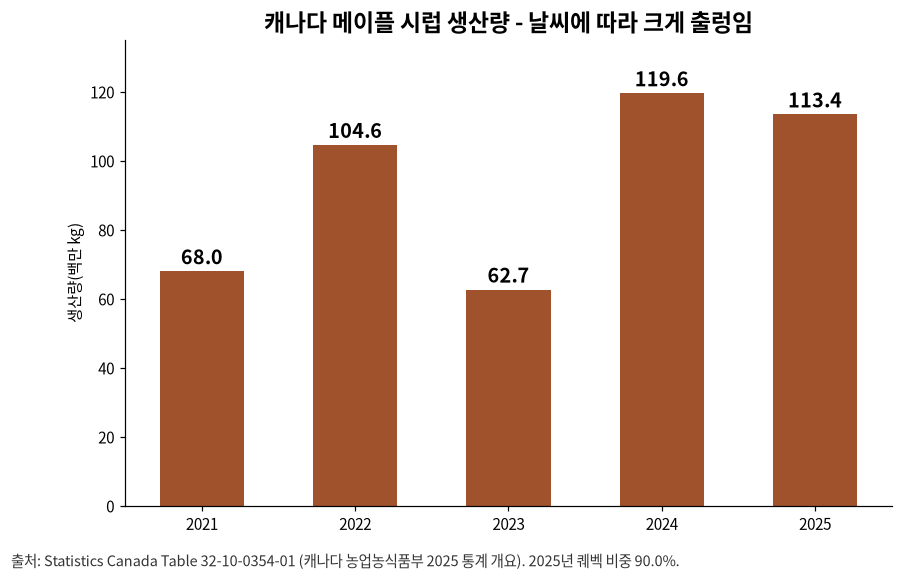
    Bar chart of Canadian maple syrup production 2021-2025 - how to make money with maple syrup

    Maple syrup, the kind poured on pancakes, is made by boiling down the sap of maple trees (mainly sugar maple) for a long time. In Canada and the northeastern United States, many farms drill small holes in trees every spring, collect the sap, and sell it as syrup. It is somewhat like collecting gorosoe (painted maple) sap in Korea in spring. This guide explains how to make money with maple syrup overseas, based on data from Statistics Canada (StatCan), the Quebec Maple Syrup Producers (PPAQ), USDA NASS, Cornell University and the University of Vermont.

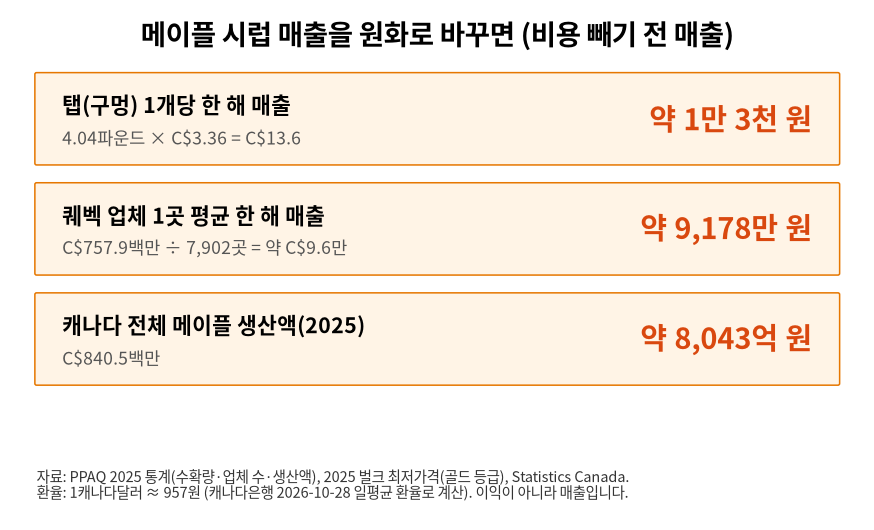
    In one line: making money with maple syrup comes down to “number of taps × yield per tap × price.” Canada produced about 113.43 million kg in 2025, worth C$840.5 million (about KRW 804.3 billion). Quebec harvested about 4.04 lb per tap; at the 2025 minimum bulk price, that is about KRW 13,000 of sales per tap. Weather changes the harvest a lot.

    Note: KRW amounts in this guide are calculated with the Bank of Canada daily average exchange rates for 28 October 2026 (C$1 ≈ KRW 957, US$1 ≈ KRW 1,343). If exchange rates change, so do the KRW amounts.

    1. What is maple syrup production?

    • In late winter to early spring you drill small holes (taps) in maple trees, collect the sap that flows out, and boil it into syrup.
    • Sap is only about 2% sugar, so about 43 gallons of sap make 1 gallon of syrup (Cornell Cooperative Extension). Syrup is finished at 66% sugar.
    • Sap flows best when nights are below freezing and days are above freezing. So the season is short, usually late February to April, about 6–8 weeks (UVM Proctor Maple Research Center).
    • Canada makes over 75% of the world’s maple syrup, and the US about 25% (Agriculture and Agri-Food Canada). Within Canada, Quebec makes 90.0% (StatCan, 2025).
    • Canada has 6,364 maple farms (2021 Census of Agriculture), and Quebec has more than 13,500 producers in 7,902 enterprises (PPAQ 2025).

    2. How much does it cost to start?

    Start-up costs for an overseas maple farm vary too much with forest size, equipment and region for an official average. Here are the essential items.

    Item Details Notes
    Maple forest (sugarbush) Owned or leased sugar maple woods Land prices and lease terms differ by region
    Taps (spiles) and drill Small spouts in the tree; 7/16 or 5/16 inch bit Hole depth about 1.5–2.5 inches
    Sap collection Buckets or a tubing network Larger operations use tubing + vacuum pump
    Concentrating Reverse osmosis (RO) unit Can cut boiling time and fuel by over 90% (UVM)
    Evaporator Large pans and firebox to boil sap Needs wood, oil or other fuel
    Finishing tools Filter, thermometer, hydrometer, bottles Filter hot; bottle at 180°F (82°C) or above
    Sales rules Food sales rules differ by country and state Quebec has a production quota system

    3. Equipment and how to work

    Guidance from Cornell and UVM, in simple words:

    • Which trees to tap: only healthy trees at least 10 inches (about 25 cm) in diameter at breast height (about 4.5 ft). 10–17 inches: 1 tap; 18–24 inches: 2 taps; 25 inches or more: 3 taps (Cornell).
    • Hole size: drill with a 7/16 or 5/16 inch bit about 1.5–2.5 inches deep. With vacuum tubing, UVM advises shallower holes (about 1.5 inches or less).
    • Vacuum tubing: high vacuum can roughly double yield compared with gravity flow (UVM).
    • Reverse osmosis (RO): removes water from sap first, greatly cutting boiling time and fuel.
    • Boiling and finishing: syrup is done at about 7.1°F (about 4°C) above the boiling point of water. Filter while hot and bottle at about 180°F (82°C) or higher.
    • Weather risk: in 2012 and 2021, early spring warmth cut crops by more than 20% (UVM).

    Comparison with Korea: gorosoe sap

    • In Korea, collecting sap from gorosoe and similar trees requires a permit from the city mayor or county head and training every year, and collectors must wear a sap-collector ID (Korea Forest Service).
    • Holes must be within 2 m of the ground, no wider than 0.8 cm and no deeper than 1.5 cm into the wood. Trees under 10 cm in breast-height diameter may not be tapped; 10–19 cm: 1 hole, 20–29 cm: 2 holes, 30 cm or more: 3 holes. Hoses must be double-walled drinking-water pipe and not used for more than 5 years (Korea Forest Service Sap Collection and Management Guideline).
    • Maple and gorosoe share the same principle: “tap only thick trees, with a fixed number of holes.” Gorosoe is mostly sold as raw sap rather than syrup, and the Korea Forest Service describes it as an off-season income source for mountain villages. Check the latest rules with the Korea Forest Service and local governments.

    4. How much can you earn?

    KRW conversion of maple syrup sales per tap and per enterprise - how to make money with maple syrup

    Real profit differs from person to person with forest size, equipment debt, labor and fuel costs. Below are sales figures (before costs) calculated from official statistics.

    • All of Canada: 2025 value C$840.5 million (about KRW 804.3 billion). Volume fell 5.1% from the 2024 record but was the second-highest ever (StatCan, AAFC).
    • Quebec minimum bulk price: the 2025 minimum set by PPAQ and buyers is C$3.36 per lb for Golden (Doré) grade (C$3.40 in 2026), about KRW 7,100 per kg. Organic syrup earns an extra C$0.18 per lb.
    • Per tap: Quebec’s 2025 average of 4.04 lb × C$3.36 ≈ C$13.6, about KRW 13,000.
    • Average Quebec enterprise: C$757.9 million ÷ 7,902 enterprises ≈ C$96,000, about KRW 91.78 million. Enterprise sizes vary widely, so this is only an average.
    • United States: US maple syrup production was worth about US$206.26 million in 2024 (about KRW 277 billion). Vermont produced 3.06 million gallons in 2025, 53.1% of US output, and Vermont’s 2024 average retail price was US$58.30 per gallon (about 3.8 L), about KRW 78,000.
    • Exports: in 2025 Canada exported C$844.2 million (about KRW 807.9 billion) of maple products to 69 countries, 64.2% to the US. Korea imported about 800 tonnes of Canadian maple products worth C$9.717 million (about KRW 9.3 billion) in 2025.

    5. How do you find customers?

    • Bulk sales (Quebec): in Quebec, the producers’ organization (PPAQ) manages production quotas, barrel sales and a strategic reserve. A set minimum price keeps prices relatively stable.
    • Direct sales: bottled syrup sold at farm stores, farmers’ markets and online. You can charge more than bulk, but bottles, packaging and selling take time.
    • Value-added products: maple cream, sugar and candy can earn higher prices.
    • Agritourism: some farms sell farm tours and meals during the spring season.
    • For Korea: Korea imports Canadian maple products every year. Importing and selling food requires registration and reports, so check with the Ministry of Food and Drug Safety first. Gorosoe sap is sold by permitted collectors at local festivals, directly and online.

    6. Start steps 1-2-3

    1. Learn: use free materials and courses from university extension services such as Cornell and UVM to learn tapping, boiling and hygiene. In Korea, ask your city or county office about gorosoe collection permits and training.
    2. Try it small: overseas, run one season at a small scale with a few dozen buckets and record your yield per tap. For gorosoe, collect only within your permit.
    3. Choose buyers and grow: once yields are stable, add vacuum tubing and RO, and decide between bulk and direct sales. To sell bulk in Quebec, check quota rules with PPAQ.

    8. Watch out for these real cases

    • Quebec maple syrup heist (2012): about 9,600 barrels of maple syrup worth C$18.7 million (about KRW 17.9 billion) were stolen from the Quebec producers’ strategic reserve warehouse, and people were charged (CBC). The lesson: large inventories need careful storage and records.
    • Fake gorosoe sap (2014): a group mixed cheap sap with groundwater and saccharin and sold it as “Gwangyang Baegunsan gorosoe sap.” About 15,000 cans of 18 L, worth KRW 510 million, went to some 30 inns and restaurants, and the group was booked for violating the Food Sanitation Act (Maeil Business News). Buyers should check for permitted collectors and origin; sellers should sell only honest, unmixed products.
    • Beware of maple farm investment pitches: for offers of shares in overseas farms or “guaranteed high returns,” check the actual land, permits and production records first. If in doubt, contact Korea’s Financial Supervisory Service (1332).

    Sources

    7. FAQ

    Can I make maple syrup in Korea?

    Forests rich in sugar maple and similar syrup trees are mainly in Canada and the northeastern US. The similar work in Korea is gorosoe sap collection, which needs a permit and training every year.

    Why does production swing so much from year to year?

    Sap flows well only with "freezing nights and thawing days." An early warm spring cuts the harvest sharply. Canadian output nearly doubled from about 62.67 million kg in 2023 to about 119.56 million kg in 2024.

    Can I earn more by drilling more holes?

    No. The number of taps is set by tree size, and too many holes damage the tree. The same principle applies to maple and gorosoe.

    How much sap do I need to boil?

    About 43 gallons of sap make 1 gallon of syrup. That is why fuel costs are high and large farms remove water first with RO.

    Can I advertise maple syrup or gorosoe sap as healthy?

    This guide does not cover health effects. Exaggerating that a food cures illness or is good for the body can break advertising rules, so honestly describe taste, production method and origin only.

    Last updated: October 30, 2026. Based on official sources; rules and prices can change.
  • How to Make Money with a Christmas Tree Farm (US Case)

    How to Make Money with a Christmas Tree Farm (US Case)

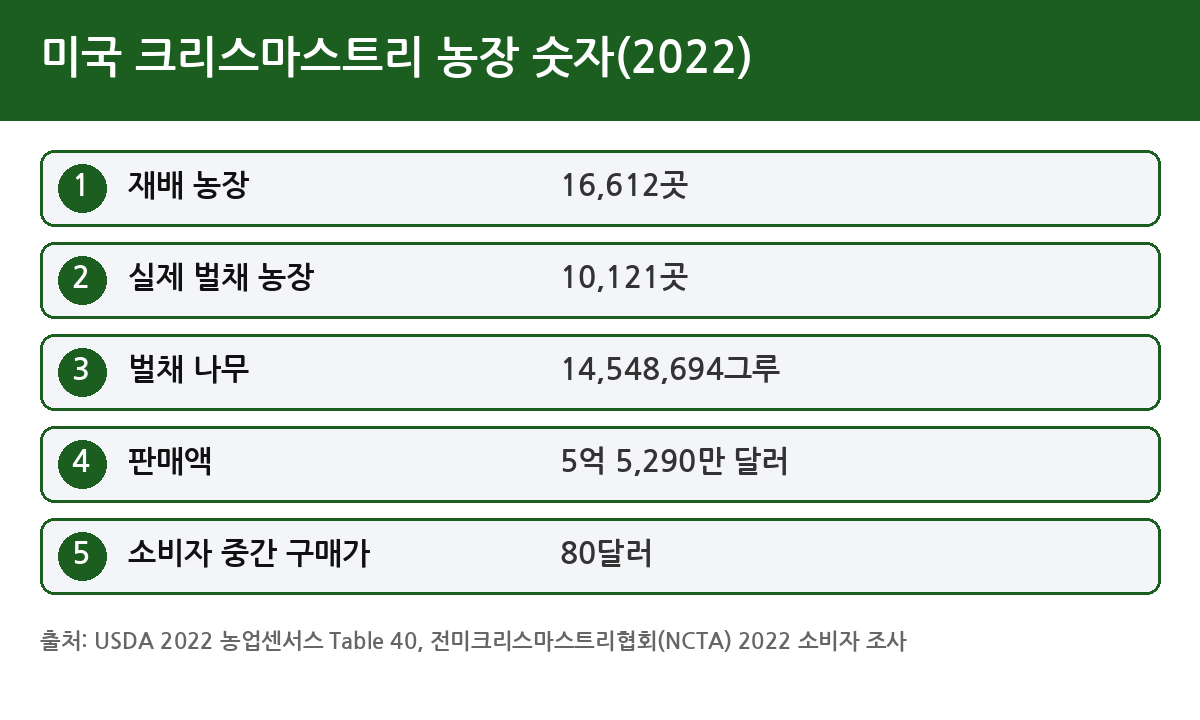
    US Christmas tree farm numbers 2022: 16,612 farms, $552.9 million in sales - how to make money with a Christmas tree farm

    Every winter in the US, families visit “Choose & Cut” farms to pick and cut their own Christmas tree. This guide uses the USDA Census of Agriculture, the National Christmas Tree Association (NCTA) and NC State Extension to explain how to make money with a Christmas tree farm. The key is surviving the years while trees grow, then selling an experience along with the tree in a few weeks each year. This is a US case. We found no official statistics on Christmas tree farm income in Korea (varies).

    In one line: in 2022 the US had 16,612 Christmas tree farms that cut 14.5 million trees and sold $552.9 million worth (USDA). A 6–7 ft tree takes about 7 years to grow, and 30.8% of buyers cut their own at a farm (NCTA).

    1. What is a Christmas tree farm?

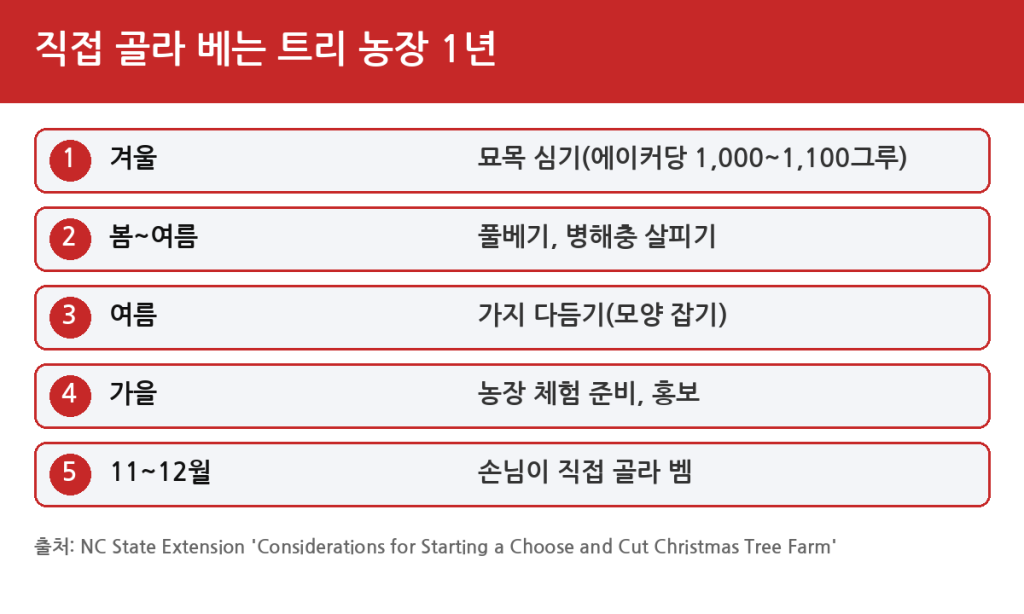
    • You plant conifers such as firs and pines, shape them for years, and sell them as Christmas trees in November–December.
    • NCTA says 25–30 million real trees are sold in the US each year, with about 350 million growing on farms.
    • A 6–7 ft tree takes 4–15 years, 7 on average. Growers plant 1–3 seedlings for each tree harvested.
    • Top states: Oregon, North Carolina, Michigan, Pennsylvania, Wisconsin, Washington.

    2. The US market in numbers

    Item Figure Source
    Farms growing Christmas trees 16,612 on 292,050 acres USDA 2022 Census
    Farms that cut trees 10,121 USDA 2022
    Trees cut 14,548,694 USDA 2022
    Sales $552.9M (2017: $377.0M) USDA 2022
    Median consumer price $80 (2022) NCTA survey
    Bought at a choose-and-cut farm 30.80% NCTA 2022

    Buyers got trees from choose-and-cut farms 30.80%, chain stores 19.38%, nurseries 16.61%, retail lots 15.92%, non-profits 7.61% and online 7.27% (NCTA 2022).

    3. Start-up cost and land

    • NC State Extension says eastern choose-and-cut farms are mostly part-time operations of about 2–6 acres.
    • Plant 1,000–1,100 trees per acre at 5×5 or 6×6 ft spacing with 8 ft between rows.
    • Costs depend on land, seedlings, mowing gear, pest control and parking/visitor facilities (varies). We found no official average start-up cost.
    • Extension advises planting only about 20% of the land at first and being conservative, because customers won’t find you in year one.

    4. Equipment and work

    A year on a choose-and-cut tree farm: planting, mowing, shearing, November–December sales - how to make money with a Christmas tree farm
    • Mowing equipment between rows.
    • Shearing tools to shape trees, which is labor-intensive.
    • Pest control following local extension guidance.
    • Sales-season gear: saws for customers, netting machine, carts, parking, checkout.
    • Some eastern species reach market size in 3–5 years, according to Extension.

    5. How much can you earn?

    Simple calculations from USDA data. These are sales, not profit. KRW uses a simple assumption of $1 = KRW 1,400.

    • 2022 sales divided by trees cut is about $38 per tree (about KRW 53,000), lower than the $80 median retail price (about KRW 112,000) because wholesale trees are included.
    • 5,352 farms of 1–2 acres sold $5.448M, about $1,018 per farm (about KRW 1.42 million).
    • 3,402 farms of 5–9 acres sold $22.32M, about $6,561 per farm (about KRW 9.18 million).
    • Net income after costs varies widely. Small farms are often run alongside another job.

    6. Finding customers and selling

    1. Choose & cut: market it as a family outing; 30.8% of buyers buy this way.
    2. Agritourism: hayrides, cider, Santa photos, pumpkins and school tours, as Extension notes.
    3. Resell pre-cut trees: many farms buy in Fraser fir while their own trees grow.
    4. Wreaths and greenery from trimmed branches.
    5. Directory listings with state associations and NCTA’s farm locator.

    7. Step-by-step start (in the US)

    1. Ask your local extension office about species, soil and pests.
    2. Plant small: about 20% of your land, expanding yearly.
    3. Build income while trees grow: pre-cut trees, pumpkin and farm events to build a customer list.
    4. Prepare for the season: parking, saws, netting, payment.
    5. Record and replant so you have trees to sell every year.

    For a similar farm in Korea, forestry and farmland laws and seedling import quarantine differ, so check with local agricultural technology centers and forestry agencies first.

    9. Watch out for these scams

    The Better Business Bureau (BBB) warns each holiday season about fake shops that advertise very cheap real or artificial trees and decorations on social media ads or shopping apps, then send nothing or a fake tracking number. It advises checking the seller’s address and reviews and paying by credit card rather than payment apps, gift cards or wire transfers. If you’re starting a farm, be wary of investment pitches that sell overpriced seedlings or land with promises of big money in a few years.

    Sources

    8. FAQ

    When can I sell after planting?

    A 6–7 ft tree averages 7 years (4–15) per NCTA; some eastern species take 3–5 years per NC State Extension.

    How much land do I need?

    Eastern choose-and-cut farms are often 2–6 acres; 5,352 farms in 2022 had just 1–2 acres (USDA).

    How many days a year is the work?

    Sales are concentrated in Nov–Dec, but mowing, pest control and shearing run all year.

    Will customers come in year one?

    Extension advises being conservative because customers won't know you yet.

    Are there Korean statistics?

    We found no official Korean statistics on Christmas tree farm income (varies).

    Last updated: October 30, 2026. Based on official sources; rules and prices can change.
  • Overseas Case: How to Make Money with a U-Pick Farm in the USA

    Overseas Case: How to Make Money with a U-Pick Farm in the USA

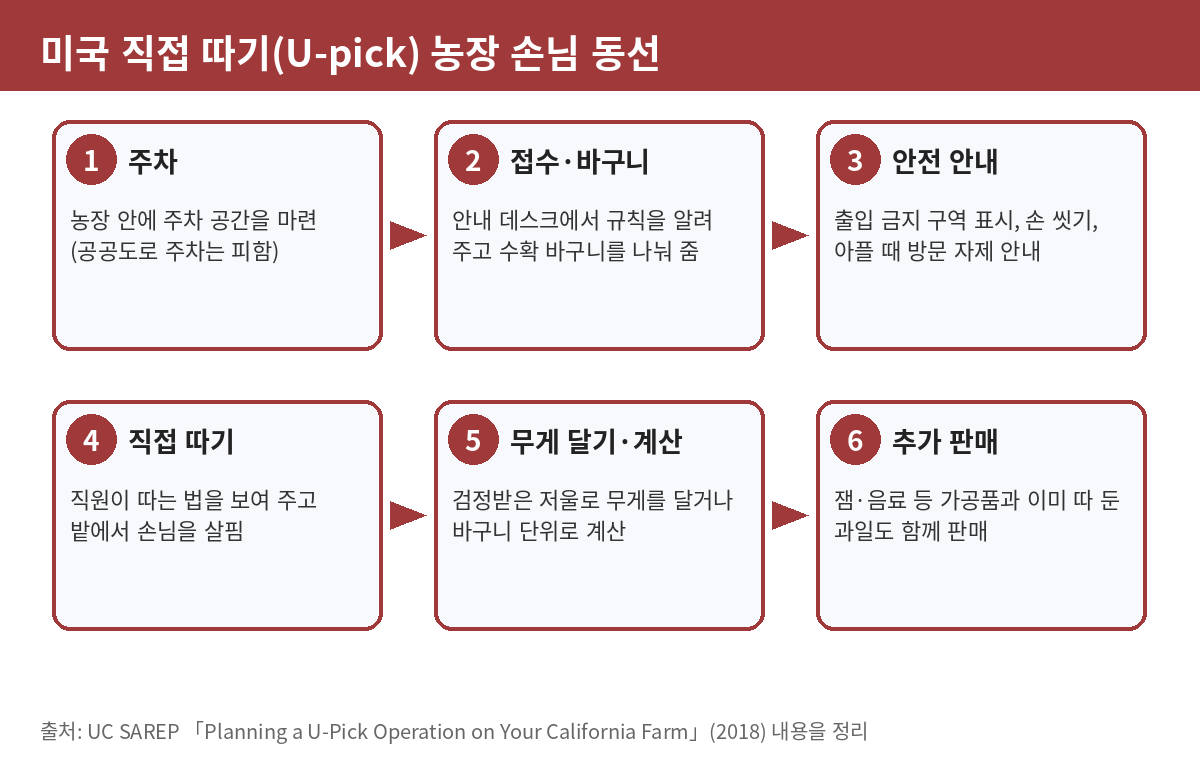
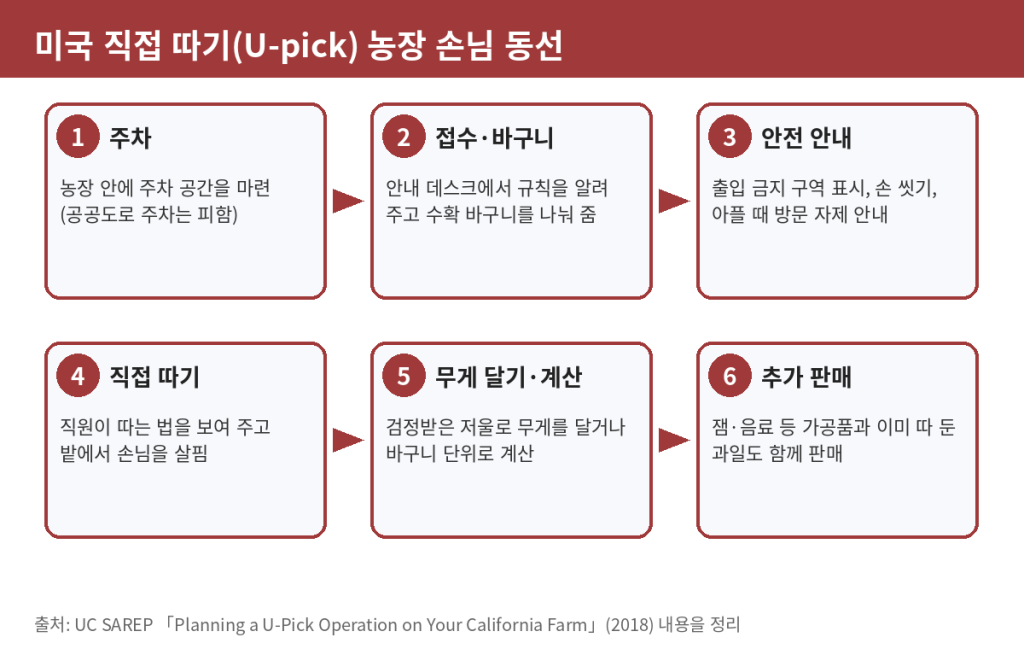
    U-pick farm visitor flow: parking, check-in and baskets, safety briefing, picking, weighing and payment, extra sales - How to make money with a U-pick farm

    In the US, many “U-pick” (pick-your-own) farms let customers come to the farm, pick crops such as strawberries, blueberries, apples and pumpkins themselves, and pay for what they pick. Based on US Department of Agriculture (USDA) statistics and university Extension guides, this article explains in plain words how to make money with a U-pick farm, and it introduces the Korean laws a Korean farm should check when adapting the idea as a farm experience. The key point is that you save harvest labor, but you must prepare for hosting visitors, safety and parking.

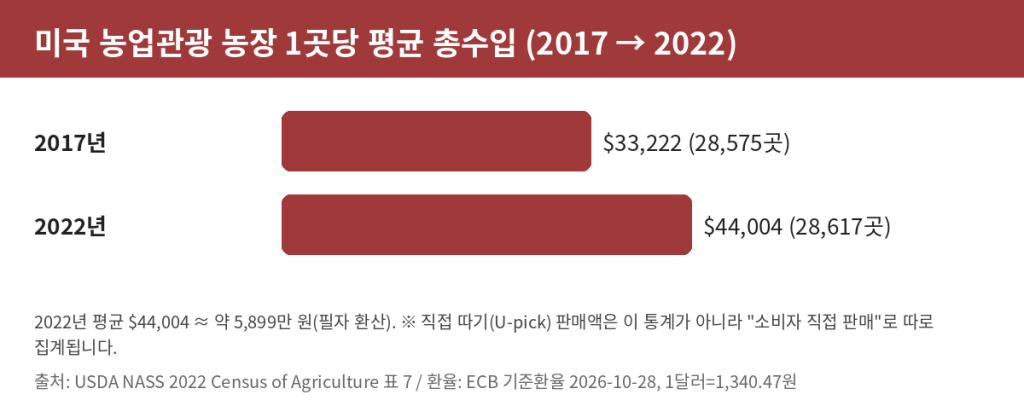
    In one line: In the 2022 US Census of Agriculture, 28,617 farms had income from agritourism and recreational services, averaging $44,004 per farm. However, U-pick sales are not in this number; they are counted separately as “direct sales to consumers”.

    1. What it is

    • The farm opens its fields, customers get baskets, pick crops themselves, and pay by weight or basket size.
    • According to a University of California guide (UC SAREP), the advantages are less harvest labor, no packing or shipping, and immediate cash. The challenges are accident and food-safety risk, labor for serving customers, crop damage, and visitor numbers that swing with the weather.
    • In US statistics, U-pick sales count as “direct sales to consumers”, while admission fees, corn mazes and hayrides count as “agritourism” (Penn State NERCRD).

    2. Start-up costs

    We found no official average start-up cost for U-pick in either the US or Korea. It varies by crop and scale.

    Item Description Note
    Parking Space for visitors’ cars A must-have in the UC SAREP guide; cost varies
    Restrooms and handwashing Visitor restrooms and handwashing stations varies
    Scale A certified scale that can be used for trade The US requires a legal-for-trade scale; in Korea, check the measurement rules
    Insurance Liability insurance for visitor accidents NC State: consider property, workers’ comp and general liability insurance
    Signs and baskets Picking areas, cautions, price list varies
    Promotion Social media, map apps, experience booking sites Free to varies

    3. Equipment and preparation

    • Choosing crops: Crops that are easy and low to pick (strawberries, blueberries) or good for seasonal events (pumpkins, apples) are common.
    • Pricing: The UC SAREP guide suggests pricing by volume (basket) or weight, and setting prices with some room for the fruit customers eat in the field.
    • Safety briefing: Mark picking areas and set rules for children, keep people out of areas with pesticide use, and warn about slippery paths.
    • Records: Record visitor numbers, sales and average sale per customer to plan for next year (UC SAREP).
    • Legal liability: The NC State guide advises insurance as well as posting the agritourism warning signs required by state law. Some states charge an amusement tax on admission fees.

    4. How much can you earn?

    Exchange rate: 1 USD = KRW 1,340.47, calculated by the author from the European Central Bank (ECB) reference rates for October 28, 2026.

    Source Figure KRW (author’s conversion)
    USDA 2022 Census of Agriculture: average per farm with agritourism and recreational services income $44,004 (28,617 farms) about KRW 58.99 million
    Same source, 2017 average $33,222 (28,575 farms) about KRW 44.53 million
    NERCRD: average agritourism income of farms under 10 acres (2022) $27,010 about KRW 36.21 million
    NERCRD: average for farms of 10-49.9 acres (2022) $33,903 about KRW 45.45 million
    NC State case study: projected profit of a corn maze (year 1 → year 5) $15,918 → $38,735 about KRW 21.34 million → 51.92 million
    • These numbers are average revenue for agritourism as a whole, or one case’s projection. They are not U-pick-only income and not net profit. The NC State case also assumes about 450 hours of the owner’s work.
    • Income from running a farm experience in Korea varies by region, crop and visitor numbers (varies by region and conditions).

    5. Finding customers and selling

    1. Social media and map apps: Post opening days, what’s ready to pick today, and weather closures every day. The UC SAREP guide also recommends social media and listing on U-pick farm directory sites.
    2. Families and children: Welcome weekend family outings and daycare or school field-trip groups.
    3. Extra sales: Besides picked fruit, sell jam, juice, pre-picked fruit boxes and snacks to raise the average sale (in Korea, check food business rules for food sales).
    4. Seasonal events: Turn the season into an event, like strawberry season or an autumn pumpkin festival.
    5. Regular customer list: With consent, collect contacts and let customers know about the next harvest.

    How a Korean farm could apply this

    • In Korea this is usually run as a “harvest experience” or “experience farm”.
    • Article 2(16) of the Rural Community Improvement Act (농어촌정비법) defines a tourist farm business (관광농원사업), with facilities for rural resources, producing, processing and selling farm products, and farm experiences, and a weekend farm business (주말농원사업) that lets city people experience farm work. Under Article 85 of the same act, a tourist farm can be run only by eligible people such as farmers, who must submit an operation plan and file a report with the city/county/district head.
    • An Rural Experience and Recreation Village operator (농어촌체험·휴양마을사업자) under Article 5 of the Act on Promoting Urban-Rural Exchange (도농교류법) is applied for by a village council and needs things like consent from at least one-third of households, so a single private farm may not qualify.
    • The reports you need may differ between running only a harvest experience in your own field and also running food, lodging or facilities. Always ask your city/county agricultural technology center or the responsible office before you start.

    6. Start steps 1-2-3

    1. Pick a crop and dates: Test with one easy-to-pick crop on a few weekends in harvest season.
    2. Check laws and insurance: Ask the city or county office which report (tourist farm, etc.) a harvest experience needs, and look into liability insurance for visitor accidents.
    3. Design the visitor flow: Set the order parking → check-in and baskets → safety briefing → picking → weighing and payment, put up a price list and signs, and announce your first opening on social media.
    US agritourism farms average total income per farm: $33,222 in 2017 and $44,004 in 2022 - How to make money with a U-pick farm

    Watch out for these problems

    In March 2026, the Michigan Attorney General’s office warned about fake Facebook event pages made to look like real events that asked vendors to send booth fees first through payment apps such as Zelle. It advised checking directly on the official website, paying with protected methods such as a credit card, and reporting to the FTC or IC3. In October 2025, the Massachusetts Office of Consumer Affairs also warned about social media ads that copied real fall events to sell fake tickets or attractions that don’t exist. If you run a farm, clearly announce your official accounts and booking method in one place, and warn customers right away if you see a fake page. Customers should also check dates and prices on the farm’s official account before booking.

    Sources

    7. FAQ

    How many U-pick farms are there in the US?

    We did not find a count of U-pick farms alone. According to Penn State, in 2022 there were 139,891 farms with income from direct sales to consumers or agritourism, and 116,617 of them had direct-sales income. U-pick is part of direct sales.

    What about fruit customers eat in the field?

    The UC SAREP guide suggests leaving room in your prices for what's eaten in the field. Some farms charge admission or set a minimum purchase.

    Who is responsible if a visitor gets hurt?

    The farm owner can be liable. The NC State guide advises considering liability insurance and posting the warning signs required by state law. In Korea, too, prepare insurance and safety briefings.

    In Korea, can I just open my field?

    Depending on whether you run only a harvest experience or also food, lodging or facilities, you may need procedures such as a tourist farm report (Rural Community Improvement Act Art. 85). Ask your city/county agricultural technology center or the responsible office first.

    Are the KRW amounts exact?

    They are the author's conversions at the ECB reference rate for October 28, 2026 (1 USD = KRW 1,340.47). If the exchange rate changes, the KRW amounts change too.

    Last updated: October 30, 2026. Based on official sources; rules and prices can change.
How to Make Money
Add to Home Screen