Path
At a glance
Contents
In Korea, strawberries are grown in plastic greenhouses (protected cultivation) over winter and sold from November to the following May. In a Rural Development Administration (RDA) survey, hydroponic strawberries earned about 15 million won of income per 10a (1,000㎡, about 300 pyeong), placing them near the top of greenhouse crops (2024 crop). But building greenhouses costs a lot, and disease while raising seedlings in summer (especially anthracnose) can ruin a whole season. This guide explains how to make money with strawberry farming in plain language, based on the RDA, the Korea Rural Economic Institute (including Statistics Korea data), the Ministry of Agriculture, Food and Rural Affairs (MAFRA) and the government’s Easy-to-Find Law Information service.
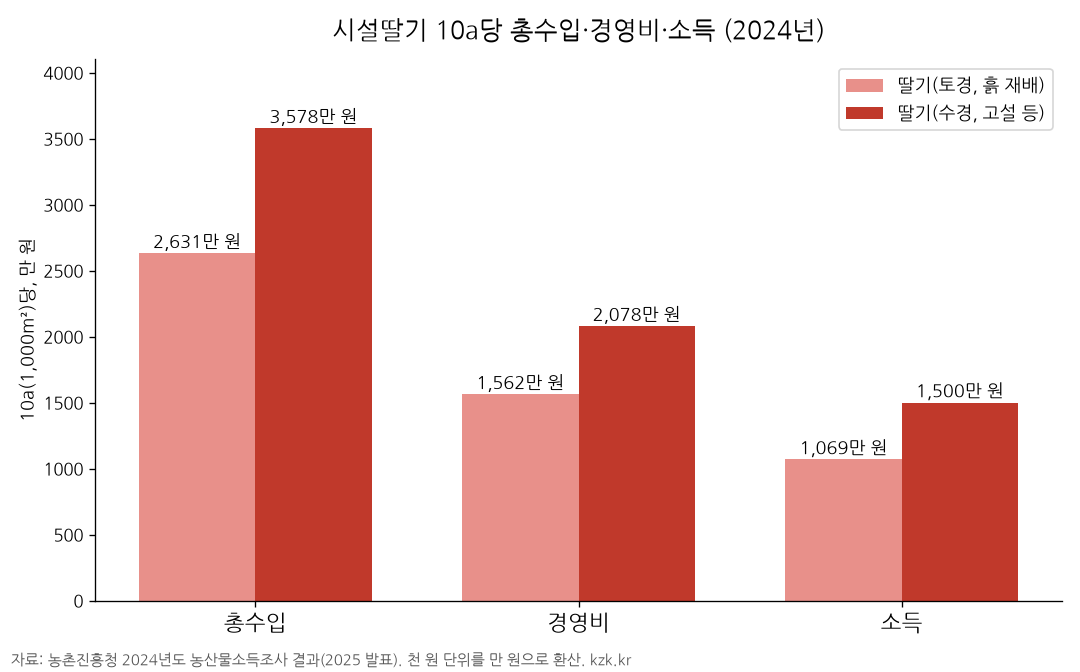
One-line summary: The way to make money with strawberry farming is to “raise strong seedlings in summer and get your first berries out in November–December, when prices are highest.” In 2024, average income per 10a was about 10.69 million won for soil-grown (togyeong) and about 15 million won for hydroponic (raised-bed etc.) strawberries, but operating costs were also 15.62–20.78 million won. People returning to farming can apply for start-up funds (up to 300 million won per household, as a loan), and running a pick-your-own experience farm widens your sales channels.
1. What is greenhouse strawberry farming?
- Most strawberries eaten in Korea in winter are forcing-culture (chokseong) strawberries. Seedlings are planted in the greenhouse in early-to-mid September, the greenhouse is closed up for warmth in mid-to-late October before it gets cold, and the first harvest comes in November–December (RDA).
- There are two main growing methods.
- Soil culture (togyeong): plants go into raised rows in the greenhouse soil. Facility costs are lower, but you work bent over.
- Raised-bed culture (goseol, hydroponic): plants grow in substrate on waist-high benches (about 1 m) and are fed nutrient solution (fertilizer dissolved in water). The work is easier and yields are higher, but facilities cost more.
- National cultivation area was 5,612 ha in 2023/24 and 5,691 ha in 2024/25 (survey figure). Production is about 150,000–157,000 tonnes (KREI Agricultural Outlook Center, based on Statistics Korea data).
- 54% of the area is in the Yeongnam region (2024), and Seolhyang makes up about 81% of varieties. Varieties such as Geumsil and Kingsberry are growing (Agricultural Outlook Center).
- The institute projects strawberry area will grow slowly to 6,382 ha by 2034. This is only a forecast.
2. How much does it cost to start?
There is no official average start-up cost. It varies a lot depending on whether you buy or rent land and whether a greenhouse already exists. Below are figures from official sources.
| Item | Amount (official source) | Notes |
|---|---|---|
| Single-span greenhouse construction | about 310,000 won per 3.3㎡ (pyeong) | For 10a (about 303 pyeong) that is about 94 million won (RDA, Sept 2025) |
| Multi-span greenhouse construction | about 460,000 won per 3.3㎡ (pyeong) | For 10a about 139 million won; about 48% more than single-span |
| Raised beds, nutrient dosing unit, heater | Varies | Depends on supplier quotes and local-government support programs |
| Annual operating cost (soil) | 15.62 million won per 10a | Seedlings, fertilizer, pesticides, heating, electricity, packaging, hired labor, etc. (2024 crop) |
| Annual operating cost (hydroponic) | 20.78 million won per 10a | Same basis (2024 crop) |
| Farmland | Varies | Purchase and rent prices differ by region; also check the Farmland Bank for leases |
- The RDA explained that strawberry output is about 10 kg per pyeong in single-span and 11 kg in multi-span greenhouses, not a big difference, so several single-span houses can be more profitable for young and new farmers starting out. More than 67% of strawberry farms are small or mid-sized, under 0.5 ha.
- It is also labor-heavy. One survey puts hydroponic greenhouse strawberries at about 699 hours of labor per 10a per crop (2023 Agricultural and Livestock Income Data Book, cited by the Agricultural Outlook Center).
When you are short of money: support for returning and young farmers
- Return-to-farming start-up fund: a loan of up to 300 million won per household, fixed rate 2.0% a year (or variable), repaid over 10 years after a 5-year grace period. The return-to-farming housing fund is up to 75 million won per household. You must complete at least 8 hours of farming education to apply, and under 100 hours gets the lowest grade in the evaluation (2026 implementation guidelines; Easy-to-Find Law Information and Greendaero).
- Young farmer settlement support: young people aged 18 to under 40 with 3 years or less of independent farming receive up to 1.1 million won a month for up to 3 years, linked with successor-farmer loans, priority farmland leasing and more (MAFRA, 2026 recruitment).
- Loans are debt. The actual amount can be lower after credit and collateral review.
3. What you need and the growing cycle (seedlings are half the job)
Summer care matters so much that strawberry farming is often called half seedling (nursery) farming. In plain words, RDA guidance says:
- Plant mother plants by late March: choose healthy, disease-free mother plants.
- Root daughter plants in May–June: daughter plants at the tips of runners from the mother plants are rooted into pots.
- Summer care in July–August: install shade cloth of about 55% and ventilate to lower greenhouse temperatures. Water neither too much nor too little.
- Transplant in early-to-mid September: move plants into the main greenhouse after flower buds have formed.
- Close up for warmth in mid-to-late October, first harvest in November–December: keep picking until spring. Pollination is done with bees and similar.
Choosing a variety
- Seolhyang: high-yielding and fairly disease-resistant, so it is the most widely planted (about 81% of area). Plenty of technical material and experienced farmers make it easy to learn.
- Geumsil: replacing the former export variety (Maehyang); its share of area grew from 1.2% in 2019/20 to 8.8% in 2024/25. It can also be sold domestically.
- Kingsberry and other new varieties: popular and attracting more growers, but they can be harder to grow, so ask your local agricultural technology center whether they suit your area (Agricultural Outlook Center).
Anthracnose basics
- When: hot and humid conditions of 25–30℃, especially the rainy season (late June to late August) and from mid-September to October after transplanting.
- Symptoms: runners or leaf stalks turn black as if water-soaked, the crown (where root meets stem) browns from the outside in, and eventually the whole plant wilts and dies.
- Prevention: raise seedlings under rain shelters, water only at the roots with drip irrigation so leaves stay dry, use healthy mother plants, remove sick plants and leaves at once, disinfect beds, pins and scissors, and avoid excess nitrogen and potassium.
- Chemicals: on days you remove leaves or cut runners, protect the wounds with a registered product. Always check on the Pesticide Safety Information System (psis.rda.go.kr) that a product is registered for strawberries and follow the label rules.
- In a year when heat followed a late rainy spell, 10–43% of plants died depending on the region (RDA).
The year at a glance (forcing culture)
| When | What to do | Watch out for |
|---|---|---|
| March | Plant mother plants | Choose disease-free stock |
| May–June | Root daughter plants (guide runners) | Disinfect pins and scissors |
| July–August | Summer nursery | Heat and rain → anthracnose, Fusarium wilt |
| Early–mid September | Transplant into main greenhouse | Planting too early risks heat damage |
| Mid–late October | Start keeping the greenhouse warm | Night temperature control |
| November–December | First harvest and shipping | Highest prices of the year |
| January–May | Keep harvesting, run experiences | Prices fall sharply after March |
Common beginner mistakes
- Buying seedlings only because they are cheap: a few sick plants can spread disease to the whole greenhouse. Ask where seedlings were raised and check root and crown color on arrival.
- Watering from above: wet leaves spread anthracnose. Use drip irrigation at the roots.
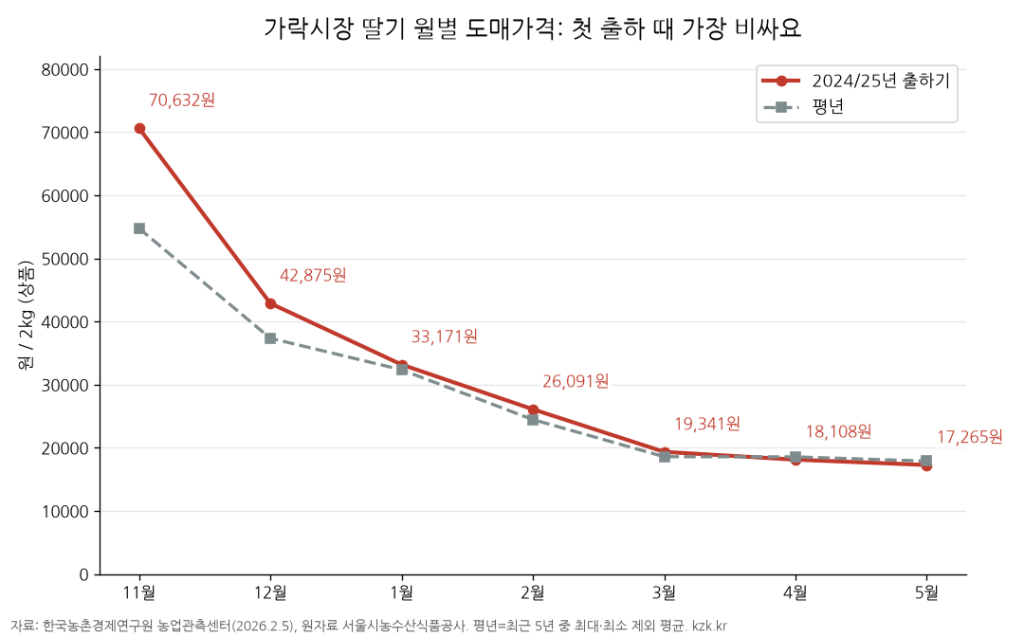
- Producing most when prices are low: for the same amount picked, November–December prices were about 4 times April–May prices (70,632 won vs 17,265 won in 2024/25). Timing the first harvest drives income.
- Harvesting without a buyer: strawberries don’t keep. Before harvest, decide whether you ship to a wholesale market, a growers’ group or direct buyers, and which boxes you will use.
- Using any pesticide: products not registered for strawberries can leave residues that stop you selling. Always check registration and safe-use rules (how many days before harvest it may be used).
4. How much can you earn?
These are RDA 2024 farm income survey figures (2024 crop, average per 10a). Income = gross revenue − operating cost; family labor is not deducted.
| Type | Yield | Price received | Gross revenue | Operating cost | Income |
|---|---|---|---|---|---|
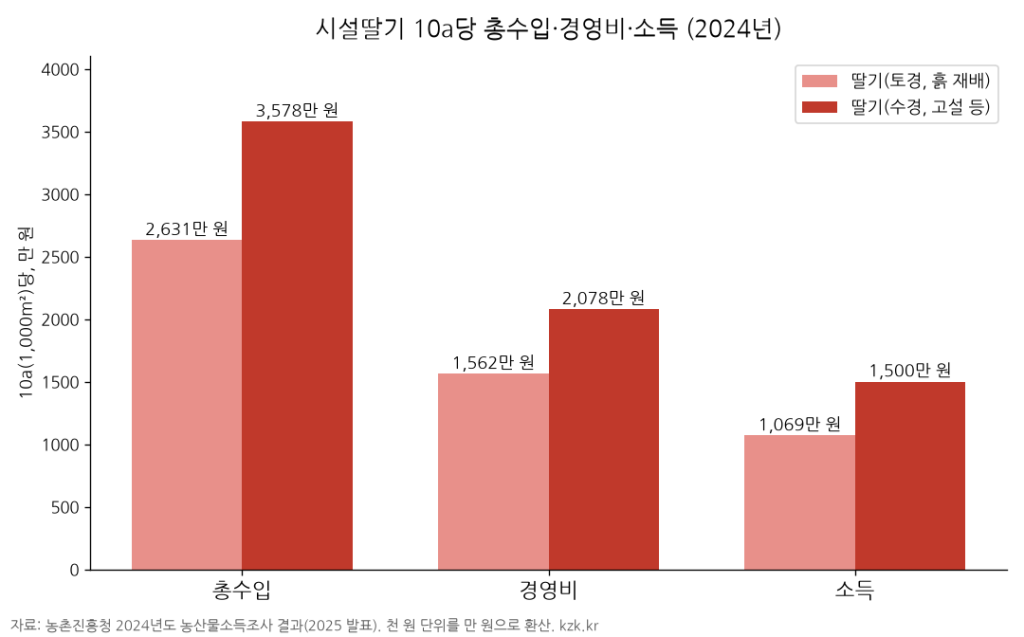
| Strawberry (soil) | 2,893 kg | 9,094 won/kg | 26.31 million won | 15.62 million won | 10.69 million won |
| Strawberry (hydroponic) | 3,292 kg | 10,868 won/kg | 35.78 million won | 20.78 million won | 15.00 million won |
- Worked example: if you farm 3,000㎡ (about 900 pyeong) of hydroponic greenhouse at the average, income is 15 million × 3 = about 45 million won. You still need to account for loan interest and greenhouse depreciation, so what you actually keep varies by person. This is not a promised income.
- Years differ a lot. Hydroponic strawberry income in the 2023 crop was 14.67 million won per 10a, and in 2023/24 heavy summer rain weakened seedlings so yield per 10a fell 6.2% from the year before (Korea Agriculture & Fisheries News, Agricultural Outlook Center).
When you sell changes how much you make
- The Garak Market wholesale price for 2 kg of top-grade strawberries in 2024/25 fell sharply: 70,632 won in November → 42,875 won in December → 19,341 won in March → 17,265 won in May (Agricultural Outlook Center, Seoul Agro-Fisheries & Food Corporation data).
- In 2025/26 it was 54,353 won in November, 40,129 won in December and 35,964 won in January 2026.
- So more farms are trying to harvest earlier, and the share shipped in November–December rose 4 percentage points over the last three years (2022–2024). On the other hand, transplanting too early risks rain and heat damage.
- Over the whole season, the 2023/24 Garak Market strawberry price averaged 9,539 won/kg, 7.5% above the previous year (8,874 won). Prices rise when production falls and drop when supply is plentiful (Agricultural Outlook Center).
- You can check daily prices free on aT’s KAMIS agricultural price service (kamis.or.kr) and Garak Market quotes.
5. Where and how do you sell?
- Wholesale markets: shipping to a wholesale market such as Garak lets you sell large volumes at once, but the price is set by that day’s auction. Transport and commission fees apply.
- Growers’ groups and cooperative (Nonghyup) shipping: sorting and shipping together with local farms makes logistics easier than going alone.
- Local food stores and online direct sales: you set the price, but you handle packaging, delivery and customer contact yourself.
- Supplying cafés and bakeries: strawberry products are popular, and demand from processors, bakeries and cafés helped frozen strawberry imports rise 31.3% in 2024 (Agricultural Outlook Center). That is also an opportunity to find buyers for fresh Korean berries.
- Export: fresh strawberry exports were 4,866 tonnes in 2025, going to Singapore, Thailand, Hong Kong and others. Export requires matching variety (e.g., Geumsil) and grading standards, so many farms work through export complexes or companies.
Selling through a strawberry experience (pick-your-own) farm
- Strawberry-picking experiences, where visitors pick, eat and take berries home, cut harvesting, packing and transport work while earning a higher price, and reports say they are growing fast near the Seoul metropolitan area (Korea Agriculture & Fisheries News, 2024).
- One raised-bed farm near Seoul was reported to charge 18,000 won per person (pick and eat, then take home 500 g) and to have had more than 20,000 visitors in a year, also offering strawberry waffle and cake making. This is one farm’s case, and results vary by farm.
- Raised beds put berries at waist height, which is convenient for children and families. Many farms run experiences mainly from January to June (RDA Green Magazine).
- The RDA certifies farms that run curriculum-linked hands-on learning as Rural Education Farms, which helps when hosting groups such as daycares and schools.
- Ask your city/county office and agricultural technology center first about visitor safety (slips, parking), insurance, and any registration needed to make and sell food such as jam or cake.
6. Getting started, step 1-2-3
- Learn and check: get counseling from the Return-to-Farm/Rural Center (Greendaero, greendaero.go.kr) and take farming education (100+ hours recommended if you are considering the start-up fund). Take strawberry courses at your local agricultural technology center and help out on an experienced farm to live through one full cycle (nursery → transplanting → harvest).
- Plan to start small: decide on farmland (including leasing) and greenhouse size, and choose soil or raised-bed. Using the income data above, calculate “15.62–20.78 million won operating cost per 10a + greenhouse cost + loan interest.” Check with your city/county when the return-to-farming start-up fund or young farmer settlement support takes applications (usually first and second half of the year).
- Be careful with seedlings and line up buyers early: in the first year, buy seedlings from a trustworthy source or raise them yourself under rain shelters. Follow an anthracnose prevention calendar, and before the first harvest decide whether you will sell through a wholesale market, growers’ group, direct sales or experiences.
8. Watch out for these reported damage cases
In 2026, Nongmin Shinmun reported farmers who trusted promises of “guaranteed income of 2.5 million won a month,” took out loans of 100–200+ million won backed by the Agricultural Credit Guarantee Fund to install container-type smart farms, and were left with only debt after facility defects and the company’s refusal to buy their harvest (mushroom-growing cases in South and North Chungcheong). Strawberry smart farms and raised-bed systems also cost a lot, so don’t sign a contract just because of claims like “guaranteed income,” “we buy everything you grow,” or “the government loan will cover it all.” Check the company’s construction record, after-sales service and contract terms carefully, and consult your city/county agricultural technology center or the Return-to-Farm/Rural Center before signing. Also, in 2024 young farmers at the Gimje Smart Farm Innovation Valley sought compensation for roof leaks in leased smart farms, and MAFRA pledged to find the cause and arrange compensation. Always inspect for defects when you take over a facility.
Sources
- RDA, 2024 Farm Product Income Survey results (press release)
- 2024 Farm Product Income Survey results table (Attachment 1, file posted by Hortinews)
- Nongsaro, 2024 Farm Product Income Data Book
- KREI Agricultural Outlook 2025, fruit-vegetable supply and outlook (strawberry, incl. Statistics Korea data)
- KREI Agricultural Outlook Center, Strawberry and Oriental Melon Supply Trends and Outlook (Feb 5, 2026)
- RDA, single-span strawberry smart farm productivity model (Sept 11, 2025)
- RDA, summer strawberry seedling pest and disease management
- Easy-to-Find Law Information, return-to-farming support (start-up fund)
- Easy-to-Find Law Information, return-to-farming housing support
- Greendaero (Return-to-Farm/Rural Center), start-up and housing support
- MAFRA, 2026 Young Farmer Settlement Support recruitment
- KAMIS agricultural price information (Garak Market auction prices)
- Korea Agriculture & Fisheries News, strawberry top high-income crop in 2023
- Korea Agriculture & Fisheries News, metro-area strawberry experience farm case (Feb 20, 2024)
- RDA Green Magazine, smart farm experience farms (Dec 2022)
- Nongmin Shinmun, container smart farm guaranteed-income loan damage (Jul 10, 2026)
- Korea.kr Policy Briefing, MAFRA statement on Gimje smart farm rain damage (Aug 22, 2024)
7. Frequently asked questions (FAQ)
I'm a beginner. Is raised-bed or soil culture better?
On 2024 averages, hydroponic (raised-bed etc.) income was about 15 million won per 10a, higher than soil (about 10.69 million won), but operating and facility costs are also higher. It varies with your money, health and experience-farm plans. Raised beds are easier if you have a weak back or want to run picking experiences.
When in the year is it busy?
Almost all year. Mother plants in March, nursery in May–August, transplanting in September, harvest from November to the next May. Know before you start that the off-season is short.
Where can I check strawberry prices?
Daily on aT's KAMIS and Garak Market quotes. The KREI Agricultural Outlook Center publishes monthly strawberry outlooks with shipping and price forecasts.
Does the government just give money if I move to farm?
No. The return-to-farming start-up fund (up to 300 million won) and housing fund (up to 75 million won) are **loans you must repay**. The young farmer settlement payment (up to 1.1 million won a month, up to 3 years) has age and income conditions and a selection review.
What do I do if anthracnose appears?
Pull sick plants right away and take them out of the greenhouse, disinfect tools, and treat with products registered for strawberries. The best approach is prevention (rain-shelter nursery, drip irrigation, healthy mother plants). Your local agricultural technology center can help diagnose it.
Last updated: October 30, 2026. Based on official sources; rules and prices can change.
🎁 Free: 7-day starter checklist for earning extra income
Leave your email and get the free checklist now. No spam, unsubscribe anytime.
Popular guides
- Top 10 Ways to Make Money Starting This Week (Free Checklist)
- How to Make Money as a Student: Legit Ideas (2026)
- Passive Income Ideas: Realistic Options for 2026
- Make Money Online Without Investment: 20 Free Ways
- How to Make Money with AI: 50 Practical Ways (2026)
- How to Make Money From Home: 20 Legit Ways
- Make Money Online for Beginners: 15 Easy Ways to Start
- How to Make Money as a Mom: 16 Flexible Ideas (Work Around Nap Time)
- 16 Legit Ways to Make Money Fast (This Week)
- How to Make Money as a Teenager: 16 Safe Ideas
- 14 Remote Jobs With No Experience Needed
Next method: How to Make Money with Oyster Farming (Korea) →