Path
Contents
In Korea, shops and brands often recruit people to try a product and write a review. This is called a 체험단 (review campaign / experience group). If you are picked, you get a meal, a product or a service for free, and you post a review on your blog or Instagram by a set date. This guide explains how to make money (mostly in savings) with review campaigns, step by step.
What is a review campaign?
- An advertiser (a shop or brand) posts a campaign on a review-campaign platform.
- Bloggers or Instagram users apply, and the advertiser or platform picks people.
- Picked reviewers try the product, post a review by the deadline, and register the post URL on the platform.
- Three common types:
- Visit: go to a restaurant, café, salon, etc.
- Delivery: receive a product by courier and try it at home
- Reporter (기자단): write from provided materials without a trial, for points
Platforms operating now (checked October 2026)
| Platform | Site | Notes (from official pages) |
|---|---|---|
| REVU (레뷰) | revu.net | Blog, Instagram, YouTube campaigns; points can be withdrawn via the app |
| Reviewnote (리뷰노트) | reviewnote.co.kr | Visit and at-home (delivery) campaigns; penalties if you don’t follow through |
| Dinner Queen (디너의여왕) | dinnerqueen.net | Mostly restaurants by area; reservation required, no-shows may be charged |
| Mrblog (미블) | mrblog.net | Blog and Instagram campaigns; sponsor-banner instructions |
| Gangnam Matzip (강남맛집) | operator page | Visit, delivery and reporter campaigns (run by 체험 주식회사) |
Who is it for?
- People who already run a Naver blog or Instagram
- People who like taking photos and writing honest reviews
- People who want to save on eating out and household items
- People who keep deadlines
Not for: people who often miss deadlines, brand-new blogs with almost no posts (hard to get picked), or people who dislike set keyword/photo rules.
Cost and time
- Sign-up: free (reviewer sign-up on the platforms above is free)
- Possible costs: travel, and anything you order beyond the provided amount (many campaigns say “extra cost paid by reviewer”)
- Time: 10–20 min a day applying, 1–2 hours per trial, 1–2 hours per review
- Time to first selection: varies. Popular campaigns are very competitive.
How much can you earn?
Most campaigns pay in goods, meals or services, not cash, so it is closer to “saving money” than “earning money”.
- Example: Dinner Queen campaign pages list rewards such as “₩25,000 meal voucher” and “₩30,000 meal voucher” (checked October 2026).
- Some campaigns pay a cash writing fee or points, but amounts vary by campaign. Platforms do not publish average earnings.
- A bigger audience and a longer track record can open more paid campaigns. Nothing is guaranteed.
Rough range (estimate): in the first 1–3 months, 1–3 selections a month worth about ₩20,000–₩100,000 in meals or items is common. With a longer track record, ₩100,000–₩300,000+ worth a month is possible, and cash writing fees are often in the tens of thousands of won per post (all estimates).
Rough estimates based on public campaign pages, not a guarantee. Results vary from person to person.
Want to compare many ways to make money side by side? See our.
Pros and cons
| Pros | Cons |
|---|---|
| Free to start | Mostly goods/meals, not cash |
| Save on meals and daily items | Missed deadlines mean penalties or charges |
| Gives you blog topics | Many rules (keywords, photo counts) |
| Track record can lead to paid campaigns | You must follow ad-disclosure rules |
Step by step: start today
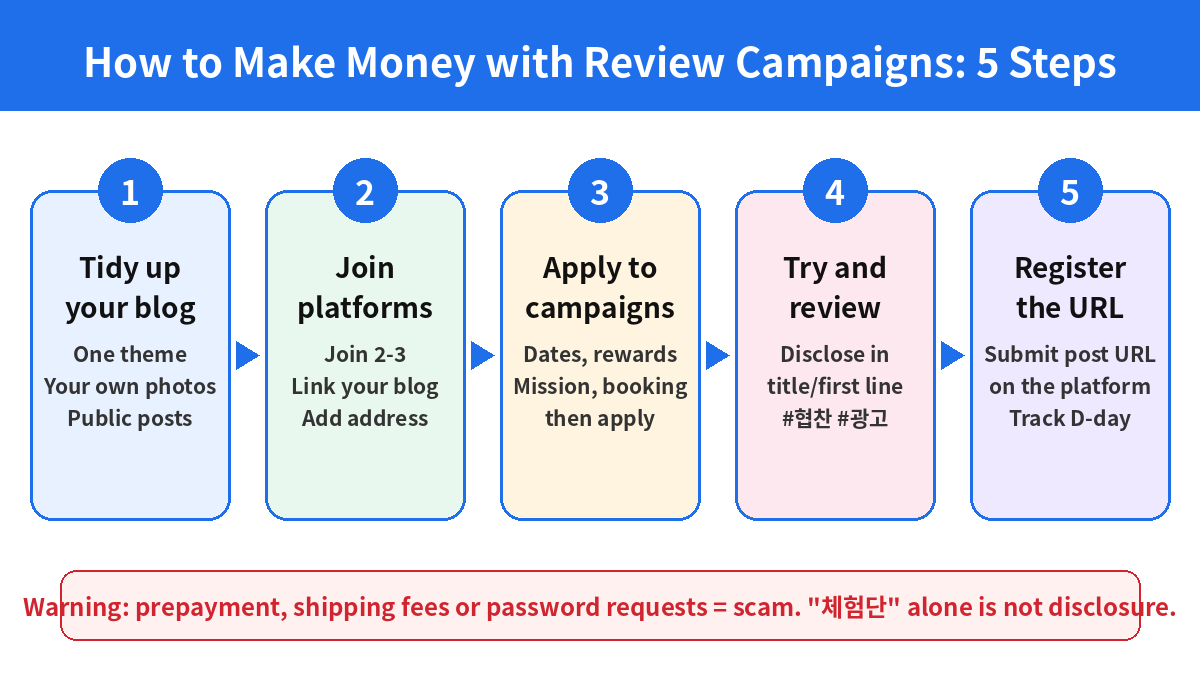
Step 1. Tidy up your blog (1 day)
- Pick a theme, e.g. “local restaurants” or “home items for parents”.
- Fill in your profile photo, blog name and intro.
- Publish at least a few public posts with your own photos. Advertisers look at your blog before picking.
- Some platforms (e.g. Mrblog) check the visitor graph. On the Naver blog PC screen: 관리 → 꾸미기 설정 → 레이아웃·위젯 설정 → turn on 방문자 그래프.
Step 2. Join 2–3 platforms (30 min)
- Sign up at two or three of REVU, Reviewnote, Dinner Queen, Mrblog.
- Link your blog/Instagram correctly.
- Enter a correct delivery address for delivery campaigns.
- Use a different password for each platform.
Step 3. Choose and apply (10–20 min a day)
Check these five things first:
| Check | Why |
|---|---|
| Application period, announcement date, review period | Late = penalty |
| What’s provided (e.g. ₩30,000 voucher) | You pay anything above it |
| Available days/hours, reservation rules | Dinner Queen says no same-day booking; no-shows may be charged |
| Mission (title/body keywords, photo rules) | Missing them = revision request |
| Your own schedule | Don’t apply to too many at once |
- At first, apply to campaigns with fewer applicants and visit campaigns near home.
- In your application, briefly say what photos you’ll take and what you’ll review honestly.
Step 4. Do the trial
- When picked, re-check dates on the campaign page.
- Visit: book 2–3 days ahead and say you’re a reviewer from the platform. Tap “use” on the voucher at the shop. Dinner Queen says unused vouchers are recalled with a penalty.
- Delivery: photograph the box on arrival and use the product for a few days.
- Take your own photos. Many campaigns ban shop listing photos or product-page screenshots.
Step 5. Write and disclose (most important)
Under the Korea Fair Trade Commission’s Guidelines on Endorsements and Testimonials (추천·보증 등에 관한 표시·광고 심사지침), if you get cash, products, vouchers, points or discounts from an advertiser, you must disclose that economic relationship in every post.
- For text posts such as blogs, put the disclosure in the title or at the very beginning, and make it stand out (bigger or different-colored text).
- Disclosures only in comments, behind “more”, or behind a link may not count.
- Good: “#광고”, “#협찬”, “상품 협찬”, “무료 상품”, “I received a free meal voucher from OO for this review” (in Korean for Korean readers).
- Not enough: “체험단”, “체험 후기”, “gift”, “sent by ~”, “#brandname”, or foreign-only words like “AD” or “Sponsor” for Korean readers.
- On Instagram, put the wording inside the photo, or as the first hashtag.
- Don’t delete or shrink the platform’s sponsor banner / disclosure text. Adding your own clear line at the top as well is safer.
Only write what you actually experienced. Some campaigns ban AI-written reviews (Dinner Queen campaign notes).
Step 6. Register the URL and track deadlines
- You are done only after you register the post URL on the platform.
- Track deadlines in a calendar or sheet. The review campaign tracker template calculates D-day automatically.
- Fix revision requests quickly.
Step 7. Know about tax
Goods, vouchers, points and fees from campaigns can count as income in some cases. Record dates and estimated values, and ask the National Tax Service at 126 whether you need to file. This is not tax advice.
First-week plan
| Day | Task |
|---|---|
| 1 | Tidy profile, pick one theme |
| 2 | Write one local review with your own photos |
| 3 | Join 2–3 platforms, link your blog |
| 4 | Apply to 3–5 nearby visit and 2–3 delivery campaigns |
| 5 | Write another post, log applications in a tracker |
| 6 | Check results; if picked, book the visit |
| 7 | Do the trial, sort photos, write the review with disclosure in the title/first line |
Common mistakes
- Applying to too many → overlapping deadlines and penalties. Keep 2–3 active.
- Writing only “체험단” → the KFTC does not treat it as clear disclosure.
- Disclosure only at the bottom → for blogs, title or beginning is the rule.
- Forgetting to register the URL → counted as not done.
- Not tapping “use” on the voucher → recall, penalty or charges.
- Using others’ photos → copyright issues and mission failure.
- Hiding downsides or exaggerating → readers stop trusting you.
Sources: KFTC Endorsement Guidelines (law.go.kr, KFTC Rule No. 499, effective 2026-06-01), Korea.kr policy news, 2024-11-20, REVU, Reviewnote support, Dinner Queen FAQ, Mrblog, Gangnam Matzip operator (checked October 2026). General information only; not legal or tax advice.
Watch out for these scams
Some people message you saying “you were selected” and ask for a prepayment, shipping fee or deposit, or your blog/Instagram ID and password. Real selections show up in your account on the platform you joined. Some delivery campaigns use “buy first, get refunded later (payback)”, so only do this inside the platform you signed up with. Never accept requests to write fake reviews without a real trial. Paid reviews without disclosure (“hidden ads”) can be sanctioned under Korea’s Act on Fair Labeling and Advertising, and platforms also apply penalties.
Want to run Blog Review Campaigns in Korea as a 30-day plan? The PDF guide (one-time .99) compares 30 methods with steps and income estimates. All steps above stay free.
See full guide →FAQ
Is How to Make Money with Blog Review Campaigns in Korea: From Applying to the Review Deadline (2026) a legit way to make money?
Yes, it is legal and used worldwide. In Korea, shops and brands often recruit people to try a product and write a review. This is called a 체험단 (review campaign / experience group). If you are picked, you get a meal, a product or a service for free, and you post a review on your blog or Instagram by a set date. This guide explains how to make money (mostly in savings) with review campaigns, step by step. Results depend on your time, skills and consistency; never pay upfront fees to unknown "opportunities".
What are the main pros and cons of How to Make Money with Blog Review Campaigns in Korea: From Applying to the Review Deadline (2026)?
Pros: An advertiser (a shop or brand) posts a campaign on a review-campaign platform., Bloggers or Instagram users apply, and the advertiser or platform picks people., Picked reviewers try the product, post a review by the deadline, and register the post URL on the platform., Three common types:, Visit: go to a restaurant, café, salon, etc., Delivery: receive a product by courier and try it at home, Reporter (기자단): write from provided materials without a trial, for points. Cons: People who already run a Naver blog or Instagram, People who like taking photos and writing honest reviews, People who want to save on eating out and household items, People who keep deadlines.
How do I start How to Make Money with Blog Review Campaigns in Korea: From Applying to the Review Deadline (2026) step by step?
The full step-by-step guide is free to read on this page.
🎁 Free: 7-day side-hustle starter checklist
Leave your email and get the free checklist now. No spam, unsubscribe anytime.
Popular guides
- Top 10 Ways to Make Money Starting This Week (Free Checklist)
- How to Make Money as a Student: Legit Ideas (2026)
- Passive Income Ideas: Realistic Options for 2026
- Make Money Online Without Investment: 20 Free Ways
- How to Make Money with AI: 50 Practical Ways (2026)
- How to Make Money From Home: 20 Legit Ways
- Make Money Online for Beginners: 15 Easy Ways to Start
- How to Make Money as a Mom: 16 Flexible Ideas (Work Around Nap Time)
- 16 Legit Ways to Make Money Fast (This Week)
- How to Make Money as a Teenager: 16 Safe Ideas
- 14 Remote Jobs With No Experience Needed
Next method: How to Make Money with a Review Campaign Tracker Template: A Free Excel Sheet So You Never Miss a Deadline (2026) →