Path
At a glance
Contents
In the US, many “U-pick” (pick-your-own) farms let customers come to the farm, pick crops such as strawberries, blueberries, apples and pumpkins themselves, and pay for what they pick. Based on US Department of Agriculture (USDA) statistics and university Extension guides, this article explains in plain words how to make money with a U-pick farm, and it introduces the Korean laws a Korean farm should check when adapting the idea as a farm experience. The key point is that you save harvest labor, but you must prepare for hosting visitors, safety and parking.
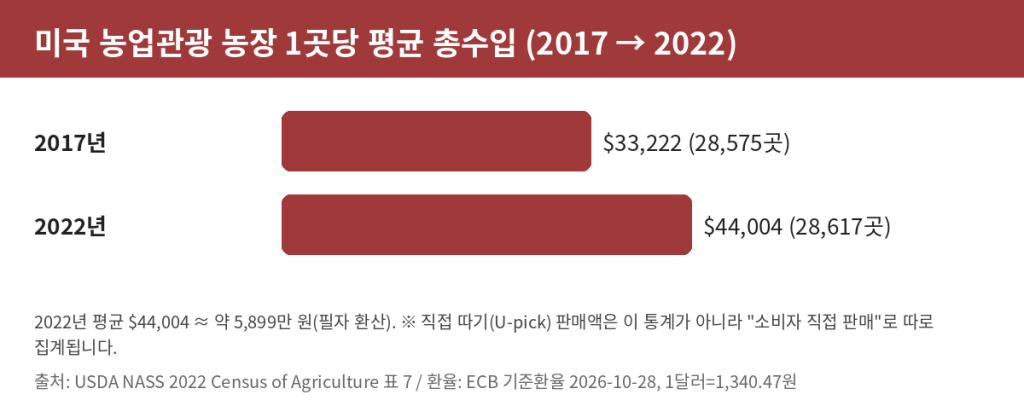
In one line: In the 2022 US Census of Agriculture, 28,617 farms had income from agritourism and recreational services, averaging $44,004 per farm. However, U-pick sales are not in this number; they are counted separately as “direct sales to consumers”.
1. What it is
- The farm opens its fields, customers get baskets, pick crops themselves, and pay by weight or basket size.
- According to a University of California guide (UC SAREP), the advantages are less harvest labor, no packing or shipping, and immediate cash. The challenges are accident and food-safety risk, labor for serving customers, crop damage, and visitor numbers that swing with the weather.
- In US statistics, U-pick sales count as “direct sales to consumers”, while admission fees, corn mazes and hayrides count as “agritourism” (Penn State NERCRD).
2. Start-up costs
We found no official average start-up cost for U-pick in either the US or Korea. It varies by crop and scale.
| Item | Description | Note |
|---|---|---|
| Parking | Space for visitors’ cars | A must-have in the UC SAREP guide; cost varies |
| Restrooms and handwashing | Visitor restrooms and handwashing stations | varies |
| Scale | A certified scale that can be used for trade | The US requires a legal-for-trade scale; in Korea, check the measurement rules |
| Insurance | Liability insurance for visitor accidents | NC State: consider property, workers’ comp and general liability insurance |
| Signs and baskets | Picking areas, cautions, price list | varies |
| Promotion | Social media, map apps, experience booking sites | Free to varies |
3. Equipment and preparation
- Choosing crops: Crops that are easy and low to pick (strawberries, blueberries) or good for seasonal events (pumpkins, apples) are common.
- Pricing: The UC SAREP guide suggests pricing by volume (basket) or weight, and setting prices with some room for the fruit customers eat in the field.
- Safety briefing: Mark picking areas and set rules for children, keep people out of areas with pesticide use, and warn about slippery paths.
- Records: Record visitor numbers, sales and average sale per customer to plan for next year (UC SAREP).
- Legal liability: The NC State guide advises insurance as well as posting the agritourism warning signs required by state law. Some states charge an amusement tax on admission fees.
4. How much can you earn?
Exchange rate: 1 USD = KRW 1,340.47, calculated by the author from the European Central Bank (ECB) reference rates for October 28, 2026.
| Source | Figure | KRW (author’s conversion) |
|---|---|---|
| USDA 2022 Census of Agriculture: average per farm with agritourism and recreational services income | $44,004 (28,617 farms) | about KRW 58.99 million |
| Same source, 2017 average | $33,222 (28,575 farms) | about KRW 44.53 million |
| NERCRD: average agritourism income of farms under 10 acres (2022) | $27,010 | about KRW 36.21 million |
| NERCRD: average for farms of 10-49.9 acres (2022) | $33,903 | about KRW 45.45 million |
| NC State case study: projected profit of a corn maze (year 1 → year 5) | $15,918 → $38,735 | about KRW 21.34 million → 51.92 million |
- These numbers are average revenue for agritourism as a whole, or one case’s projection. They are not U-pick-only income and not net profit. The NC State case also assumes about 450 hours of the owner’s work.
- Income from running a farm experience in Korea varies by region, crop and visitor numbers (varies by region and conditions).
5. Finding customers and selling
- Social media and map apps: Post opening days, what’s ready to pick today, and weather closures every day. The UC SAREP guide also recommends social media and listing on U-pick farm directory sites.
- Families and children: Welcome weekend family outings and daycare or school field-trip groups.
- Extra sales: Besides picked fruit, sell jam, juice, pre-picked fruit boxes and snacks to raise the average sale (in Korea, check food business rules for food sales).
- Seasonal events: Turn the season into an event, like strawberry season or an autumn pumpkin festival.
- Regular customer list: With consent, collect contacts and let customers know about the next harvest.
How a Korean farm could apply this
- In Korea this is usually run as a “harvest experience” or “experience farm”.
- Article 2(16) of the Rural Community Improvement Act (농어촌정비법) defines a tourist farm business (관광농원사업), with facilities for rural resources, producing, processing and selling farm products, and farm experiences, and a weekend farm business (주말농원사업) that lets city people experience farm work. Under Article 85 of the same act, a tourist farm can be run only by eligible people such as farmers, who must submit an operation plan and file a report with the city/county/district head.
- An Rural Experience and Recreation Village operator (농어촌체험·휴양마을사업자) under Article 5 of the Act on Promoting Urban-Rural Exchange (도농교류법) is applied for by a village council and needs things like consent from at least one-third of households, so a single private farm may not qualify.
- The reports you need may differ between running only a harvest experience in your own field and also running food, lodging or facilities. Always ask your city/county agricultural technology center or the responsible office before you start.
6. Start steps 1-2-3
- Pick a crop and dates: Test with one easy-to-pick crop on a few weekends in harvest season.
- Check laws and insurance: Ask the city or county office which report (tourist farm, etc.) a harvest experience needs, and look into liability insurance for visitor accidents.
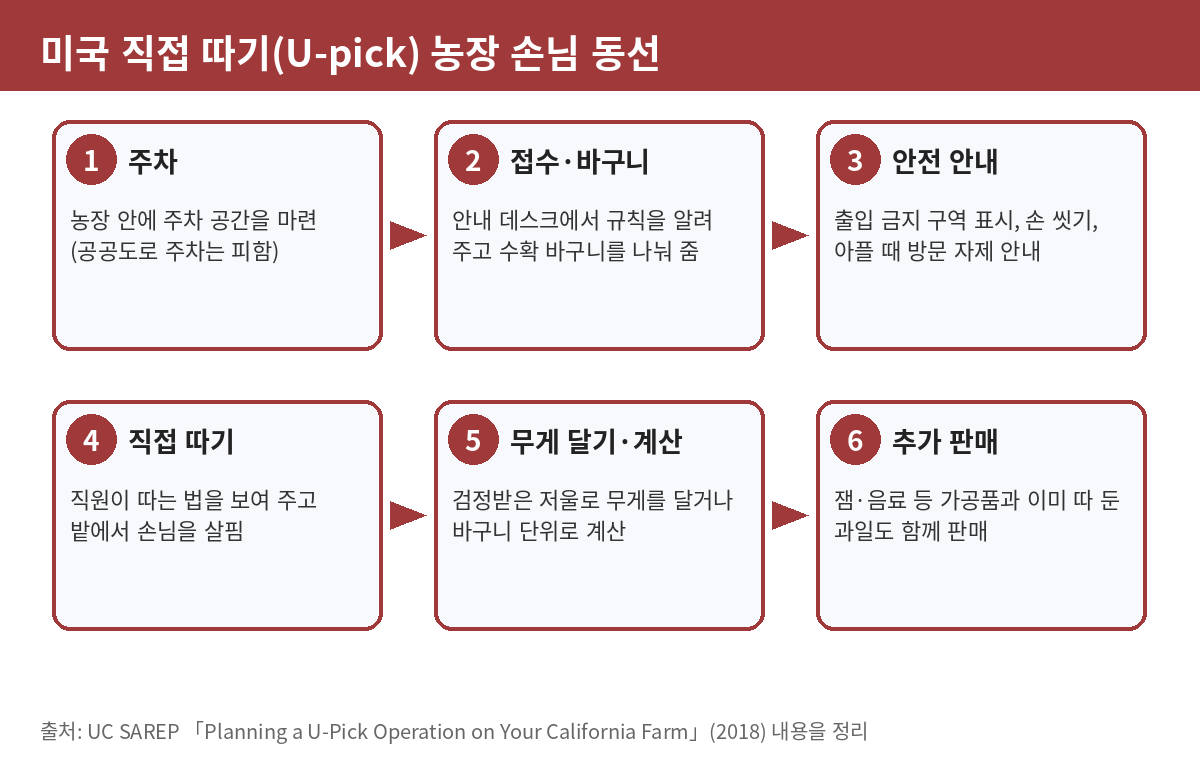
- Design the visitor flow: Set the order parking → check-in and baskets → safety briefing → picking → weighing and payment, put up a price list and signs, and announce your first opening on social media.
Watch out for these problems
In March 2026, the Michigan Attorney General’s office warned about fake Facebook event pages made to look like real events that asked vendors to send booth fees first through payment apps such as Zelle. It advised checking directly on the official website, paying with protected methods such as a credit card, and reporting to the FTC or IC3. In October 2025, the Massachusetts Office of Consumer Affairs also warned about social media ads that copied real fall events to sell fake tickets or attractions that don’t exist. If you run a farm, clearly announce your official accounts and booking method in one place, and warn customers right away if you see a fake page. Customers should also check dates and prices on the farm’s official account before booking.
Sources
- USDA NASS – 2022 Census of Agriculture, Table 7 (agritourism and recreational services income)
- Penn State NERCRD – Agritourism Data Brief (May 2024)
- Penn State – US agritourism and direct sales factsheet (2022)
- UC SAREP – Planning a U-Pick Operation on Your California Farm (2018)
- NC State Extension – Agritourism for Small Farms in North Carolina (AG-886-02)
- European Central Bank – Euro foreign exchange reference rates (2026.10.28)
- National Law Information Center – Rural Community Improvement Act Art. 2
- Rural Community Improvement Act Art. 85 (tourist farm report), article text
- Act on Promoting Urban-Rural Exchange Art. 5 (designation of experience villages), article text
- Michigan Attorney General – Warning on fraudulent Facebook event pages (2026.3.26)
- Massachusetts Office of Consumer Affairs – Halloween scams to avoid (2025.10.17)
7. FAQ
How many U-pick farms are there in the US?
We did not find a count of U-pick farms alone. According to Penn State, in 2022 there were 139,891 farms with income from direct sales to consumers or agritourism, and 116,617 of them had direct-sales income. U-pick is part of direct sales.
What about fruit customers eat in the field?
The UC SAREP guide suggests leaving room in your prices for what's eaten in the field. Some farms charge admission or set a minimum purchase.
Who is responsible if a visitor gets hurt?
The farm owner can be liable. The NC State guide advises considering liability insurance and posting the warning signs required by state law. In Korea, too, prepare insurance and safety briefings.
In Korea, can I just open my field?
Depending on whether you run only a harvest experience or also food, lodging or facilities, you may need procedures such as a tourist farm report (Rural Community Improvement Act Art. 85). Ask your city/county agricultural technology center or the responsible office first.
Are the KRW amounts exact?
They are the author's conversions at the ECB reference rate for October 28, 2026 (1 USD = KRW 1,340.47). If the exchange rate changes, the KRW amounts change too.
Last updated: October 30, 2026. Based on official sources; rules and prices can change.
🎁 Free: 7-day starter checklist for earning extra income
Leave your email and get the free checklist now. No spam, unsubscribe anytime.
Popular guides
- Top 10 Ways to Make Money Starting This Week (Free Checklist)
- How to Make Money as a Student: Legit Ideas (2026)
- Passive Income Ideas: Realistic Options for 2026
- Make Money Online Without Investment: 20 Free Ways
- How to Make Money with AI: 50 Practical Ways (2026)
- How to Make Money From Home: 20 Legit Ways
- Make Money Online for Beginners: 15 Easy Ways to Start
- How to Make Money as a Mom: 16 Flexible Ideas (Work Around Nap Time)
- 16 Legit Ways to Make Money Fast (This Week)
- How to Make Money as a Teenager: 16 Safe Ideas
- 14 Remote Jobs With No Experience Needed
Next method: How to Make Money with Edible Insect (Mealworm) Farming in Korea →