Path
At a glance
Contents
Every winter in the US, families visit “Choose & Cut” farms to pick and cut their own Christmas tree. This guide uses the USDA Census of Agriculture, the National Christmas Tree Association (NCTA) and NC State Extension to explain how to make money with a Christmas tree farm. The key is surviving the years while trees grow, then selling an experience along with the tree in a few weeks each year. This is a US case. We found no official statistics on Christmas tree farm income in Korea (varies).
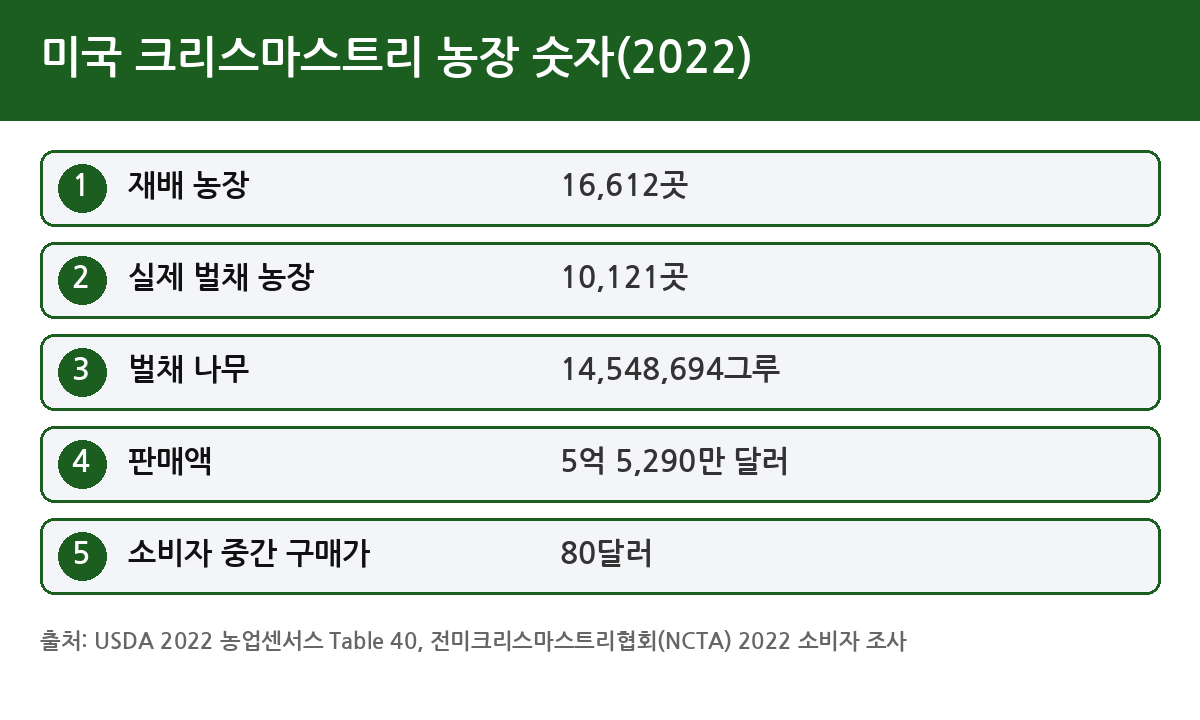
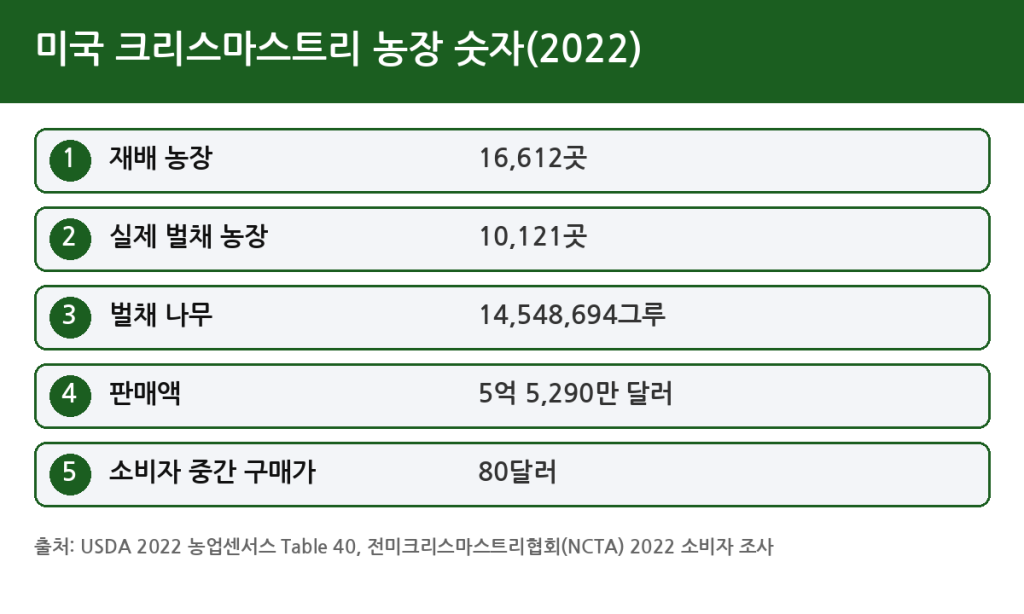
In one line: in 2022 the US had 16,612 Christmas tree farms that cut 14.5 million trees and sold $552.9 million worth (USDA). A 6–7 ft tree takes about 7 years to grow, and 30.8% of buyers cut their own at a farm (NCTA).
1. What is a Christmas tree farm?
- You plant conifers such as firs and pines, shape them for years, and sell them as Christmas trees in November–December.
- NCTA says 25–30 million real trees are sold in the US each year, with about 350 million growing on farms.
- A 6–7 ft tree takes 4–15 years, 7 on average. Growers plant 1–3 seedlings for each tree harvested.
- Top states: Oregon, North Carolina, Michigan, Pennsylvania, Wisconsin, Washington.
2. The US market in numbers
| Item | Figure | Source |
|---|---|---|
| Farms growing Christmas trees | 16,612 on 292,050 acres | USDA 2022 Census |
| Farms that cut trees | 10,121 | USDA 2022 |
| Trees cut | 14,548,694 | USDA 2022 |
| Sales | $552.9M (2017: $377.0M) | USDA 2022 |
| Median consumer price | $80 (2022) | NCTA survey |
| Bought at a choose-and-cut farm | 30.80% | NCTA 2022 |
Buyers got trees from choose-and-cut farms 30.80%, chain stores 19.38%, nurseries 16.61%, retail lots 15.92%, non-profits 7.61% and online 7.27% (NCTA 2022).
3. Start-up cost and land
- NC State Extension says eastern choose-and-cut farms are mostly part-time operations of about 2–6 acres.
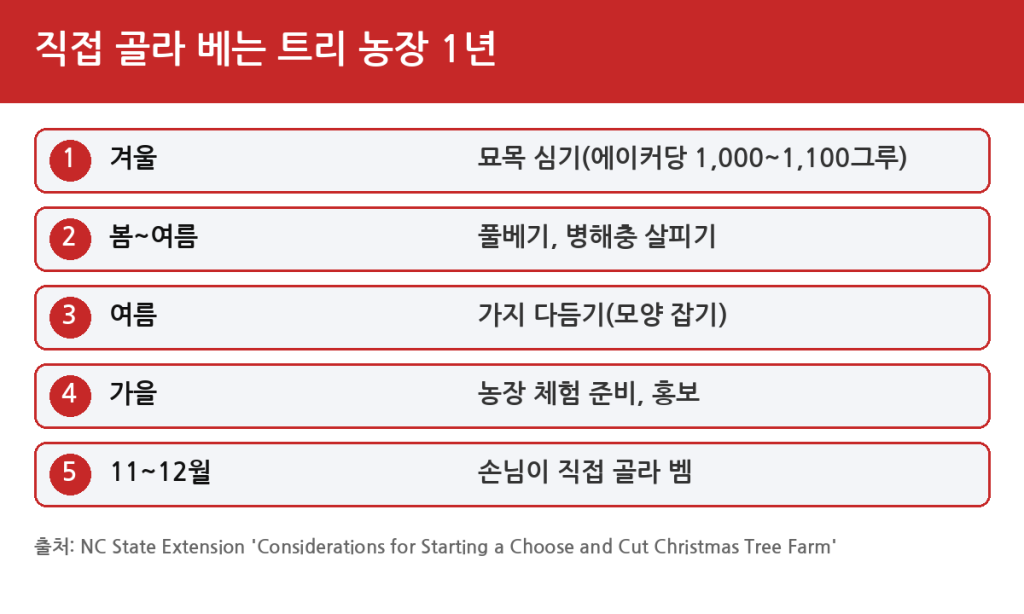
- Plant 1,000–1,100 trees per acre at 5×5 or 6×6 ft spacing with 8 ft between rows.
- Costs depend on land, seedlings, mowing gear, pest control and parking/visitor facilities (varies). We found no official average start-up cost.
- Extension advises planting only about 20% of the land at first and being conservative, because customers won’t find you in year one.
4. Equipment and work
- Mowing equipment between rows.
- Shearing tools to shape trees, which is labor-intensive.
- Pest control following local extension guidance.
- Sales-season gear: saws for customers, netting machine, carts, parking, checkout.
- Some eastern species reach market size in 3–5 years, according to Extension.
5. How much can you earn?
Simple calculations from USDA data. These are sales, not profit. KRW uses a simple assumption of $1 = KRW 1,400.
- 2022 sales divided by trees cut is about $38 per tree (about KRW 53,000), lower than the $80 median retail price (about KRW 112,000) because wholesale trees are included.
- 5,352 farms of 1–2 acres sold $5.448M, about $1,018 per farm (about KRW 1.42 million).
- 3,402 farms of 5–9 acres sold $22.32M, about $6,561 per farm (about KRW 9.18 million).
- Net income after costs varies widely. Small farms are often run alongside another job.
6. Finding customers and selling
- Choose & cut: market it as a family outing; 30.8% of buyers buy this way.
- Agritourism: hayrides, cider, Santa photos, pumpkins and school tours, as Extension notes.
- Resell pre-cut trees: many farms buy in Fraser fir while their own trees grow.
- Wreaths and greenery from trimmed branches.
- Directory listings with state associations and NCTA’s farm locator.
7. Step-by-step start (in the US)
- Ask your local extension office about species, soil and pests.
- Plant small: about 20% of your land, expanding yearly.
- Build income while trees grow: pre-cut trees, pumpkin and farm events to build a customer list.
- Prepare for the season: parking, saws, netting, payment.
- Record and replant so you have trees to sell every year.
For a similar farm in Korea, forestry and farmland laws and seedling import quarantine differ, so check with local agricultural technology centers and forestry agencies first.
9. Watch out for these scams
The Better Business Bureau (BBB) warns each holiday season about fake shops that advertise very cheap real or artificial trees and decorations on social media ads or shopping apps, then send nothing or a fake tracking number. It advises checking the seller’s address and reviews and paying by credit card rather than payment apps, gift cards or wire transfers. If you’re starting a farm, be wary of investment pitches that sell overpriced seedlings or land with promises of big money in a few years.
Sources
- USDA NASS, 2022 Census of Agriculture Table 40
- USDA NASS, 2022 Census Table 35 (state level)
- NCTA, Quick Tree Facts
- NCTA, 2023 supply note and 2022 consumer survey
- NC State Extension, Starting a Choose and Cut Christmas Tree Farm
- BBB, Holiday decorations scams
- BBB, Buying an artificial Christmas tree
8. FAQ
When can I sell after planting?
A 6–7 ft tree averages 7 years (4–15) per NCTA; some eastern species take 3–5 years per NC State Extension.
How much land do I need?
Eastern choose-and-cut farms are often 2–6 acres; 5,352 farms in 2022 had just 1–2 acres (USDA).
How many days a year is the work?
Sales are concentrated in Nov–Dec, but mowing, pest control and shearing run all year.
Will customers come in year one?
Extension advises being conservative because customers won't know you yet.
Are there Korean statistics?
We found no official Korean statistics on Christmas tree farm income (varies).
Last updated: October 30, 2026. Based on official sources; rules and prices can change.
🎁 Free: 7-day starter checklist for earning extra income
Leave your email and get the free checklist now. No spam, unsubscribe anytime.
Popular guides
- Top 10 Ways to Make Money Starting This Week (Free Checklist)
- How to Make Money as a Student: Legit Ideas (2026)
- Passive Income Ideas: Realistic Options for 2026
- Make Money Online Without Investment: 20 Free Ways
- How to Make Money with AI: 50 Practical Ways (2026)
- How to Make Money From Home: 20 Legit Ways
- Make Money Online for Beginners: 15 Easy Ways to Start
- How to Make Money as a Mom: 16 Flexible Ideas (Work Around Nap Time)
- 16 Legit Ways to Make Money Fast (This Week)
- How to Make Money as a Teenager: 16 Safe Ideas
- 14 Remote Jobs With No Experience Needed
Next method: How to Make Money with Hanwoo Cow-Calf Breeding in Korea →