Path
Contents
When a person who lived alone dies and is not found for a long time, the home is left with odor and contamination, and the family or landlord often has no idea where to start, from sorting belongings to cleaning. This is when people call special cleaning and estate cleanup (yupum jeongni) services. This guide explains how to make money with special cleaning in Korea in plain words, based on Ministry of Health and Welfare statistics, laws, and Korea Consumer Agency (KCA) complaint data. The key points are: give on-site estimates and written agreements, never throw away belongings without permission, and dispose of waste legally.
In one line: Cleaning after lonely deaths (godoksa) or accidents and sorting the deceased’s belongings is a call-out service with growing demand (3,924 lonely deaths in 2024, Ministry of Health and Welfare). But disinfection as a business requires a disinfection business report, collecting and transporting waste as a business requires a waste collection and transport permit, and most complaints about cleaning services are about “poor quality” and “extra charges demanded on site” (KCA).
1. What it is
- Special cleaning: removing contamination, washing, disinfecting and deodorizing places that ordinary cleaning cannot handle, such as scenes of lonely deaths, accidents or suicides.
- Estate cleanup: sorting the deceased’s belongings with the family into things to keep (photos, bankbooks, documents, valuables) and things to discard. It is often ordered together with special cleaning.
- This guide covers homes where someone has died and accident scenes. It is a different job from regular house cleaning, move-in cleaning, mattress cleaning, drain cleaning or signboard cleaning.
- Article 2 of the Act on the Prevention and Management of Lonely Deaths defines a lonely death as the death of a person who lived socially isolated, cut off from family, relatives and others, who dies alone by suicide, illness or other causes and whose body is found after a certain period of time.
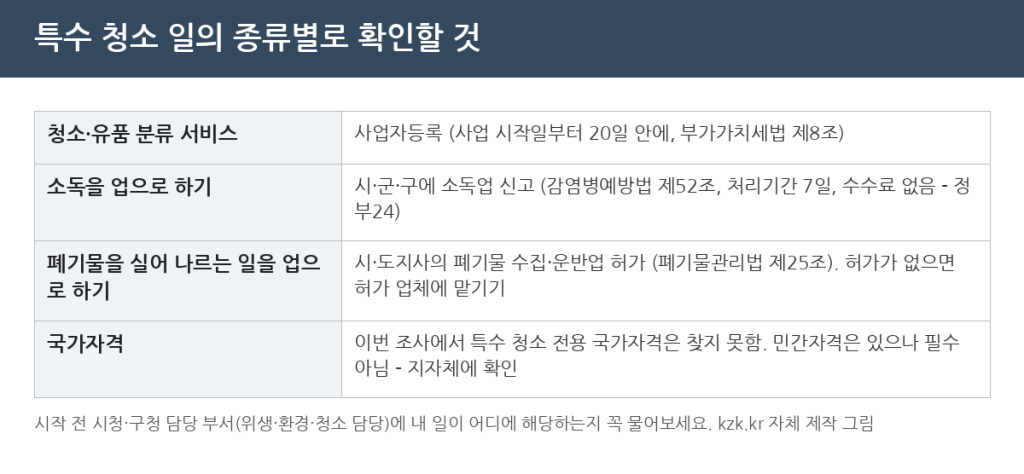
| Type of work | What you need | Legal basis |
|---|---|---|
| Cleaning and sorting belongings | Business registration (within 20 days of starting) | Value-Added Tax Act, Art. 8 |
| Disinfection as a business | A disinfection business report to the city/county/district head (submit a list of facilities, equipment and staff; processing time 7 days; no fee) | Infectious Disease Control and Prevention Act, Art. 52 (Gov24 guide) |
| Collecting and transporting waste as a business | A waste collection and transport business permit from the provincial/metropolitan governor (submit a business plan → notice of suitability → obtain the permit within 6 months after meeting facility, equipment and technical standards) | Wastes Control Act, Art. 25 |
- In this research we did not find a national qualification just for special cleaning. Private certificate courses exist, but they are not required by law. Requirements may still differ by area, so always ask your city or district office before you start.
2. Start-up costs
There are no official average figures. Costs vary greatly with your equipment, whether you already have a vehicle, and whether you handle waste yourself.
| Item | Description | Note |
|---|---|---|
| Personal protective equipment | Full-body coveralls, respirator mask, goggles, nitrile gloves, boots | Used up at each site, varies |
| Cleaning and disinfection equipment | Sprayers, wet/dry vacuum, steam cleaner, disinfectants | varies |
| Deodorizing equipment | Ozone generators and similar | Use only when no one is inside, varies |
| Packing and moving tools | Sealable bags, boxes, hand trucks | varies |
| Vehicle | A truck for equipment and items | No extra cost if you already have one |
| Business registration | Hometax or a tax office | Within 20 days of starting |
| Disinfection business report | City/county/district office | No fee (Gov24) |
| Liability insurance | Covers damage to customers’ property | Varies by insurer |
3. Equipment and safety tips
- Don’t skimp on protective gear. Contaminated sites may have body fluids, mold and insects. Wear coveralls, a mask and gloves, and take them off and seal them in bags when you leave.
- Use disinfectants and deodorizing equipment exactly as the instructions say. Mixing different chemicals can be dangerous. Run ozone equipment only when no one is inside, and ventilate well before re-entering.
- Photo records: before-and-after photos are the easiest way to prevent disputes. A phone is enough, but never post photos online without the family’s consent.
- Check before entering: confirm that police investigations and death-related procedures are finished, and whether the landlord or the family is the one signing the contract.
4. How much can you earn?
We did not find official average income figures. Income varies with the size of the site, how contaminated it is, the amount of belongings, and how waste is handled (varies by area and conditions).
- For reference, some local governments support the cost of special cleaning and estate cleanup for low-income lonely deaths and unclaimed deaths. Seoul’s Dongdaemun-gu (up to KRW 1 million, 2024) and Jongno-gu (up to KRW 1 million per household, 2022) said they pay the cleaning company directly, and Ulsan’s Jung-gu also announced support of up to KRW 1 million. These are support limits, not company income.
- Why the work exists: according to the Ministry of Health and Welfare, lonely deaths rose from 3,559 in 2022 to 3,661 in 2023 and 3,924 in 2024. In 2024 they occurred in houses (48.9%), apartments (19.7%) and studio apartments/officetels (19.6%), and the share of landlords and health and welfare workers among those who first found the deceased increased.
- Set an itemized price list, such as “basic cleaning by floor area / disinfection and deodorizing / hours of sorting belongings / amount of waste (tons or truckloads)”, and write it on the estimate.
5. How to find customers
- Landlords, real estate agencies and building management offices: landlords of studios and officetels are increasingly the first to find the deceased. Give local real estate agencies and building management companies your business card and a sample work report.
- Local government support programs: ask the lonely-death prevention or unclaimed-death team at the district office or community center how to register or cooperate as a company. Some districts, like Dongdaemun-gu and Jongno-gu, pay companies directly.
- Funeral homes and funeral-service companies: they can refer families looking for estate cleanup after the funeral. Put any referral-fee terms clearly in writing.
- Map apps and search listings: many customers search in a hurry, so list your company on map apps with accurate hours and whether you have business registration and a disinfection business report.
- Quiet, respectful promotion: families are grieving. Instead of shocking site photos, promote trust: “free on-site estimate, belongings checked before disposal, before-and-after report.”
6. Getting started, step by step
- Decide the scope of your work: decide whether you will only clean and sort belongings, also disinfect, and whether you will leave waste transport to a permitted company. First ask your city or district office whether your work requires a disinfection business report or a waste collection and transport permit.
- Registration, reports and insurance: register your business on Hometax within 20 days of starting (VAT Act Art. 8), and if you will disinfect as a business, file a disinfection business report with the city/county/district office. Look into liability insurance too.
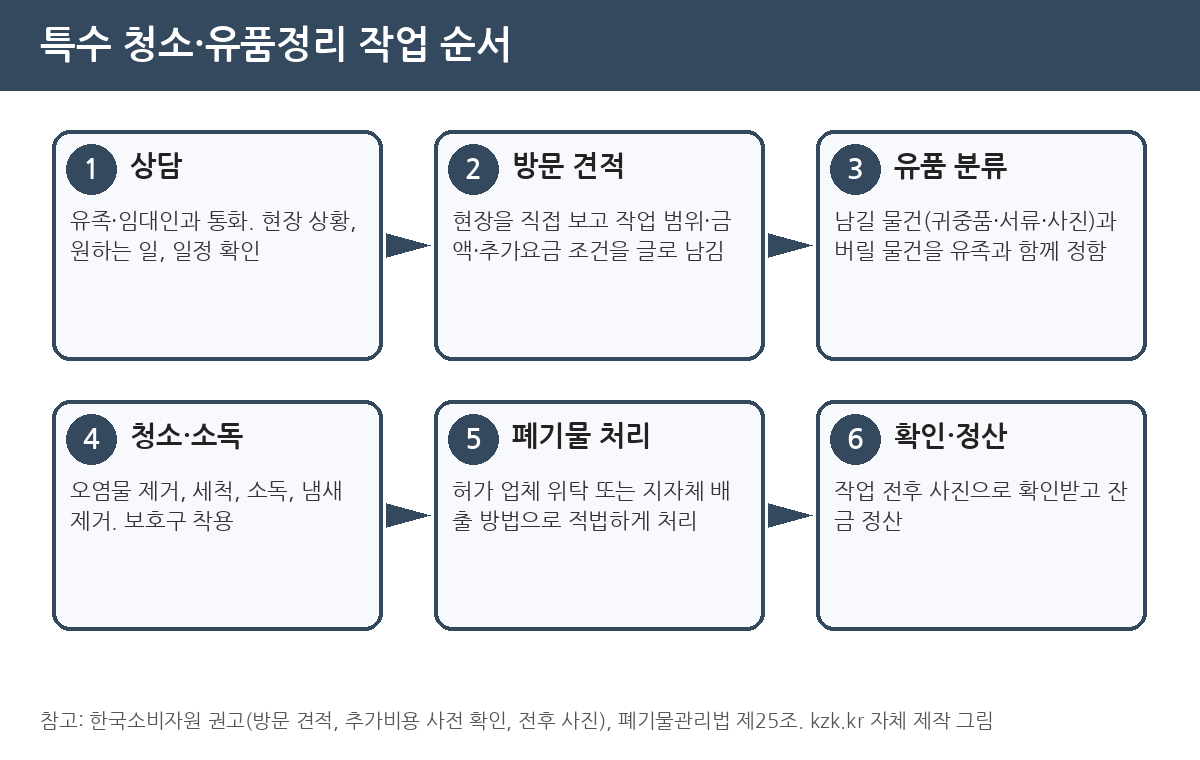
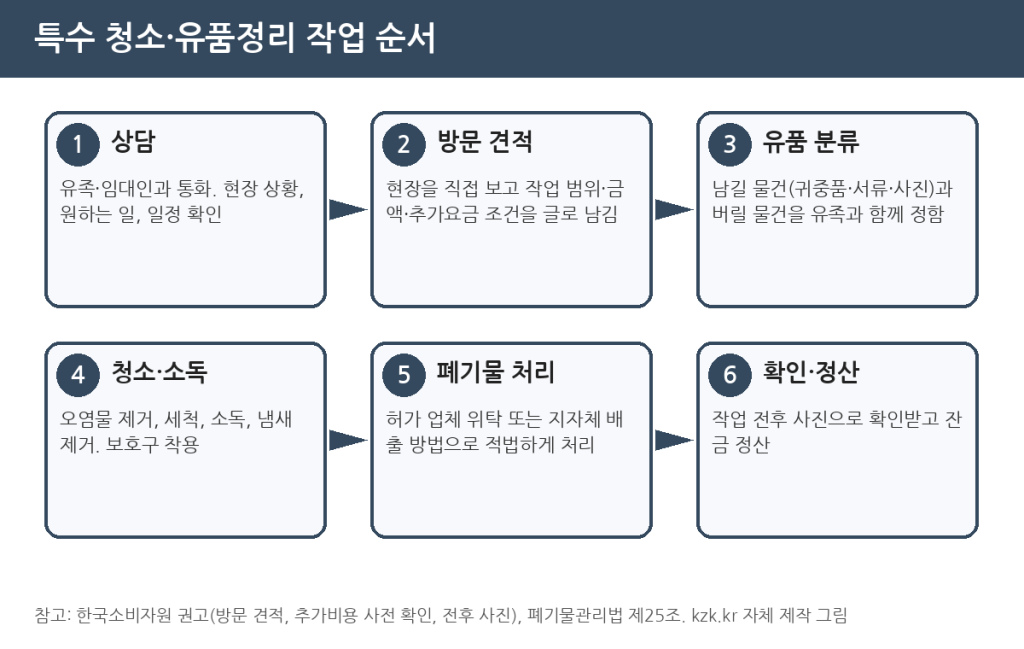
- Paperwork and your first job: prepare an estimate form (scope, price, conditions for extra charges), a belongings checklist (items to keep, signed by the family) and a before-and-after photo report, then take your first job.
Watch out for these reported problems
According to a KCA analysis released on July 15, 2026, of 1,204 damage-relief cases for cleaning and sewer sanitation services over the last three years (2023 to Q1 2026), 292 (24.3%) involved extra charges demanded on site. For cleaning services alone, the top issues were poor quality (42.8%, 510 cases), extra charges (20.5%, 244 cases), and damage to or loss of household items (15%, 179 cases). In many cases the contract was made only by phone or online, and then the company demanded more money on site, saying the contamination was severe. Japan’s National Consumer Affairs Center (2018) also reported rising complaints about estate cleanup services: extra fees not in the estimate, disposal of belongings that should have been kept, and high cancellation fees. If you do this work, always follow: on-site estimate → explain reasons and amounts of extra charges in writing before the contract → signed belongings checklist → before-and-after photos → final payment after confirmation. Customers, too, should get on-site estimates, compare two or three companies, and can contact the 1372 Consumer Counseling Center if problems arise.
Sources
- Ministry of Health and Welfare – Press release on the 2024 lonely death survey (2025.11.27)
- Ministry of Health and Welfare – Press release on the 2023 lonely death survey (2024.10.17)
- Korea Consumer Agency (Yonhap report) – Extra-charge damage in cleaning, plumbing and sewer services (2026.7.15)
- National Law Information Center – Wastes Control Act Art. 25 (Waste management business)
- Gov24 – Disinfection business report and change report (Infectious Disease Control and Prevention Act Art. 52)
- Seoul& – Dongdaemun-gu support for special cleaning and estate cleanup after lonely and unclaimed deaths (2024.1.31)
- Kyunghyang Shinmun – Jongno-gu special cleaning support for lonely-death households (2022.11.9)
- Ulsan Jung-gu – Lonely death special cleaning support notice
- National Consumer Affairs Center of Japan – Troubles with estate cleanup services (2018.7.19)
- National Tax Service Hometax – Business registration
7. FAQ
Do I need a national license to do special cleaning?
In this research we did not find a national qualification just for special cleaning. Private certificates are optional. However, disinfection as a business requires a disinfection business report (Infectious Disease Control and Prevention Act Art. 52), and collecting and transporting waste as a business requires a waste collection and transport permit (Wastes Control Act Art. 25).
How do I dispose of the items and waste from a site?
Collecting and transporting waste as a business requires a permit from the provincial/metropolitan governor. If you don't have one, hand it over to a permitted company or follow the local government's disposal rules (such as reporting bulky waste). Dumping it anywhere is illegal.
Which belongings may I throw away?
Dispose only of what the family or the contracting party has decided. Set aside bankbooks, documents, photos and valuables, make a list, and get a signed confirmation before disposal. Japan's National Consumer Affairs Center has also reported complaints that companies "disposed of belongings that should not have been discarded."
Who pays?
Usually the family or the landlord. For low-income lonely deaths and unclaimed deaths, some local governments have supported up to KRW 1 million and paid the company directly, so ask the district office whether support is available.
What if the job turns out bigger than the estimate?
Before starting, write on the estimate "in which cases and by how much the price can increase." If extra work comes up on site, stop, show photos and get consent. The KCA also advises checking the reasons and amounts of extra charges in advance.
Last updated: October 30, 2026. Based on official sources; rules and prices can change.
🎁 Free: 7-day starter checklist for earning extra income
Leave your email and get the free checklist now. No spam, unsubscribe anytime.
Popular guides
- Top 10 Ways to Make Money Starting This Week (Free Checklist)
- How to Make Money as a Student: Legit Ideas (2026)
- Passive Income Ideas: Realistic Options for 2026
- Make Money Online Without Investment: 20 Free Ways
- How to Make Money with AI: 50 Practical Ways (2026)
- How to Make Money From Home: 20 Legit Ways
- Make Money Online for Beginners: 15 Easy Ways to Start
- How to Make Money as a Mom: 16 Flexible Ideas (Work Around Nap Time)
- 16 Legit Ways to Make Money Fast (This Week)
- How to Make Money as a Teenager: 16 Safe Ideas
- 14 Remote Jobs With No Experience Needed
Next method: How to Make Money with Drain Cleaning in Korea →