Path
Contents
The outside glass of apartments, office buildings, government offices and shop buildings quickly gets dirty from dust and rain marks. Tall buildings can’t be cleaned from the inside, so owners usually call an exterior wall and window cleaning company once or twice a year to clean from the outside. Apartment management offices and public agencies post tenders every year, and companies earn money by winning that work. But this work is done high up, hanging on ropes or standing on aerial work platforms, so it is dangerous work where falls really do happen often. This guide explains, in simple terms, how to make money with window cleaning in Korea, based on Easylaw (찾기쉬운 생활법령정보), the Rules on Occupational Safety and Health Standards on the National Law Information Center, Ministry of Employment and Labor (MOEL) materials, and published tender results.
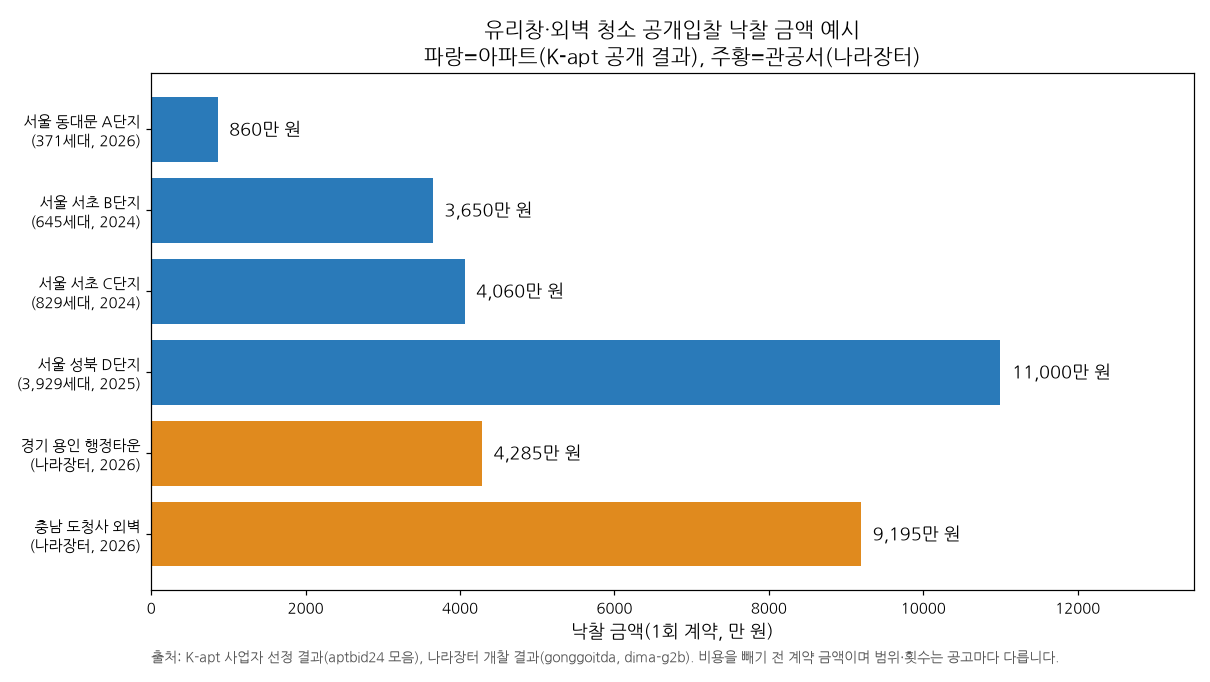
One-line summary: The way to make money with window cleaning is to win “exterior wall / window cleaning” tenders from apartments (K-apt) and public agencies (KONEPS / 나라장터). Published winning prices for one contract range from about KRW 8.6 million (a 371-household apartment) to KRW 110 million (a 3,929-household apartment). Companies that clean large buildings usually need to register as a Building Sanitation Management Business (건물위생관리업), and rope (suspended scaffold, 달비계) work must follow legal safety rules: work rope tied to 2 or more anchor points, a lifeline on a different anchor point, and rope protectors.
1. What is a window cleaning business?
- It means washing dust, water stains, bird droppings and so on off a building’s outside glass, window frames and exterior walls with water and detergent. Unlike indoor or home cleaning, most of it is work at height.
- There are three main ways to work:
1. Suspended scaffold (rope) work: tie ropes on the roof and clean while descending on a small seat (chair-type suspended scaffold). Common for apartment exterior glass.
2. Aerial work platforms: clean from a truck-mounted or self-propelled platform. Common for shops and low buildings of about 2-5 floors.
3. Gondolas: work from a gondola installed on the roof of a high-rise. - Customers are mainly apartment management offices, building management companies, public bodies such as government offices, schools and hospitals, and shop building owners.
- This guide covers only exterior building glass and shop windows. It does not cover signboard cleaning, move-in cleaning or indoor home cleaning.
Do I need to register? (Building Sanitation Management Business)
- The Public Health Control Act calls a business that cleans, on someone else’s behalf, buildings and facilities used by the public to keep them clean and purify indoor air a “Building Sanitation Management Business”. To do it, you must have the required equipment and report to the city/county/district office (Article 3 of the Act).
- According to the government guide, it applies to work on buildings of a certain size or larger, and individual services such as single units or move-in cleaning are not covered. There is no separate legal standard for “a certain size”, and the guide says you can refer to the size of multi-use facilities under the Indoor Air Quality Control Act (Easylaw, Ministry of Health and Welfare public health guide).
- Running this business without reporting can lead to up to 1 year in prison or a fine of up to KRW 10 million (Article 20 of the Act).
- Public tenders actually require “Building Sanitation Management Business” as an industry restriction in some cases. For example, the 2026 South Chungcheong Provincial Office exterior wall cleaning contract was restricted to that business type (KONEPS notice data, dima-g2b). So to win larger work, registration is practically required.
- If you only clean small shop windows, whether you must register can be unclear, so ask the sanitation department of your local city/county/district office directly.
2. How much does it cost to start?
There is no official average start-up cost. It varies widely depending on whether you only buy rope gear, buy or rent an aerial work platform, and already have a vehicle. Below are the must-have items from the law and government guides.
| Item | Standard | Notes |
|---|---|---|
| Building Sanitation Management Business report | Report to city/county/district office | Business report certificate is issued right away (Enforcement Rule Art. 3) |
| Required equipment | 2 floor polishers of 25 cm diameter or more, 2 vacuum cleaners (wet and dry), safety belts, helmets and ropes, meters for dust, carbon monoxide and carbon dioxide | Meters not needed if you only clean small buildings, e.g. office buildings under 3,000 m² (Enforcement Rule Annex 1) |
| Sanitation training | Complete the required sanitation training | Attach the certificate if taken before reporting |
| Business registration | Register at the tax office with a copy of the report certificate | Within 20 days of starting (VAT Act Art. 8) |
| Window cleaning tools | Squeegee, washer (strip applicator), scraper, bucket, detergent | Prices vary by product |
| Rope work gear | Work fiber rope, lifeline, work seat, safety harness, rope protector, warning sign | Use products that meet legal standards (section 3) |
| Aerial work platform | Buy or rent | Rental fees vary by region and model |
| Insurance | Industrial accident insurance (mandatory once you employ even 1 worker), business liability insurance (optional) | Premiums vary by industry and headcount |
Industrial accident insurance: in principle, any business employing 1 or more workers is automatically covered, and even day laborers who work a single day are covered (4 Major Social Insurances Information Center). Business liability insurance is not legally required, but many companies buy it in case dropped tools injure people or damage cars. Always check whether a tender notice asks for proof of insurance.
3. Equipment and how to do the work
Basic cleaning tools
- Squeegee: a rubber blade that pulls water off so no streaks are left. Replace worn blades often, or they leave lines.
- Washer (strip applicator): a fluffy bar you dip in soapy water to scrub the glass.
- Scraper: removes paint, stickers and cement marks. Keep the glass well wetted and scrape in one direction so you don’t scratch it.
- Bucket, neutral detergent, dry towels: for wiping water off frames and corners.
- Low floors can be cleaned from the ground with an extension pole, so you don’t have to go up high.
Rope (suspended scaffold) safety rules: set by law
Article 63(2) of the Rules on Occupational Safety and Health Standards (chair-type suspended scaffolds) was newly added on November 19, 2021. In plain words, the employer must:
- Make the work seat from strong material that can bear a person’s weight, and hang it with ropes at all 4 corners.
- Tie the work fiber rope to 2 or more strong anchor points (rings embedded in concrete, concrete or steel parts of the building, etc.) so it cannot come loose.
- Tie the work rope and the lifeline to different anchor points.
- Make sure the seat does not descend unless the worker controls it.
- Prevent others from untying the rope at the anchor point, and attach a “work in progress” warning sign.
- Where the rope touches a roof edge or sharp corner, fit a protective cover (rope protector).
- Do not use ropes whose strands are broken, that are badly damaged, that are two ropes joined together, or that are shorter than the working height.
- Install a lifeline, and have the worker wear a safety harness connected to it.
The same rules also require work platforms where there is a risk of falling, or, if that is difficult, fall-prevention measures such as safety nets or harnesses (Article 42). The Korea Occupational Safety and Health Agency’s “Safe Work Guideline for Chair-type Suspended Scaffolds (KOSHA GUIDE C-33-2022)” explains the work order and what to do when the roof has no anchor points, with drawings. Be sure to read it.
When using an aerial work platform
Article 186 of the same rules sets what to follow when using aerial work platforms:
- Keep the ground as level as possible, and use outriggers or brakes so it cannot move suddenly.
- When moving it, lower the platform fully and, as a rule, do not move it with people on board.
- Workers wear helmets and safety harnesses, and unrelated people are kept out of the work area.
- When working near power lines, assign a watcher. Never load or ride beyond the rated load.
Work order (example)
- Visit the site in advance to check the number of floors, glass area, roof anchor point locations and vehicle access.
- Set a date with the management office and post notices for residents/tenants (close windows, watch out below).
- On the day, check wind and rain. Postpone if it is windy or rainy.
- Mark a no-entry zone below; on the roof, the supervisor checks rope ties, the lifeline and protectors.
- Work from upper to lower floors: washer → squeegee → dry towel.
- Take before-and-after photos and do a final check with the management office.
4. How much can you earn?
Profit from window cleaning varies by company, depending on labor, equipment, insurance and local competition. Below are published tender winning (contract) amounts. These are before costs, and the scope (whether walls are included) and frequency differ by notice.
Apartments (K-apt published contractor selection results)
- Complex A, Dongdaemun-gu, Seoul (371 households, 23 floors): 2026 exterior window cleaning won at KRW 8.6 million. 5 bidders, bids from KRW 8.6M to 12.7M.
- Complex B, Seocho-gu, Seoul (645 households, 46 floors): 2024 exterior window cleaning won at KRW 36.5 million (5 bidders). The same complex paid KRW 35M in 2022 and KRW 19M in 2017.
- Complex C, Seocho-gu, Seoul (829 households, 34 floors): 2024 exterior wall and window cleaning won at KRW 40.6 million. 6 bidders, KRW 40.6M to 55M.
- Complex D, Seongbuk-gu, Seoul (3,929 households, 30 buildings): 2025 exterior wall window cleaning won at KRW 110 million. 7 bidders, KRW 110M to 135M.
Public agencies (KONEPS opening results)
- Yongin City administrative town exterior glass cleaning, Gyeonggi (September 2026): KRW 42,848,000 (negotiated contract, 1 participant).
- South Chungcheong Provincial Office exterior wall cleaning (June 2026): KRW 91,954,070. 137 companies bid, and competition was so fierce that the winner was only KRW 3,882 above the minimum acceptable price.
Things to know
- Apartment tenders are often won by the lowest bid. In the examples above, the gap between 1st and 2nd place was about 13-30%.
- The contract amount must cover several people’s wages, equipment and vehicle costs, insurance and taxes. What is actually left varies by company. These numbers are not a promise of income.
- Large complex tenders often attract companies with lots of past experience. Many companies start with small shops and small buildings to build a track record.
- Small jobs such as ground-floor shop windows have almost no public price data. Prices vary by area, height and how dirty the glass is.
What to check before quoting
If you don’t check the following before bidding or quoting, you may win cheaply and still lose money, or end up cutting safety gear.
- Scope: only glass, or also wall surfaces, frames and railings?
- Frequency and timing: how many times a year, spring or autumn, and whether rainy days can be postponed. Put it in the contract.
- Method: check whether the roof has 2 or more strong anchor points (rings) and whether an aerial platform can get in. Without anchor points, rope work may be impossible or need extra measures.
- Manpower: from the number of buildings and floors, calculate how many people for how many days. Include the person watching the ropes on the roof.
- Liability: decide who is responsible, and whether insurance covers it, if glass breaks or water gets inside.
5. How do you find customers?
- K-apt tender notices: apartments post tenders and results on the Apartment Management Information System (K-apt) when choosing contractors. Search daily with words like “외벽” (exterior wall) and “유리창” (window), and prepare documents in advance: report certificate, business registration, proof of insurance, proof of past work.
- KONEPS (나라장터): government offices, schools and public companies post exterior wall and window cleaning contracts. You must first register as a bidder with the Public Procurement Service, and always check regional and industry restrictions (e.g. Building Sanitation Management Business).
- Building management companies and owners: send facility managers of office, academy and hospital buildings a proposal summarizing “how many times a year, when, and how much”.
- Regular contracts with local shops: 1st-2nd floor shop windows can be cleaned from the ground with an extension pole, so the risk is low. Collecting several 1-2 times a month contracts gives steady work.
- Partnering within the industry: exterior painting, waterproofing and general building management companies sometimes outsource glass cleaning.
6. Step-by-step start 1-2-3
- Learn and check: work at an experienced company and learn rope tying, lifelines and squeegee technique first-hand. Read the KOSHA GUIDE (chair-type suspended scaffold safe work guideline) and Articles 42, 63 and 186 of the Rules on Occupational Safety and Health Standards. Then ask your city/county/district office whether your work requires a Building Sanitation Management Business report.
- Report, register and insure: get the required equipment (2 floor polishers, 2 vacuum cleaners, safety belts, helmets, ropes, etc.), complete sanitation training, and file the report. Register your business with the report certificate, and join industrial accident insurance if you hire workers. Also look into business liability insurance.
- Build a track record with small jobs: start regular contracts with local shops and low buildings, and keep before-and-after photos and contracts as your track record. Then try K-apt and KONEPS tenders. Once you have 5 or more regular workers, the Serious Accidents Punishment Act also applies (expanded from January 27, 2024), so you must set up a safety and health management system.
8. Watch out for these real damage cases
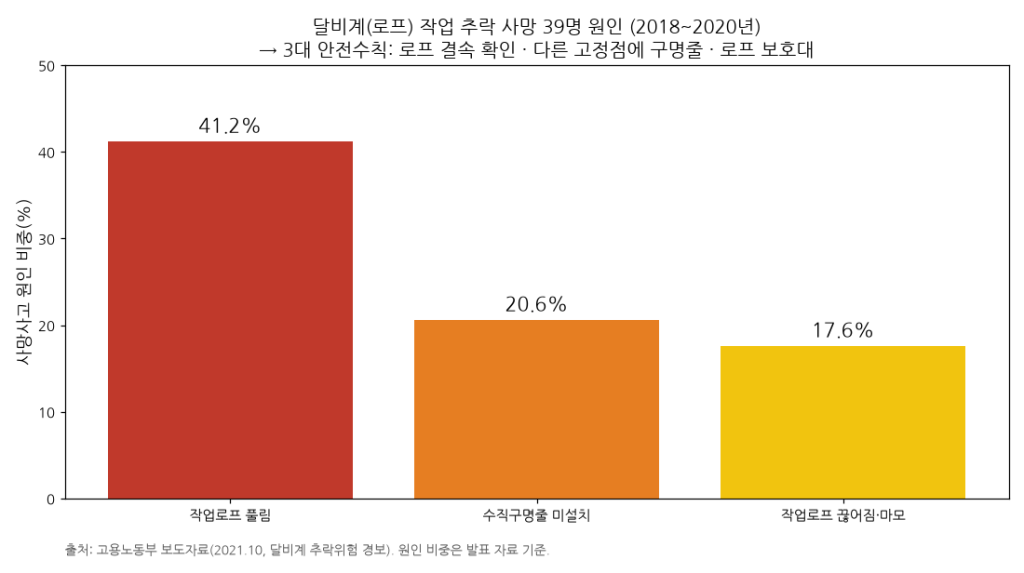
MOEL reported that 39 people died from suspended scaffold falls in 2018-2020, and the causes were work rope coming loose (41.2%), no vertical lifeline (20.6%) and rope damage/wear (17.6%). In September 2021, a worker also died when a rope broke during exterior window cleaning on an apartment. In 2015, after a day laborer fell to his death while cleaning an apartment’s exterior windows, the de facto head of the company, which had not installed a lifeline or harness, received an actual prison sentence of 6 months (Ulsan District Court 2015고단1020). If you start work believing “one rope is enough” or “a lifeline is a waste of time”, people can get hurt and the business owner can face heavy punishment. Never cut safety gear to win jobs cheaply.
Sources
- Easylaw, Building Sanitation Management Business report
- National Law Information Center, Rules on Occupational Safety and Health Standards Art. 63 (suspended scaffolds)
- National Law Information Center, same rules Art. 186 (aerial work platforms)
- National Law Information Center, same rules Art. 42 (fall prevention)
- MOEL press release (posted on KDI Economic Information and Education Center), 12 suspended scaffold fall deaths in 2021
- Safety Info, MOEL’s 3 safety rules for suspended scaffolds and court case
- Newsis, suspended scaffold fall deaths report (Oct 2021)
- Incheon Today, report citing 48 suspended scaffold deaths in 2019-2022
- 4 Major Social Insurances Information Center, industrial accident insurance coverage
- MOEL, Serious Accidents Punishment Act expanded to workplaces with 5+ workers
- aptbid24 (collection of K-apt contractor selection results): https://aptbid24.kr/result/20260729165323449 , https://aptbid24.kr/result/20240814161250027 , https://aptbid24.kr/result/kg2b_76191 , https://aptbid24.kr/result/20240702160803209 , https://aptbid24.kr/result/20250328100824069
- KONEPS opening result (Yongin administrative town exterior glass cleaning)
- KONEPS opening result (South Chungcheong Provincial Office exterior wall cleaning)
- Apartment Management Information System (K-apt)
- KONEPS (나라장터)
7. FAQ
Do I need a national license for window cleaning?
The law does not set a separate national license just for window cleaning. However, a business that cleans buildings of a certain size used by the public needs a Building Sanitation Management Business report, and rope and high work must meet the safety standards in the Rules on Occupational Safety and Health Standards. Check with your city/county/district office whether you must report.
Can I do rope work alone?
It is very dangerous. The law requires the work rope to be tied to 2 or more anchor points, the lifeline to a different anchor point, and prevention of others untying the rope. MOEL also says supervisors must watch rope ties and harness use. Avoid working alone with no one watching on the roof.
How often does work come up each year?
The law sets no required frequency. Apartments and public agencies usually tender on a yearly basis, and the number of cleanings differs by contract. Always check the frequency and scope (glass only, or walls too) in the notice.
In which seasons are accidents most common?
In MOEL's analysis, suspended scaffold deaths in 2018-2020 were most frequent in November (8), May (7) and September (6). Be especially careful in spring and autumn, when good weather concentrates exterior work.
Can cleaning only ground-floor shop windows make money?
The risk and equipment costs are low, but each job is small. There is no published standard price, so amounts vary by region and area. Grouping regular contracts with many shops in one area and doing rounds is efficient.
Last updated: October 30, 2026. Based on official sources; rules and prices can change.
🎁 Free: 7-day starter checklist for earning extra income
Leave your email and get the free checklist now. No spam, unsubscribe anytime.
Popular guides
- Top 10 Ways to Make Money Starting This Week (Free Checklist)
- How to Make Money as a Student: Legit Ideas (2026)
- Passive Income Ideas: Realistic Options for 2026
- Make Money Online Without Investment: 20 Free Ways
- How to Make Money with AI: 50 Practical Ways (2026)
- How to Make Money From Home: 20 Legit Ways
- Make Money Online for Beginners: 15 Easy Ways to Start
- How to Make Money as a Mom: 16 Flexible Ideas (Work Around Nap Time)
- 16 Legit Ways to Make Money Fast (This Week)
- How to Make Money as a Teenager: 16 Safe Ideas
- 14 Remote Jobs With No Experience Needed
Next method: How to Make Money with a Water Tank Cleaning Business in Korea →