Path
Contents
Apartment complexes and large buildings in Korea keep tap water in big storage tanks (저수조), usually in the basement or on the roof. By law, these buildings must clean the tank at least once every six months, so the work comes back twice a year. But not everyone can do it: you need the right staff and equipment, and you must file a water tank cleaning business report with the city, county or district office. This guide explains how to make money with water tank cleaning based on the Water Supply and Waterworks Installation Act (수도법), the government’s Easy Law guide, city notices and public apartment bid results.
In one line: the money comes from the legally required cleaning every six months. To start, you need one cleaning supervisor plus at least two cleaning workers, a high-pressure washer, a wet vacuum and other equipment, and a storage warehouse, then you file a report. Public apartment bids show single contracts awarded at roughly KRW 1.11–3.31 million. Enclosed tanks carry a serious risk of suffocation, so safety comes first.
1. What is a water tank cleaning business?
- You drain the building’s storage tank, scrub or pressure-wash the floor and walls, remove rust, disinfect with chlorine and refill it (Anyang City waterworks guide).
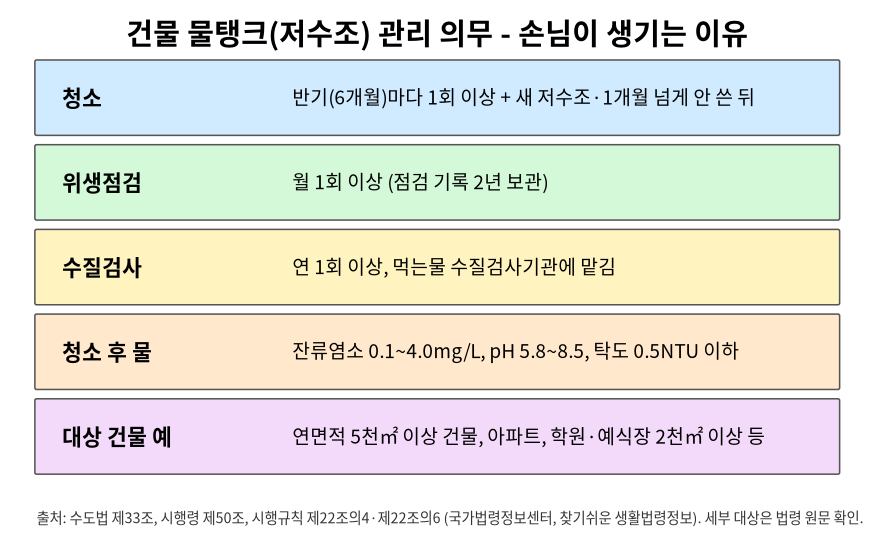
- After cleaning, the water must meet these standards: residual chlorine 0.1–4.0 mg/L, pH 5.8–8.5, turbidity 0.5 NTU or less (Enforcement Rules Art. 22-4).
- Building owners can clean the tank themselves, but most hire a registered water tank cleaning business. That business must put a cleaning supervisor on site (Enforcement Rules Art. 22-5).
- The Ministry of the Interior’s open dataset lists 7,634 water tank cleaning business records, including closed ones (data.go.kr, as of 2025-11-27). Most areas already have competitors.
Why customers need you: cleaning is required by law
- Cleaning: at least once every six months. A new tank, or one unused for over a month, must also be cleaned before use.
- Hygiene check: at least monthly. Water test: at least yearly, by a certified drinking water testing lab.
- Records: keep cleaning, check and test records for two years (Enforcement Rules Art. 22-6).
- Buildings covered (examples): buildings of 5,000 ㎡ or more, multi-use buildings of 2,000 ㎡ or more, offices of 3,000 ㎡ or more, apartment complexes, academies and wedding halls of 2,000 ㎡ or more, large retail stores, and so on (Enforcement Decree Art. 50; parking area excluded).
- A building that breaks these rules faces up to two years in prison or a fine of up to KRW 20 million (Act Art. 83). That is why management offices hire cleaners on a regular schedule.
- Seoul says about 16,000 buildings had storage tanks at the end of 2024 (14,059 large and 2,079 small). A Seoul ordinance also requires small tanks to be cleaned every six months (Seoul City news report).
2. How much does it cost to start?
There is no official average start-up cost. It varies with whether you buy new equipment or already own a vehicle and a warehouse. The legal minimums, however, are fixed (Enforcement Rules Annex 7-3, revised 2026-06-26).
| Item | Legal standard | Note |
|---|---|---|
| Cleaning supervisor | At least 1 | Industrial engineer or higher in environment (water quality), civil engineering, sanitation or chemical engineering; water treatment facility operator license; a related junior college degree (20 related credits); or 3 years in waterworks |
| Cleaning workers | At least 2 | No license required |
| Warehouse | For storing equipment | Ask your local office whether a rented space is accepted |
| Filing fee | None | Processing time 7 days (Easy Law) |
| Training | 8 hours every 5 years | First session within one year of qualifying (Act Art. 36, Decree Art. 52) |
| Equipment | See list below | Varies by supplier quote |
3. Equipment and working tips
The equipment below is required by Annex 7-3. Missing any item can block your filing or lead to penalties later.
- Continuous-discharge wet vacuum ×1: sucks up leftover water and sludge.
- High-pressure washer ×1: at least 18 L/min and 150 kg/㎠.
- Drainage pumps: one of 1 hp or less and one of 5 hp or more.
- Ventilator ×1 (200 ㎥/hour or more), lighting ×1 (DC 24 V or less), earth-leakage breaker ×1.
- Transport vehicle ×1, plus rubber suit, hard hat, safety belt and rope for every worker.
- Simple water test kit (pH, residual chlorine, color, turbidity): needed only if you also do hygiene checks on behalf of owners.
Work steps (simplified from Anyang City’s guide):
1. Post a water outage notice in advance and check workers’ health.
2. Drain the tank, measure the air inside and ventilate.
3. Scrub or pressure-wash the walls and floor; remove rust and peeling paint.
4. Disinfect with chlorine and remove remaining water with the wet vacuum.
5. Refill, check residual chlorine, pH and turbidity, and record the results.
Safety rules: a water tank is a confined space where oxygen can run low or toxic gas can build up. Korea’s Ministry of Employment and Labor says safe air means oxygen of at least 18% and below 23.5%, and hydrogen sulfide below 10 ppm. Never go in without breathing protection to rescue someone who has collapsed; call 119 right away.
4. How much can you earn?
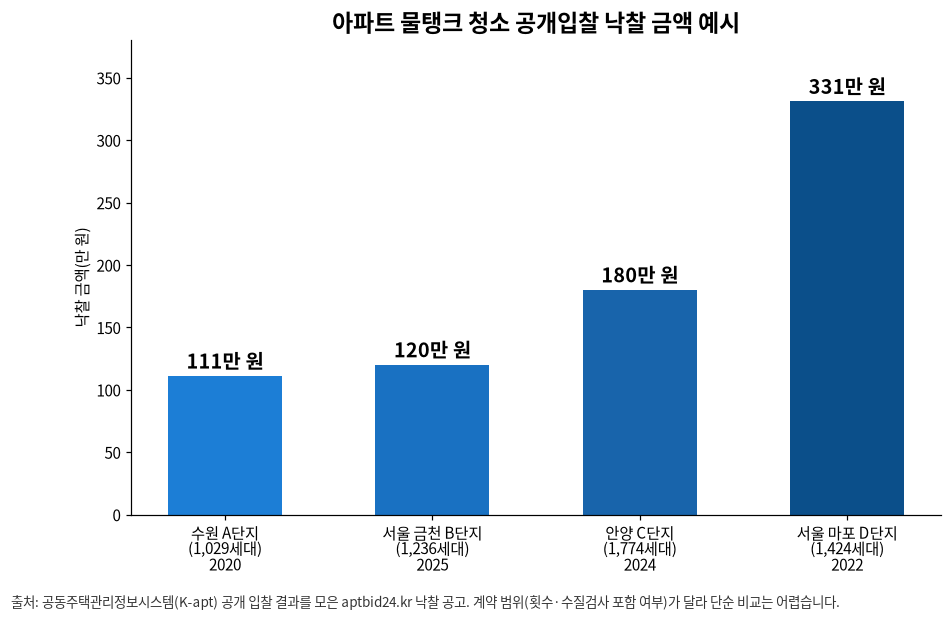
Profit varies by labor cost, equipment loans and local competition. Below are public contract (revenue) examples, before costs.
- Public apartment bids (results published through the K-apt apartment management system)
- Complex A in Suwon (1,029 households): won at KRW 1.11 million in 2020. Nine companies bid between KRW 1.11 million and 1.8 million.
- Complex B in Geumcheon, Seoul (1,236 households): won at KRW 1.2 million in 2025. Six bids ranged from KRW 1.2 million to 2.24 million.
- Complex C in Anyang (1,774 households): won at KRW 1.8 million in 2024.
- Complex D in Mapo, Seoul (1,424 households): won at KRW 3.31 million in 2022.
- The same complex pays different amounts from year to year, and the lowest bid often wins. Contracts differ in how many cleanings and whether water testing is included, so always read the notice.
- One company’s public price list: underground tanks up to 100 tons KRW 600,000; 500–1,000 tons KRW 1.18–1.78 million; household tanks under 5 tons KRW 50,000. Water testing is extra. Prices differ by company, so treat this as a reference only.
- Example calculation: ten complexes at KRW 1.2 million per cleaning, twice a year, bring KRW 24 million in annual revenue. You still have to pay at least three workers, plus the vehicle, equipment, disinfectant and insurance, so actual profit varies. This is not an income promise.
5. How do you find customers?
- Apartment bids: many complexes post tenders for service contracts on the K-apt system. Check notices daily and prepare documents (filing certificate, track record, insurance) in advance.
- Visit management offices and building management firms: reach the facility managers of covered buildings such as office towers, academy buildings, wedding halls and large shopping buildings. Helping them track the next cleaning date and keep records makes renewals easier.
- Work with testing labs: the yearly water test must be done by a certified lab, so a cleaner who also helps with test scheduling is convenient for owners.
- Tank reporting rules: since 2024, a new storage tank must be reported within 30 days, with fines of KRW 500,000–1,000,000 for violations (Korea Apartment News). Explaining such changes builds trust.
- Small buildings: in areas like Seoul, where an ordinance also covers small tanks, small buildings are customers too. Check your local ordinance with the city office.
6. Steps to start 1-2-3
- Build your team: secure one person qualified as a cleaning supervisor (industrial engineer license, water treatment operator license, 3 years in waterworks, etc.) and at least two cleaning workers. If you lack the qualification yourself, hire a supervisor.
- Get equipment and a warehouse, then file: once you meet Annex 7-3, submit the water tank cleaning business report (Form 13) with staff and qualification proof and an equipment list to your city, county or district office. No fee; 7-day processing. Register your business for tax as well.
- Get trained and find your first customer: complete the required training (8 hours every 5 years), train your crew in safety, and buy an oxygen/gas meter. Then start bidding on K-apt and visiting nearby buildings, and keep before-and-after photos and water readings for every job.
8. Watch out for these cases
In confined spaces such as water tanks, people collapse from lack of oxygen or toxic gas. Korea’s labor ministry warns that many deaths happen when coworkers rush in without protection to rescue someone. Always measure and ventilate the air first, and never go in alone. In Seoul’s inspections, the most common violation (59.8%) was a manager who had not completed the required training. If you buy expensive equipment or start work because someone said “training isn’t needed” or “you can file later,” you may end up with fines or a closure order. Check the standards directly with your local office before you start.
Sources
- Easy Law (찾기쉬운 생활법령정보), Water tank cleaning business filing
- Easy Law, Water tank management duties
- Korea Law Information Center, Enforcement Rules Annex 7-3 (facilities, equipment and staff)
- Korea Law Information Center, Enforcement Rules articles
- Wonju City, Water tank cleaning business guide
- Anyang City, How to clean a water tank
- Ansan City, Water tank cleaning business guide
- Public Data Portal, Ministry of the Interior water tank cleaning business dataset
- Seoul City (news), Seoul water tank hygiene inspections
- Korea Apartment News, Water tank reporting rules
- aptbid24 (collection of K-apt bid results): https://aptbid24.kr/result/20250324101419588 , https://aptbid24.kr/result/20200327143646651 , https://aptbid24.kr/result/20240725144655291 , https://aptbid24.kr/result/kg2b_68486
- Ministry of Employment and Labor, Confined space suffocation prevention
7. FAQ
Can I just clean tanks without filing?
No. Running this business without filing can bring a fine of up to KRW 3 million and an order to close (Act Art. 84, Easy Law).
Do I really need a cleaning supervisor?
Every business needs at least one. Any one of these qualifies: an industrial engineer license or higher, a water treatment facility operator license, a related junior college degree, or 3 years in waterworks. Confirm the details with your local office.
How often does the work come?
Covered buildings must clean at least every six months, so usually twice a year per building, plus an extra cleaning for new tanks or tanks unused for over a month.
What happens if I fall short of the standards?
Penalties range from a warning to a 15-day or one-month suspension, up to closure. One city notes that a closed business cannot file again for one year (Ansan City).
Do we do the water test too?
The yearly test must be done by a **certified drinking water testing lab**. Cleaners take simple readings after cleaning (residual chlorine, pH, turbidity) and can connect owners to a lab for the official test.
Last updated: October 30, 2026. Based on official sources; rules and prices can change.
🎁 Free: 7-day starter checklist for earning extra income
Leave your email and get the free checklist now. No spam, unsubscribe anytime.
Popular guides
- Top 10 Ways to Make Money Starting This Week (Free Checklist)
- How to Make Money as a Student: Legit Ideas (2026)
- Passive Income Ideas: Realistic Options for 2026
- Make Money Online Without Investment: 20 Free Ways
- How to Make Money with AI: 50 Practical Ways (2026)
- How to Make Money From Home: 20 Legit Ways
- Make Money Online for Beginners: 15 Easy Ways to Start
- How to Make Money as a Mom: 16 Flexible Ideas (Work Around Nap Time)
- 16 Legit Ways to Make Money Fast (This Week)
- How to Make Money as a Teenager: 16 Safe Ideas
- 14 Remote Jobs With No Experience Needed
Next method: How to Make Money with an Air Conditioner Cleaning Business in Korea →