Path
At a glance
Contents
Beekeeping means raising honeybees to get products such as honey, pollen, propolis and royal jelly, or to help with pollination. You can start without owning much land, but you must learn about legal registration, bee pest control and sting safety. This article explains how to make money with beekeeping in Korea, based on official sources.
One-line summary: Making money with beekeeping follows this order: “learn the basics through training → register as a beekeeping farm → manage varroa mites and hornets → sell honey with quality grading and direct sales.”
1. What is beekeeping?
- It is a type of livestock farming in which you keep honeybee colonies in hives to get honey and other products. One hive (one queen plus a group of worker bees) is counted as “1 colony.”
- In Korea, people keep Western honeybees and native Korean bees (Asian honeybees).
- There is migratory beekeeping, where hives are moved to follow flowering seasons, and stationary beekeeping, where hives stay in one place.
Beekeeping in Korea today
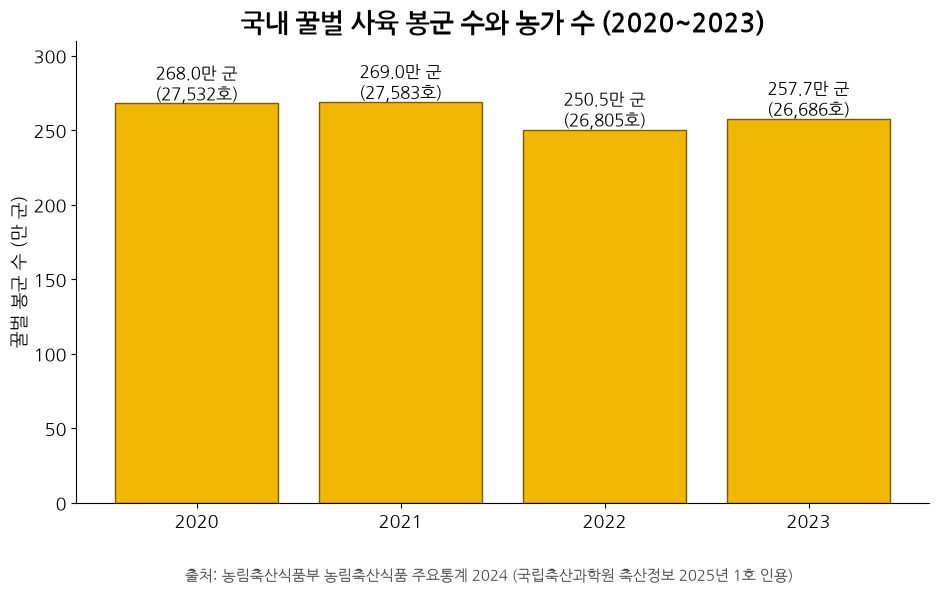
According to the Ministry of Agriculture, Food and Rural Affairs’ key statistics (cited in the National Institute of Animal Science’s livestock information), the number of bee colonies and farms was:
| Year | Colonies | Farms |
|---|---|---|
| 2020 | 2.680 million | 27,532 |
| 2021 | 2.690 million | 27,583 |
| 2022 | 2.505 million | 26,805 |
| 2023 | 2.577 million | 26,686 |
According to Rural Development Administration (RDA) material (2023 policy briefing), Korea’s colony density is high at 21.8 colonies per km², and honey production in 2021 was about 16,000 tonnes.
2. Laws you must know: the Beekeeping Industry Act and the Livestock Industry Act
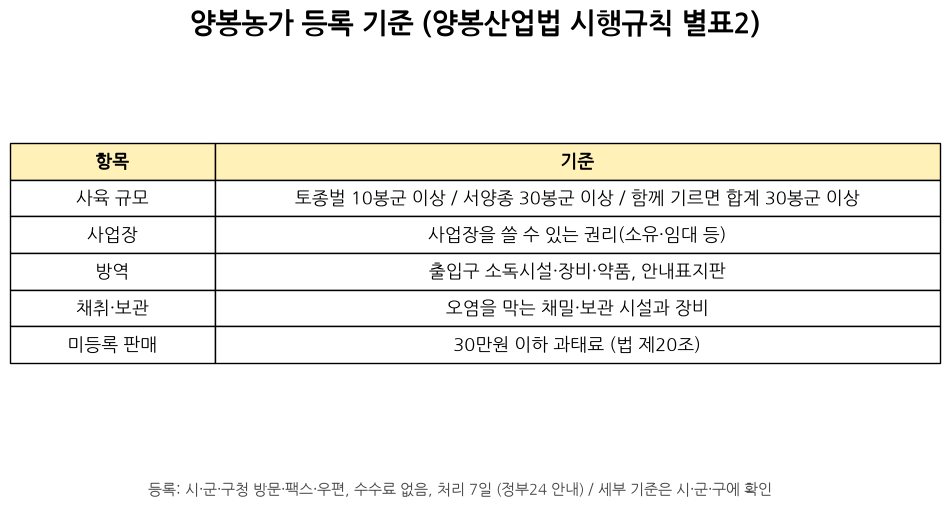
- Beekeeping farm registration (Beekeeping Industry Act, Art. 13): If you keep bees above a certain scale, you must register as a beekeeping farm with the mayor, county head or district head. The criteria are in Annex 2 of the Enforcement Rule (see the image above).
- Colony size: 10+ native-bee colonies, 30+ Western-bee colonies, or 30+ in total if keeping both
- Right to use the site (ownership, lease, etc.), biosecurity facilities (disinfection facility, equipment, chemicals, signboard), and contamination-preventing extraction and storage facilities
- How to apply: According to Gov24, you apply at the city/county/district office in person, by fax or by mail. It is free, and processing takes 7 days.
- Succession report (Art. 14): If you take over a beekeeping farm, you must report within 30 days.
- Fines (Art. 20): Selling bee products without registering, or failing to report changes or succession, can lead to a fine of up to 300,000 won.
- Relation to the Livestock Industry Act: Honeybees are excluded from livestock-raising business registration under the Livestock Industry Act. Instead, you register as a beekeeping farm under the Beekeeping Industry Act.
- Agricultural business entity registration: According to the National Agricultural Products Quality Management Service, you can register as an agricultural business entity if you hold a beekeeping farm registration certificate or sell at least 1.2 million won of farm/livestock products a year. Local government support programs are often available only to registered farms (e.g., Jangsu County’s provincial subsidy notice).
※ Laws can change. Check the latest details at the National Law Information Center and your city/county/district livestock department.
3. How much does it cost to start?
I could not find official statistics on start-up costs for beekeeping. Costs vary widely with the number of colonies, the level of hives and equipment, and whether you rent land. Items you need:
| Item | Details | Note |
|---|---|---|
| Bees (colonies) | Western or native bees | Registration threshold is 30+ Western colonies |
| Hives and frames | Hive boxes, foundation, covers | One set per colony |
| Protective gear | Veil, bee suit, gloves, smoker | Safety essential |
| Extraction equipment | Extractor, bee brush/blower, strainer, storage containers | Contamination-prevention standards apply |
| Biosecurity | Mite treatments, hornet traps, disinfection | Regular expense |
| Site | Apiary land (owned or leased) | Migratory beekeeping needs a vehicle |
| Training | Agricultural Technology Center or association courses | Varies by region |
4. What equipment do I need?
- Hives and frames: Where the bees live.
- Smoker: Calms bees with smoke.
- Veil, bee suit, gloves: Basic gear to reduce stings.
- Hive tool: For prying open lids and frames.
- Extractor, strainer, storage containers: For extracting, filtering and storing honey.
- Hornet traps and control tools: Reduce hornet damage from summer to autumn.
5. What does the yearly schedule look like?
According to the RDA’s Nongsaro beekeeping work schedule, tasks change by season. Roughly (varies by region and climate):
- Spring: Check colonies after winter, add feed, build up colonies
- Late spring to early summer: Main flowering season (e.g., black locust), honey extraction
- Summer: Varroa mite control — the RDA stresses treatment in July and intensive control from June to October
- Summer to autumn: Prepare for hornet damage
- Autumn to winter: Prepare for wintering, check food stores
6. How much can I earn?
Beekeeping income varies greatly each year depending on the number of colonies, that year’s flowering and weather, bee losses, and sales method (wholesale vs. direct). This article does not list unverified amounts. Look up crop-specific income data in the “income information” menu on the RDA’s Nongsaro and consult your local Agricultural Technology Center.
7. How to sell honey
- Honey quality grading: The Korea Institute for Animal Products Quality Evaluation grades honey as 1+, 1 or 2. You submit a 500 g sample, and the process goes through participating businesses such as food repackaging businesses. A grade label builds customer trust.
- Direct sales: Local food stores, farmers’ markets, online shops.
- Wholesale: Sell to beekeeping cooperatives or buyers.
- Check before selling: If you repackage honey into jars to sell, you may need a food-business report. Check with your city/county/district hygiene department first.
- Careful with ads: Don’t claim honey cures diseases.
8. Step-by-step start
Step 1 – Learn
1. Find out whether your local Agricultural Technology Center or the Korea Beekeeping Association runs beekeeping courses (courses and schedules vary by region).
2. Help out at an experienced beekeeping farm to see a full year’s cycle.
Step 2 – Start small
1. Choose an apiary site and check whether there are many homes or pesticide-sprayed fields nearby.
2. Start with a few colonies and learn how to manage them.
Step 3 – Register
1. Once you meet the criteria (e.g., 30+ Western colonies), register as a beekeeping farm at the city/county/district office.
2. Look into agricultural business entity registration too.
Step 4 – Manage and sell
1. Put mite and hornet control dates on a calendar and stick to them.
2. After extracting honey, try quality grading and build direct sales channels.
Watch out for these damage cases
Some people may tell would-be beekeepers that “just buy hives and the honey comes by itself and makes money,” pushing them to buy expensive hives and colonies all at once or collecting management fees up front. Honey production changes a lot from year to year with weather and pests, so don’t trust anyone who promises a fixed return. When buying colonies, open the hive yourself to check its condition (queen, pests and diseases), and keep the contract and receipts. If you suffer damage, you can get advice from the 1372 Consumer Counseling Center.
Sources
- National Law Information Center – Beekeeping Industry Act Enforcement Rule, Annex 2 (registration criteria)
- Act on the Promotion and Support of the Beekeeping Industry (text)
- Gov24 – Beekeeping farm registration
- National Law Information Center – Livestock Industry Act, livestock-raising business registration
- National Agricultural Products Quality Management Service – Agricultural business entity registration
- National Institute of Animal Science – Livestock information (bee statistics)
- Korea Policy Briefing – RDA varroa mite control guidance
- Korea Institute for Animal Products Quality Evaluation – Honey grading process
- RDA Nongsaro – Beekeeping work schedule
- RDA Nongsaro – Income information
- RDA – Hornet damage prevention
- Jangsu County – Beekeeping farm support notice
- Korea Beekeeping Association
9. FAQ
How many colonies before I must register?
Under Annex 2 of the Enforcement Rule, 10+ native-bee colonies, 30+ Western-bee colonies, or 30+ in total when keeping both.
What happens if I sell honey without registering?
Under Article 20 of the Beekeeping Industry Act, you may be fined up to 300,000 won.
What are varroa mites and why do they matter?
They are parasites that live on honeybees and weaken colonies. The RDA has warned about resistance to some treatments (such as fluvalinate) and advises rotating treatments and doing intensive control in summer.
I'm worried about bee stings.
Always wear a veil, bee suit and gloves, and avoid working alone. If you are worried about bee allergies, talk to a medical professional before starting. This article does not give medical advice.
Can I keep bees in a city?
It depends on the location and neighbors. Rules and complaint handling differ by local government, so ask your city/county/district office first.
Last updated: October 30, 2026. Based on official sources; rules and prices can change.
🎁 Free: 7-day starter checklist for earning extra income
Leave your email and get the free checklist now. No spam, unsubscribe anytime.
Popular guides
- Top 10 Ways to Make Money Starting This Week (Free Checklist)
- How to Make Money as a Student: Legit Ideas (2026)
- Passive Income Ideas: Realistic Options for 2026
- Make Money Online Without Investment: 20 Free Ways
- How to Make Money with AI: 50 Practical Ways (2026)
- How to Make Money From Home: 20 Legit Ways
- Make Money Online for Beginners: 15 Easy Ways to Start
- How to Make Money as a Mom: 16 Flexible Ideas (Work Around Nap Time)
- 16 Legit Ways to Make Money Fast (This Week)
- How to Make Money as a Teenager: 16 Safe Ideas
- 14 Remote Jobs With No Experience Needed
Next method: How to Make Money with Elastic Coat Painting (Korea) →