Path
At a glance
Contents
“Gwieo” means a city dweller moving to a fishing village to start a fisheries business such as boat fishing, aquaculture, or seafood processing and distribution. The government offers training, counseling and start-up/housing loans for new fishers. This article explains how to make money with gwieo, based on official sources such as the Ministry of Oceans and Fisheries, the Return-to-Fishing-Village Center and the national statistics office.
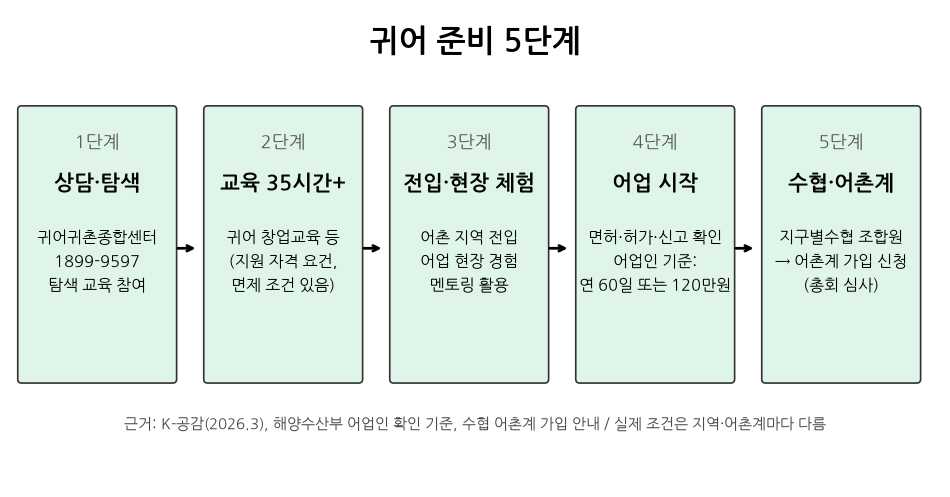
One-line summary: Making money with gwieo follows this order: “counseling and training → moving to a fishing village and hands-on experience → starting fishing after checking licenses and permits → joining Suhyup and the fishing village society.” You can borrow up to 300 million won in start-up funds at a fixed 1.5% rate.
1. What is gwieo?
- Moving from a city to a fishing village to run fishing, aquaculture, salt production, or seafood processing and distribution.
- Fishing village businesses such as marine tourism and marine leisure are also eligible for government support.
- There are criteria for being recognized as a “fisher” (see section 4).
Gwieo today
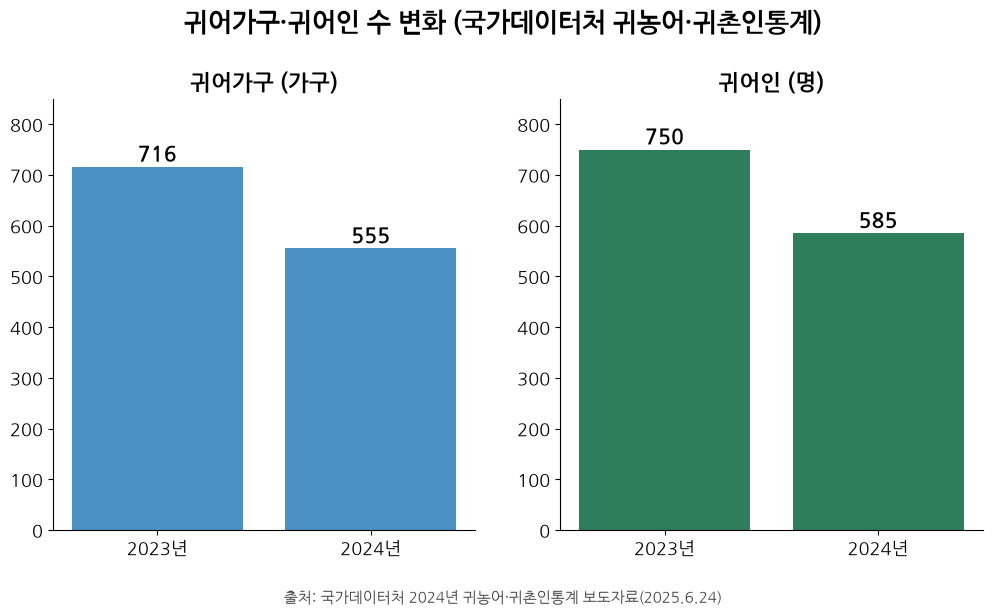
According to the national statistics office’s 2024 statistics on people returning to farming/fishing villages, gwieo households numbered 555, down 22.5% from the previous year (716), and gwieo individuals numbered 585 (750 the year before). Also, 180 people who moved for fishing over the past 5 years returned to cities, and 1,200 people who moved to rural areas started fishing. Since the numbers are small, careful preparation matters.
2. How much does it cost to start?
Costs differ greatly depending on what you do: buying a boat, renting a fish farm or finding a house all make a big difference, and I could not find an official average. Instead, there is a government loan program.
| Item | Details | Note |
|---|---|---|
| Gwieo start-up fund | Loan up to 300 million won | Fishing, aquaculture, salt, processing, distribution, village business |
| Housing fund | Loan up to 75 million won per household | Purchase, new build, remodeling |
| Interest and repayment | 1.5% fixed, 5-year grace then 10-year installments | Interest gap covered by the Ministry of Oceans and Fisheries |
| Boat and equipment | Boat, fishing gear, aquaculture facilities | Varies by fishery type |
| Housing and living costs | Early living expenses after moving | Needed until income starts |
Loan eligibility (2026, per the Ministry and Gov24)
- Gwieo fishers (including those planning to start) and non-fishers living in fishing villages, aged 65 or under. People 66 or older can also apply if they completed 35+ hours of gwieo start-up training by age 65 (training valid for 5 years).
- The housing fund has no age limit, but non-fishers living in fishing villages are not eligible for it.
- You must apply within 5 years of moving to a rural/fishing area, and you cannot get double support if you previously received gwieo or gwinong start-up/housing funds.
- The loan is disbursed by Suhyup with collateral after the project is (partly) completed. Apply in person at the city/county/district fisheries department.
- Application periods and remaining budget differ by local government, so check your city/county notice (e.g., Jindo County’s 2026 notice).
3. What equipment do I need?
It depends on the type of fishery, but usually:
- Boat fishing: A fishing boat, fishing gear (nets, traps, etc.), safety equipment (life jackets, etc.)
- Aquaculture: A fish farm (license required), cages or lines, feed and management equipment
- Processing and distribution: Space for cleaning and packing, refrigeration/freezing, a delivery vehicle
- In every case, first check whether you need a fishery license, permit or report (Fisheries Act, etc.; see the National Law Information Center).
4. Fisher recognition and joining the fishing village society
Fisher recognition
According to the Ministry of Oceans and Fisheries, to be recognized as a fishery business operator you need annual seafood sales of 1.2 million won or more or at least 60 days a year engaged in fishing. You prove this with port entry/exit report days, fishing village society records, sales receipts, etc. The fisher confirmation is issued within 10 days and is valid for 3 months.
Joining Suhyup and the fishing village society (eochongye)
- An eochongye is an organization that jointly manages village fishing grounds. According to the Ministry, at the end of 2016 there were 2,029 societies with 132,990 members.
- According to Suhyup, to join a society you must be a member of the regional Suhyup (address or business in the area and at least 60 days of fishing a year) and live within the society’s area.
- Process: application → society head → general meeting review → written approval → entry in the member list
- Members have duties such as sharing costs and labor, and you can be expelled if you don’t use the society’s business for over a year.
- Each village has its own atmosphere and rules, so talk with the society before you move.
5. How much can I earn?
According to the national statistics office’s 2024 Fishery Household Economy Survey, average fishing household income was 63.652 million won (up 16.2% year on year) and household spending was 35.821 million won. Average assets were 533.868 million won and debt 70.826 million won.
However, these are averages for all existing fishing households. Income for a new gwieo fisher varies widely by fishery type, region, catch, weather and market prices, and it may be low for the first few years.
6. How to find customers (selling seafood)
- Suhyup auction markets: The basic route for selling your catch through auctions.
- Direct sales: Online shops, local direct-sale stores, regular customers.
- Processed goods: Dried or cleaned products keep longer (check food-business reporting requirements).
- Fishing village tourism: Can be combined with fishing experiences, guesthouses and marine leisure.
7. Step-by-step start
Step 1 – Counseling and exploration
1. Call the Return-to-Fishing-Village Center (1899-9597, weekdays 09:00–18:00, run by the Korea Fisheries Infrastructure Public Agency).
2. Look for the exploration course and mentoring programs on the center’s website.
Step 2 – Training
1. Complete 35+ hours of gwieo start-up training (a loan condition for those 66+; also check the training requirements in your local notice).
2. Look into fishing village schools in Gyeonggi, Gangwon, Gyeongbuk, Gyeongnam and elsewhere.
Step 3 – Moving in and hands-on experience
1. Pick a village and try living there briefly or learn alongside local fishers.
2. Register your move and talk with the fishing village society.
Step 4 – Start fishing
1. Check and obtain the licenses, permits or reports for your fishery.
2. Acquire boats and fish farms through official procedures, and apply for the start-up loan at the city/county/district office if needed.
Step 5 – Join Suhyup and the society
1. Keep records of fishing days and sales to get fisher recognition, then join Suhyup and the fishing village society.
Watch out for these damage cases
The Ministry of Oceans and Fisheries warned of cases in which unregistered fishing-boat brokers took premiums and purchase money, and advised people to use registered fishing-boat brokers and the official fishing-boat trading system (www.어선거래.kr). There have also been news reports of fraud in which people took money for selling fishing permits and disappeared. When buying a boat or fishing rights, check the license/permit name and whether it can be transferred directly with the city/county/district office, and keep contracts and transfer records. Also be careful of places pushing expensive courses or consulting with claims like “gwieo makes you rich.” Official training and counseling are available from the Return-to-Fishing-Village Center.
Sources
- Korea Policy Briefing K-Gonggam – 2026 gwieo start-up and housing support
- Gov24 – Gwieo start-up and housing support program
- Jindo County – 2026 gwieo start-up and housing support notice
- Return-to-Fishing-Village Center
- Ministry of Oceans and Fisheries – Fisher confirmation FAQ
- Ministry of Oceans and Fisheries – Fishing village society FAQ
- Suhyup – Joining a fishing village society
- National statistics office – 2024 statistics on returning farmers/fishers
- National statistics office – 2024 Fishery Household Economy Survey
- Ministry of Oceans and Fisheries – Fishing boat trading fraud warning (2020-09-28)
- Seoul Shinmun – Fishing permit sale fraud report (2023-11-28)
- National Law Information Center (Fisheries Act, etc.)
8. FAQ
Can older people get the gwieo start-up fund?
The basic limit is age 65 or under. People 66+ can apply if they completed 35+ hours of gwieo start-up training by 65 (valid 5 years), and the housing fund has no age limit.
Is the start-up fund free money?
No. It is a loan at a fixed 1.5% rate, repaid in installments over 10 years after a 5-year grace period. Suhyup requires collateral.
What are the criteria for being recognized as a fisher?
Annual seafood sales of 1.2 million won or more, or at least 60 days a year of fishing, proven with port records, receipts, etc.
Can I join a fishing village society right away?
You must be a regional Suhyup member and live within the society's area, and pass a general meeting review. Conditions may differ by village.
I don't know where to begin.
Start with a phone consultation at the Return-to-Fishing-Village Center (1899-9597). They can guide you on training, mentoring and local information.
Last updated: October 30, 2026. Based on official sources; rules and prices can change.
🎁 Free: 7-day starter checklist for earning extra income
Leave your email and get the free checklist now. No spam, unsubscribe anytime.
Popular guides
- Top 10 Ways to Make Money Starting This Week (Free Checklist)
- How to Make Money as a Student: Legit Ideas (2026)
- Passive Income Ideas: Realistic Options for 2026
- Make Money Online Without Investment: 20 Free Ways
- How to Make Money with AI: 50 Practical Ways (2026)
- How to Make Money From Home: 20 Legit Ways
- Make Money Online for Beginners: 15 Easy Ways to Start
- How to Make Money as a Mom: 16 Flexible Ideas (Work Around Nap Time)
- 16 Legit Ways to Make Money Fast (This Week)
- How to Make Money as a Teenager: 16 Safe Ideas
- 14 Remote Jobs With No Experience Needed
Next method: How to Make Money with Beekeeping in Korea →