Path
At a glance
Contents
Black goats are small and eat grass well, so they can be raised even on a small farm. But goat farming also legally requires livestock farming business registration, and the meat can only be sold after slaughter at a licensed slaughterhouse. This guide explains how to make money with black goat farming in Korea in plain words, based on the Ministry of Agriculture, Food and Rural Affairs (MAFRA), an analysis by the National Institute of Animal Science, and guidance from the Livestock Environment Management Institute. The key to making money with black goats is: “register first, start small, manage feed costs, and sell through official channels.”
In one line: Goats must be registered as a livestock farming business regardless of farm size, and 6 hours of training are required before registration. In a 2024 National Institute of Animal Science analysis, farms with fewer than 300 goats earned 1.7 times more income per head than large farms, but feed-cost increases and imported goat meat make profits vary greatly from farm to farm.
1. What it is
- You raise black goats (such as native Korean black goats), breed them, and sell grown goats for meat through livestock markets or slaughterhouses.
- In February 2026 MAFRA announced a “Goat Industry Development Plan,” including recognizing the native black goat as an indigenous livestock breed, developing a new meatier breed (from 50 kg at 13–15 months to a target of 55 kg at 12 months), dedicated regional slaughterhouses, and more livestock-market auctions.
- This guide covers raising black goats for meat. It does not cover health-food claims.
| What to do | Details | Basis |
|---|---|---|
| Livestock farming registration | Goats (including dairy goats) must be registered with the city/county/district regardless of area | Livestock Industry Act Art. 22(3), Agricultural Education Portal guide |
| Livestock training | 6 hours of new-farmer training within 2 years before registration (in person KRW 10,000, online free), then 6 hours of refresher training every 2 years | Agricultural Education Portal |
| Facility requirements | A ventilated housing facility (a fence if raised without buildings), an entrance disinfector and a footbath | Livestock Environment Management Institute Q&A |
| Livestock manure discharge facility | A report may be required depending on size (e.g., Wonju City guide: sheep housing of 200㎡ or more, or 50 or more grazing sheep/deer) | Livestock Manure Act, Wonju City guide (check with your local government whether and how it applies to goats) |
| Slaughter and sales | Only meat slaughtered at a licensed slaughterhouse may be distributed | Livestock Products Sanitary Control Act (Incheon City enforcement notice) |
- The Livestock Industry Act has no standard for adequate housing area for goats. For reference, the (optional) animal welfare certification standard is 2.5㎡ per adult goat, 0.5㎡ per growing goat, and 3.0㎡ per doe with kids (Livestock Environment Management Institute).
2. Start-up costs
We did not find official average start-up cost figures. Costs vary greatly with whether you own land, whether you build a new barn, and how many goats you start with (varies).
| Item | Description | Note |
|---|---|---|
| Land and barn | A ventilated barn or fenced pasture | Check building and manure permits/reports, varies |
| Disinfection facilities | Entrance disinfector, footbath | Registration requirement, varies |
| Buying goats (stocking) | Does and bucks | Depends on livestock-market prices, varies |
| Feed and hay | Compound feed, hay, roughage | One of the largest costs, varies |
| Water and feeding equipment | Waterers, feed troughs, hay racks | varies |
| Training | 6 hours of new-farmer training | In person KRW 10,000, online free |
3. Facilities and management tips
- Barn: the registration requirement is “a ventilated facility,” so choose a barn with good airflow.
- Fence: if you only graze without a barn, a fence is a registration requirement. Goats jump well, so build it sturdy and high.
- Disinfection: set up an entrance disinfector and a footbath, and record outside vehicles and visitors.
- Disease: MAFRA said it is pushing to develop vaccines for goat diseases. If you see signs of illness, consult a veterinarian and use medicines only as directed.
- Records: keep records of birth dates, dams, weights, feed amounts and sales so you know your real income and costs. The government is also considering a goat traceability system.
4. How much can you earn?
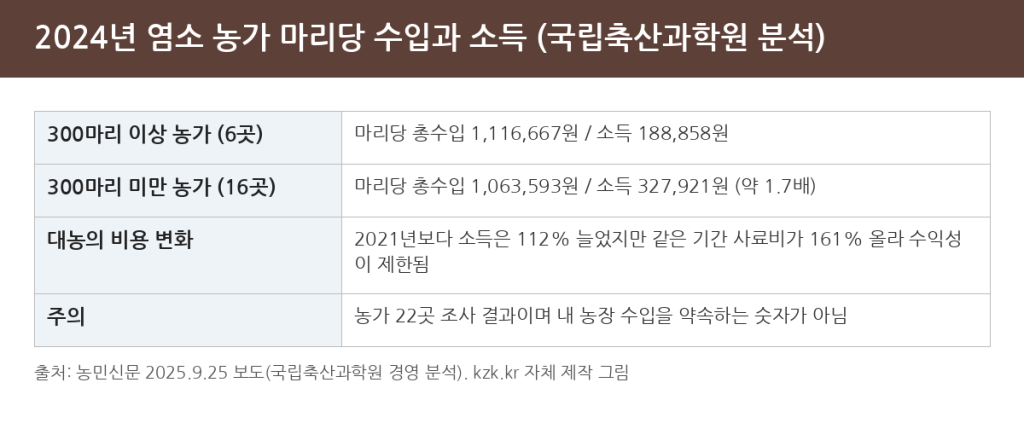
Results of the National Institute of Animal Science’s analysis of 22 goat farms in 2024 (reported by Nongmin Shinmun on Sept. 25, 2025) are below. These are averages of the surveyed farms, not a promise of your farm’s income.
- Farms with 300+ goats (6 farms): total revenue per head KRW 1,116,667; income per head (revenue minus operating costs) KRW 188,858
- Farms with fewer than 300 goats (16 farms): total revenue per head KRW 1,063,593; income per head KRW 327,921 (about 1.7 times the large farms)
- Reasons cited for small and mid-size farms: lower feed costs by using local by-products and wild grass (roughage), and lower labor costs through family labor.
- Large farms’ income rose 112% compared with 2021, but feed costs rose 161% over the same period, limiting profitability.
- Risks: Australian goat meat enters tariff-free under the Korea–Australia FTA, and it was pointed out that many goat farms are unlicensed or unregistered.
5. How to sell
- Livestock-market auctions: MAFRA said it will expand auctions at livestock markets and provide online price information. Check your local market’s schedule and prices first.
- Licensed slaughterhouse → meat sales: to sell meat yourself, it must be slaughtered at a licensed slaughterhouse. Incheon City announced it caught a case of unlicensed goat slaughter. Ask your local government whether you need a separate business license or report (such as a livestock products sales business) to process or sell meat.
- Follow country-of-origin labeling: when selling to restaurants or shops, domestic/imported labeling must be accurate. False labeling is a criminal offense.
- Regular buyers: steady deals with goat restaurants and local butchers can reduce price swings. Agree on shipping schedules and weight standards in advance.
6. Getting started, step by step
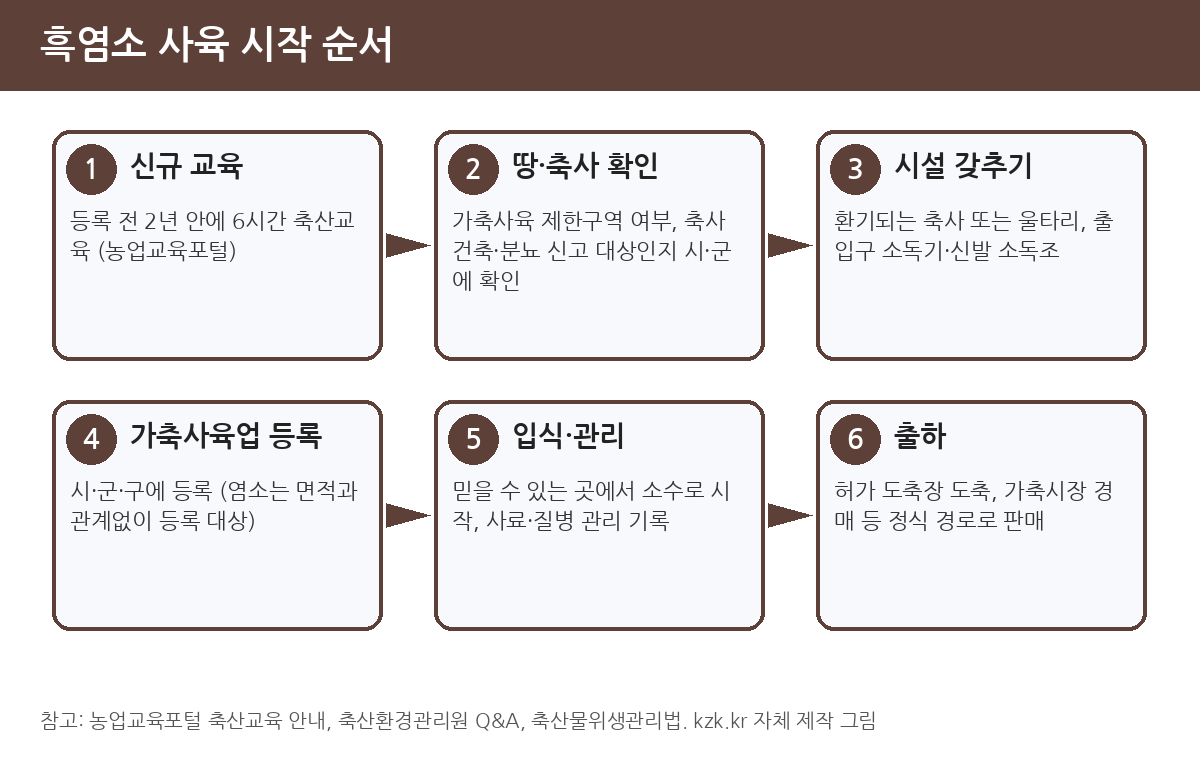
- Training and field study: take the 6-hour new-farmer livestock training on the Agricultural Education Portal, and visit nearby goat farms and livestock markets to see real management and prices.
- Check land and register: ask the city/county office whether the land is in a livestock-restricted zone and whether you need barn building permits or a manure discharge facility report, then set up the facilities (barn/fence/disinfection) and register as a livestock farming business.
- Start small and keep records: start with a few goats, record feed costs, deaths and sales for a year, check whether you earn income per head, then expand.
Watch out for these reported problems
In an enforcement campaign from April 20 to May 20, 2026, the National Agricultural Products Quality Management Service caught 73 businesses violating country-of-origin labeling, of which 17 involved goat meat (12 false labeling, 5 no labeling). 26 were criminally charged, and KRW 13.7 million in fines were imposed on those that failed to label. False origin labeling is punishable by up to 7 years in prison or a fine of up to KRW 100 million, and failure to label by a fine of KRW 50,000 to 10 million. Businesses passing off imported meat as domestic can shake prices for honest farmers, so be careful when choosing buyers. The Financial Supervisory Service has also warned about illegal fundraising scams that pose as farming associations, promise “30–70% annual returns, principal guaranteed,” pay dividends at first, and then disappear. If someone invites you to invest in “goats we raise for you, with high returns,” contact the Financial Supervisory Service (1332) before putting in money.
Sources
- MAFRA – Goat Industry Development Plan press release (2026.2.24)
- Agricultural Education Portal – Livestock training guide (registration, new and refresher training)
- Livestock Environment Management Institute – Q&A on goat livestock farming registration requirements
- Wonju City – Livestock manure discharge facility report/permit guide
- Nongmin Shinmun – Goat farm business analysis (National Institute of Animal Science symposium, 2025.9.25)
- Nongmin Shinmun – Goat traceability review and barn legalization status (2026.1.20)
- Incheon Metropolitan City – Unlicensed goat slaughter enforcement notice
- MAFRA – Country-of-origin labeling enforcement results (2026.5.28)
- Newsway – FSS warning on illegal fundraising posing as farming associations (2015.12.2)
7. FAQ
Do I need to register even if I keep only a few goats?
Yes. According to the Agricultural Education Portal, goats (including dairy goats) must be registered as a livestock farming business regardless of facility area. You must complete 6 hours of new-farmer training within 2 years before registering.
Where do I take the training?
The Agricultural Education Portal (farmedu.kr) provides livestock training information. New-farmer training costs KRW 10,000 in person and is free online; after registration you take 6 hours of refresher training every 2 years.
How many ㎡ of barn do I need?
The Livestock Industry Act has no adequate-area standard for goats. For (optional) animal welfare certification, you must meet standards such as 2.5㎡ per adult goat. Check manure discharge facility report thresholds with your local government.
Can I slaughter my goats myself and sell the meat?
No. Goat meat may be distributed only if slaughtered at a licensed slaughterhouse (Livestock Products Sanitary Control Act). Incheon City caught a case of 13 goats being slaughtered without a license.
Is black goat farming profitable?
It differs by farm. In the 2024 analysis, farms with fewer than 300 goats earned KRW 327,921 per head, but feed costs rose sharply and you compete with imported goat meat. Start small and check your own farm's numbers.
Last updated: October 30, 2026. Based on official sources; rules and prices can change.
🎁 Free: 7-day starter checklist for earning extra income
Leave your email and get the free checklist now. No spam, unsubscribe anytime.
Popular guides
- Top 10 Ways to Make Money Starting This Week (Free Checklist)
- How to Make Money as a Student: Legit Ideas (2026)
- Passive Income Ideas: Realistic Options for 2026
- Make Money Online Without Investment: 20 Free Ways
- How to Make Money with AI: 50 Practical Ways (2026)
- How to Make Money From Home: 20 Legit Ways
- Make Money Online for Beginners: 15 Easy Ways to Start
- How to Make Money as a Mom: 16 Flexible Ideas (Work Around Nap Time)
- 16 Legit Ways to Make Money Fast (This Week)
- How to Make Money as a Teenager: 16 Safe Ideas
- 14 Remote Jobs With No Experience Needed
Next method: Overseas Case: How to Make Money with a U-Pick Farm in the USA →