Path
At a glance
Contents
Korean gim (laver) is so popular worldwide that exports reached about USD 1 billion (USD 997 million) in 2024. More people are interested in laver farming, but you can’t farm in just any sea: you need an aquaculture license, and raw laver prices swing widely from year to year. This guide explains how to make money with laver farming in Korea in plain words, based on Ministry of Oceans and Fisheries (MOF) announcements, the Aquaculture Industry Development Act, and news reports. The key to making money with laver farming is: “secure a license (or a leased public farm) first, learn in a fishing village first, and prepare for price crashes.”
In one line: Laver farming requires a seaweed aquaculture license from the mayor, county head or district head, and new licenses are issued only within the government’s development plan. Exports grew, but in 2025 raw laver prices fell sharply from the year before, even leading to discarded harvests, so income differs greatly from year to year.
1. What it is
- You install laver nets in the sea, attach laver spores (seeding), grow them, then harvest raw laver from winter to spring and sell it at Suhyup (fisheries cooperative) production-area auction markets and elsewhere.
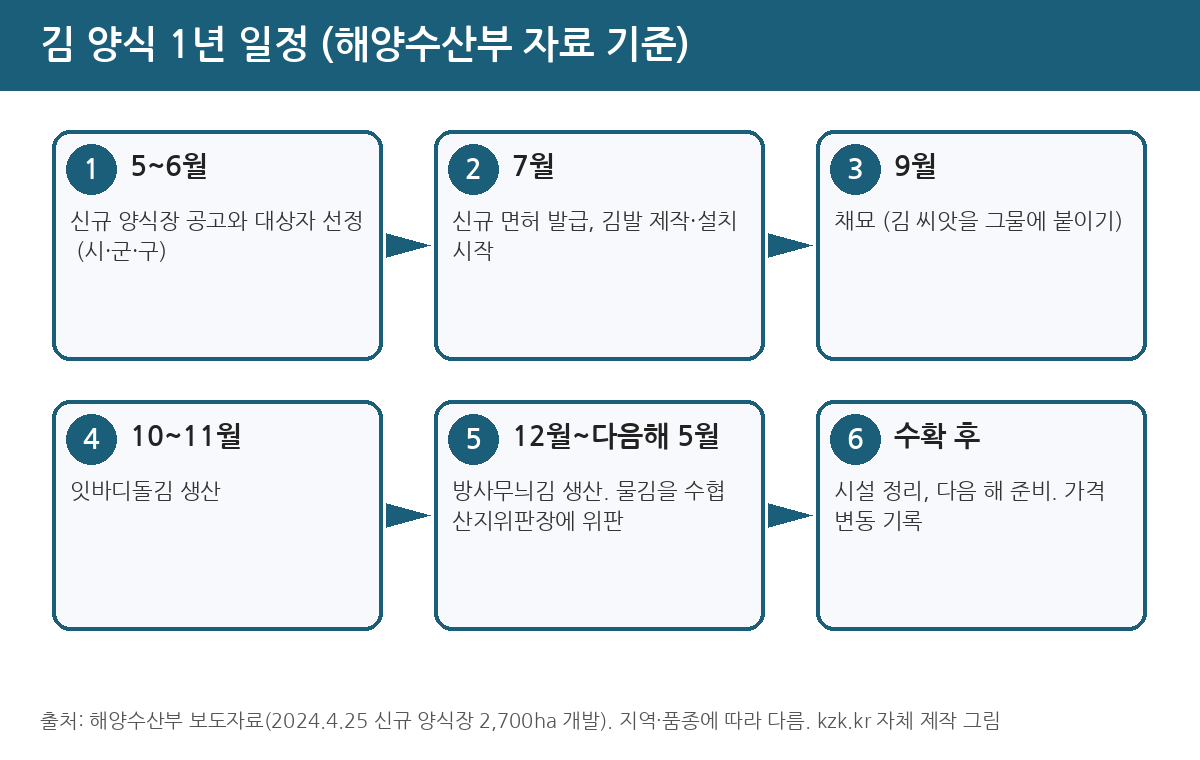
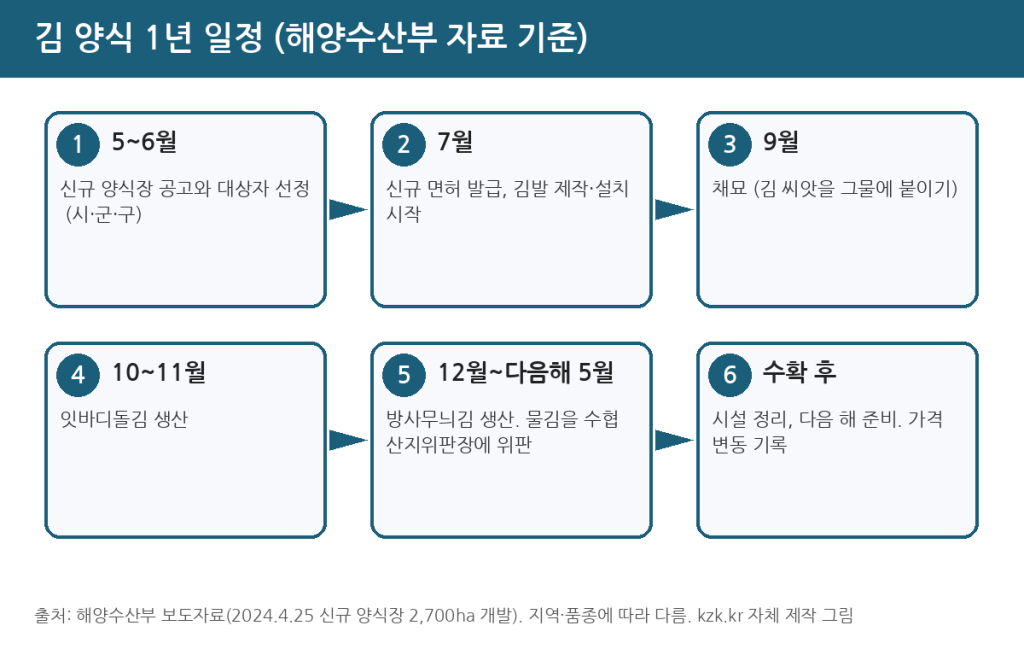
- According to MOF, the usual schedule is May–June new farm notice and selection → July license and net installation → September seeding; Pyropia dentata is produced in October–November and Pyropia yezoensis from December to May of the next year.
- In April 2024 MOF decided to newly develop 2,700 ha of laver farms and said it is developing new varieties resistant to high water temperatures. As of November 2025, total laver farming area is 66,204 ha.
- Laver exports grew from USD 793 million in 2023 → USD 997 million in 2024 → USD 1.015 billion as of Nov. 20, 2025 (MOF), and one report put the 2025 full-year total at USD 1.13 billion (Korea Farmers & Fishermen Newspaper).
| What to do | Details | Basis |
|---|---|---|
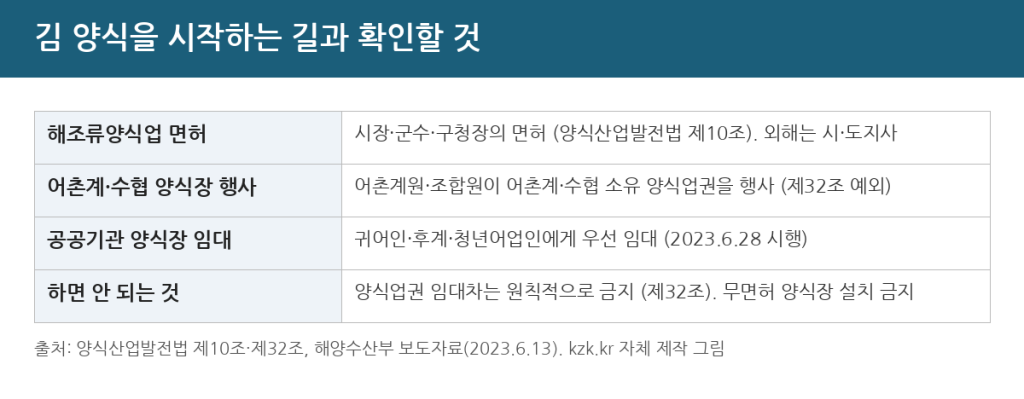
| Seaweed aquaculture license | Licensed by the mayor/county head/district head (provincial governor for offshore). Licenses only within government/local aquaculture development plans | Aquaculture Industry Development Act Art. 10 |
| Ban on leasing | Aquaculture rights in principle cannot be leased to or from others. Exceptions include rights exercised by fishing-village association or cooperative members, and leasing by public institutions | Aquaculture Industry Development Act Art. 32 |
| Public leased farms | Public institutions secure farms and lease them first to people returning to fishing villages, successor fishers and young fishers (effective June 28, 2023; notices on the website) | MOF press release 2023.6.13 |
| Business registration | Apply within 20 days of starting | VAT Act Art. 8, Hometax |
2. Start-up costs
We did not find official average start-up cost figures. Costs vary greatly with farm area, whether you buy a boat and equipment, and whether it is a leased farm (varies).
| Item | Description | Note |
|---|---|---|
| Farm (license/lease) | New license or leased public farm | Check notice conditions, varies |
| Nets and facilities | Laver nets, poles/buoys, ropes | Installed and maintained every year, varies |
| Seed and seeding | Laver spores (seed) and seeding work | varies |
| Boat and equipment | Work boat, harvesting equipment | Sometimes shared in the village, varies |
| Labor and fuel | Workers during harvest, boat fuel | varies |
| Business registration | Hometax or a tax office | Within 20 days of starting |
3. Equipment and work tips
- Net installation and seeding: installing nets in July and seeding in September is the basic schedule (MOF). Missing it delays the whole year, so coordinate with the fishing-village association and experienced fishers.
- Water temperature: MOF is developing varieties resistant to high water temperatures. Temperature changes greatly affect production, so keep checking information from local fisheries institutions.
- Harvest and transport: raw laver cannot be stored and must be sold right after harvest, according to reports (Korea Farmers & Fishermen Newspaper). Adjust your harvest to the auction schedule.
- No illegal facilities: illegal farming that expands facilities without a license is cited as one cause of price crashes. Install facilities only within your license.
4. How much can you earn?
In this research we could not confirm official statistics on average income per farming household. Income varies greatly with area, output and that year’s raw laver price (varies). Instead, here is the price trend:
- In 2025, raw laver auction volume was 710,410 tons and value KRW 1.04023 trillion; the average price was about KRW 1,460 per kg, about 32% lower than the previous year (about KRW 2,160). At one point the price of one bag (120 kg) reportedly crashed from KRW 250,000 to around KRW 50,000 (Korea Farmers & Fishermen Newspaper, 2026.1.27).
- In January 2025, the raw laver price at production-area auctions was KRW 762 per kg, 54% lower than the same month a year earlier (KRW 1,655), and 5,989 tons of raw laver (5,296 tons in South Jeolla) went unsold and were discarded that month (Yonhap, 2025.2.12).
- In other words, strong exports do not guarantee higher raw laver prices.
5. How to sell
- Suhyup production-area auction markets: raw laver is mainly sold by auction at Suhyup production-area markets. Check the auction schedule and that day’s prices.
- Deals with processing plants: raw laver is processed into dried laver. In January 2025 dried laver sold for around KRW 145 per sheet (Yonhap). Discussing terms with processors in advance widens your sales channels.
- Contract farming: after the price crash, contract farming was reportedly considered. Ask your local Suhyup or local government whether contract farming or purchase programs exist.
6. Getting started, step by step
- Learn in a fishing village first: learn the work in a village that farms laver, and check the association’s membership conditions and the local farming schedule.
- Secure a farm: check local governments’ new farm notices in May–June, or apply for leased farms announced by MOF and public institutions (priority for returnees and young fishers). Leasing aquaculture rights between individuals is in principle prohibited, so be careful.
- Start small after licensing and registration: get a seaweed aquaculture license and register your business, then start small in the first year with July net installation → September seeding, and keep records of costs and auction sales.
Watch out for these reported problems
In January 2025, as raw laver prices crashed, 5,989 tons of raw laver went unsold at production-area auction markets and were discarded (Yonhap). Illegal farming that expanded facilities without licenses was cited as one cause, and producer groups claimed that unlicensed facilities reach 40% in South Jeolla (Korea Farmers & Fishermen Newspaper). Illegal facilities pull down prices even for fishers who honestly obtained licenses. Also, because leasing aquaculture rights is in principle prohibited, if someone offers to “rent you a farm cheaply” or “transfer a license to you” and asks for money first, be sure to check the license status with the fisheries department of the city/county/district office before signing anything.
Sources
- MOF – Press release on newly developing 2,700 ha of laver farms (2024.4.25)
- MOF – Press release on laver exports surpassing USD 1 billion (2025.11.21)
- MOF – Press release on the aquaculture farm leasing system (2023.6.13)
- Aquaculture Industry Development Act Art. 10 (Aquaculture license)
- Aquaculture Industry Development Act Art. 32 (Ban on leasing)
- Korea Farmers & Fishermen Newspaper – 2025 laver exports and falling raw laver prices (2026.1.27)
- Yonhap News – Raw laver price crash and discarded raw laver (2025.2.12)
- National Tax Service Hometax – Business registration
7. FAQ
Can I just install laver nets in the sea?
No. Seaweed aquaculture requires a license from the mayor/county head/district head (provincial governor for offshore) (Aquaculture Industry Development Act Art. 10). Unlicensed facilities are illegal.
Can I rent someone else's farm?
Leasing aquaculture rights is in principle prohibited (Art. 32). However, there is a system of farms secured and leased by public institutions, with priority for returnees, successor fishers and young fishers.
What is the yearly schedule?
According to MOF: May–June notice and selection, July license and net installation, September seeding; Pyropia dentata is produced in October–November and Pyropia yezoensis from December to May of the next year.
Exports are strong, so can I earn a lot?
Exports grew, but in 2025 raw laver prices fell about 32% from the previous year, and some raw laver was discarded in January. Income differs greatly from year to year.
Can I store harvested raw laver and sell when prices rise?
Raw laver reportedly cannot be stored and must be sold right after harvest. That's why it's important to adjust harvest volume while watching auction schedules and prices.
Last updated: October 30, 2026. Based on official sources; rules and prices can change.
🎁 Free: 7-day starter checklist for earning extra income
Leave your email and get the free checklist now. No spam, unsubscribe anytime.
Popular guides
- Top 10 Ways to Make Money Starting This Week (Free Checklist)
- How to Make Money as a Student: Legit Ideas (2026)
- Passive Income Ideas: Realistic Options for 2026
- Make Money Online Without Investment: 20 Free Ways
- How to Make Money with AI: 50 Practical Ways (2026)
- How to Make Money From Home: 20 Legit Ways
- Make Money Online for Beginners: 15 Easy Ways to Start
- How to Make Money as a Mom: 16 Flexible Ideas (Work Around Nap Time)
- 16 Legit Ways to Make Money Fast (This Week)
- How to Make Money as a Teenager: 16 Safe Ideas
- 14 Remote Jobs With No Experience Needed
Next method: How to Make Money with Black Goat Farming in Korea →