Path
At a glance
Contents
A Hanwoo (Korean native cattle) breeding farm keeps cows, breeds them, raises the calves for about 6–7 months and sells them at livestock markets. That is different from “finishing” farms, which buy calves and raise them for beef. This guide uses national statistics, the Livestock Industry Act and government program reports. One fact first: according to national statistics, breeding farms have lost money per head on average in recent years. Making money here means keeping costs low, raising the breeding rate and selling calves when prices are good.
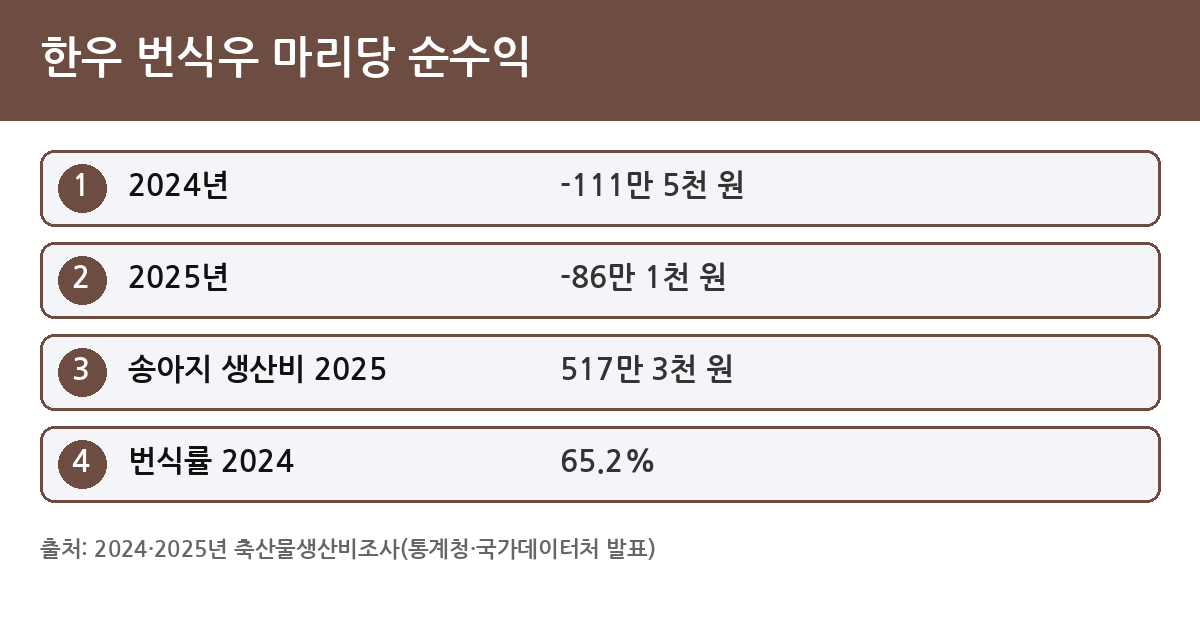
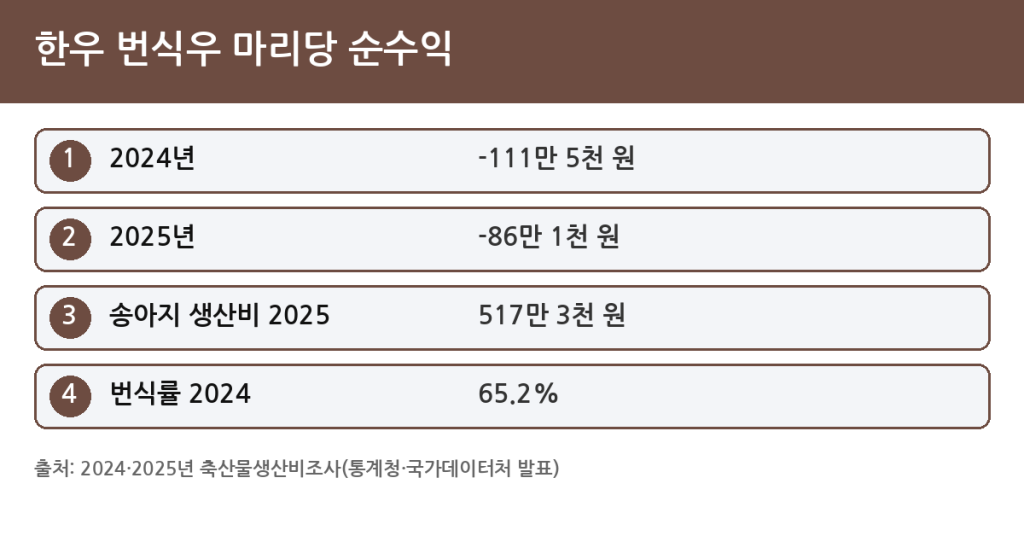
In one line: in 2025 it cost KRW 5,173,000 to produce one calf, and net profit per breeding cow was −KRW 861,000 (Statistics Korea). That is better than 2024 (−KRW 1,115,000) but still a loss on average. Depending on barn size you need a permit or registration plus training first.
1. What does a breeding farm do?
- Cows are bred by artificial insemination; calves are raised for about 6–7 months, then sold.
- Statistics Korea reports calf prices for 6–7-month-old bull calves. In 2024 that price was KRW 3,541,000.
- In 2025, bull calf prices rose 16.2% year on year, which improved breeding-farm results.
- The key number is the breeding rate. It fell from 68.0% to 65.2% in 2024, meaning only about 65 of 100 cows calved that year.
2. Start-up costs
| Item | Reference figure | Source |
|---|---|---|
| One cow | Hanwoo cow (600 kg) farm-gate price KRW 4,748,000 (2024) | Statistics Korea |
| Cost to produce one calf | KRW 5,173,000 (2025) | Statistics Korea |
| Breeding feed | KRW 518/kg (2024) | Statistics Korea |
| Barn and manure facilities | Depends on land, size, region | varies |
| New-farmer training | 24 hours for permit holders (KRW 40,000 in person, free online) | farmedu.kr |
Building a new barn changes costs a lot (varies). Many beginners lease an existing barn or start small.
3. Facilities and equipment
- Barn: resting space, feeding and water systems.
- Disinfection and biosecurity facilities, required for a livestock permit.
- Manure handling: manure facility report or permit and a treatment plan; compost it yourself or contract a processor.
- Calf care tools: calving tools, warmth for calves, ear tags for traceability.
4. Permits and training (check first)
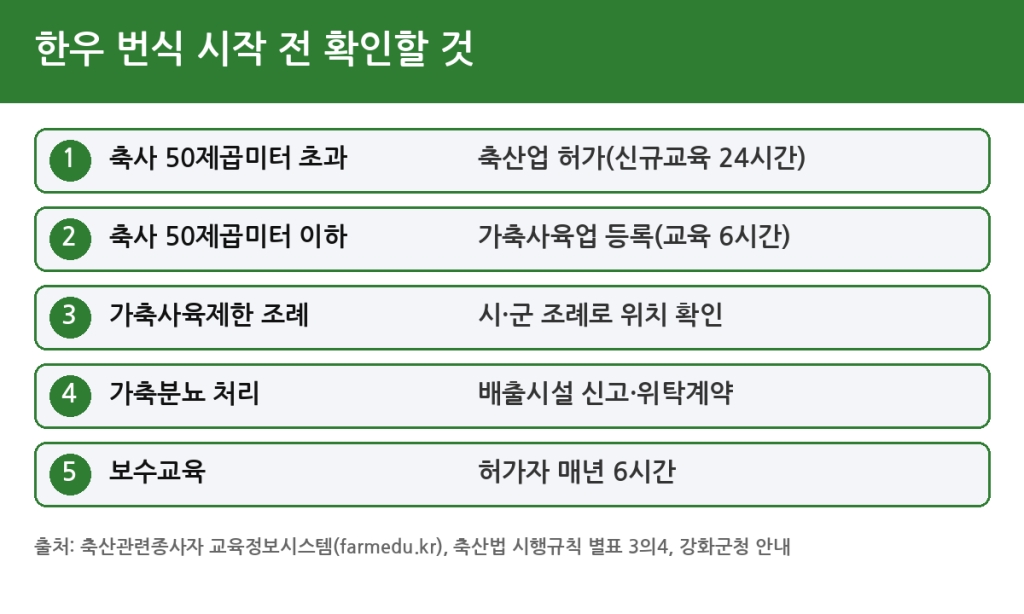
- If the cattle facility is over 50 m², you need a livestock business permit; 50 m² or less needs registration.
- Permit applicants must complete 24 hours of new-farmer training within 2 years before applying (KRW 40,000 in person, free online). Registration requires 6 hours (KRW 10,000 in person, free online).
- Permit holders take 6 hours of refresher training every year; registered farms every 2 years.
- Applications need facility standards, a manure facility report, building permits, training certificates and a manure/odor plan (Ganghwa and Gimpo county guides).
- Cities and counties have livestock restriction zone ordinances, so ask the local office before buying land.
5. How much can you earn?
- The national average is a loss: −KRW 1,115,000 per head in 2024 and −KRW 861,000 in 2025.
- These averages include the farmer’s own labor and land costs. Real results vary widely with breeding rate, feed cost and calf prices (varies).
- Calf prices are forecast to stay in the KRW 4 million range for the next 2 years (Korea Rural Economic Institute, via Nongmin Shinmun).
- The Calf Production Stabilization Program pays KRW 100,000–400,000 per head when calf prices fall below a reference. From 2026 the reference rises from KRW 1.85M to 2.7M, but payouts are seen as unlikely for several years because of the breeding-cow-count condition. Only about 6,000 of 76,000 Hanwoo farms had joined by end-2025.
6. How to sell calves
- Local cooperative livestock auctions: most calves are sold at auction; weight, pedigree and health set the price.
- Direct sales to finishing farms: keep traceability records and a written contract.
- Genetics: use good semen and record cow performance to raise calf value.
7. Step-by-step start
- Training first at farmedu.kr (24 or 6 hours; online is free).
- Hands-on experience with a neighboring farm or cooperative: calving, calf care, insemination timing.
- Check land and barn with the city/county office: restriction zones, manure handling, building approval.
- Get the permit or registration.
- Start small with a few cows, record breeding rate and feed costs, and look into the stabilization program.
9. Watch out for these scams
In June 2026 in Gimje, a “Hanwoo consignment investment” promised a 10% return after 2 years for KRW 5.5 million per head and raised over KRW 1.3 billion for 250 head. The same cattle were double-contracted with a cooperative and 47 head were secretly sold; one investor lost about KRW 380 million and filed a complaint (JMBC). A separate frozen-beef investment scam reportedly raised KRW 240 billion (Yonhap). Be careful with offers to “just invest in cattle,” and always check the cattle traceability number, ownership and contract.
Sources
- Statistics Korea, 2025 Livestock Production Cost Survey (May 15, 2026)
- Newsis (May 15, 2026)
- Statistics Korea, 2024 Livestock Production Cost Survey
- Livestock worker training system
- Ganghwa County, livestock permit guide
- Gimpo City, livestock permit/registration guide
- Enforcement Rules of the Livestock Industry Act
- Nongmin Shinmun (June 2026), calf stabilization program
- JMBC (June 17, 2026), Gimje Hanwoo consignment fraud
- Yonhap, frozen-meat investment scam
8. FAQ
Do I need a permit for just one cow?
The rule is based on facility area, not head count: over 50 m² needs a permit, 50 m² or less needs registration. Confirm locally.
Is breeding really unprofitable?
National average net profit was negative in 2024 and 2025, but that includes the farmer's own labor; individual results differ.
What about future calf prices?
The Korea Rural Economic Institute reportedly forecasts the KRW 4 million range for 2 years. Forecasts change.
Where do I take the training?
At farmedu.kr; online courses are free.
What changes in 2026?
The stabilization program is revised, and the Hanwoo industry support act takes effect in July 2026, according to reports. Check official notices after it starts.
Last updated: October 30, 2026. Based on official sources; rules and prices can change.
🎁 Free: 7-day starter checklist for earning extra income
Leave your email and get the free checklist now. No spam, unsubscribe anytime.
Popular guides
- Top 10 Ways to Make Money Starting This Week (Free Checklist)
- How to Make Money as a Student: Legit Ideas (2026)
- Passive Income Ideas: Realistic Options for 2026
- Make Money Online Without Investment: 20 Free Ways
- How to Make Money with AI: 50 Practical Ways (2026)
- How to Make Money From Home: 20 Legit Ways
- Make Money Online for Beginners: 15 Easy Ways to Start
- How to Make Money as a Mom: 16 Flexible Ideas (Work Around Nap Time)
- 16 Legit Ways to Make Money Fast (This Week)
- How to Make Money as a Teenager: 16 Safe Ideas
- 14 Remote Jobs With No Experience Needed
Next method: How to Make Money with Laver (Gim Seaweed) Farming in Korea →