Path
At a glance
Contents
Abalone is one of the higher-priced shellfish farmed in Korean seas. Many farms raise it in sea cages (floating net compartments) off the south coast, such as Wando and Jindo in South Jeolla Province. Recently, however, production has grown and prices have dropped sharply, and summer marine heat (seawater getting too warm) sometimes kills stock all at once. This guide explains how to make money with abalone farming, based on data from the Ministry of Oceans and Fisheries (MOF), the National Institute of Fisheries Science (NIFS) and the national statistics agency. Look at the risks, not just the good points.
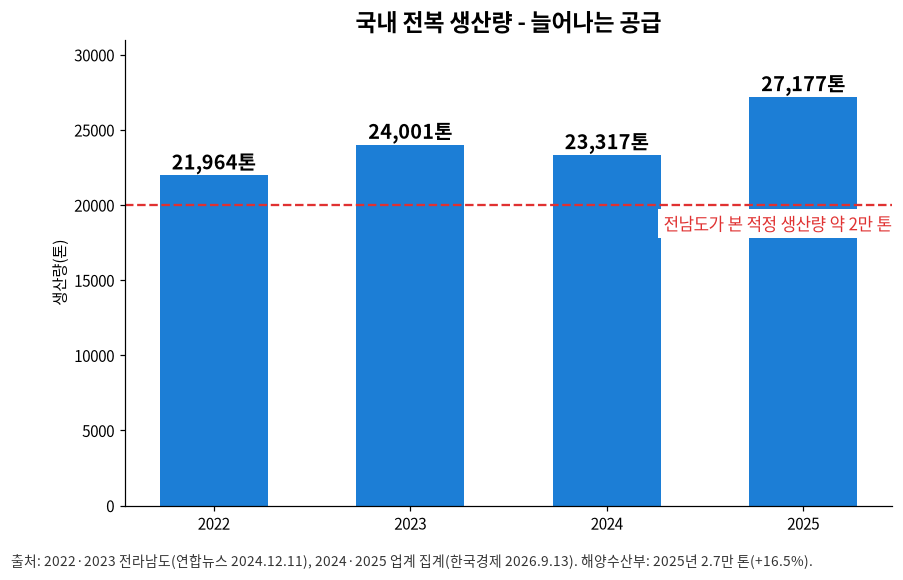
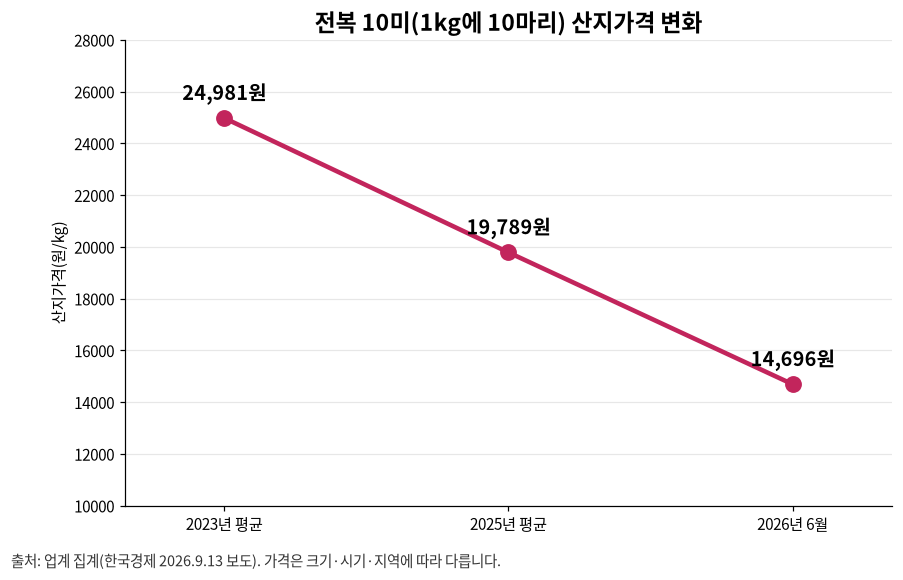
In one line: making money with abalone farming means “a license + 2–3 years of waiting + managing summer heat + a place to sell.” Output rose to about 27,000 tonnes in 2025, but the farm-gate price of size-10 abalone fell from KRW 24,981/kg in 2023 to KRW 14,696 in June 2026. Many regions have frozen new licenses, and leasing a farm license is illegal, so start your research through official channels.
1. What is abalone farming?
- You buy juvenile abalone (seed) and raise them for about 2–3 years at sea or in land-based tanks until they reach market size (shell length about 8 cm or more) (NIFS abalone farming manual).
- Article 10 of the Aquaculture Industry Development Act classifies raising shellfish such as abalone as shellfish aquaculture, with methods such as cage, hanging and bottom culture.
- Farming at sea requires a license from the city mayor, county head or district head. A license lasts 10 years (Article 17 of the same Act).
- Land-based farming in tanks requires a permit from the city mayor, county head or district head (Article 43).
- Most Korean abalone comes from South Jeolla Province, where about 3,766 households farm abalone on 6,195 ha, about 80% of the national total (2024 report).
- Moving to a fishing village to start sea work (returning to fishing) and laver farming on the same coast are separate topics, so this guide covers only abalone.
2. How much does it cost to start?
Costs vary so much by license, facility size and region that there is no official average. Here are the essential items and where to check.
| Item | Details | Notes |
|---|---|---|
| Farming license or permit | Sea: license (10 years); land: permit | Ask the fisheries office of the city/county/district. Many regions have frozen new licenses |
| Fishing village cooperative (eochongye) | A group of fishers who share village fishing grounds | Membership rules differ by cooperative (Suhyup guide) |
| Cage facilities | Floating net compartments (about 2.4 m × 2.4 m each) | Need moorings strong enough for typhoons |
| Seed (juvenile abalone) | Bought from seed producers | Check that the seed is healthy |
| Feed | Seaweeds such as kelp and sea mustard | Plan your seaweed supply for winter to spring |
| Work boat and gear | For feeding, net changes and harvest | Check boat licensing and registration separately |
| Aquaculture disaster insurance | Covers typhoon and abnormal water temperature damage | Government pays 50% of the net premium (via Suhyup) |
| Business and tax | Business registration depending on how you sell | Hometax or tax office consultation |
3. Equipment and how to work
Key points from the NIFS Abalone Farming Manual, in simple words:
- Stocking density: in one 2.4 m × 2.4 m cage, the guide is about 2,300 abalone in year 1, about 1,500 in year 2 and about 1,100 in year 3. As they grow, split them into more cages so they grow well.
- Feeding: give seaweeds such as kelp and sea mustard. Remove leftover feed before it rots.
- Heat management: when seawater reaches 23°C, cut feed by half; above 25°C, stop feeding. August to October is the high-risk period for mass deaths.
- Facility checks: before typhoons, check cage mooring lines and nets.
- Keep records: write down the number of seed stocked, dates and deaths. Stocking records are needed to buy disaster insurance and to claim payouts.
4. How much can you earn?
Income from abalone farming differs from person to person. It changes a lot each year with license size, that year’s water temperature, death rate and selling price. Here are official and reported figures for reference.
- Average income of aquaculture households: in the national statistics agency’s 2024 Farm and Fishery Household Economy Survey, aquaculture households earned an average of KRW 115,297,000, higher than capture-fishing households at KRW 44,188,000 (Korea Farmers & Fishermen Newspaper). But this figure averages all farmed species, including laver, so it is not abalone-only income.
- Abalone prices: the farm-gate price of size-10 abalone (about 10 per kg) fell from KRW 24,981/kg in 2023 to KRW 19,789 in 2025 and KRW 14,696 in June 2026. Size-8 abalone fell from about KRW 45,000 in 2022 to around KRW 22,000–25,000 recently (Korea Economic Daily, 2026-09-13).
- Why prices fell: 2025 production was about 27,000 tonnes, up 16.5% from the year before (MOF). South Jeolla Province considers about 20,000 tonnes the right national output. Exports rely heavily on Japan.
- Simple example: selling 1 tonne of size-10 abalone brings about KRW 19.79 million at KRW 19,789/kg, and about KRW 14.70 million at KRW 14,696/kg. The same amount differs by about KRW 5 million depending on price. Subtract seed, feed, facilities, labor and insurance to get real profit.
5. How do you find customers?
- Suhyup auction markets: many fishers sell through Suhyup (National Federation of Fisheries Cooperatives) auctions. Ask your nearest Suhyup about the process.
- Distributors and middle wholesalers: they buy large volumes at once. Prices move with the market.
- Direct and online sales: you can sell straight to consumers by parcel delivery or regional specialty online shops. Packaging and shipping that keep abalone alive are critical.
- Processing: cleaned, frozen or ready-to-eat abalone can help when prices fall. Check food-related reports and permits separately for processed products.
- Use promotion programs: when prices fell, MOF said it would use about KRW 1.99 billion in self-help funds (a promotion fund pooled by producers) for consumption campaigns, and push license conversion to other species plus an industry–government–research council (August 2025).
6. Start steps 1-2-3
- Learn and check: learn about sea work through training and counseling at the Return to Fishing Village Center, and first ask the fisheries office of your target city or county whether new abalone farming licenses are available. News reports say South Jeolla has frozen new licenses and is converting some abalone facilities to laver.
- Work on site first: work at an abalone farm and experience a full year, especially the summer heat. Learn cooperative membership rules and facility sale terms then. Secretly leasing a license is prohibited by law (Article 32).
- Start small and insure: after you get an official license or permit, start small and buy aquaculture disaster insurance at Suhyup (the government pays 50% of the net premium; inquiries 1588-4119). Line up one or two buyers in advance.
8. Watch out for these real cases
- “Invest in an abalone farm and earn 4% a month” scam: Korea’s Financial Supervisory Service said in 2012 that a company raising money by promising 4% monthly returns from a Wando abalone farm was an illegal unauthorized deposit-taking scheme, and it referred 59 such companies to investigators (Newspim report). This crime is punishable by up to 5 years in prison or a fine of up to KRW 50 million. Check any farm investment promising “guaranteed principal and high interest” with the FSS first (1332, fss.or.kr).
- License rental offers: paying someone to “rent” you a license violates the law (Article 32), and you could later lose the facility.
- Heat damage: summer marine heat repeatedly causes mass deaths. One reason 2025 output rose was “less heat damage,” which shows how much weather drives income.
Sources
- Ministry of Oceans and Fisheries, 2025 fishery production press release (2026-02-26)
- Ministry of Oceans and Fisheries, 2024 fishery production press release
- Ministry of Oceans and Fisheries, abalone supply stabilization press release (2025-08-15)
- Korea Economic Daily, report on rising abalone output and falling prices (2026-09-13)
- Yonhap News, South Jeolla abalone farm restructuring (2024-12-11)
- National Institute of Fisheries Science, Abalone Farming Manual
- Eco Journal, introduction of the NIFS abalone farming manual
- National statistics agency (mods.go.kr), 2024 Farm and Fishery Household Economy Survey
- Korea Farmers & Fishermen Newspaper, 2024 fishery household income report
- Gov.kr, aquaculture disaster insurance guide
- Agriculture, Fisheries & Livestock News, aquaculture disaster insurance report
- Aquaculture Industry Development Act Article 10 (aquaculture licenses)
- Aquaculture Industry Development Act Article 17 (license term)
- Aquaculture Industry Development Act Article 32 (ban on leasing aquaculture rights)
- Aquaculture Industry Development Act Article 43 (land-based aquaculture permits)
- Suhyup, fishing village cooperative guide
- Return to Fishing Village Center
- Newspim, FSS crackdown on unauthorized deposit-taking firms (2012-11-05)
7. FAQ
Can I raise abalone at sea without a license?
No. Sea farming needs a license and land farming needs a permit (Aquaculture Industry Development Act, Articles 10 and 43).
Can I just borrow someone else's farm license?
Lending or leasing a license is prohibited by law (Article 32). Be careful with offers to "rent you a license."
How long until the first harvest?
Per the NIFS manual, it usually takes 2–3 years to reach market size. Feed and management costs continue during that time.
What if my abalone die in summer?
Abalone is a main item of aquaculture disaster insurance. News reports say abnormal water temperature damage is included in the main contract, but always confirm coverage with Suhyup before joining. Day to day, reduce or stop feeding at the 23°C and 25°C thresholds to limit losses.
Is now a good time to start?
Production has grown and prices have fallen, and many places have frozen new licenses. Decide on timing and scale only after talking in depth with the local fisheries office, Suhyup and the Return to Fishing Village Center.
Last updated: October 30, 2026. Based on official sources; rules and prices can change.
🎁 Free: 7-day starter checklist for earning extra income
Leave your email and get the free checklist now. No spam, unsubscribe anytime.
Popular guides
- Top 10 Ways to Make Money Starting This Week (Free Checklist)
- How to Make Money as a Student: Legit Ideas (2026)
- Passive Income Ideas: Realistic Options for 2026
- Make Money Online Without Investment: 20 Free Ways
- How to Make Money with AI: 50 Practical Ways (2026)
- How to Make Money From Home: 20 Legit Ways
- Make Money Online for Beginners: 15 Easy Ways to Start
- How to Make Money as a Mom: 16 Flexible Ideas (Work Around Nap Time)
- 16 Legit Ways to Make Money Fast (This Week)
- How to Make Money as a Teenager: 16 Safe Ideas
- 14 Remote Jobs With No Experience Needed
Next method: How to Make Money with a Christmas Tree Farm (US Case) →