Path
At a glance
Contents
In winter, Koreans use a lot of oysters in kimchi, oyster rice soup and oyster pancakes. Most of the oysters eaten in Korea are farmed in the sea off the south coast. Off Tongyeong, Geoje and Goseong in South Gyeongsang Province, you can see rows of white floats with oysters hanging below. This guide explains, in plain words, how to make money with oyster farming in Korea. It covers licenses, the fishing village cooperative (eochongye), support for people moving to fishing villages, production and prices, food safety and where to sell.
Oyster farming uses the sea, so you can’t just start tomorrow. You need an aquaculture license under Korean law, and most farmers work together with the local eochongye. Don’t think of it as “put money in, get money out right away.” It takes a few years of learning in the field.
One-line summary: The way to make money with oyster farming is “return-to-fishing counseling and training → move to an oyster area and learn on site → join the eochongye → secure an aquaculture license (or use the eochongye’s farm) → install hanging-culture gear → sell at the Oyster Hanging Culture Fisheries Cooperative auction or directly.” Korea’s farmed oyster output was 302,000 tonnes in 2025. At the first auction of the 2026 season, a 10 kg box of shucked oysters sold for an average of about KRW 83,000–87,000, according to news reports. You must follow food safety rules on norovirus and shellfish toxins.
1. What is oyster farming?
Oyster farming means raising oysters in sea facilities, then shucking them (bakshin) and selling the meat, or selling them in the shell. The most common method on Korea’s south coast is longline hanging culture (yeonseung suhasik).
- Hanging culture: Long, thick ropes float on the sea, held by floats and anchors. Strings of young oysters (suhayeon) hang down from these ropes. The oysters stay underwater all the time, eat plankton and grow fast.
- Rack culture (geoldaesik): Wooden or steel posts are set in shallow water near shore and oysters are hung on them. They are exposed to air at low tide, so they grow more slowly than in hanging culture.
- When are they sold? The first auction of the season (chomaesik) at the Gyeongnam Oyster Hanging Culture Fisheries Cooperative (Gulsuhasik Suhyup) is held in late October each year, and the season runs until about June of the next year, according to news reports.
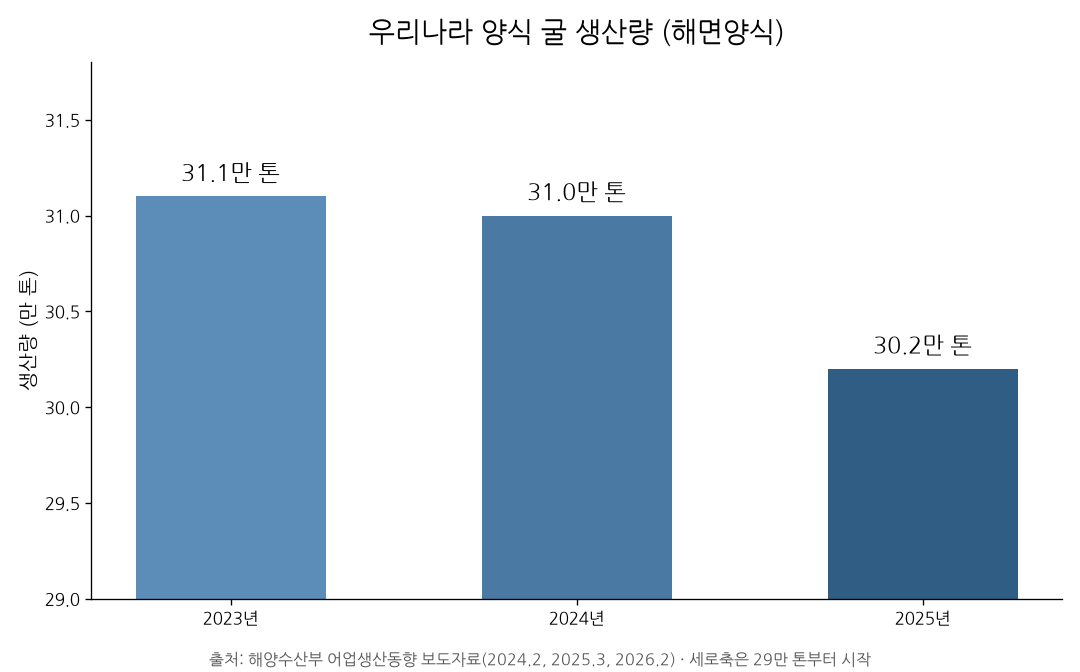
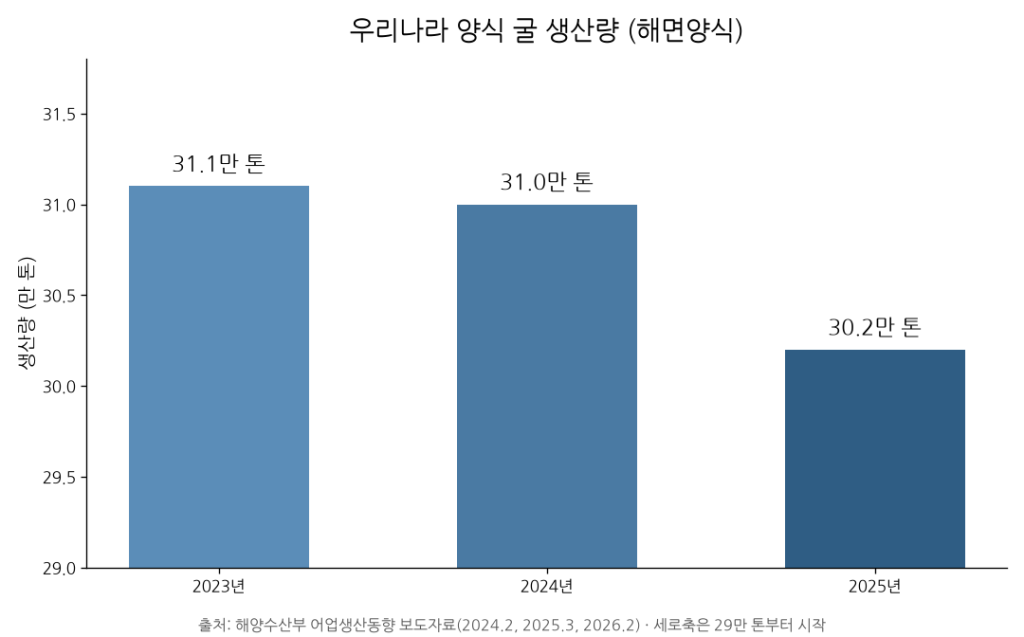
Oysters are a big aquaculture item in Korea. According to the Ministry of Oceans and Fisheries (MOF), farmed oyster production was 311,000 t in 2023, 310,000 t in 2024 and 302,000 t in 2025. Production is concentrated on the south coast, and one report says South Gyeongsang produced about 78% of Korea’s oysters.
Who is this for?
- People who can handle sea work, early mornings and cold winter work
- People who can move to an oyster area such as Tongyeong, Geoje, Goseong or Yeosu
- People willing to spend the first few years learning at someone else’s farm or shucking site
- People who can work with villagers and follow local rules
2. How much does it cost to start?
Costs depend a lot on farm size, method and whether you buy a boat. The table only shows numbers confirmed in public research and government sources.
| Item | Confirmed figure | Source / note |
|---|---|---|
| Longline hanging culture facilities (1 ha) | About KRW 181.66 million (181,657 thousand) | Journal of Fisheries Business Administration paper, Sacheon Bay oyster study (2022). Based on 20 lines and 5,000 strings |
| Rack culture facilities (1 ha) | About KRW 54.77 million (54,772 thousand) | Same paper |
| Yearly depreciation (hanging culture, 1 ha) | About KRW 14.80 million (14,798 thousand) | Same paper. The yearly share of wear on the gear |
| Return-to-fishing start-up loan | Up to KRW 300 million, 1.5% interest, 5-year grace then 10-year repayment | Government policy notice (Mar 2026). Requires selection |
| Return-to-fishing housing loan | Up to KRW 75 million per household, 1.5% interest | Same notice |
| License and eochongye joining costs | Varies | Differs by area and village. Ask the city/county fisheries office and the eochongye |
| Boat, work vessel, shucking site | Varies | Depends on whether you do it yourself or outsource |
A loan is borrowed money and must be paid back. The facility figures are examples from one study and may differ from current prices in your area.
3. What you need and how it works
3-1. The law you must know: the aquaculture license
To raise shellfish such as oysters in the sea, you need a shellfish aquaculture license under the Aquaculture Industry Development Act. Licenses are issued by the mayor, county head or district head (Article 10).
- A license lasts 10 years and can be extended, but the total extension cannot exceed 10 years (Article 17).
- Aquaculture rights can’t be freely bought and sold. They can be transferred only with official approval at least one year after the license was granted, or through inheritance or merger (Article 30).
- Leasing aquaculture rights is banned in principle. However, members of an eochongye or fisheries cooperative may use rights owned by that eochongye or cooperative (Article 32).
- A license holder also may not let someone else effectively run the business (Article 23).
So beginners usually join an eochongye and use its farm, or ask the city/county fisheries office about a proper legal transfer. An offer to “rent you a license cheaply” may be illegal, so be careful.
3-2. Joining the eochongye
According to Suhyup (the National Federation of Fisheries Cooperatives), you need two things to become an eochongye member:
- Membership in the regional fisheries cooperative: You must have an address or business inside the cooperative’s area and fish or work in fishing for at least 60 days a year.
- You must live inside the eochongye’s area.
You submit an application and proof of cooperative membership to the eochongye head, and the general meeting reviews and decides. Members pay shared costs and contribute labor, and can be expelled if they don’t use the eochongye’s business for over a year. The general steps of moving to a fishing village are covered in a separate kzk.kr guide on returning to fishing villages, so this guide only covers the parts specific to oysters.
3-3. A year of oyster farming (hanging culture)
- Spat collection: In summer, collectors such as scallop shells are put in the sea so baby oysters attach. These are threaded onto strings (suhayeon).
- Hanging: The strings are hung from the floating ropes. Check anchors and floats often so typhoons don’t break the gear.
- Harvest: Oysters are pulled up from autumn. Some are grown for two years (wolhagul); in 2026, news reports warned of a shortage of these.
- Shucking: Oysters are shucked at shucking sites. Reports say there are about 300 such sites in Tongyeong, Geoje and Goseong, each with 20 to over 50 workers.
- Shipping: The meat is washed in clean water, packed in boxes such as 10 kg boxes and sent to the auction.
One string normally yields about 3 kg of shucked oysters, and a farmer quoted in a 2026 report said this year it was 4–5 kg. It varies with sea conditions each year.
3-4. Food safety (very important)
Oysters are often eaten raw, so the government regularly tests the sea and the oysters. The points below are not health or treatment claims. They are food safety rules you must follow to sell.
- Norovirus: MOF tests oyster-growing waters for norovirus from November to April. When it is detected, oysters from that area must be held back or sold labeled “for cooking only.” The Ministry of Food and Drug Safety says oysters with norovirus can’t be sold for raw eating. MOF material says heating at 85°C or more for over 1 minute removes the virus’s ability to infect.
- Shellfish toxins: In spring, plankton can make toxins build up in shellfish. If a limit is exceeded (e.g., paralytic toxin 0.8 mg/kg), the area becomes a no-harvest zone, and shipments need inspection first. These toxins are not removed by cooking or freezing. MOF checks up to 120 points weekly from March to June.
- Where to check: Results are posted by the National Institute of Fisheries Science (nifs.go.kr) and the Food Safety Korea portal (foodsafetykorea.go.kr).
- Sea hygiene: Some south-coast oyster waters are managed as US FDA designated areas for export. News reports also mention management of floating public toilets and hygiene checks at shucking sites.
4. How much can you earn?
First, know this: oyster farming income varies a lot with farm size, the year’s harvest, oyster prices and labor costs. The figures below are examples from public numbers. They do not mean everyone will earn this much.
Prices (cooperative auction)
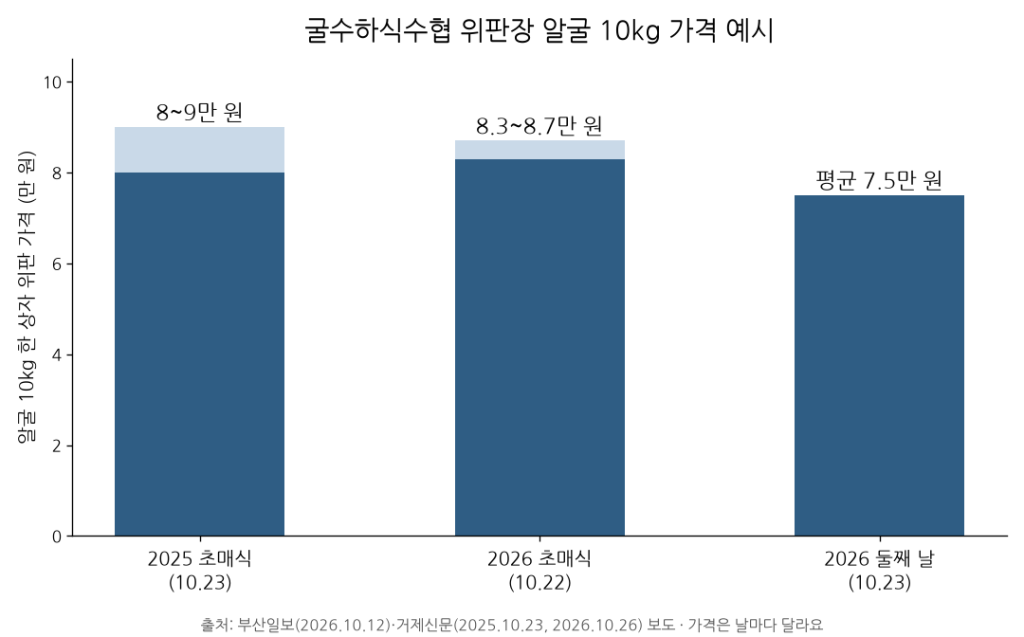
- 2025 first auction: a 10 kg box of shucked oysters sold for about KRW 80,000–90,000 (about 5,800 boxes).
- 2026 first auction (Oct 22): the first-day average was about KRW 83,000–87,000, with about 6,900 boxes traded, according to a report. The next day (Oct 23), 7,680 boxes sold at an average of about KRW 75,000.
- Before the 2026 season, one report said prices reached KRW 110,000–120,000 per 10 kg and were expected to settle in the high KRW 90,000s.
- According to an MOF explanatory note (2023), oyster prices tend to be highest in November (kimchi-making season) and lowest in April–May. The May wholesale price was KRW 9,586/kg in 2022 and KRW 7,509/kg in 2023.
Total sales volume
- The Oyster Hanging Culture Fisheries Cooperative reportedly auctioned about 10,873 t worth about KRW 93.4 billion last season. Simply dividing these gives about KRW 8,590 per kg (our own calculation).
Example: a 1 ha farm (research data)
According to the Journal of Fisheries Business Administration paper (Sacheon Bay oyster study), a 1 ha longline hanging farm had:
- About 15 t of shucked oysters, worth about KRW 105.3 million (105,300 thousand)
- A profit rate of 15.2%
- Facilities of about KRW 181.66 million, with yearly depreciation of about KRW 14.80 million
A 15.2% profit rate also means that not much is left after costs. Results vary by area, year and the condition of the gear.
Money taken out when selling
According to the same paper, selling through a wholesale market costs about a 3.5% fee plus about 0.5% management cost, and average distribution costs nationwide were about KRW 1,358 per kg. Labor (shuckers), fuel and boxes cost extra.
For reference, the 2024 Fishery Household Economy Survey by the national statistics office found average fishery household income of KRW 63,652,000. This is the average of all fishing households, not just oyster farmers, so don’t treat it as oyster farming income.
5. Where and how to sell
- Cooperative auction (gyetong chulha): The most common route. Research says most oysters go through auctions at the Oyster Hanging Culture Fisheries Cooperative and the Yeosu Fisheries Cooperative. The cooperative’s auction house in Yongnam-myeon, Tongyeong, was reported to hold auctions three times a week from Oct 26, 2026. Prices are set by auction and change daily.
- Processing and export: About 20% of south-coast oysters are exported as raw, frozen or steamed oysters, mostly to Japan, according to a report. Export products face stricter hygiene standards.
- Direct and online sales: Research says online direct sales are growing. When shipping by courier, you need cold packaging, country-of-origin labeling and a check of norovirus and shellfish toxin results.
- Festivals and local markets: Autumn and winter oyster festivals, such as those in Yeosu, Tongyeong (Hallyeosudo) and Geoje (Geoje Island Oyster Festival), hold direct-sale markets.
MOF has said it will support adding value to and exporting items such as oysters, laver and flatfish. To grow direct sales, neat packaging and safety test records build trust.
6. Step-by-step 1-2-3
Step 1 – Counseling and training (1–3 months)
1. Call the Return to Farming and Fishing Village Center (1899-9597, sealife.go.kr) and ask about oyster areas and training.
2. Take return-to-fishing start-up training. Training hours can count in loan screening.
3. Ask the fisheries office of Tongyeong, Geoje, Goseong or Yeosu whether a new shellfish aquaculture license or use of an eochongye farm is possible.
Step 2 – Learn on site (1+ year recommended)
1. Move to an oyster area and register your new address.
2. Work at a farm or shucking site to learn spat collection, hanging, harvest and shucking firsthand.
3. Keep records of at least 60 days of fishing work a year to prepare for cooperative membership.
Step 3 – Join the eochongye, get a license and gear
1. After becoming a cooperative member, apply to join the eochongye (reviewed at the general meeting).
2. Secure use of the eochongye farm or an aquaculture license through proper procedures. Always check the official registry.
3. If you need a loan, apply for the return-to-fishing start-up fund at the city/county office.
4. Build the facilities and look into aquaculture disaster insurance (for typhoons and high water temperatures).
Step 4 – First shipment
1. Check norovirus and shellfish toxin results before shipping.
2. Sell through the cooperative auction, and slowly add direct sales as you gain experience.
8. Watch out for these reported cases of fraud and damage
In November 2023, the Changwon Coast Guard said it had arrested and sent to prosecutors a man in his 40s accused of taking KRW 328 million from three fishers by pretending to sell them fishing permits. He reportedly used new down payments to cover earlier deals, a “robbing Peter to pay Paul” scheme. The Coast Guard urged extra care when signing such deals. Oyster aquaculture rights are also tightly restricted by law, so before sending money, check the official registry and whether a transfer can be approved, directly with the city/county office.
Also, in July–August 2025, the US FDA advised people not to eat, serve or sell certain frozen half-shell oysters from Korea processed by a company in Tongyeong because of possible norovirus contamination, and the importer recalled the product. A single hygiene failure can shake both export routes and prices. In the end, the basis of making money with oyster farming is a clean sea and careful safety management.
Sources
- MOF – 2025 fishery production press release (Feb 2026)
- MOF – 2024 fishery production press release (Mar 2025)
- MOF – 2023 fishery production press release (Feb 2024)
- Sisamirae – 2023 aquaculture production by item
- Etoday – 2025 oyster production
- KOSIS – Fishery production survey table
- Journal of Fisheries Business Administration – Distribution of farmed oysters in Sacheon Bay
- Geoje Shinmun – 2025 first oyster auction (Oct 23, 2025)
- Geoje Shinmun – 2026 first oyster auction (Oct 26, 2026)
- Busan Ilbo – South coast oyster season outlook (Oct 12, 2026)
- Tongyeong Shinmun – Cooperative auction results (Oct 22, 2026)
- MOF – Oyster price explanatory note (Jun 27, 2023)
- MOF – 2026 shellfish toxin management plan (Dec 31, 2025)
- MOF – Oyster norovirus management (Jan 28, 2022)
- Ministry of Food and Drug Safety, Busan office – Oyster norovirus notice (Nov 26, 2019)
- Korea Law Information Center – Aquaculture Industry Development Act
- Suhyup – Joining an eochongye
- K-Gonggam – Return-to-fishing start-up and housing support (Mar 3, 2026)
- Gov24 – Return-to-fishing start-up and housing support
- Return to Farming and Fishing Village Center
- National statistics office – 2024 Fishery Household Economy Survey
- Gov24 – Aquaculture disaster insurance
- Seoul Shinmun – Changwon Coast Guard fishing permit fraud (Nov 28, 2023)
- US FDA – Advisory on frozen half-shell oysters from Korea (2025)
7. FAQ
Can I raise and sell oysters on a small scale without a license?
No. Raising oysters in the sea requires a license under the Aquaculture Industry Development Act. If you are an eochongye member, you may be able to use rights owned by the eochongye, so ask the eochongye and the city/county office.
Can't I just rent a farm to start?
The law bans leasing aquaculture rights in principle (except members using farms owned by their eochongye or cooperative). If someone offers a cheap lease, check with the city/county office before signing.
When are oyster prices best?
MOF data show prices tend to be highest in November (kimchi-making season) and lower in April–May. But it varies with each year's production and weather.
What happens if norovirus is found?
Oysters from that area must be held back or sold labeled "for cooking only," and can't be sold for raw eating. That's why you must always check test results.
Can older people get the start-up loan?
Under the 2026 notice, applicants must be 65 or younger in the application year. However, those who completed at least 35 hours of return-to-fishing start-up training by age 65 may still qualify for up to 5 years. Applicants are selected through screening, so approval is not automatic.
Last updated: October 30, 2026. Based on official sources; rules and prices can change.
🎁 Free: 7-day starter checklist for earning extra income
Leave your email and get the free checklist now. No spam, unsubscribe anytime.
Popular guides
- Top 10 Ways to Make Money Starting This Week (Free Checklist)
- How to Make Money as a Student: Legit Ideas (2026)
- Passive Income Ideas: Realistic Options for 2026
- Make Money Online Without Investment: 20 Free Ways
- How to Make Money with AI: 50 Practical Ways (2026)
- How to Make Money From Home: 20 Legit Ways
- Make Money Online for Beginners: 15 Easy Ways to Start
- How to Make Money as a Mom: 16 Flexible Ideas (Work Around Nap Time)
- 16 Legit Ways to Make Money Fast (This Week)
- How to Make Money as a Teenager: 16 Safe Ideas
- 14 Remote Jobs With No Experience Needed
Next method: How to Make Money with Kiwifruit Farming (Overseas Case: New Zealand) →