Path
At a glance
Contents
Written on 2026-10-26 after checking the National Pension Service’s public pages and the National Pension Act decree. This explains the programs only; it is not advice on whether to pay in. Ask the NPS about your own case. No application was made and no logged-in screens were viewed. The only image is a self-made illustration. Nothing here promises income.
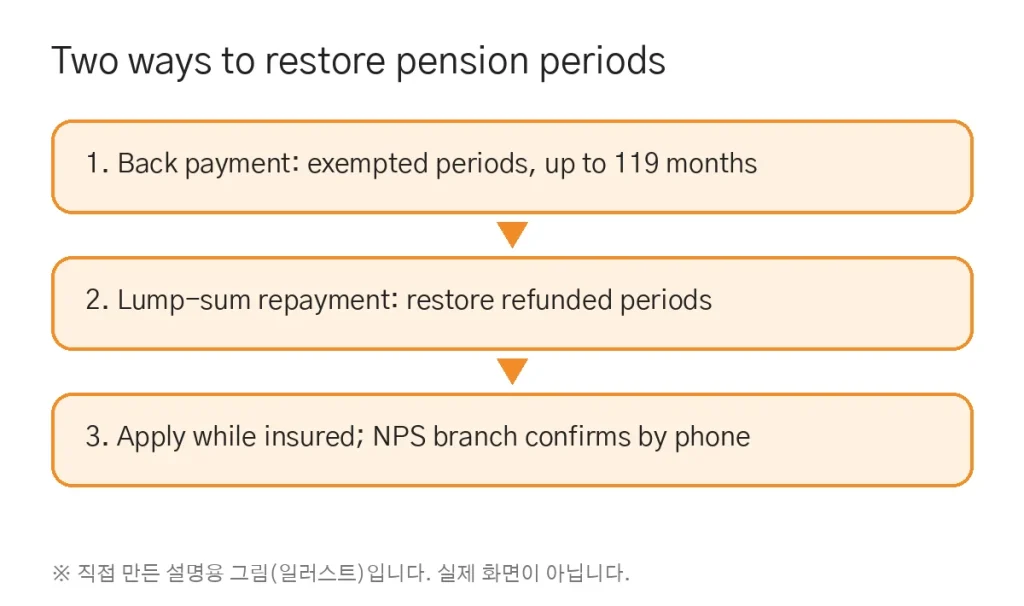
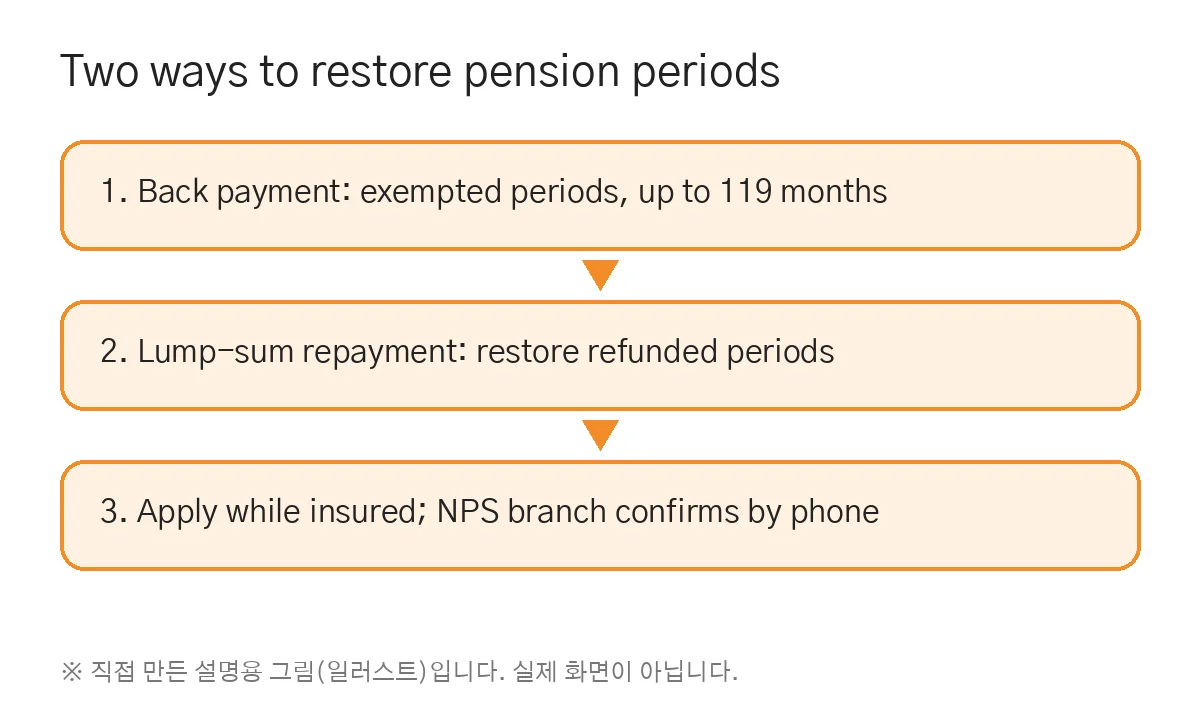
The diagram below is a self-made illustration, not a real screen.
The National Pension has two programs for adding periods to your record later: periods when you couldn’t pay, and periods you were refunded as a lump sum. This guide only explains the programs. Whether to use them depends on your situation, so talk to the NPS before deciding.
Who this suits
- People who had an exemption period, for example after losing a job
- People who were excluded as a spouse with no income
- People who once got a lump-sum refund and are insured again now
1. Back payment (chunap)
- Who: insured people with an exemption or exclusion history who are paying contributions now
- Eligible periods
- Exemption periods when you couldn’t pay, for example after losing a job
- Exclusion periods after at least 1 month of contributions, for reasons such as being a spouse with no income (exclusions for emigration do not count)
-
Military service from 1 January 1988 (service counted under another public pension does not count)
-
Limit: up to 119 months
- Installments: monthly, within 60 installments. Interest at the 1-year term deposit rate is added when you split payments.
- Documents: a detailed marriage certificate showing full resident numbers is required. Extra documents apply in some cases, such as a removed-register copy for a divorce or bereavement before 2008, or a military record for service periods.
- The bill arrives around the 11th to 15th of the month after you apply, and is due by the end of that month.
2. Lump-sum repayment
- Who: people who received a lump-sum refund and are insured again (including exempted people, and those over 60 if still insured)
- What: pay back the refund plus interest to restore your earlier insured period. It is optional.
- Deadline: only while you keep your insured status
- Installments (by earlier insured period): under 1 year, 3; 1 to under 5 years, 12; 5 years or more, 24. Term deposit interest is added.
- If you miss a payment, the NPS sends one notice and does not take arrears action.
3. How to apply (both programs)
- At an NPS branch, by post, by fax, on Government24, on the NPS website (after login), in the mobile app, or by digital ARS
- Submitting only registers the application. It is confirmed after the branch officer calls you to check.
- For expected pension amounts, ask an NPS branch or the NPS call center on 1355 (charged).
Common mistakes
- Applying for back payment while not paying contributions now
- Leaving out the marriage certificate, so the application can’t go ahead
- Thinking you can apply for lump-sum repayment after losing insured status
Checklist
- ☐ Insured now?
- ☐ Exemption, exclusion or military periods identified
- ☐ Detailed marriage certificate ready
- ☐ Lump-sum vs installments (interest added) understood
- ☐ Officer’s confirmation call received
To look for other money in your name, see our guide to finding hidden money.
We also have a $4.99 PDF guide that collects more everyday money-saving tips. Take a look if it’s useful →
FAQ
Is National Pension back payment and lump-sum repayment explained a legit way to make money?
Yes, it is legal and used worldwide. Written on 2026-10-26 after checking the National Pension Service's public pages and the National Pension Act decree. This explains the programs only; it is not advice on whether to pay in. Ask the NPS about your own case. No application was made and no logged-in screens were viewed. The only image is a self-made illustration. Nothing here promises income. Results depend on your time, skills and consistency; never pay upfront fees to unknown "opportunities".
What are the main pros and cons of National Pension back payment and lump-sum repayment explained?
Pros: People who had an exemption period, for example after losing a job, People who were excluded as a spouse with no income, People who once got a lump-sum refund and are insured again now. Cons: Who: insured people with an exemption or exclusion history who are paying contributions now, Eligible periods, Exemption periods when you couldn't pay, for example after losing a job, Exclusion periods after at least 1 month of contributions, for reasons such as being a spouse with no income (exclusions for emigration do not count), Installments: monthly, within 60 installments. Interest at the 1-year term deposit rate is added when you split payments., Documents: a detailed marriage certificate showing full resident numbers is required. Extra documents apply in some cases, such as a removed-register copy for a divorce or bereavement before 2008, or a military record for service periods., The bill arrives around the 11th to 15th of the month after you apply, and is due by the end of that month..
How do I start National Pension back payment and lump-sum repayment explained step by step?
The full step-by-step guide is free to read on this page.
🎁 Free: 7-day side-hustle starter checklist
Leave your email and get the free checklist now. No spam, unsubscribe anytime.
Popular guides
- Top 10 Ways to Make Money Starting This Week (Free Checklist)
- How to Make Money as a Student: Legit Ideas (2026)
- Passive Income Ideas: Realistic Options for 2026
- Make Money Online Without Investment: 20 Free Ways
- How to Make Money with AI: 50 Practical Ways (2026)
- How to Make Money From Home: 20 Legit Ways
- Make Money Online for Beginners: 15 Easy Ways to Start
- How to Make Money as a Mom: 16 Flexible Ideas (Work Around Nap Time)
- 16 Legit Ways to Make Money Fast (This Week)
- How to Make Money as a Teenager: 16 Safe Ideas
- 14 Remote Jobs With No Experience Needed
Next method: Earned income and child tax credits, including late filing →