Path
At a glance
Contents
Mealworms, the larvae of the yellow mealworm beetle (갈색거저리), are sold as food ingredients, animal feed and pet treats. Based on data and legal guidance from the Ministry of Agriculture, Food and Rural Affairs (MAFRA) and the Rural Development Administration (RDA), this guide explains in plain words how to make money with edible insect farming in Korea. The key points are to file the report first, decide where you will sell before you start, and keep temperature and humidity steady.
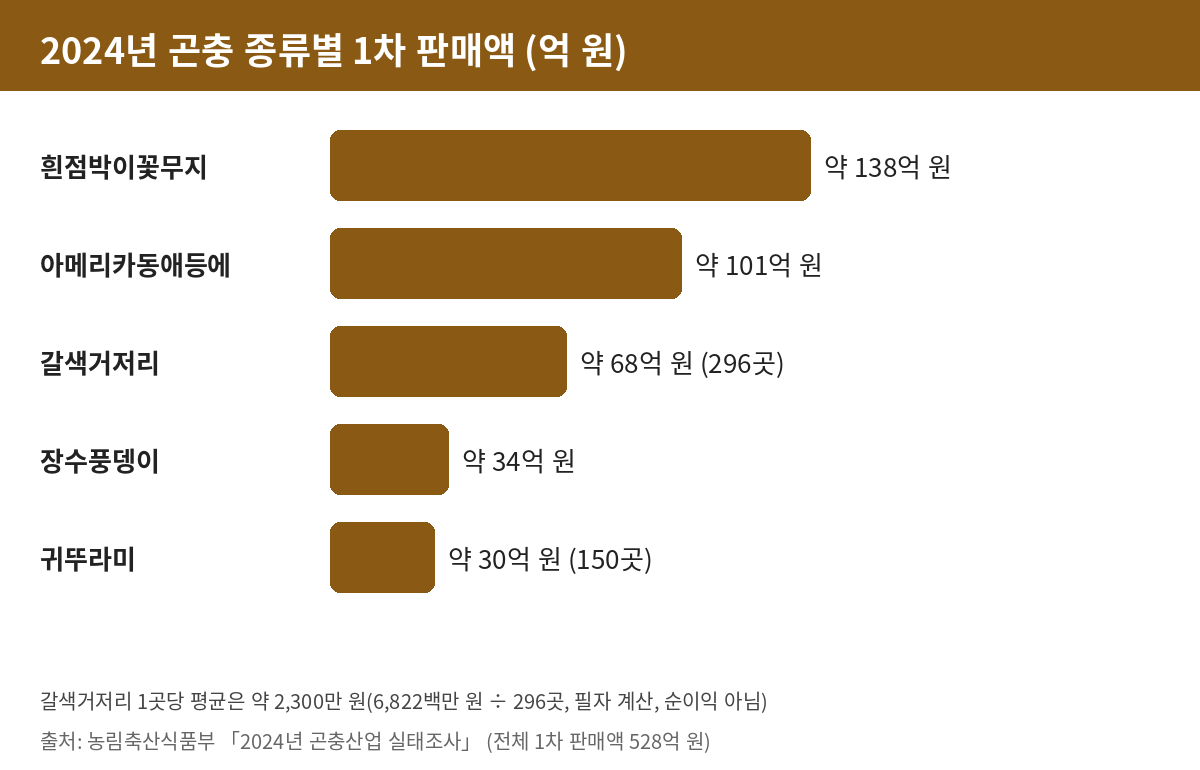
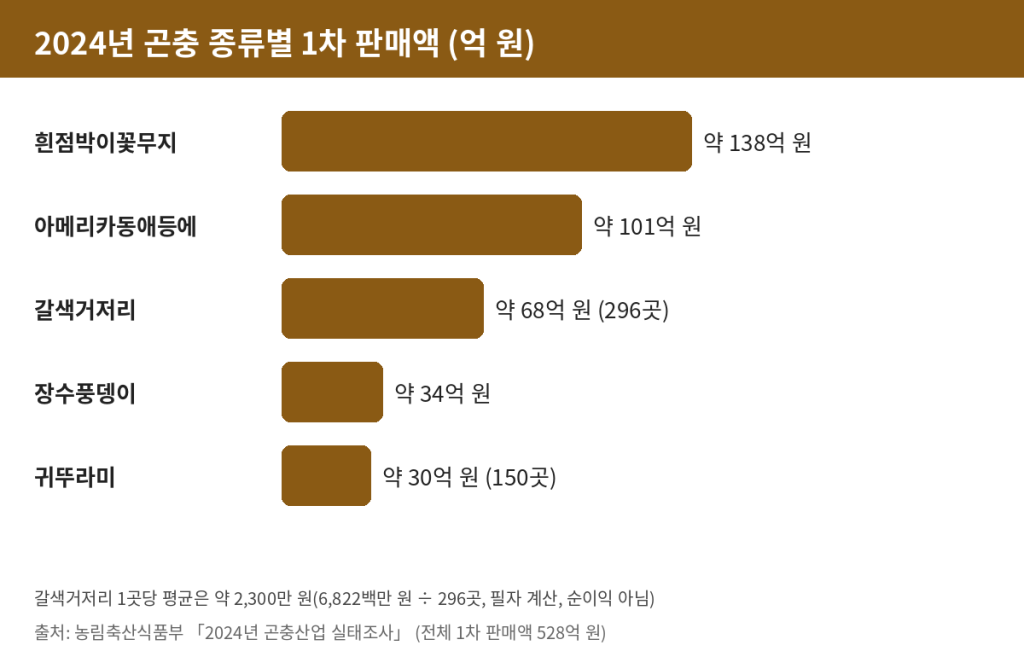
In one line: To raise and sell insects you file an “insect production business” report with your city, county or district (a report, not a permit). In 2024, first-stage mealworm sales were about KRW 6.8 billion across 296 farms, but income differs a lot between farms.
1. What it is
- You raise edible insects in boxes and sell them as food ingredients, feed (animal food) or pet food.
- According to the RDA, 10 insects are approved as food ingredients: grasshopper (메뚜기), white muscardine silkworm (백강잠), edible silkworm (larva and pupa), mealworm larva, two-spotted cricket, white-spotted flower chafer larva, rhinoceros beetle larva, superworm (아메리카왕거저리) larva, drone bee pupa, and migratory locust (풀무치).
- Mealworm larvae were added to the Korean Food Code as a general food ingredient in March 2016 (Nongsaro).
- According to MAFRA’s 2024 insect industry survey, there were 2,949 insect business reports (2,766 production, 562 processing, 1,386 distribution; one business can file more than one), and first-stage insect sales were KRW 52.8 billion, up 11.6% from the previous year.
- Insects are one of the protein sources being studied. This guide makes no health claims.
2. Start-up costs
We found no official average start-up cost. It varies with scale and facilities.
| Item | Description | Note |
|---|---|---|
| Insect production business report | File with the city/county/district head | Insect Industry Act Art. 12; you are told whether it is accepted within 5 days |
| Rearing room | Space that can keep 25-27°C and 60-70% humidity | Heating, cooling and ventilation costs vary |
| Rearing boxes and shelves | Plastic boxes (e.g. 22 L) and shelves | varies |
| Feed | Wheat bran dried to 10% moisture or less, plus vegetables | varies with volume |
| Sieve (separator) | Separates frass and shed skins from larvae | Hand sieves are cheap; machines vary |
| Starter stock | Healthy larvae and adults | varies |
| Processing and sales setup | Food manufacturing/processing registration to sell as food; feed manufacturing registration to sell as feed | Feed manufacturing registration fee KRW 30,000 (Gov24) |
3. Equipment and rearing tips
Based on a Nongsaro (RDA) video guide.
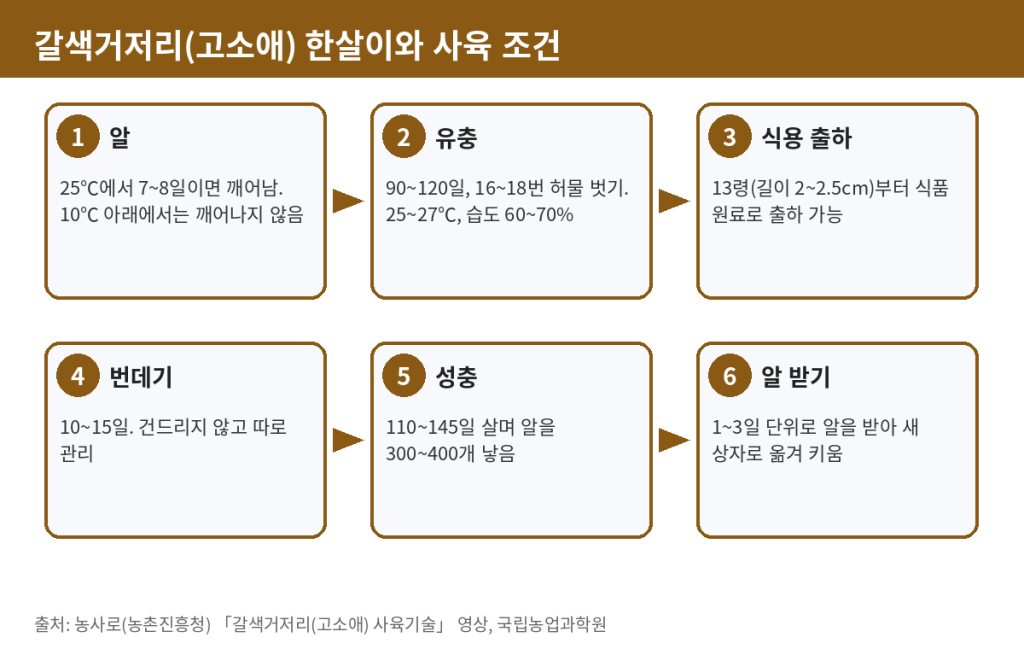
- Environment: 25-27°C and 60-70% humidity. Under these conditions you can raise 3-4 generations a year; one generation takes about 4 months.
- Life cycle: Eggs hatch in 7-8 days at 25°C. The larval stage lasts 90-120 days with 16-18 molts. The pupal stage lasts 10-15 days. Adults live 110-145 days and lay 300-400 eggs.
- Feed: Dry the wheat bran so its moisture stays at 10% or less. Damp feed easily grows mold and mites.
- Density: In a 22 L box, keep about 100 g, 600 g or 1,000 g of larvae depending on their size. Don’t pack them too tightly.
- Shipping: For food, larvae are shipped from the 13th instar (about 2-2.5 cm long).
- Separating: Sieve out frass and shed skins. Use a separator machine as you grow.
- MAFRA’s notice “Standards for Rearing Insects” also sets facility and management standards; read it before filing.
4. How much can you earn?
- In MAFRA’s 2024 survey, first-stage mealworm sales were about KRW 6.822 billion from 296 selling farms. Simply dividing gives about KRW 23 million per farm (author’s calculation). This is average sales, not net profit. Large and small farms are mixed together, so real income differs (varies by region and conditions).
- In the same survey, sales of pet and educational insects were about KRW 5.388 billion.
- What’s left after feed, electricity, labor, and whether you have buyers changes a lot.
5. Finding customers and selling
- Feed and animal food: Reptile, bird and fish keepers, pet shops, zoos and petting farms. To process and sell as feed, register a feed manufacturing business with the provincial governor under Article 8 of the Feed Management Act (Gov24: 15 days to process, KRW 30,000 fee).
- Food ingredients: To make insects into powder or roasted products and sell them as food, you need a business registration under the Food Sanitation Act. Registering as a food manufacturing/processing business counts as filing the insect processing report (Nongsaro Q&A). If you can’t process yourself, supply processors with raw material.
- Pet treat companies: Look for companies that use dried mealworms as an ingredient and ask about contract farming.
- Education and experiences: Sell life-cycle observation sets to schools and experience centers.
- Local insect associations and agricultural technology centers: Get sales-channel information and training. To get government support you need to register as an agricultural business entity (Nongsaro Q&A).
6. Start steps 1-2-3
- Learn and pick buyers: Take insect courses at your agricultural technology center and decide first whether you’ll sell for feed, food ingredients or pets. Don’t start big without buyers.
- File the report and test small: File an insect production business report with your city, county or district, and raise one generation (about 4 months) in a few boxes to learn temperature, humidity and feed management.
- Prepare sales and grow: Check feed manufacturing registration if you sell feed, or food business registration if you sell food. Grow the number of boxes slowly, based on your first sales records.
Watch out for these problems
In 2018 the RDA warned that some companies were misusing the RDA’s name and exaggerating how much money insect farming makes to attract investors and would-be farmers. Be careful with ads that take money for starter stock or facilities first while saying things like “we’ll buy back everything you raise” or “this is a government-approved business” (the author’s examples). Before signing, ask your city or county agricultural technology center, and get any buy-back promise (purchase contract) in writing with the company details, period and price. If you are harmed, you can contact the 1372 Consumer Counseling Center.
Sources
- Rural Development Administration – 10 insects approved as food ingredients (2026.6.4)
- Nongsaro (RDA) – Mealworm rearing video
- Nongsaro (RDA) – Q&A on insect business reports
- Ministry of Agriculture, Food and Rural Affairs – 2024 insect industry survey results
- National Law Information Center – Standards for Rearing Insects (MAFRA notice)
- Gov24 – Feed manufacturing business registration
- Foodnews – RDA warns about exaggerated insect business ads
- Etoday – Warning about insect investment ads misusing the RDA name
7. FAQ
Do I need a permit to raise insects?
It's a report, not a permit. Under Article 12 of the Insect Industry Act, you report to the city/county/district head to produce, process or distribute insects, and the office tells you within 5 days whether it is accepted.
Which insects can be sold as food?
According to the RDA, 10 insects are approved as food ingredients: grasshopper, white muscardine silkworm, edible silkworm, mealworm larva, two-spotted cricket, white-spotted flower chafer larva, rhinoceros beetle larva, superworm larva, drone bee pupa and migratory locust.
How long until mealworms can be shipped?
The larval stage is 90-120 days, and for food they are shipped from the 13th instar (about 2-2.5 cm). You must keep 25-27°C and 60-70% humidity (Nongsaro).
Can I raise them at home?
Small test batches are possible, but to sell you must file the report and check the "Standards for Rearing Insects" notice. Smell, dust and mites can occur, so ventilation and cleaning matter.
Is eating insects good for health?
This guide makes no health claims. Insects are just one of the protein sources being studied; follow food regulations for labeling such as allergens.
Last updated: October 30, 2026. Based on official sources; rules and prices can change.
🎁 Free: 7-day starter checklist for earning extra income
Leave your email and get the free checklist now. No spam, unsubscribe anytime.
Popular guides
- Top 10 Ways to Make Money Starting This Week (Free Checklist)
- How to Make Money as a Student: Legit Ideas (2026)
- Passive Income Ideas: Realistic Options for 2026
- Make Money Online Without Investment: 20 Free Ways
- How to Make Money with AI: 50 Practical Ways (2026)
- How to Make Money From Home: 20 Legit Ways
- Make Money Online for Beginners: 15 Easy Ways to Start
- How to Make Money as a Mom: 16 Flexible Ideas (Work Around Nap Time)
- 16 Legit Ways to Make Money Fast (This Week)
- How to Make Money as a Teenager: 16 Safe Ideas
- 14 Remote Jobs With No Experience Needed
Next method: How to Make Money with a Fishing Charter Boat in Korea →