How to Make Money

Category: Tax & Rules

  • How to Make Money with Korea’s National Employment Support Program (2026 Job-Seeking Allowance of 600,000 KRW a Month)

    How to Make Money with Korea’s National Employment Support Program (2026 Job-Seeking Allowance of 600,000 KRW a Month)

    🧭 At a glance: is this for you?

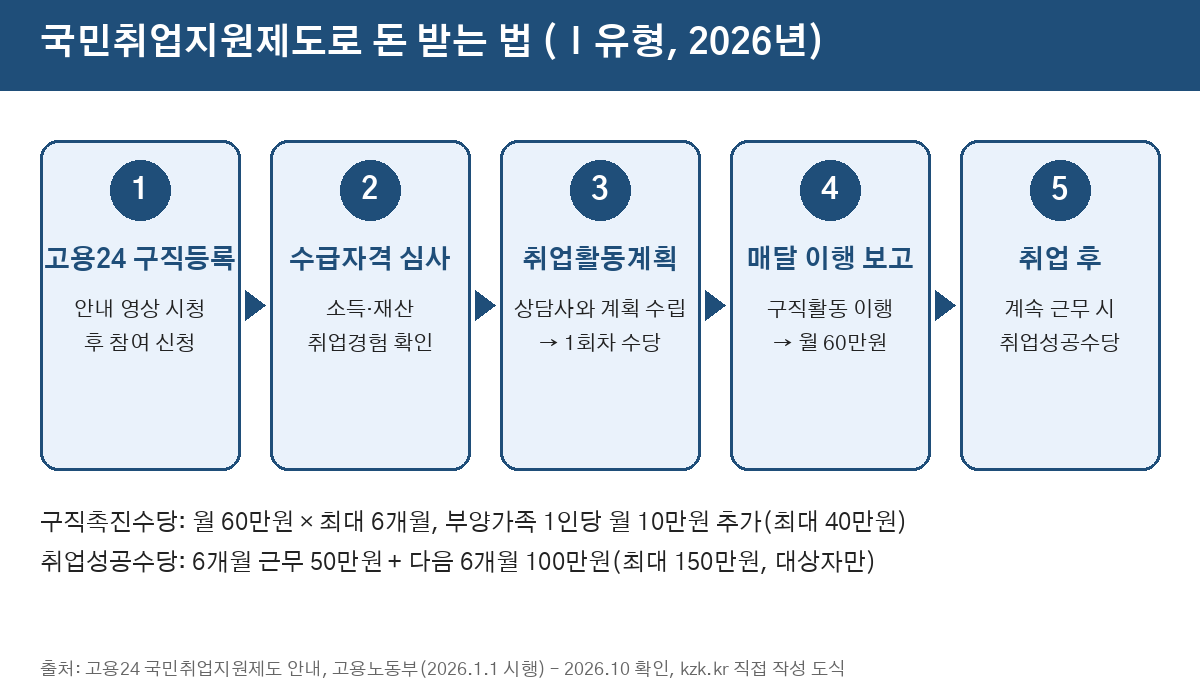
    Korea’s National Employment Support Program (국민취업지원제도) gives job seekers one-to-one counselling, training and job matching from the Ministry of Employment and Labor. Eligible Type I participants also receive a job-seeking allowance, which rose from ₩500,000 to ₩600,000 a month for up to 6 months on 1 January 2026. It is support while you look for work, paid in exchange for agreed job-search activities.

    • Best for: Job seekers in Korea aged 15–69 with low household income, and young people aged 15–34 under the youth track
    • Startup cost: ₩0 (applying is free)
    • Time to first income: 3–8 weeks: the first payment follows your eligibility decision and job-search plan (kzk.kr estimate as of 2026-10-30, not a sourced figure or a guarantee)
    • Difficulty: Easy to moderate: online application plus monthly activity reports

    👍 Pros

    • Monthly cash support plus counselling, training and job matching
    • Extra ₩100,000 a month per eligible dependant (up to ₩400,000)
    • Some participants can get an employment success bonus of up to ₩1.5 million after keeping a job

    👎 Cons and cautions

    • Payments are cut or stopped if you skip planned activities
    • Any earnings must be reported
    • Usually cannot be received at the same time as unemployment benefits

    📘 What the full guide below covers: eligibility table, the 7-step application on Work24, building a job-search plan you can keep, a first-week plan and the mistakes that stop payments.

    💰 How much you can receive (2026)

    • Type I job-seeking allowance: ₩600,000–1,000,000 a month (about $435–$725), depending on dependants, for up to 6 months
    • Dependants aged 18 or under, 70 or over, or with severe disabilities: ₩100,000 each a month, up to ₩400,000
    • Employment success bonus for eligible participants: ₩500,000 after 6 months in a job + ₩1,000,000 after the next 6 months
    • Type II: job-search activity costs and services instead of the monthly allowance

    Sources: Ministry of Employment and Labor 2026 increase notice, Work24 and Gov24 program pages, checked October 2026. Amounts are set by the government and can change; your job centre (phone 1350) has the final say. General information, not legal advice.

    🪜 Basic steps (summary)

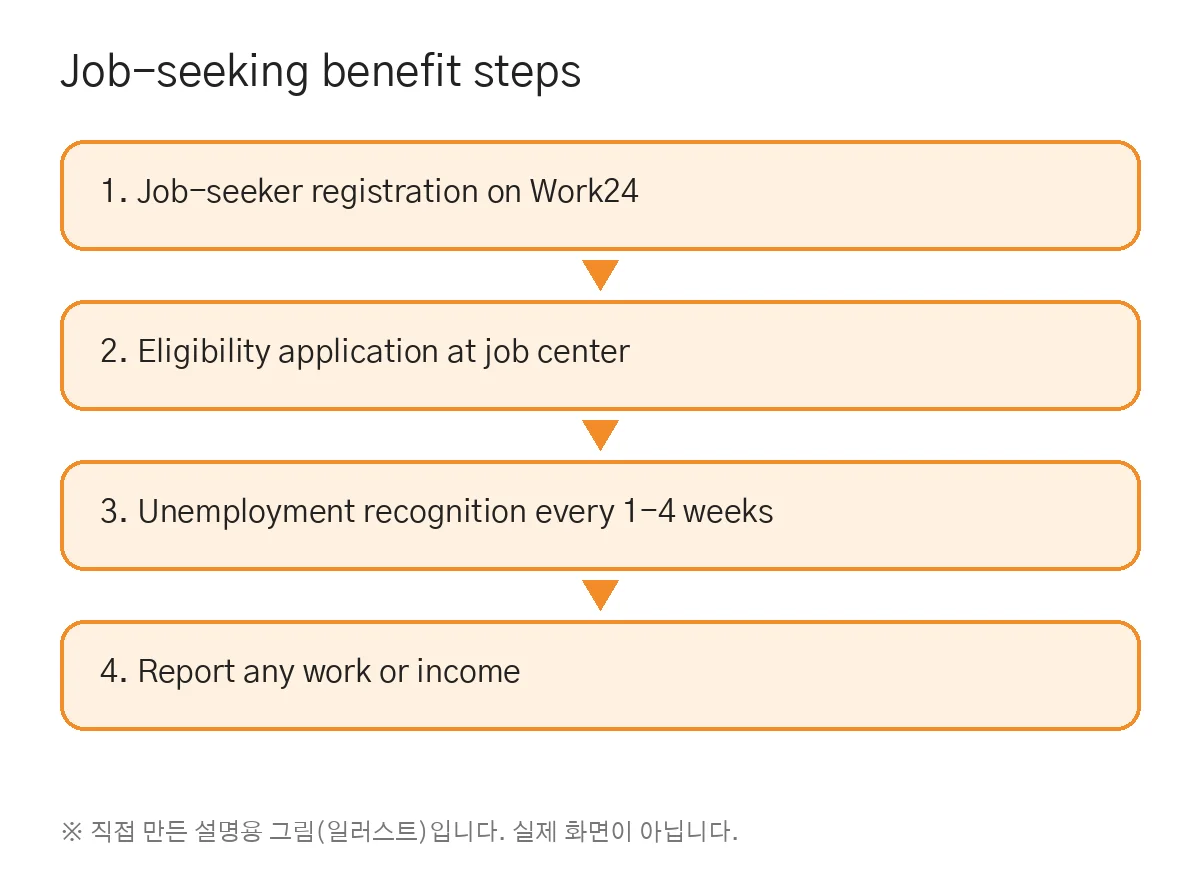
    1. Sign up on Work24 and register as a job seeker.
    2. Watch the program’s guidance video.
    3. Submit the participation application with accurate household details.
    4. Wait for the eligibility decision (income, assets, work history).
    5. Make a job-search plan with your counsellor; the first payment follows.
    6. Carry out the plan and report each month to keep receiving the allowance.

    Looking for ways to earn after you find work? Our Guide PDF ($3.49) compares 30 options side by side.

    The steps below are free. Want every method compared side by side with a first-week plan?

    See full guide →

    📘 Full practical guide (October 2026)

    ✅ Who qualifies (Type I summary)

    • Requirement-based: age 15–69, household income at or below 60% of median income, assets ₩400 million or less (₩500 million for youth), and at least 100 days or 800 hours of work in the last 2 years.
    • Selection-based: same income and asset limits but less work history; places depend on budget.
    • Youth track: age 15–34 (extended by military service, up to 37), household income at or below 120% of median, assets ₩500 million or less; places depend on budget.

    🪜 Step-by-step on Work24

    1. Register as a job seeker. Create a Work24 account and complete job seeker registration (구직신청) first; the application button stays locked without it. Enter your preferred job, region and experience.
    2. Watch the guidance video. In the National Employment Support menu, watch the required video to the end.
    3. Apply. Go to “National Employment Support → apply”. Enter every household member correctly, because the dependant top-up is decided here. You can also apply on paper at your local job centre.
    4. Wait for the decision. The job centre checks income, assets and work history and replies by text or on Work24. Send any extra documents quickly.
    5. Build your plan (IAP). At the first counselling session you agree on activities such as job applications, training or counselling. The first allowance is paid once the plan is set. Plan only what you can really do.
    6. Carry it out and report monthly. Submit the activity report and payment request; from the second payment you are paid every month from the plan date. Report any part-time income.
    7. After you get a job. Eligible participants can apply for the success bonus after 6 and 12 months of continued work.

    🧮 Worked example

    A job seeker with one child under 18 who qualifies for Type I: ₩600,000 + ₩100,000 = ₩700,000 a month, or up to ₩4.2 million over 6 months, as long as the monthly activities are done. Illustrative only.

    🔗 Official sources

    📅 First-week plan

    • Day 1: Work24 sign-up and job seeker registration.
    • Day 2: Watch the guidance video.
    • Day 3: List household members and income.
    • Day 4: Submit the application.
    • Day 5: Finish one CV (needed at counselling).
    • Day 6: Save 5 job ads in fields you want.
    • Day 7: Check for messages from the job centre and prepare any extra documents.

    🚫 Common mistakes

    • Trying to apply without job seeker registration.
    • Leaving out household members and losing the dependant top-up.
    • Doing activities that are not in your plan; they are not counted.
    • Not reporting income, then having to pay money back.
    • Missing payments three times without good reason can end your right to the rest of the allowance.

    ⚠️ Watch out for scams

    Anyone charging a fee to “apply for you” or asking for your Work24 ID and password is not official. Applying is free and you do it yourself on Work24 or at a job centre. Never lend your bank account for “easy high pay” offers on job sites; it can be used for crime.

    📚 Related guides

    This guide is free to read in full here. If you want a printable PDF comparing 30 ways to make money, see the Guide PDF ($3.49).

    Last updated: October 29, 2026. General information; check final rules with your job centre.
  • How to Make Money with Korea’s Pension Savings and IRP Tax Credit (Check Before Dec 31)

    How to Make Money with Korea’s Pension Savings and IRP Tax Credit (Check Before Dec 31)

    🧭 At a glance: is this for you?

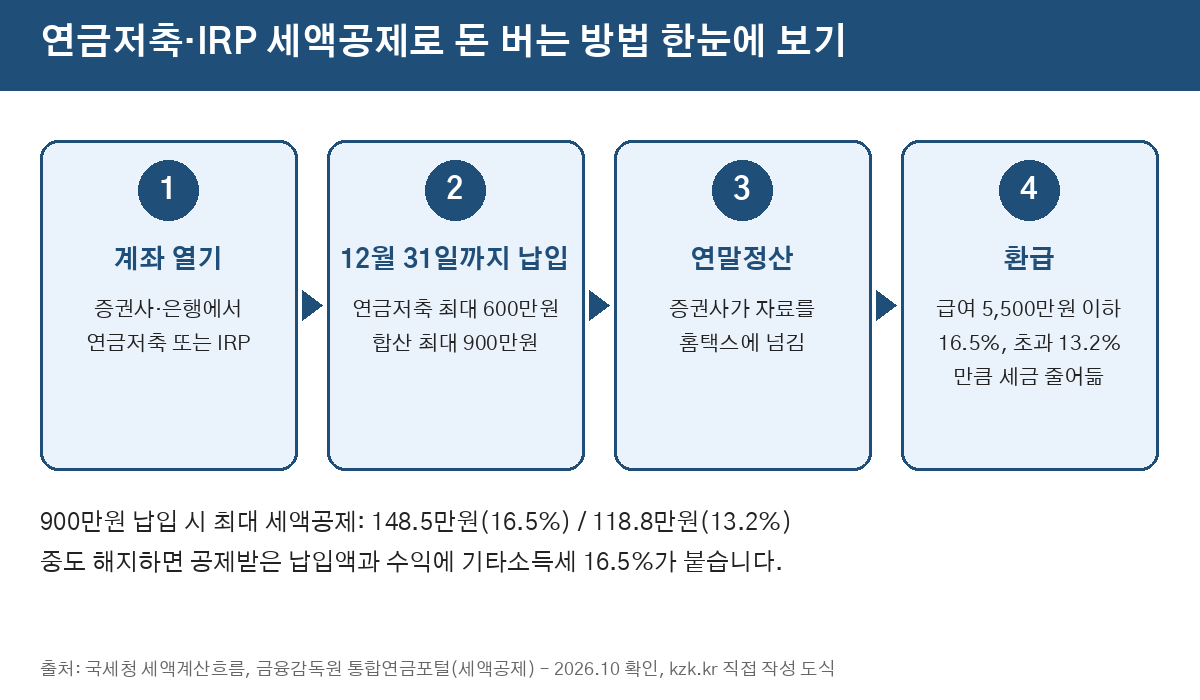
    If you pay income tax in Korea, money you put into a pension savings account (연금저축) or an IRP (individual retirement pension account) comes back as a tax credit at the next year-end settlement. You do not earn new income, but you keep more of your pay: 13.2% or 16.5% of what you deposit, up to KRW 9 million a year combined. Only deposits made by 31 December 2026 count for this year.

    • Best for: Salaried workers who do year-end tax settlement, and freelancers or business owners who file income tax in May, with savings they will not need for years
    • Startup cost: ₩0 to open (most accounts are free; product fees vary)
    • Time to first income: 2–5 months: the credit appears in the February–March payroll after year-end settlement, or after the May filing for freelancers (kzk.kr estimate as of 2026-10-30, not a sourced figure or a guarantee)
    • Difficulty: Easy: open an account in an app and deposit before year-end

    👍 Pros

    • A fixed 13.2% or 16.5% credit on what you deposit, set by law
    • You can deposit in one lump sum in December
    • The money stays yours and keeps growing tax-deferred for retirement

    👎 Cons and cautions

    • You must keep it until age 55 and take it as a pension to keep the benefit
    • Early termination: 16.5% “other income” tax on credited deposits and gains
    • No credit if you have little or no income tax to pay

    📘 What the full guide below covers: checking your remaining limit, choosing your credit rate, opening accounts, the best deposit order, a worked example, a first-week plan and the mistakes that cancel the benefit.

    💰 How much comes back (2026 rules)

    • Total pay ₩55 million or less (earned income only): 16.5% credit → up to ₩1,485,000 on ₩9 million (about $1,076)
    • Total pay over ₩55 million: 13.2% credit → up to ₩1,188,000 on ₩9 million (about $861)
    • Pension savings alone counts up to ₩6 million; IRP fills the rest up to ₩9 million combined
    • Freelancers and business owners use a total income amount of ₩45 million as the dividing line

    Figures include local income tax and come from the Income Tax Act (Art. 59-3), the National Tax Service and the Financial Supervisory Service, checked October 2026. You cannot get back more than the tax you owe. General information, not tax or investment advice.

    🪜 Basic steps (summary)

    1. Check how much you have already deposited this year in your pension savings and IRP apps.
    2. Find your total pay to see whether your rate is 16.5% or 13.2%.
    3. Open a pension savings account (securities firm) or IRP (bank or securities firm) if you do not have one.
    4. Deposit the remaining amount before 31 December, ideally by mid-December.
    5. In January, confirm the deposit shows up in Hometax’s simplified year-end data.

    Want a printable overview of more ways to grow your money? Our Guide PDF ($3.49) compares 30 options side by side.

    The steps below are free. Want every method compared side by side with a first-week plan?

    See full guide →

    📘 Full practical guide (October 2026)

    🪜 Step-by-step

    1. Check this year’s deposits. In your securities or bank app, open the pension savings and IRP menus and note this year’s deposits. If your company has a DC-type retirement pension, the employer’s contributions do not count; only extra money you add yourself does.
    2. Find your credit rate. Look at last year’s withholding receipt (근로소득 원천징수영수증) or Hometax’s year-end tax preview. Total pay of ₩55 million or less means 16.5%; above that, 13.2%. Freelancers use total income of ₩45 million as the line.
    3. Check that you actually owe tax. Your “determined tax” (결정세액) on last year’s receipt shows roughly how much tax there is to reduce. If it is small, depositing the full ₩9 million will not give you the full credit.
    4. Open the account if needed. Pension savings: in a securities app, choose “open pension savings account” (ID card and a phone in your name). IRP: in a bank or securities app, “open individual IRP”; you need earned or business income. Compare fees on the FSS comparison site before choosing.
    5. Deposit in the right order. A common order: pension savings up to ₩6 million first, then up to ₩3 million in IRP. Deposits arriving after 31 December count for next year, and banks have year-end cut-off times, so aim for mid-December.
    6. Decide what the money is invested in. Left alone it stays as cash. Deposits, bond funds or index ETFs are all possible; this is your own decision, and risk products can lose value.
    7. Confirm at settlement. In January the deposits appear in Hometax’s simplified year-end data. Check the pension account line on your company’s form; freelancers enter the same amount in the May filing.

    🧮 Worked example

    Total pay ₩40 million, ₩3 million already in pension savings this year:

    • Current credit: ₩3,000,000 × 16.5% = ₩495,000
    • Add ₩3 million to pension savings + ₩3 million to IRP in December: ₩9,000,000 × 16.5% = ₩1,485,000
    • Extra refund: ₩990,000, as long as the determined tax is at least that large

    Illustrative numbers; your result depends on your tax and other credits.

    🔗 Official sources and tools

    📅 First-week plan

    • Day 1: Check this year’s pension savings and IRP deposits.
    • Day 2: Find your total pay and credit rate.
    • Day 3: Check last year’s determined tax.
    • Day 4: Open an account if you need one.
    • Day 5: Decide the amount, keeping 3–6 months of living costs aside.
    • Day 6: Deposit.
    • Day 7: Confirm the app shows it as a tax-credit-eligible deposit.

    🚫 Common mistakes

    • Putting all ₩9 million into pension savings: only ₩6 million counts there.
    • Depositing far more than your tax: you cannot get back more than you owe.
    • Depositing on 1 January: it counts for the following year.
    • Cancelling early: 16.5% other income tax wipes out the benefit. Lower rates apply only for legal reasons such as serious illness; check the FSS guide first.
    • Expecting partial withdrawals from IRP: outside legal reasons, IRP usually has to be closed in full.

    ⚠️ Watch out for scams

    Calls or texts offering a “special year-end tax benefit” that ask you to install an app or share a verification code are not from your bank. Open pension accounts yourself in your financial company’s official app. Be wary of anyone promising guaranteed high returns, and ask the FSS (1332) if in doubt.

    📚 Related guides

    This guide is free to read in full here. For a printable PDF comparing 30 ways to make money, see the Guide PDF ($3.49).

    Last updated: October 29, 2026. General information, not tax or investment advice.

  • Korean Driver’s License Renewal Period and Fines in 2026: Now 6 Months Either Side of Your Birthday

    Korean Driver’s License Renewal Period and Fines in 2026: Now 6 Months Either Side of Your Birthday

    Korean driver’s license renewal (and the aptitude test) now has a window of 6 months before and after your birthday, from January 1, 2026 (Road Traffic Act Art. 87, Korea Road Traffic Authority). Miss it and the fine is 30,000 won for Class 1 and 20,000 won for Class 2; a Class 1 license can be cancelled one year after the deadline.

    General information only, not professional advice. Check your exact window on safedriving.or.kr (My Page) or efine.go.kr.

    What changed in the renewal window?

    It used to be Jan 1-Dec 31 of the renewal year. From Jan 1, 2026 it is 6 months either side of your birthday in that year.

    • Example (KoROAD): birthday Oct 1, due in 2026 → Apr 2, 2026 to Apr 1, 2027
    • For your first renewal after the change, the old window (Jan 1-Dec 31, 2026) also counts, so the example runs Jan 1, 2026 to Apr 1, 2027.
    • Dates printed on cards issued before 2026 may differ from the legal window.
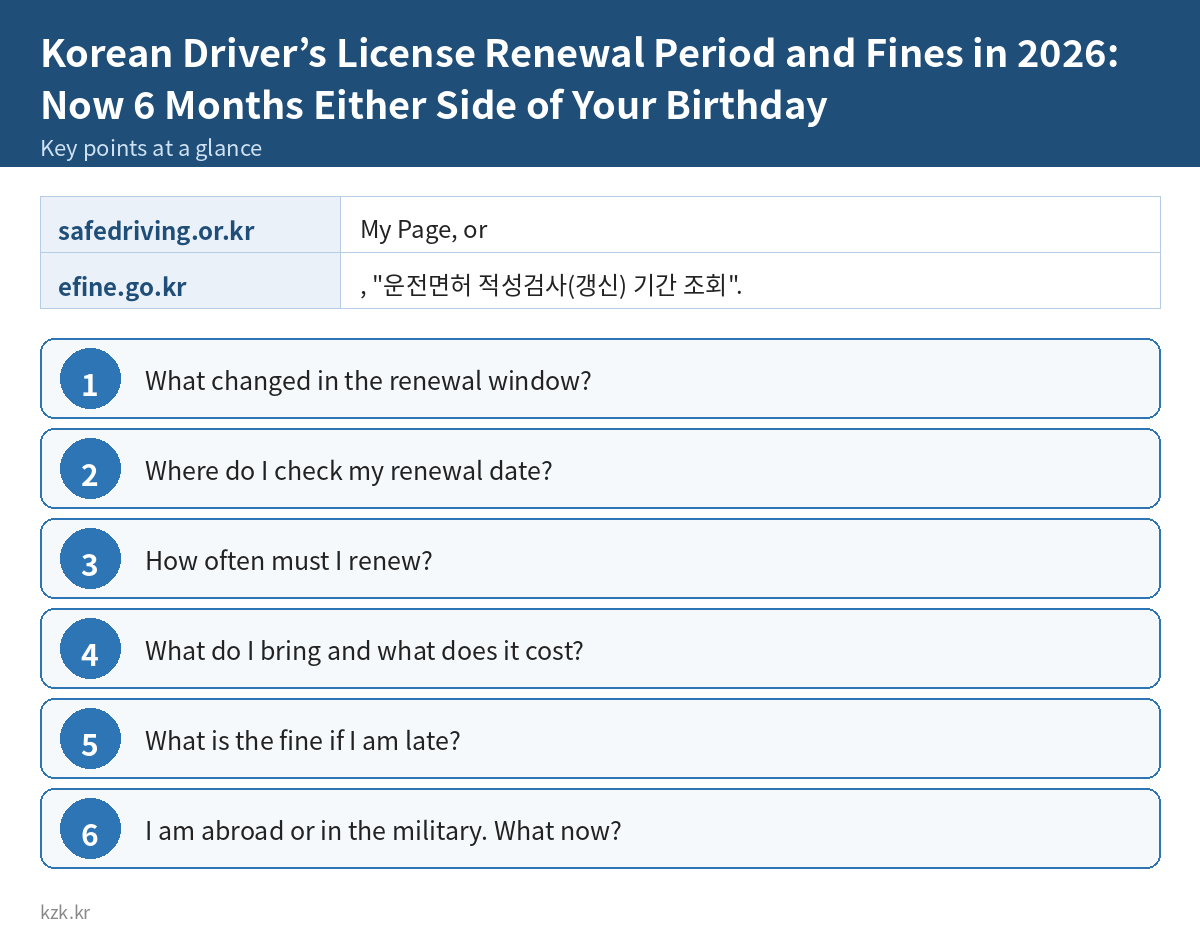
    Korean Driver’s License Renewal Period and Fines in 2026: Now 6 Months Either Side of Your Birthday: key points summary
    Korean Driver’s License Renewal Period and Fines in 2026: Now 6 Months Either Side of Your Birthday: key points summary

    Where do I check my renewal date?

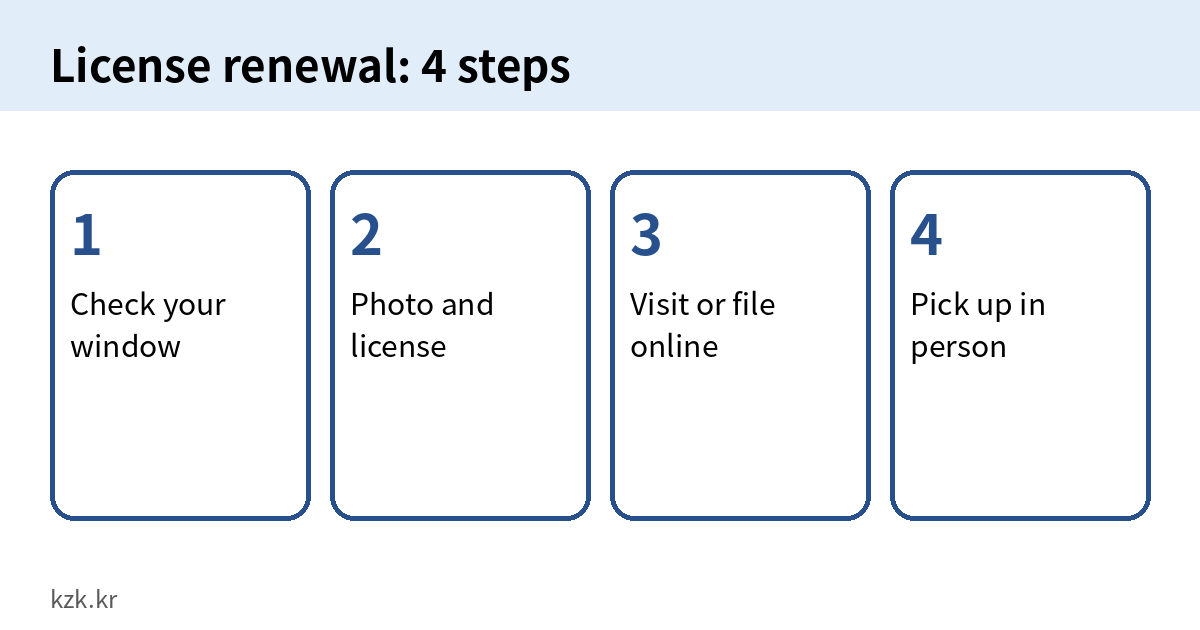
    Four steps to renew a Korean driver license
    1. safedriving.or.kr My Page, or
    2. efine.go.kr, “운전면허 적성검사(갱신) 기간 조회”.

    How often must I renew?

    Road Traffic Act Art. 87:

    • every 10 years
    • age 65-74: 5 years; 75+: 3 years
    • Class 1 holders, and Class 2 holders aged 70+ in the window, need a regular aptitude test (medical check).
    • Drivers 75+ must finish traffic safety training first.

    What do I bring and what does it cost?

    KoROAD figures:

    Type Bring Fee
    Class 1 aptitude test license, 2 photos (3.5×4.5 cm, within 6 months), form 16,000 won standard / 21,000 won mobile IC (+ medical check)
    Class 2 renewal license, 1 photo 10,000 won / 15,000 won mobile IC
    • Medical check at a test center: 8,000 won (Class 1 large/special), 7,000 won otherwise
    • An NHIS health checkup result from the last 2 years can replace it (Class 1 ordinary, Class 2); then only 1 photo is needed.
    • Class 2 can apply online or by proxy; pickup is in person only.

    What is the fine if I am late?

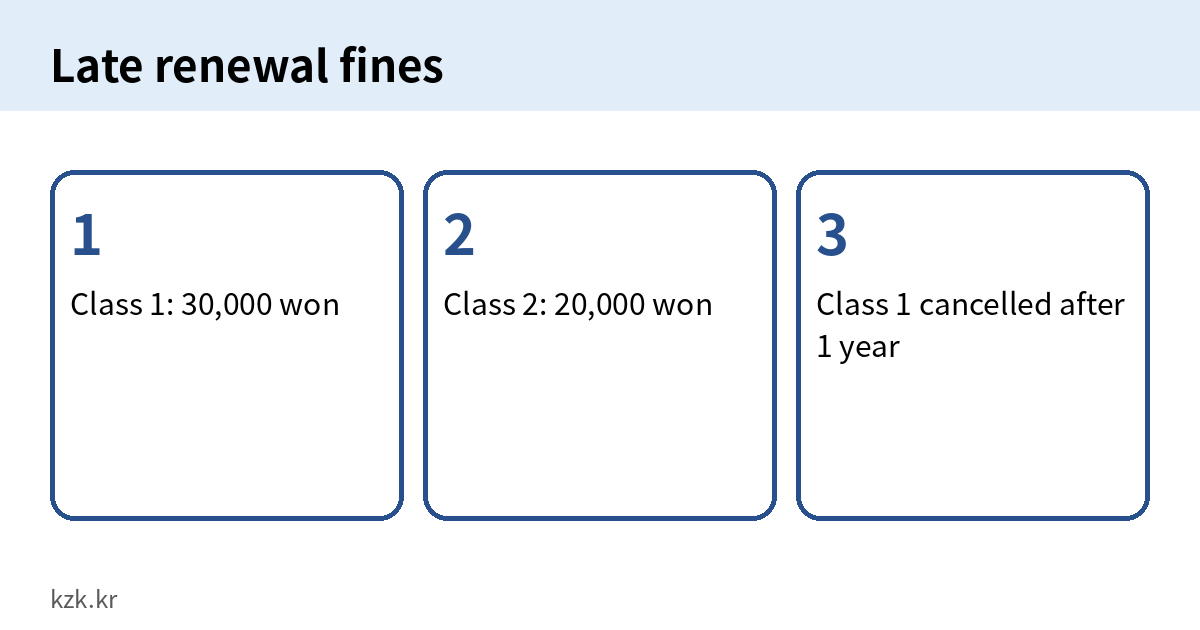
    Korean license renewal fines: Class 1 30,000 won, Class 2 20,000 won
    • Class 1: 30,000 won; license cancelled one year after the day following expiry
    • Class 2: 20,000 won (30,000 won if 70+ and test required)
    • Late payment adds 3%, then 1.2% a month, up to 75%.

    I am abroad or in the military. What now?

    You can renew early or postpone for reasons such as overseas stay, military service or hospital stay (Art. 87(4)). After a postponement, renew within 3 months of the reason ending (return, discharge, etc.).

    FAQ

    Q. When did the renewal window change?
    A. January 1, 2026: now 6 months before and after your birthday.

    Q. Do Class 2 drivers need a medical check?
    A. Only if 70 or older in the renewal window.

    Q. I missed it. Is my license cancelled?
    A. Class 2: fine only (unless 70+ with test). Class 1: cancelled one year after expiry.

    Q. Can I renew online?
    A. Class 2 renewal can be filed online at safedriving.or.kr; Class 1 can register a photo and print the form there.

    Read next


    **$3.49 PDF guide **: get this guide as a one-page checklist PDF. Get the PDF guide

    Last checked: October 27, 2026. Rules change; check the official sites.

  • How to Renew a Korean Passport Online in 2026: Fees and Steps on Gov24

    How to Renew a Korean Passport Online in 2026: Fees and Steps on Gov24

    Korean passport renewal online lets you apply on Gov24 (or KB Star Banking) and visit the issuing office only once, to pick it up. Per the Ministry of Foreign Affairs, passport fees rose by 2,000 won on March 1, 2026: a 10-year adult passport is 52,000 won (58 pages) or 49,000 won (26 pages).

    General information only, not professional advice. Confirm with the MOFA passport site (passport.go.kr) or the consular call center (+82-2-3210-0404).

    How much does a Korean passport cost in 2026?

    Domestic fees from the MOFA passport site:

    Type Validity Pages Fee
    Adult (18+) multiple 10 years 58 52,000 won
    Adult (18+) multiple 10 years 26 49,000 won
    Age 8 to 17 5 years 58 / 26 44,000 / 41,000 won
    Under 8 5 years 58 / 26 35,000 / 32,000 won
    Single-use up to 1 year – 17,000 won

    MOFA press release (Feb 23, 2026): fees rose 2,000 won from March 1, 2026 after an amendment to the Passport Act Enforcement Decree.

    How to Renew a Korean Passport Online in 2026: Fees and Steps on Gov24: key points summary
    How to Renew a Korean Passport Online in 2026: Fees and Steps on Gov24: key points summary

    Who can renew a passport online?

    Per Gov24, citizens who have had an e-passport at least once. You must apply in person if:

    • it is your first e-passport
    • you need to change your romanized name
    • you need an emergency, diplomatic or official passport
    • the passport was lost or damaged, or data must be corrected (MOFA)
      A legal guardian can apply online for a child under 18 after verifying their own identity.

    How do I apply on Gov24? (step by step)

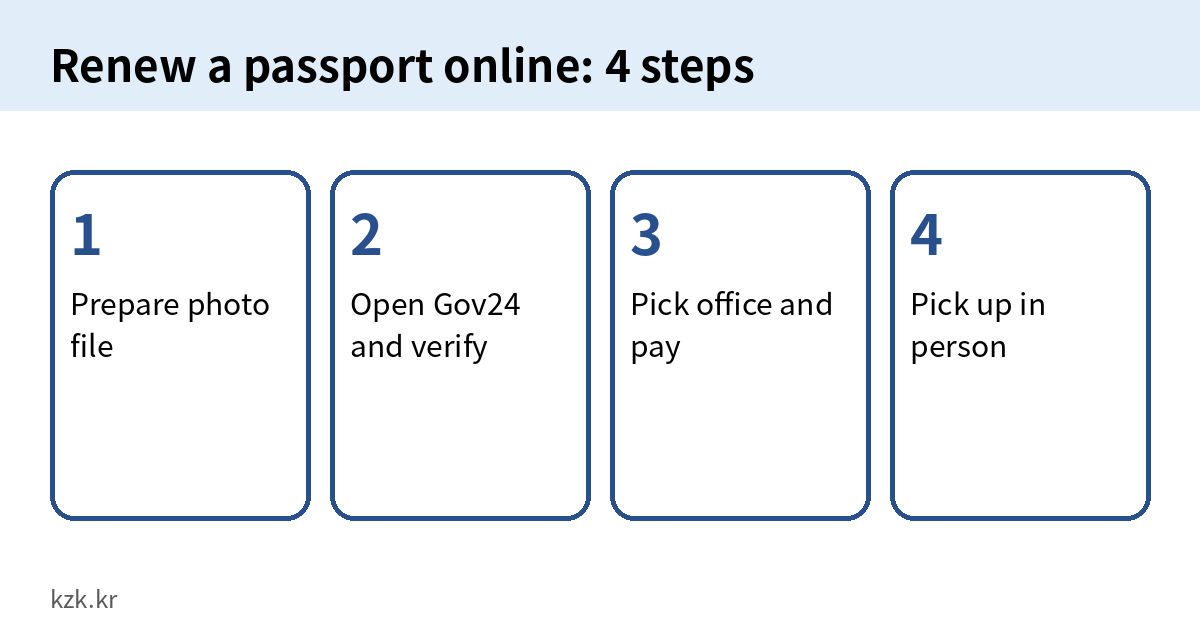
    Four steps to renew a Korean passport online: photo, Gov24 login, choose office and pay, pick up in person
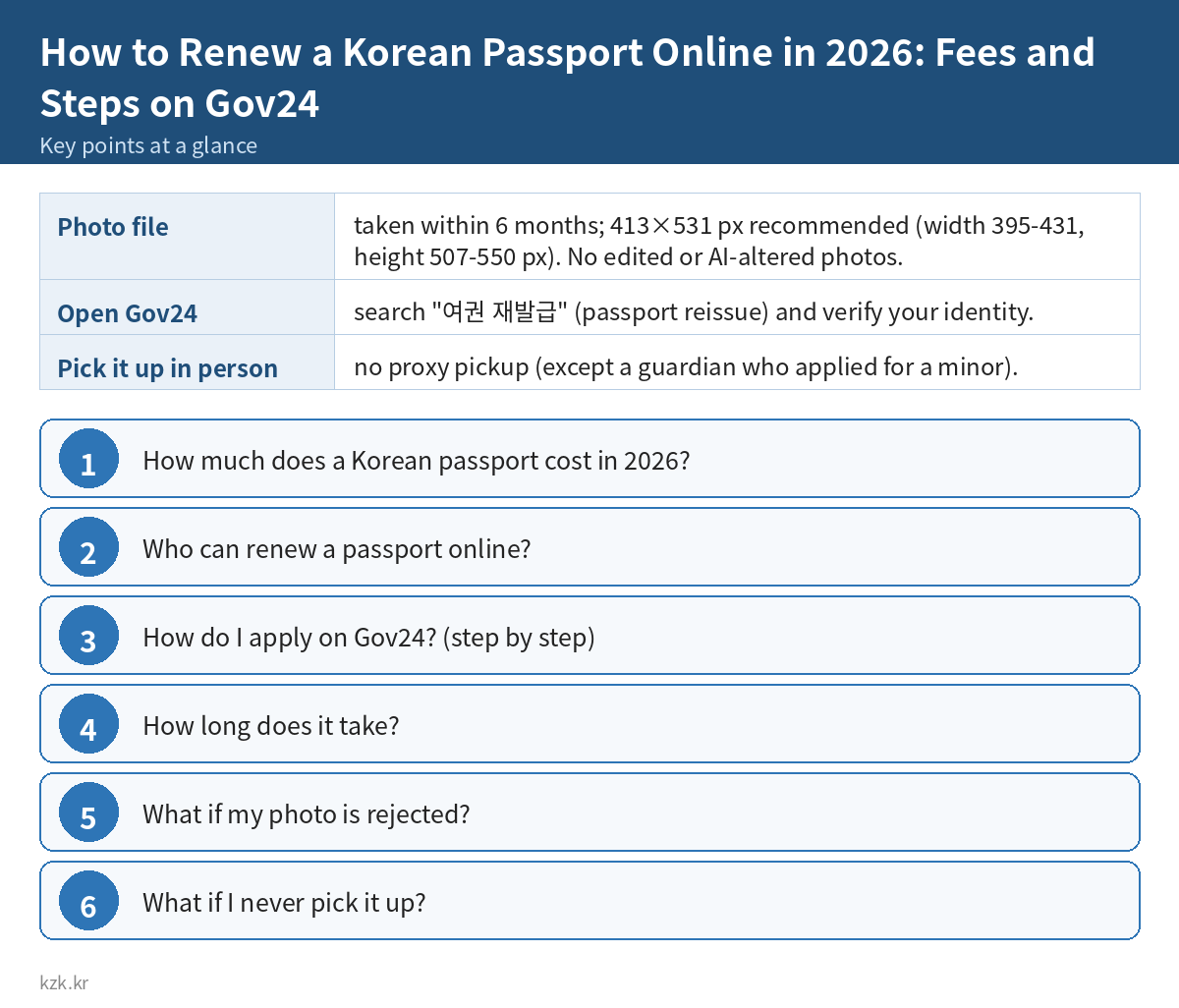
    1. Photo file – taken within 6 months; 413×531 px recommended (width 395-431, height 507-550 px). No edited or AI-altered photos.
    2. Open Gov24 – search “여권 재발급” (passport reissue) and verify your identity.
    3. Pick the pickup office and pay – you cannot change the office later.
    4. Pick it up in person – no proxy pickup (except a guardian who applied for a minor).

    How long does it take?

    Gov24 says about 8 working days in Korea, longer in peak season. Night-time online applications may add a day (two for islands such as Jeju). Track it under “여권 발급상태 조회” on Gov24.

    What if my photo is rejected?

    Gov24 says rejected photo applications are refunded automatically within 7 days; some payment types (e.g. bank transfer) need a refund request under MyGOV. More than 10 failed photo attempts in 24 hours locks applications for 24 hours.

    What if I never pick it up?

    A passport not collected within 6 months loses its validity under the Passport Act and the fee is not refunded (Gov24). Bring your old valid passport to hand in when you collect the new one.

    FAQ

    Q. How much is a Korean passport renewal?
    A. For adults, 52,000 won (58 pages) or 49,000 won (26 pages) for 10 years, from March 1, 2026 (MOFA).

    Q. Can I get my first passport online?
    A. No. A first e-passport requires an in-person application.

    Q. Can I use a phone photo?
    A. Yes, if it meets the size rules and is not edited or filtered.

    Q. Can I cancel after applying?
    A. Gov24 says you cannot cancel once processing starts.

    Read next


    **$3.49 PDF guide **: get this guide as a one-page checklist PDF. Get the PDF guide

    Last checked: October 27, 2026. Rules change; check the official sites.

  • How to Check Your Korea Health Insurance Premium Refund (2026): Claim It Before 3 Years Pass

    How to Check Your Korea Health Insurance Premium Refund (2026): Claim It Before 3 Years Pass

    A Korea health insurance premium refund check (건강보험료 환급금 조회) shows whether the National Health Insurance Service (NHIS) owes you overpaid premiums, and lets you claim them to your bank account. Refunds arise from double or mistaken payments, retroactive loss of coverage, or retroactive premium adjustments. Per Gov24, claims expire after 3 years for health (long-term care) insurance and 5 years for National Pension.

    General information only — not professional advice. Confirm with NHIS (☎1577-1000).

    Why do health insurance refunds happen?

    • Double or mistaken premium payments
    • Retroactive loss of coverage (e.g., job change, moving)
    • Retroactive premium adjustments
    How to Check Your Korea Health Insurance Premium Refund (2026): Claim It Before 3 Years Pass: key points summary
    How to Check Your Korea Health Insurance Premium Refund (2026): Claim It Before 3 Years Pass: key points summary

    How do I check and claim a health insurance refund? (step by step)

    Four steps to claim a Korea health insurance refund: open NHIS, log in, check refunds, enter bank account
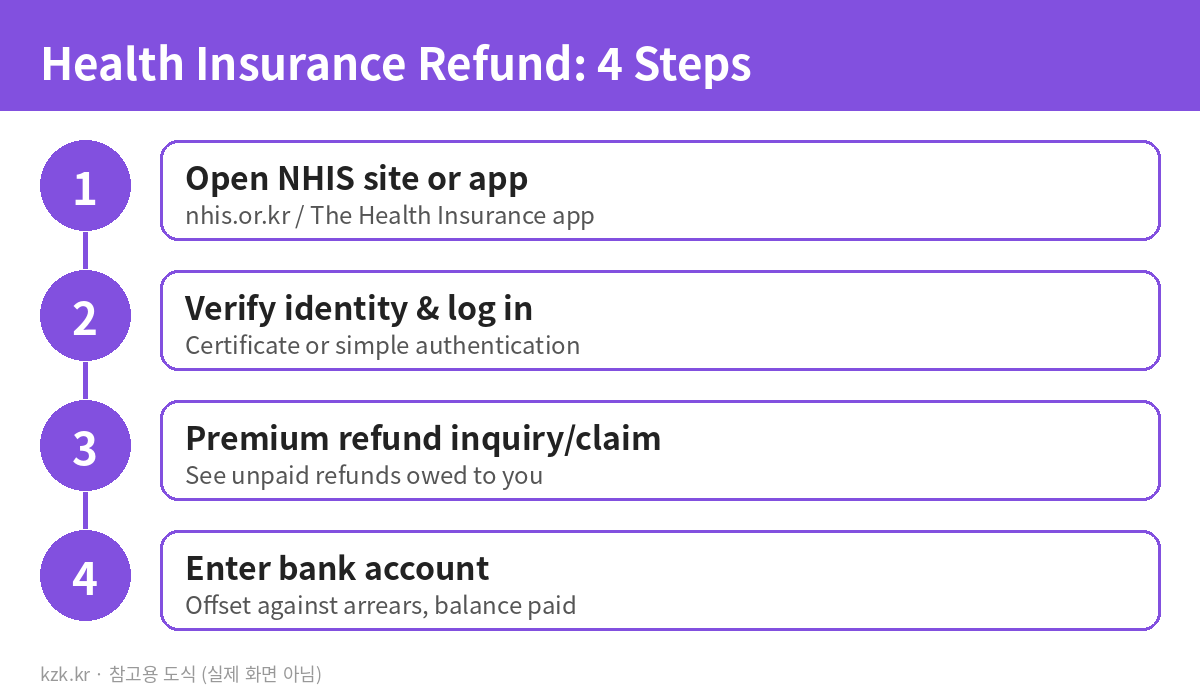
    1. Open nhis.or.kr or the NHIS mobile app (“The 건강보험”).
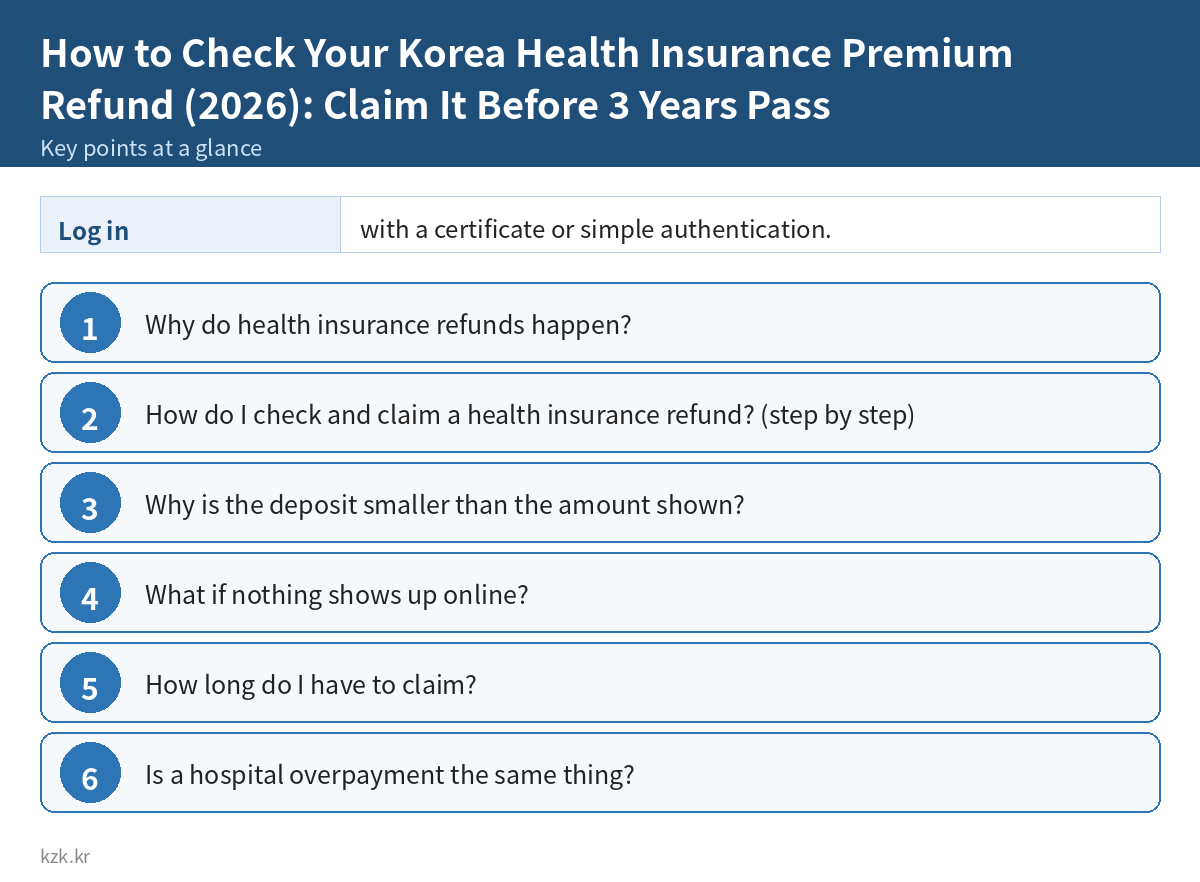
    2. Log in with a certificate or simple authentication.
    3. Go to Unpaid refund integrated inquiry & claim (or “Premium refund inquiry/claim”).
    4. Enter your bank account and submit.

    You can also apply at a branch, by fax, mail, or phone (1577-1000).

    Why is the deposit smaller than the amount shown?

    Refunds are first offset against premiums you owe; only the balance is paid.

    What if nothing shows up online?

    Online inquiry is available only to one person who was the household head within the last 3 years. Refunds go to the person liable for payment (household head or subscriber). Otherwise contact your local branch.

    How long do I have to claim?

    • Health (long-term care) premium refunds: 3 years (NHI Act Art. 91)
    • National Pension premium refunds: 5 years (Gov24)

    Is a hospital overpayment the same thing?

    No — overpaid co-payments and the annual out-of-pocket cap refund are separate. See medical expense cap refund.

    FAQ

    Q. Is there a fee?
    A. NHIS lists no fee for direct claims. Be wary of “agents” asking for money or personal data.

    Q. I got a refund link by text.
    A. Don’t tap it; go to the NHIS site or app directly.

    Q. Are pension refunds included?
    A. NHIS’s premium refund service covers both health insurance and National Pension subscribers.

    Q. More than 3 years have passed.
    A. Once the limitation period ends, claims are generally barred; ask NHIS about exceptions.

    Read next


    📘 $3.49 PDF guide – hidden refund checklist: https://kzk.kr/go/guide

    Not professional advice. Information as of Oct 27, 2026.

  • Korea Income Tax Interim Prepayment 2026: Got a November Notice? Pay by November 30

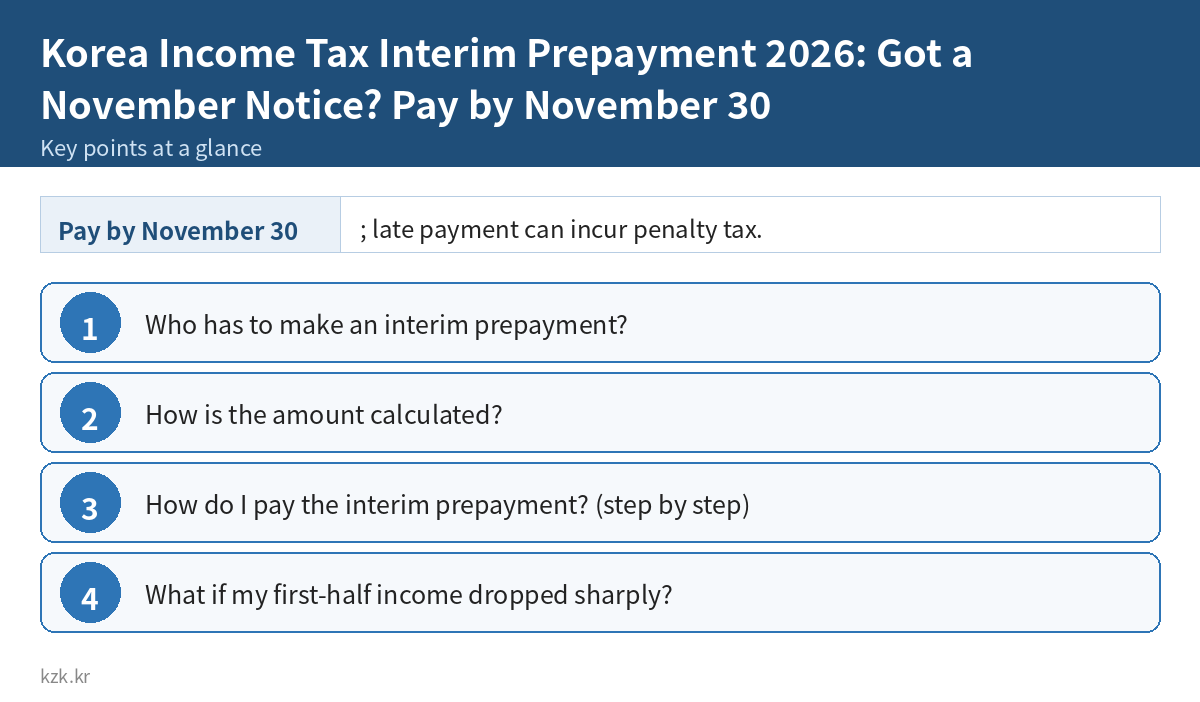
    Korea Income Tax Interim Prepayment 2026: Got a November Notice? Pay by November 30

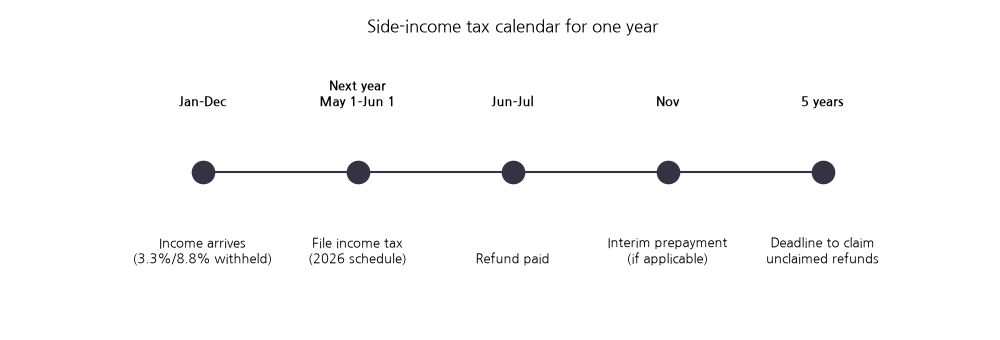
    Comprehensive income tax interim prepayment (종합소득세 중간예납) is how people with business or other comprehensive income in Korea pay part of this year’s income tax in advance. The NTS calculates half of last year’s income tax, sends notices between November 1 and 15, and the payment deadline is November 30, 2026 (NTS tax calendar). If you started reporting side-business income, here is how to read the notice.

    General information only — not professional advice. Check with the NTS (☎126) or a tax professional.

    Who has to make an interim prepayment?

    • Residents with comprehensive income, mainly business income (Income Tax Act Art. 65)
    • Excluded: people with only income types set by decree (e.g., wage income only) and people who started a business this year
    Korea Income Tax Interim Prepayment 2026: Got a November Notice? Pay by November 30: key points summary
    Korea Income Tax Interim Prepayment 2026: Got a November Notice? Pay by November 30: key points summary

    How is the amount calculated?

    • Interim tax = base amount (last year’s income tax) × 1/2, rounding down below KRW 1,000
    • If the amount is under KRW 500,000, no notice is issued (Hometax guidance).

    How do I pay the interim prepayment? (step by step)

    Interim prepayment flow: notice Nov 1–15, check amount, optional estimate filing if income fell below 30%, pay by Nov 30
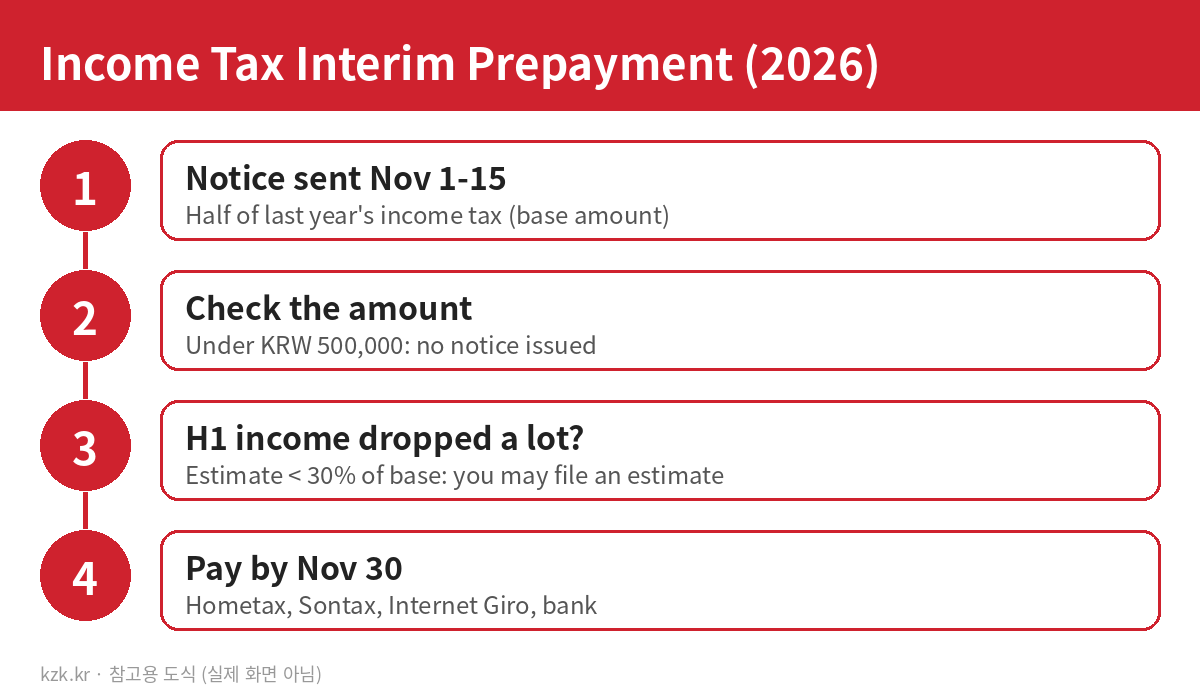
    1. Check the notice (mail or e-notice) for the amount and the Nov 30 deadline.
    2. Log in to Hometax or Sontax and look up the notice under Payment/Notice/Refund.
    3. Choose a method: Hometax bank transfer, credit card, Internet Giro, or a bank.
    4. Pay by November 30; late payment can incur penalty tax.

    What if my first-half income dropped sharply?

    If tax computed on Jan–Jun 2026 income (the interim estimate) is below 30% of the base amount, you may file and pay the estimate instead between Nov 1 and 30.

    • If the estimate is under KRW 500,000, you pay nothing but must file the estimate return to cancel the notice.
    • Double-entry bookkeepers with no base amount but first-half business income must file an estimate.
    • Amounts over KRW 10 million can be paid in installments.

    FAQ

    Q. Will I get a notice for small income?
    A. Not if half of last year’s tax is under KRW 500,000.

    Q. Is the prepayment lost money?
    A. No. It is credited against your May final return; overpayment is refunded.

    Q. Where do I file an estimate?
    A. In Hometax’s tax filing menu (interim estimate return). Menu names can change; confirm on Hometax.

    Q. What if the deadline is a weekend?
    A. It moves to the next business day. Nov 30, 2026 is a Monday.

    Read next


    📘 $3.49 PDF guide – interim prepayment & income tax calendar: https://kzk.kr/go/guide

    Not professional advice. Information as of Oct 27, 2026.

  • Korea Small Business Management Stability Voucher (2026): How to Apply and Where to Use It

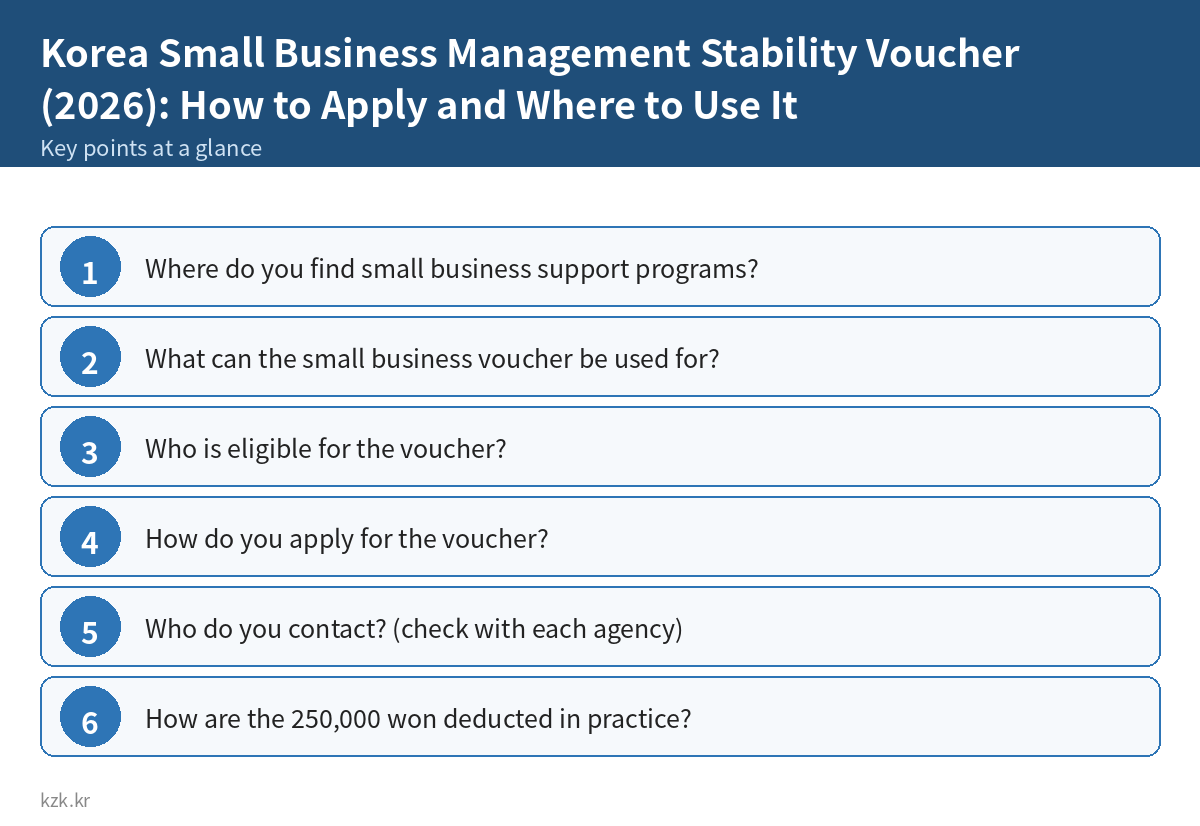
    Korea Small Business Management Stability Voucher (2026): How to Apply and Where to Use It

    Written on 2026-10-26 after checking public pages from the Ministry of SMEs and Startups, SEMAS, Bizinfo and Sosanggongin24. Where agencies differ, both are shown; check with each agency before acting. No logged-in screens were viewed. The only image is a self-made illustration. This is general information, not legal or tax advice, and nothing here promises income.

    The diagram below is a self-made illustration, not a real screen.

    The Small Business Management Stability Voucher is a 2026 Ministry of SMEs and Startups program giving up to 250,000 won in card points for fixed costs such as electricity and gas. This guide covers how to apply for the small business voucher, where to use it, and how to find other programs in official notices on Bizinfo (기업마당) and Sosanggongin24 (소상공인24).

    korea small business voucher: voucher flow (self-made illustration)

    Who this is for

    • Small business owners who opened on or before December 31, 2025
    • Anyone wanting to cut fixed costs like utilities and insurance
    • Anyone who wants one place to look for support programs
    Korea Small Business Management Stability Voucher (2026): How to Apply and Where to Use It: key points summary
    Korea Small Business Management Stability Voucher (2026): How to Apply and Where to Use It: key points summary

    1. Where do you find small business support programs?

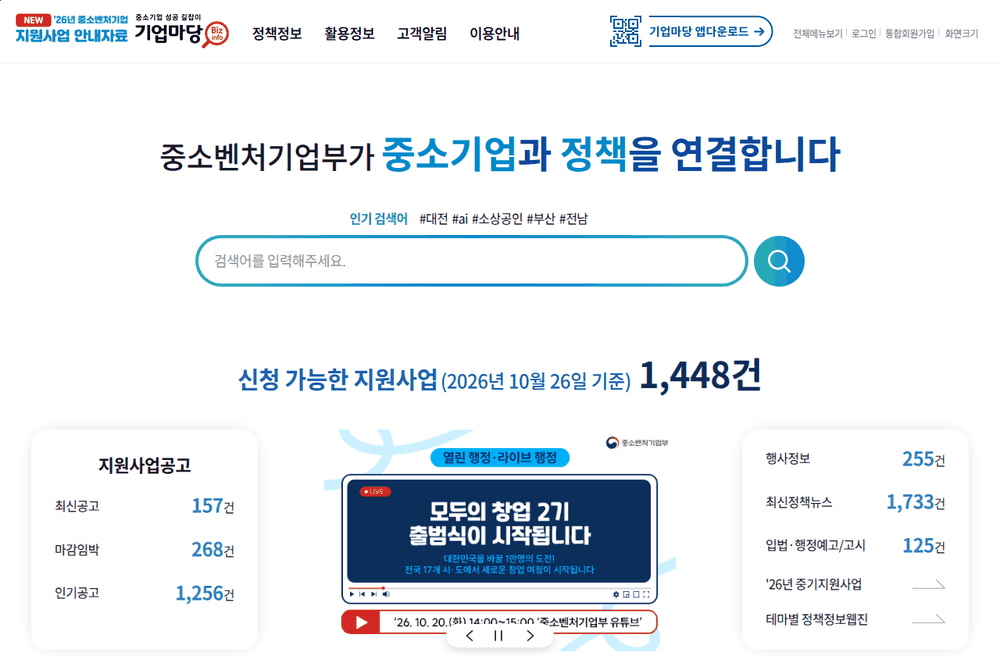
    • Bizinfo (기업마당): collects central and local government notices. You can search by program name, ministry, content or hashtag, and filter by field (finance, technology, staffing, export, domestic sales, startup, management) and region.
    • Sosanggongin24 (소상공인24): the platform run by the Korea Small Business Agency (SEMAS). You can view and apply for agency, local government and partner programs. Applying requires logging in.
    • Always recheck eligibility, dates and exclusions in the original notice before applying.
    Bizinfo front page for searching support notices such as the small business voucher
    Real public page: Bizinfo (기업마당) (captured 2026-10-26)

    2. What can the small business voucher be used for?

    • Announced as Ministry of SMEs and Startups Notice No. 2026-37 (January 28, 2026).
    • Up to 250,000 KRW per business, as card points.
    • Uses: electricity, gas (city gas, LPG), water, the four social insurances (employer share and the owner’s own), vehicle fuel, and traditional market fire mutual aid premiums.
    • Phone/telecom bills are not covered.
    • If you opt into the traditional market fire mutual aid when applying, the premium comes out of the 250,000 KRW.

    3. Who is eligible for the voucher?

    • Opened on or before December 31, 2025
    • 2025 sales above 0 and under 104 million KRW (businesses opened in 2025: monthly average × 12)
    • Not suspended or closed on the application date
    • Not in a sector excluded from policy funds (adult entertainment, gambling, virtual assets, etc.)
    • One business per person; with joint representatives, only one representative applies.

    4. How do you apply for the voucher?

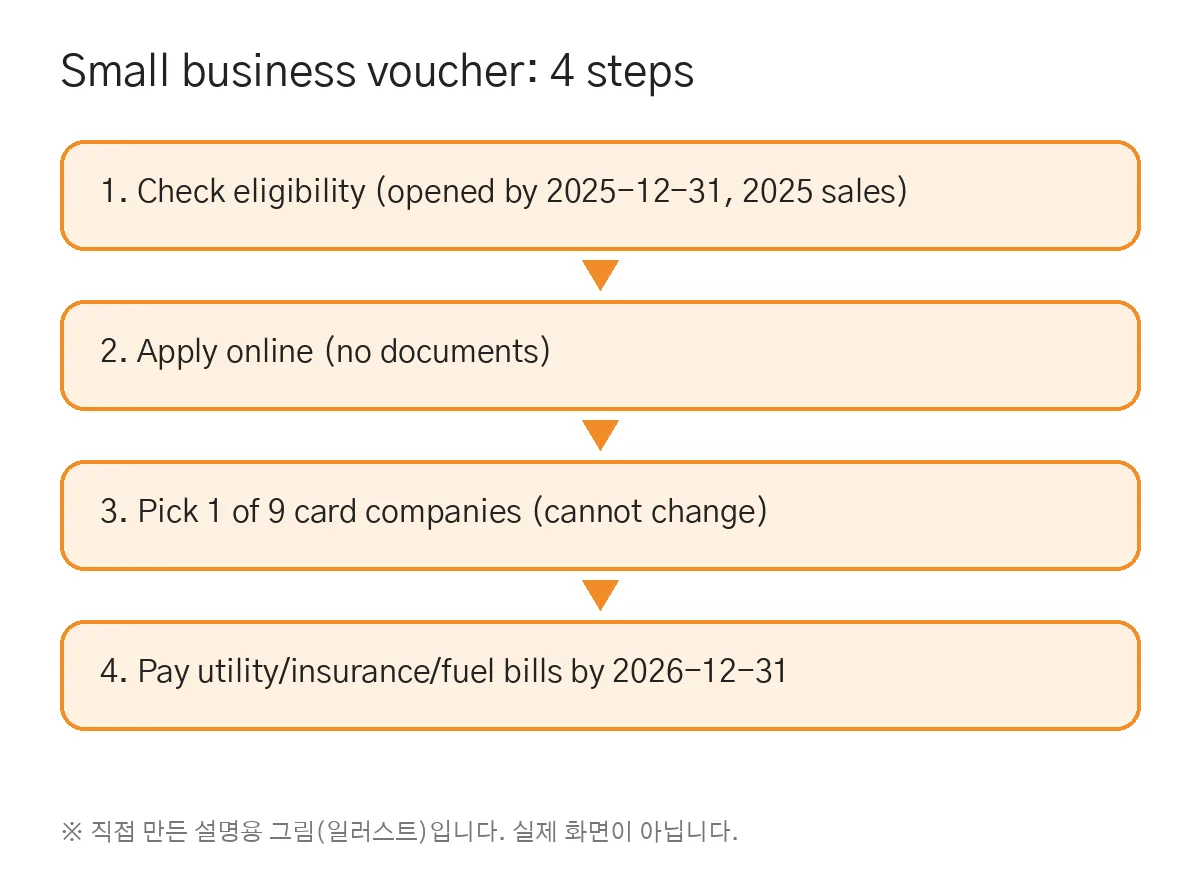
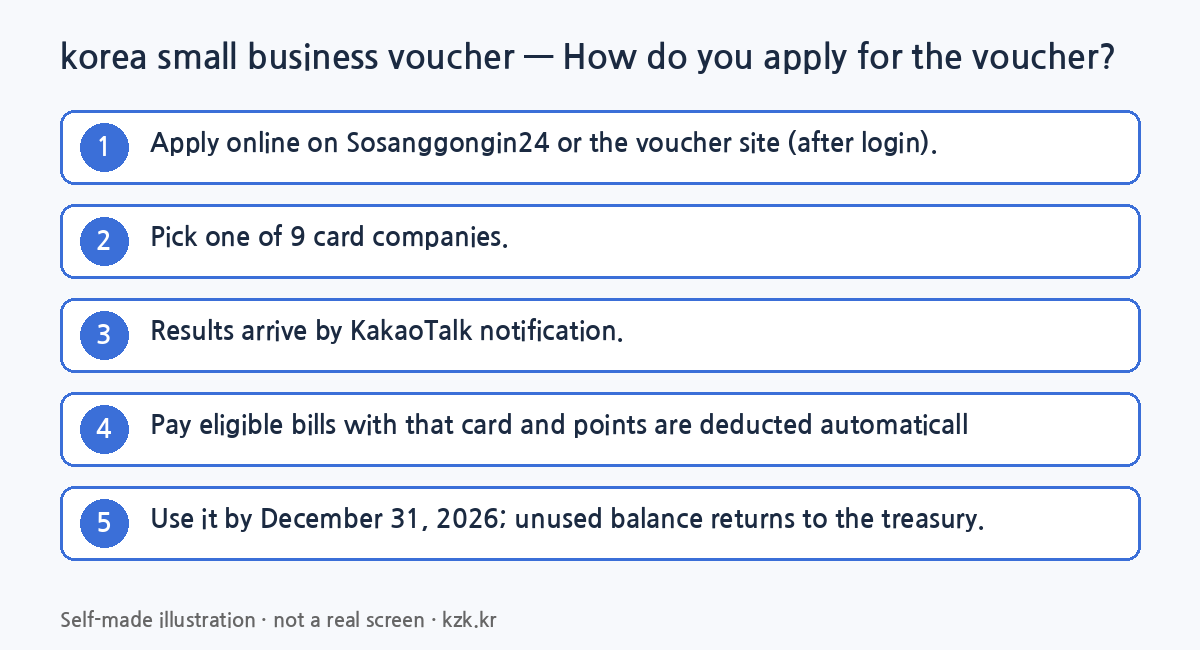
    1. Apply online on Sosanggongin24 or the voucher site (after login). Eligibility is checked with National Tax Service data, so no documents are needed.
    2. Pick one of 9 card companies. Only the owner’s personal card can be registered, and you cannot change it later.
    3. Results arrive by KakaoTalk notification.
    4. Pay eligible bills with that card and points are deducted automatically. Anything above 250,000 KRW is paid by you.
    5. Use it by December 31, 2026; unused balance returns to the treasury.
    Sosanggongin24 entry page with the small business management stability voucher link
    Real public page: Sosanggongin24 (소상공인24) (captured 2026-10-26)
    korea small business voucher step by step: How do you apply for the voucher? (self-made illustration)
    korea small business voucher step by step: How do you apply for the voucher? (self-made illustration)

    Applications run from February 9 to 18:00 on December 18 (tentative) and may close early if the budget runs out.

    5. Who do you contact? (check with each agency)

    • The voucher site lists 1533-0600 (voucher line) and 1533-0100 (agency main line).
    • The ministry press release names 1533-0100 as the voucher call center.
    • Because they differ, both are shown here; check with each agency.

    6. How are the 250,000 won deducted in practice?

    Example (illustrative numbers): an owner who did not choose fire mutual aid

    • Pays a 120,000 won electricity bill with the registered card: 120,000 points used, 130,000 left
    • Next month pays 150,000 won in social insurance: 130,000 points used, 20,000 paid by the owner

    Common mistakes

    • Assuming phone bills are covered (they are not)
    • Trying to register a corporate or family card (owner’s personal card only)
    • Choosing a card company casually (cannot be changed)
    • Saving points past December 31 (balance expires)
    • Applying for other programs without reading the original notice

    Checklist

    • ☐ Opened on or before December 31, 2025?
    • ☐ 2025 sales under 104 million KRW?
    • ☐ Not suspended or closed?
    • ☐ Card company decided?
    • ☐ Checked other notices on Bizinfo and Sosanggongin24?

    Related guides

    FAQ

    How much?

    Up to 250,000 won in card points per business; the fire mutual aid premium comes out of it if chosen.

    Are phone bills covered?

    No.

    Any documents?

    No; eligibility is checked with National Tax Service data.

    Can I change the card company?

    No. You pick one of 9 and only the owner’s personal card can be registered.

    Deadline to use it?

    December 31, 2026; the rest returns to the treasury.

    Read next


    We also have a $3.49 PDF guide that collects more everyday money-saving tips. Take a look if it’s useful → See the $3.49 PDF guide

  • How to Check Korean Traffic Fines on e-Fine: Fine Types, 20% Early Payment Reduction

    How to Check Korean Traffic Fines on e-Fine: Fine Types, 20% Early Payment Reduction

    Written on 2026-10-26 after checking public pages from law.go.kr, easylaw and the National Police Agency. Where agencies differ, both are shown; check with each agency before acting. No logged-in screens were viewed. The only image is a self-made illustration. This is general information, not legal or tax advice, and nothing here promises income.

    The diagram below is a self-made illustration, not a real screen.

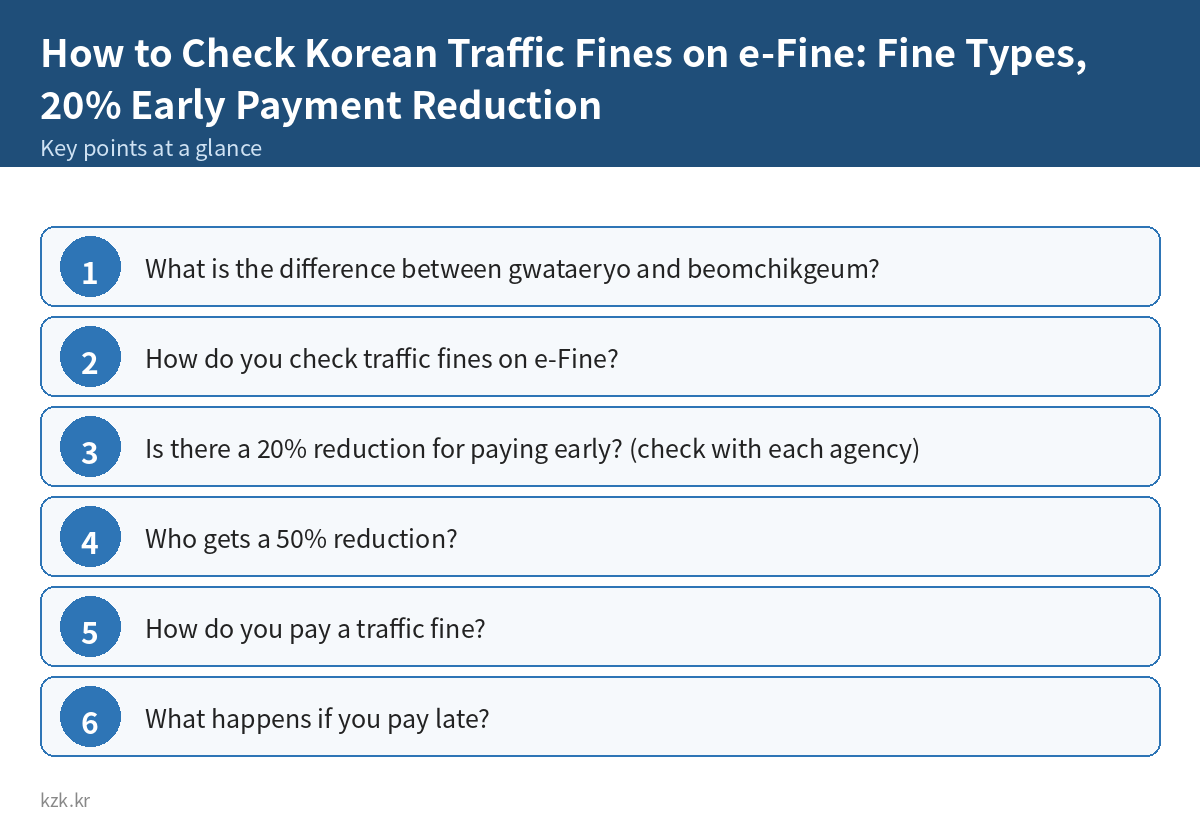
    You can check Korean traffic fines on e-Fine (이파인), the National Police Agency’s traffic civil service. When a camera ticket notice arrives, first tell whether it’s a gwataeryo (administrative fine) or a beomchikgeum (penalty fine). They differ in who pays, penalty points and reductions. Here is how to check them and pay less on time.

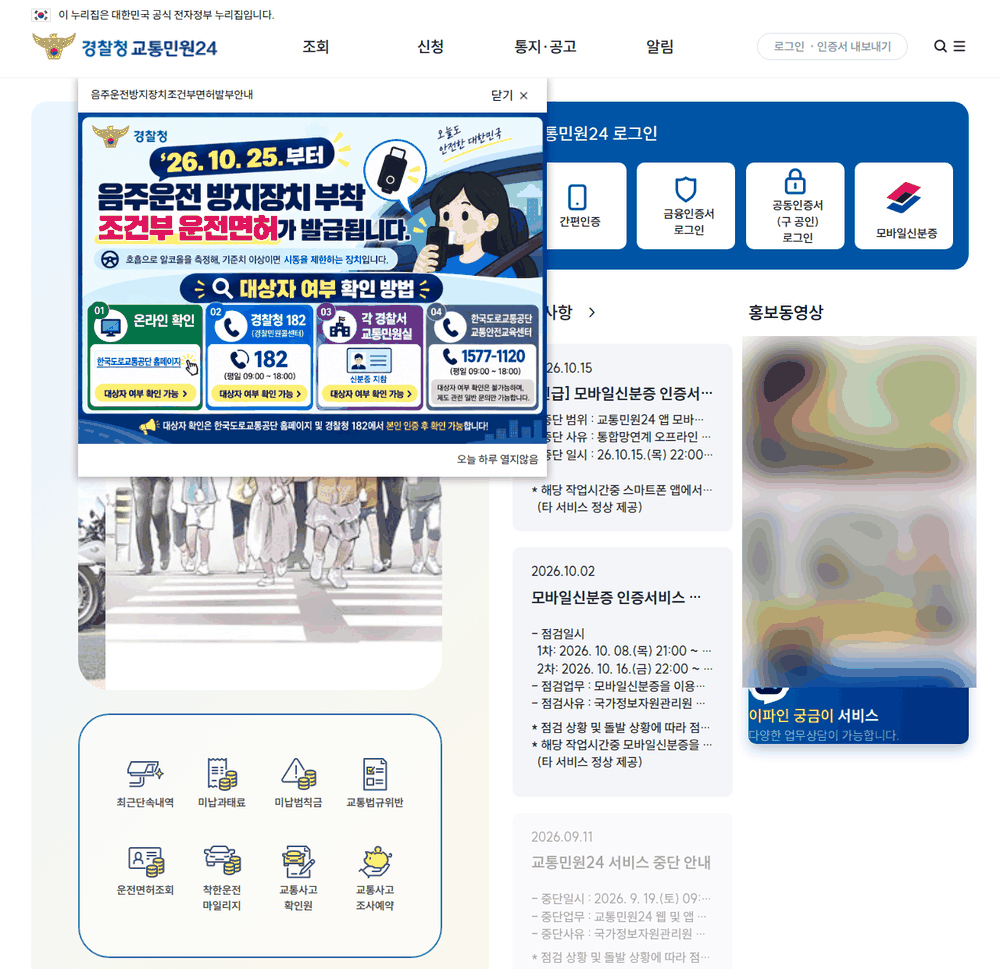
    Police eFine front page with the unpaid fines and recent violations menu
    Real public page: Korean National Police Agency eFine (교통민원24) (captured 2026-10-26)

    korea traffic fine check: fine types (self-made illustration)

    Who this is for

    • Anyone who got an advance notice and isn’t sure what to do
    • Anyone confused by the two fine types
    • Anyone wondering how much paying early saves
    How to Check Korean Traffic Fines on e-Fine: Fine Types, 20% Early Payment Reduction: key points summary
    How to Check Korean Traffic Fines on e-Fine: Fine Types, 20% Early Payment Reduction: key points summary

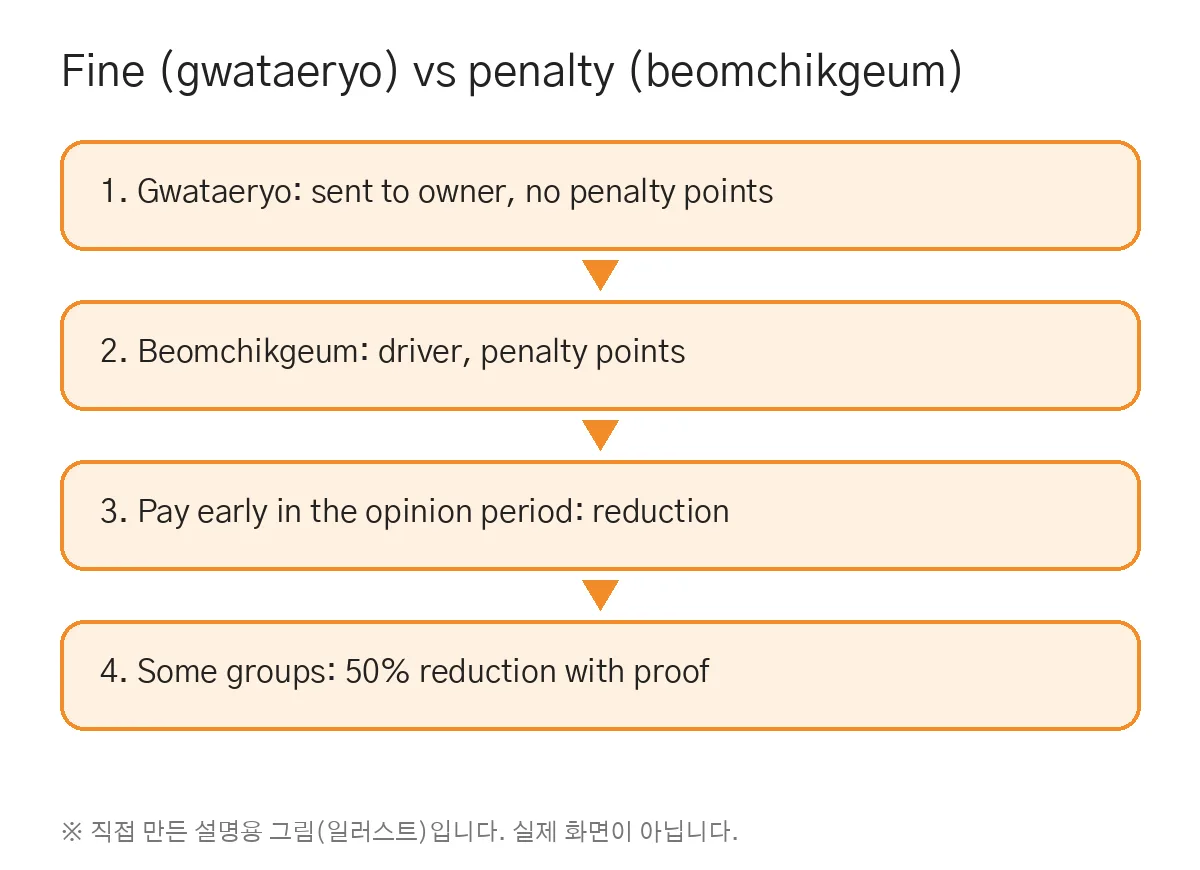
    1. What is the difference between gwataeryo and beomchikgeum?

    Gwataeryo Beomchikgeum
    Who Vehicle owner (driver not identified) Driver
    Penalty points No Yes
    Record None Summary trial if unpaid
    • Camera detections first send an advance notice to the owner. If the driver is identified, it becomes a beomchikgeum.
    • A beomchikgeum can be paid after the driver receives the notice at a police station or box, or on e-Fine.

    2. How do you check traffic fines on e-Fine?

    • On e-Fine you can check your own fines (after login).
    • You can also call 182.

    3. Is there a 20% reduction for paying early? (check with each agency)

    • The Act on the Regulation of Violations of Public Order lets a fine be cut by up to 20% if paid within the opinion deadline (at least 10 days).
    • The police advance notice form says the 20% applies only to certain minor violations listed in the Road Traffic Act Enforcement Rules (e.g. speeding by 20 km/h or less).
    • The two describe different scopes, so both are shown; check with each agency whether your notice lists a reduced amount.
    • Paying early ends the procedure, so you can’t object afterwards.

    4. Who gets a 50% reduction?

    • Basic livelihood recipients, single-parent families, people with severe disabilities (formerly grades 1-3), wounded national merit recipients grades 1-3, and minors (under 19 when applying)
    • No unpaid fines, and proof must be submitted before the opinion deadline.
    • It can combine with the 20%: example (illustrative numbers): 1,000,000 → 500,000 after 50% → 400,000 after 20%.
    • Jointly owned vehicles may have different conditions; check with the issuing office.

    5. How do you pay a traffic fine?

    • Virtual account, internet giro, internet banking, bank or post office counter, credit card, or e-Fine

    6. What happens if you pay late?

    • A gwataeryo gets a 5% surcharge after the deadline.
    • A beomchikgeum not paid within 10 days gets +20% for a second 20-day deadline, then goes to summary trial. Paying the amount +50% before the ruling cancels the trial.
    • Fines for late car inspections are in our car inspection fines guide.

    Common mistakes

    • Ignoring the advance notice until the deadline passes
    • Assuming every violation gets the 20% reduction
    • Missing the proof deadline for the 50% reduction
    • Paying early when you actually want to object

    Checklist

    • ☐ Gwataeryo or beomchikgeum?
    • ☐ Opinion deadline checked?
    • ☐ Reduced amount shown on the notice?
    • ☐ Proof ready if you qualify for 50%?

    Related guides

    FAQ

    Do I need to log in?

    Yes, your own lookup is after login. You can also call 182.

    Do gwataeryo carry penalty points?

    No. Beomchikgeum do.

    Is every fine reduced 20%?

    The public order act allows up to 20%, but the police form limits it to certain minor violations. Check with each agency.

    Can 50% and 20% combine?

    Yes. Example (illustrative numbers): 1,000,000 → 500,000 → 400,000 won.

    Beomchikgeum not paid in 10 days?

    +20% for a second 20-day deadline, then summary trial.

    Read next


    We also have a $3.49 PDF guide that collects more everyday money-saving tips. Take a look if it’s useful → See the $3.49 PDF guide

  • Korea Car Inspection Period, Booking and Late-Inspection Fines (2026)

    Korea Car Inspection Period, Booking and Late-Inspection Fines (2026)

    Written on 2026-10-26 after checking public pages from the Korea Transportation Safety Authority, law.go.kr and easylaw. Where agencies differ, both are shown; check with each agency before acting. No logged-in screens were viewed. The only image is a self-made illustration. This is general information, not legal or tax advice, and nothing here promises income.

    The diagram below is a self-made illustration, not a real screen.

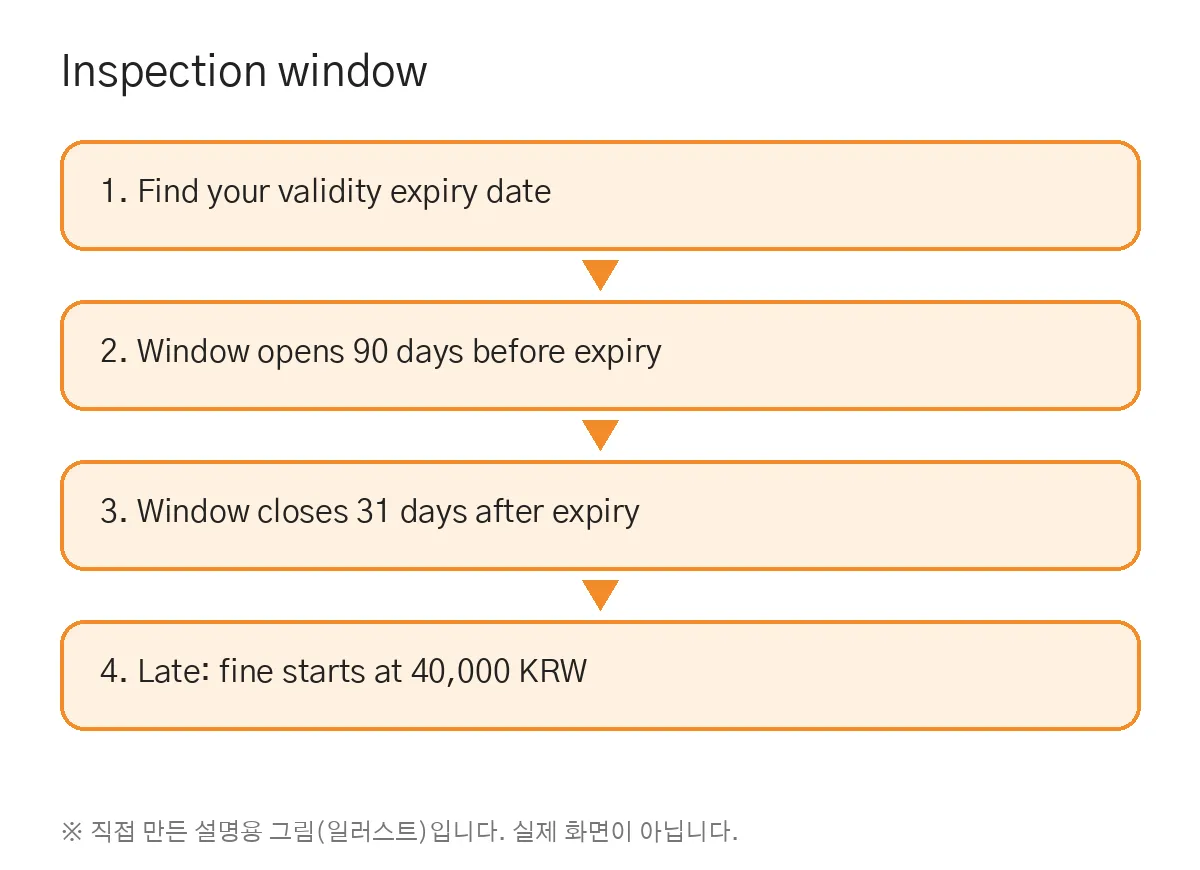
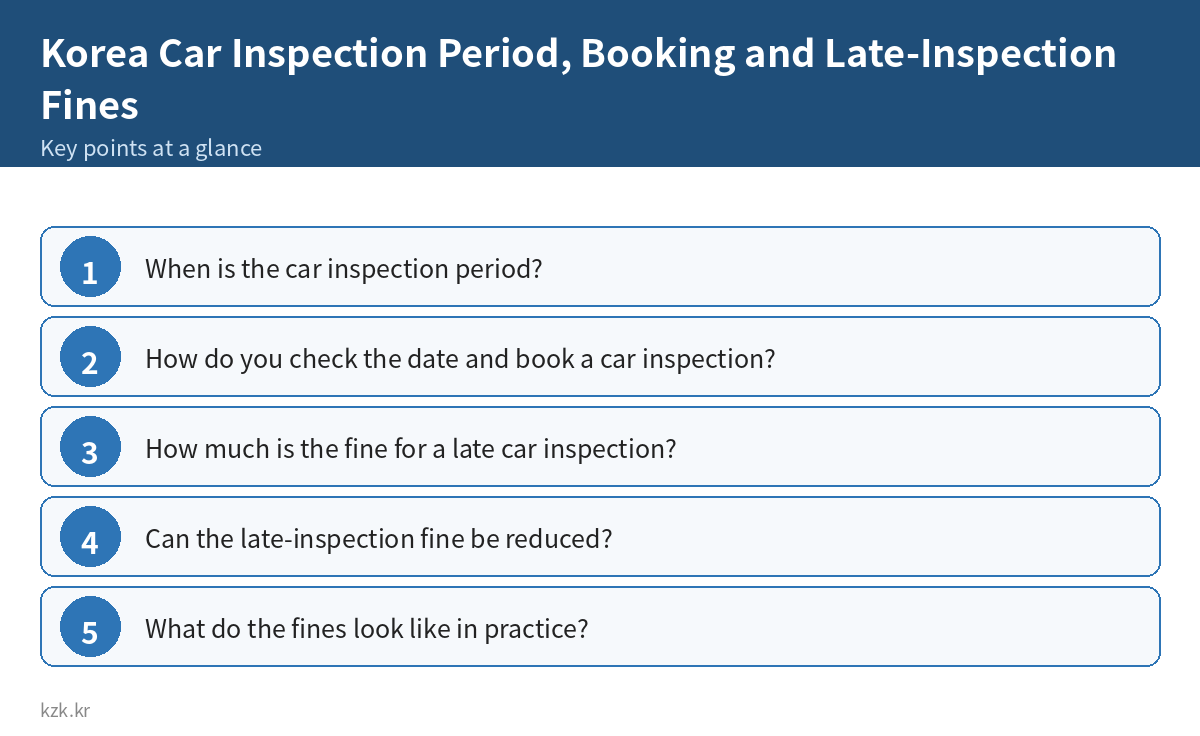
    A Korea car inspection can be done from 90 days before to 31 days after the inspection validity expiry date. Miss the car inspection period and a fine applies, growing the longer you wait. Here is how to check the date, book, and what the fines and reductions are.

    korea car inspection: inspection window (self-made illustration)

    Who this is for

    • Drivers unsure when their inspection is due
    • Anyone who missed it and wants to know the fine
    • Anyone wondering whether a fine can be reduced
    Korea Car Inspection Period, Booking and Late-Inspection Fines: key points summary
    Korea Car Inspection Period, Booking and Late-Inspection Fines: key points summary

    1. When is the car inspection period?

    • The window is 90 days before to 31 days after the validity expiry date.
    • If you pass within the window, it counts as done on the expiry date, so going early doesn’t shorten your next cycle.
    • A new non-commercial passenger car’s first validity period is 4 years.
    • If you buy a car whose validity has already expired, you have 31 days from the transfer registration.
    • Theft, accidents, seizure or long repairs can qualify for an extension or deferral.

    Note: some people say “31 days before or after expiry,” but the Korea Transportation Safety Authority (TS) and the law say 90 days before and 31 days after.

    2. How do you check the date and book a car inspection?

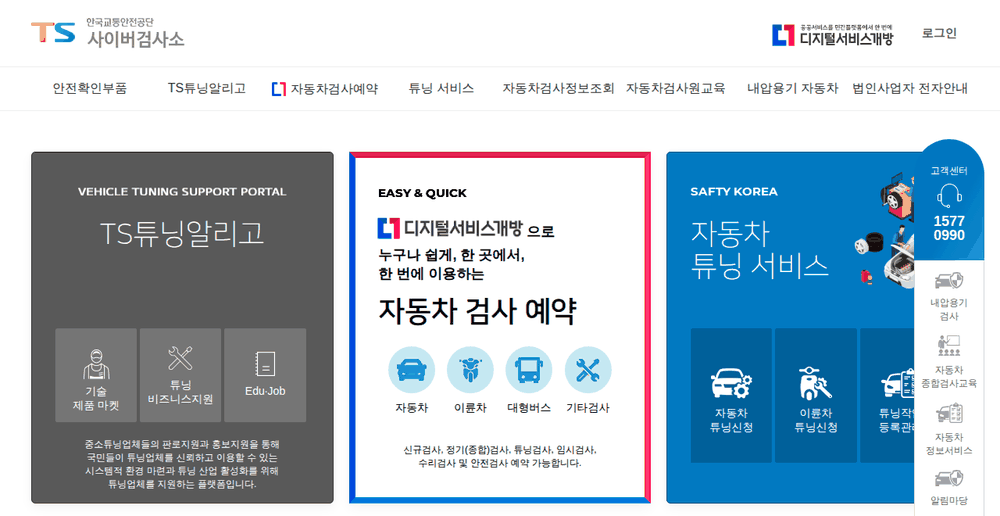
    • On the TS Cyber Inspection Center (사이버검사소), “Inspection validity lookup” shows the start and expiry dates from the plate number.
    • To book, enter the plate number and date of birth (first 6 digits of the business/corporate number for companies), check the available window, then choose a center and date.
    • To book by phone, call the TS customer center at 1577-0990 and press 0 for an agent.
    TS Cyber Inspection Center front page with the car inspection booking menu
    Real public page: TS Cyber Inspection Center (captured 2026-10-26)

    3. How much is the fine for a late car inspection?

    Days late Fine
    Up to 30 days 40,000 KRW
    31 to 114 days 40,000 KRW + 20,000 KRW for every 3 days beyond, from day 31
    115 days or more 600,000 KRW
    • Motorcycles: 20,000 KRW / +10,000 KRW per 3 days / up to 200,000 KRW.
    • Ignoring it for long can lead to an inspection order, a suspension-of-operation order, and plate seizure.

    4. Can the late-inspection fine be reduced?

    • Under the general rules of Table 2 of the Motor Vehicle Management Act Enforcement Decree, fines can be cut by up to half in cases set by law (such as basic livelihood recipients), minor mistakes, or efforts to correct the violation. Not available if you have unpaid fines.
    • Extension or deferral periods are excluded from the delay.
    • Under the Act on the Regulation of Violations of Public Order, paying voluntarily within the opinion deadline can reduce the fine by up to 20%. Check your notice and the issuing office for whether and how it applies.
    • Traffic fines like speeding are covered in our e-Fine traffic fines guide.

    5. What do the fines look like in practice?

    Example (illustrative numbers): after the window closes

    • 20 days late: 40,000 won
    • 115 days or more late: 600,000 won (cap)

    Between 31 and 114 days, 20,000 won is added for every 3 days beyond, from day 31, so go by the amount on your notice.

    Common mistakes

    • Believing the window is only “31 days either side”
    • Thinking an early inspection moves the next date earlier
    • Not checking the window after buying a used car
    • Not reporting a reduction reason before the deadline

    Checklist

    • ☐ Checked the validity expiry date?
    • ☐ Booked within 90 days before to 31 days after?
    • ☐ Applied for an extension or deferral if eligible?
    • ☐ Checked the opinion deadline on any fine notice?

    Related guides

    FAQ

    Is it 31 days either side of expiry?

    No. TS and the law say 90 days before and 31 days after.

    Does going early move my next date?

    No. Passing in the window counts as done on the expiry date.

    Where do I check the expiry date?

    The TS Cyber Inspection Center’s validity lookup, by plate number.

    Can I book by phone?

    Yes, call 1577-0990 and press 0 for an agent.

    Maximum fine?

    600,000 won for cars, 200,000 won for motorcycles.

    Read next


    We also have a $3.49 PDF guide that collects more everyday money-saving tips. Take a look if it’s useful → See the $3.49 PDF guide

  • Korea Birth Support 2026: Parent Benefit, First Meeting Voucher and Child Allowance

    Korea Birth Support 2026: Parent Benefit, First Meeting Voucher and Child Allowance

    Written on 2026-10-26 after checking public pages from the Ministry of Health and Welfare, policy briefing (korea.kr), Gov24, the National Happiness Card site, easylaw, law.go.kr and district offices. Amounts and periods can change; confirm with your community center or helpline 129. No logged-in screens were viewed. The only image is a self-made illustration. Nothing here promises income.

    The diagram below is a self-made illustration, not a real screen.

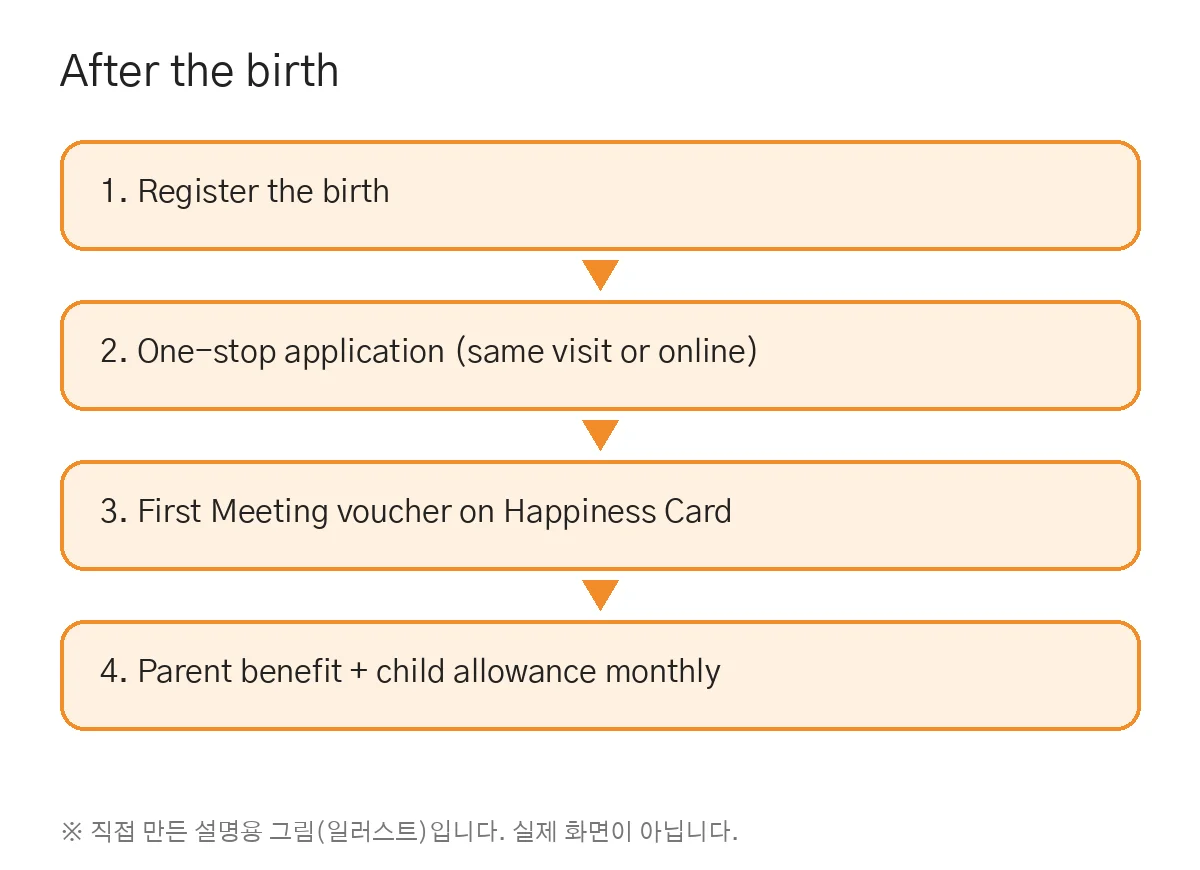
    This guide covers Korea birth support in 2026: the main cash supports after a baby is born (parent benefit, First Meeting voucher, child allowance) and how to apply for them all at once. For selling used kids’ items, see the kids’ items guide.

    korea birth support: application flow (self-made illustration)

    Who this suits

    • Families expecting a baby or who have just had one
    • Anyone unsure what to apply for, and when
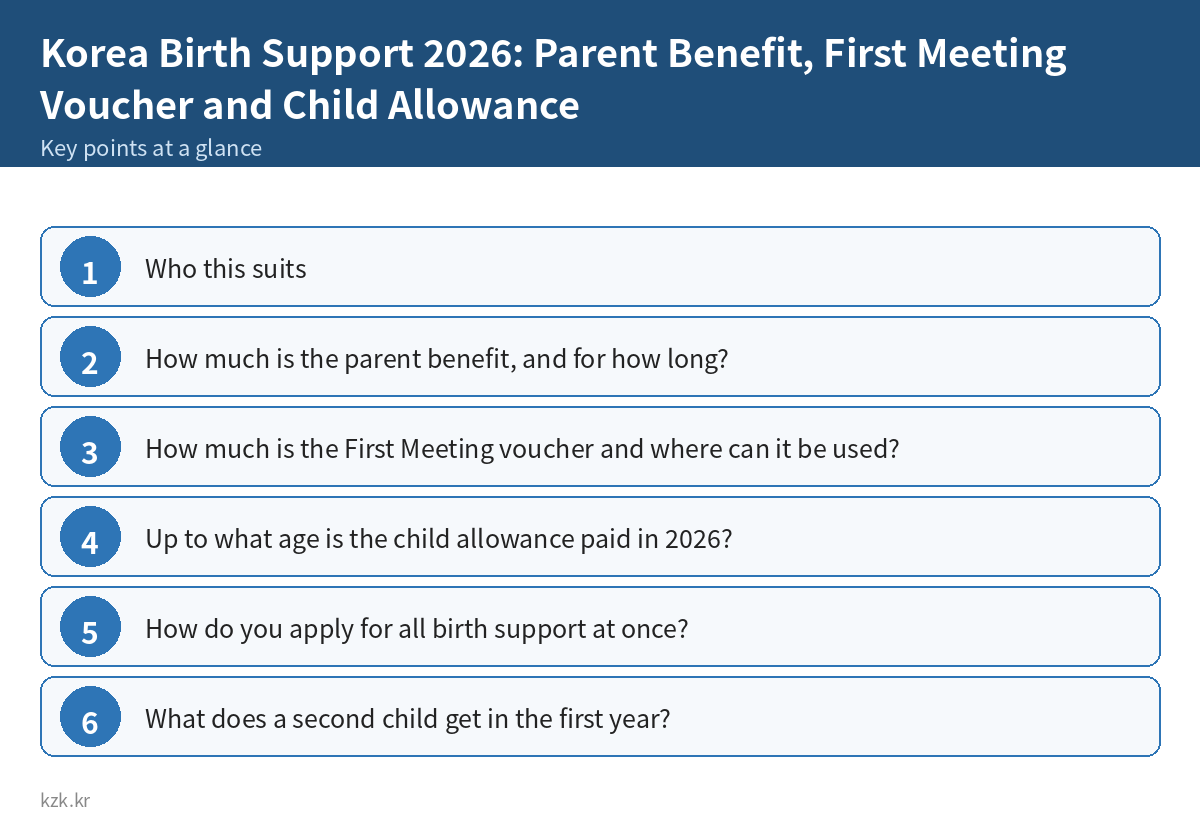
    Korea Birth Support 2026: Parent Benefit, First Meeting Voucher and Child Allowance: key points summary
    Korea Birth Support 2026: Parent Benefit, First Meeting Voucher and Child Allowance: key points summary

    1. How much is the parent benefit, and for how long?

    • 0 to 11 months: 1,000,000 won a month
    • 12 to 23 months: 500,000 won a month
    • If your child attends daycare, you get the amount minus the childcare fee (you need to apply for the childcare fee separately).
    • From 24 months the home childcare allowance takes over, so you don’t get both.

    2. How much is the First Meeting voucher and where can it be used?

    • Babies born on or after January 1, 2024: 2,000,000 won for the first child, 3,000,000 won for the second and later children
    • It’s paid as National Happiness Card points, usable in most sectors (online included) except entertainment and gambling businesses.
    • Sources state the deadline and usage period differently. The National Happiness Card site says the child must be within 1 year of birth, while a Seoul district guide says 2 years, so check with each agency. Helpline 1566-3232.

    3. Up to what age is the child allowance paid in 2026?

    • In 2026: 100,000 won a month for children under 9 (the age limit rises by one year each year from 2027)
    • Depopulating areas get an extra 10,000 won a month (20,000 won in special areas), and other areas outside the capital region get 5,000 won.

    4. How do you apply for all birth support at once?

    • When you register the birth or afterwards, apply at the community center for the child’s address or on Government24 (after login).
    • The mother or her spouse applies. Grandparents can apply on their behalf, but only in person.
    • Apply for the parent benefit, child allowance and childcare allowance within 60 days of birth to get them backdated to the birth month.
    • The same application also covers things like the multi-child KTX and SRT discount and the electricity discount for families with a new baby.
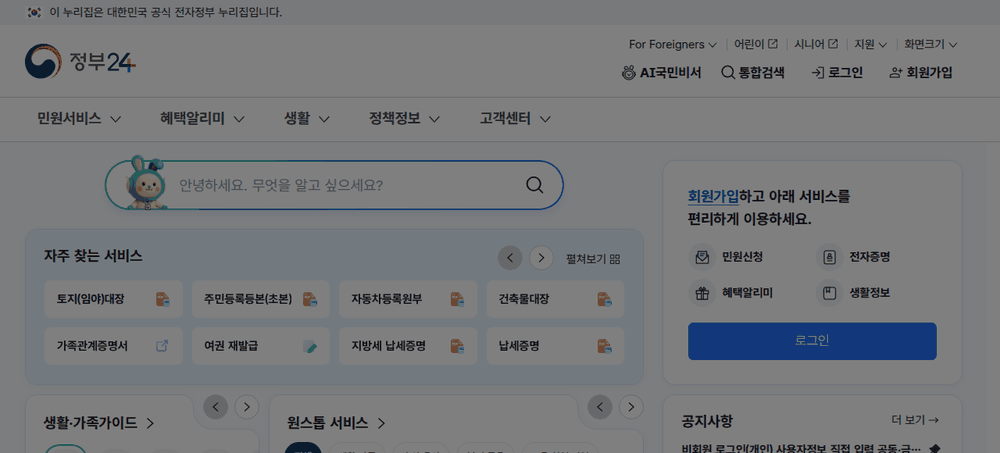
    Gov24 front page used to apply for birth and childcare support
    Real public page: Gov24 (정부24) (captured 2026-10-26)

    5. What does a second child get in the first year?

    Example (illustrative numbers): a second child born in 2026 in the Seoul area and cared for at home

    • First Meeting voucher: 3,000,000 won (Kookmin Haengbok card points)
    • Parent benefit: 1,000,000 won a month for months 0–11
    • Child allowance: 100,000 won a month

    Apply within 60 days of birth to be paid from the birth month. Local governments’ own birth grants vary and are not included here.

    Common mistakes

    • Applying after 60 days and losing the earlier months
    • Forgetting the childcare fee application when your child attends daycare
    • Letting the First Meeting voucher expire

    Checklist

    • ☐ One-stop application filed along with the birth registration
    • ☐ Applied within 60 days of birth
    • ☐ National Happiness Card ready
    • ☐ First Meeting voucher deadline checked
    • ☐ Childcare fee applied for if using daycare

    Related guides

    FAQ

    How much is the parent benefit?

    1,000,000 won a month for 0–11 months, 500,000 won for 12–23 months; with daycare, the difference after childcare fees.

    First Meeting voucher amount?

    For births on or after January 1, 2024: 2,000,000 won for a first child, 3,000,000 won for later children.

    Where can it be used?

    As Kookmin Haengbok card points at most businesses (online too), except adult entertainment, gambling and similar.

    Deadline?

    The card site says within 1 year of birth; Seodaemun-gu says 2 years. Check with each agency (1566-3232).

    What if I apply late?

    Apply within 60 days of birth for the parent benefit, child allowance and home care allowance to be backdated to the birth month.

    Read next


    We also have a $3.49 PDF guide that collects more everyday money-saving tips. Take a look if it’s useful → See the $3.49 PDF guide

  • Korea Car Tax Prepayment (2026): Application Periods, Discount Rates and Refunds

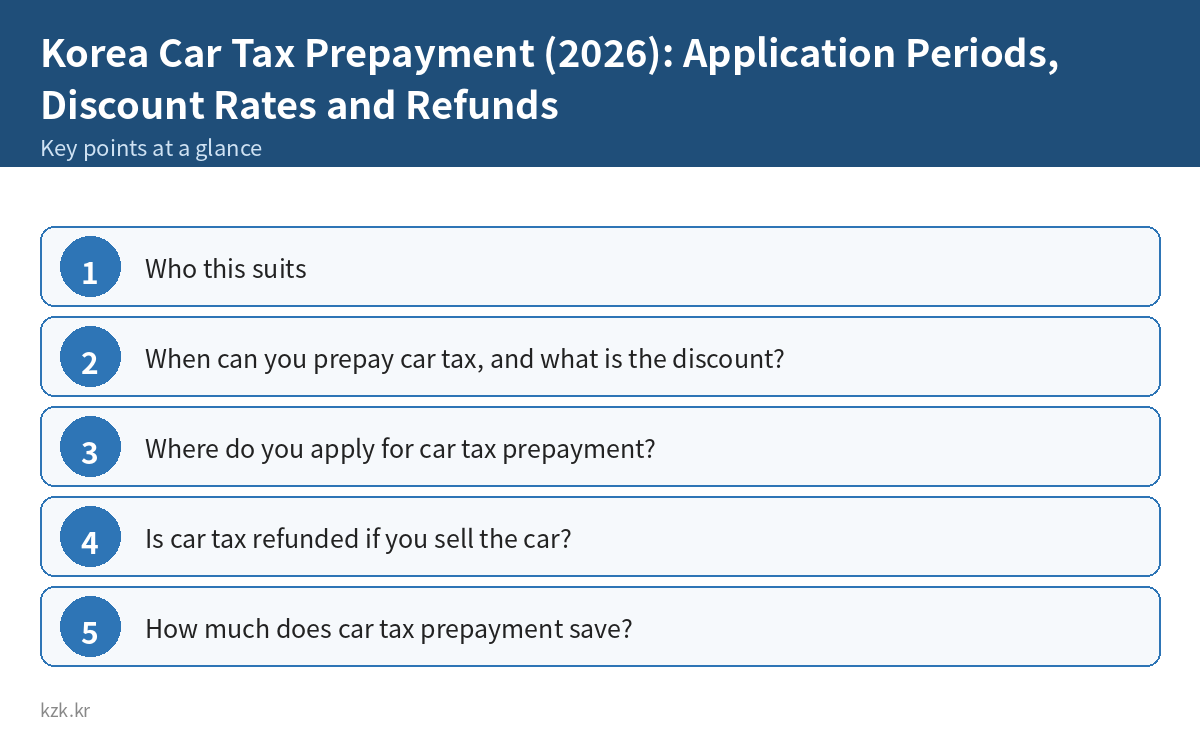
    Korea Car Tax Prepayment (2026): Application Periods, Discount Rates and Refunds

    Written on 2026-10-26 after checking public pages from the 110 government call center, the Ministry of the Interior and Safety, Seoul, Incheon and car365. This is not tax advice; dates and rates vary by local government, so check yours. No logged-in screens were viewed. The only image is a self-made illustration. Nothing here promises income.

    The diagram below is a self-made illustration, not a real screen.

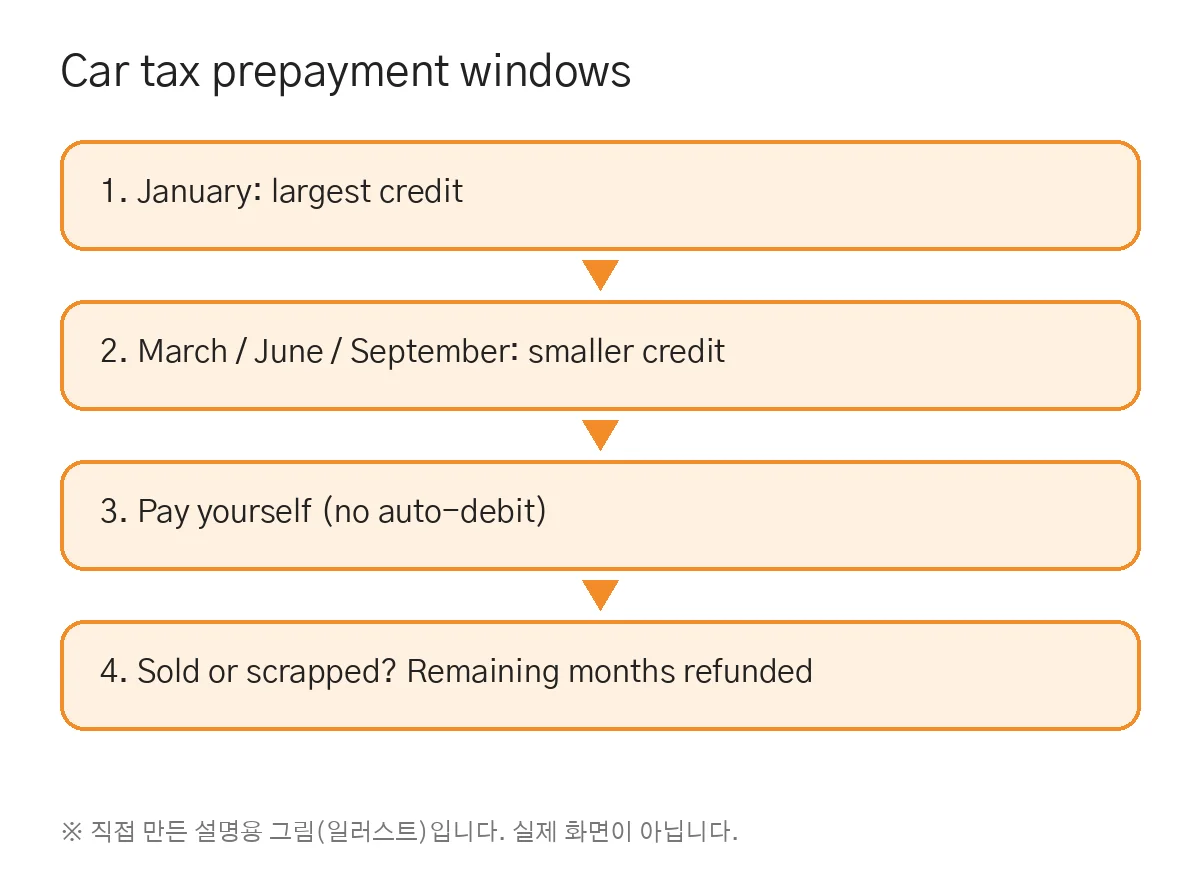
    Car tax prepayment in Korea means paying a year’s car tax in advance for a 5% credit on the rest of the year. This guide covers the 2026 car tax prepayment periods, discount rates, how to apply, and refunds when you sell or scrap the car. Car insurance discounts and used car prices have their own guides.

    korea car tax prepayment: prepayment windows (self-made illustration)

    Who this suits

    • People paying car tax in June and December installments
    • Anyone planning to sell or scrap a car this year
    Korea Car Tax Prepayment (2026): Application Periods, Discount Rates and Refunds: key points summary
    Korea Car Tax Prepayment (2026): Application Periods, Discount Rates and Refunds: key points summary

    1. When can you prepay car tax, and what is the discount?

    • You can apply in January, March, June or September. The earlier you pay, the bigger the credit.
    • According to the government 110 call center:

    – January (Jan 14 to Feb 4): annual tax × 335/366 × 5%, about 4.57%

    – March (Mar 16 to 31): about 3.76%

    – June (Jun 16 to 30): about 2.52%. It only covers the second half (July to December), so the first installment is paid separately.

    – September (Sep 16 to 30): annual tax × 92/366 × 5%. The same notice says both “about 1.3%” and “about 2.5% of the second-half tax”, so check with each agency.

    • Incheon gave the January discount as up to 4.58%, and Seoul gave different January dates. Check dates and rates with your local government.
    • I couldn’t find the 2027 windows yet, so check each year’s notice.

    2. Where do you apply for car tax prepayment?

    • Wetax or Smart Wetax: apply after logging in. You can only apply in your own name.
    • Seoul: use Seoul’s ETAX or the STAX app, or your district office.
    • In person or by phone: your city, county or district tax office
    • There’s no auto-debit, so pay it yourself. If your annual tax is under 100,000 won, you can only apply in January or March.
    • Seoul says that if you prepaid last year, it sends you the January payment notice without a new application.

    3. Is car tax refunded if you sell the car?

    • After prepaying, if you transfer or scrap the car, you get back the tax for the months after you stopped owning it.
    • In Seoul you can claim the refund on ETAX or STAX. Elsewhere, ask your local tax office.

    4. How much does car tax prepayment save?

    Example (illustrative numbers): prepaying a 500,000 won annual car tax in January

    • 500,000 × 335/366 × 5% ≈ 22,900 won credit
    • The same car in March gets about 3.76%, so less.

    Check the real amount on Wetax or your local tax notice.

    Common mistakes

    • Assuming it’s auto-debited and missing the deadline
    • Prepaying in June and skipping the first installment bill
    • Not checking for a refund after selling

    Checklist

    • ☐ January window checked
    • ☐ ETAX for Seoul, Wetax elsewhere
    • ☐ Paid it yourself
    • ☐ First installment paid separately if you prepaid in June
    • ☐ Refund checked after selling or scrapping

    Related guides

    FAQ

    When are the windows?

    January, March, June and September. In 2026 January ran January 14–February 4 (Government Call Center); some local governments state other dates.

    Discount rates?

    About 4.57% in January, 3.76% in March, 2.52% in June. For September the same notice says about 1.3% and about 2.5% of the second-half tax; check with each agency.

    Can it be auto-debited?

    No. You must pay it yourself.

    Annual tax under 100,000 won?

    Only January and March.

    Refund if I sell?

    Yes, the tax for the remaining period after transfer or scrapping. Seoul: ETAX/STAX; elsewhere ask the local tax office.

    Read next


    We also have a $3.49 PDF guide that collects more everyday money-saving tips. Take a look if it’s useful → See the $3.49 PDF guide

  • Donation Tax Credit in Korea and the Hometown Love Donation (2026 Year-End Tax)

    Donation Tax Credit in Korea and the Hometown Love Donation (2026 Year-End Tax)

    Written on 2026-10-26 after checking public pages from the National Tax Service, the National Election Commission, Gohyang Sarang e-eum, the Ministry of the Interior and Safety and law.go.kr. This is not tax advice or a request to donate; your actual credit depends on your own tax. No logged-in screens were viewed. The only image is a self-made illustration. Nothing here promises income.

    The diagram below is a self-made illustration, not a real screen.

    This guide explains how the donation tax credit in Korea is calculated and how the Hometown Love Donation credit and gifts work, for 2026. It sets out the rules and doesn’t encourage you to donate. For claiming a missed deduction later, see the tax correction claim guide.

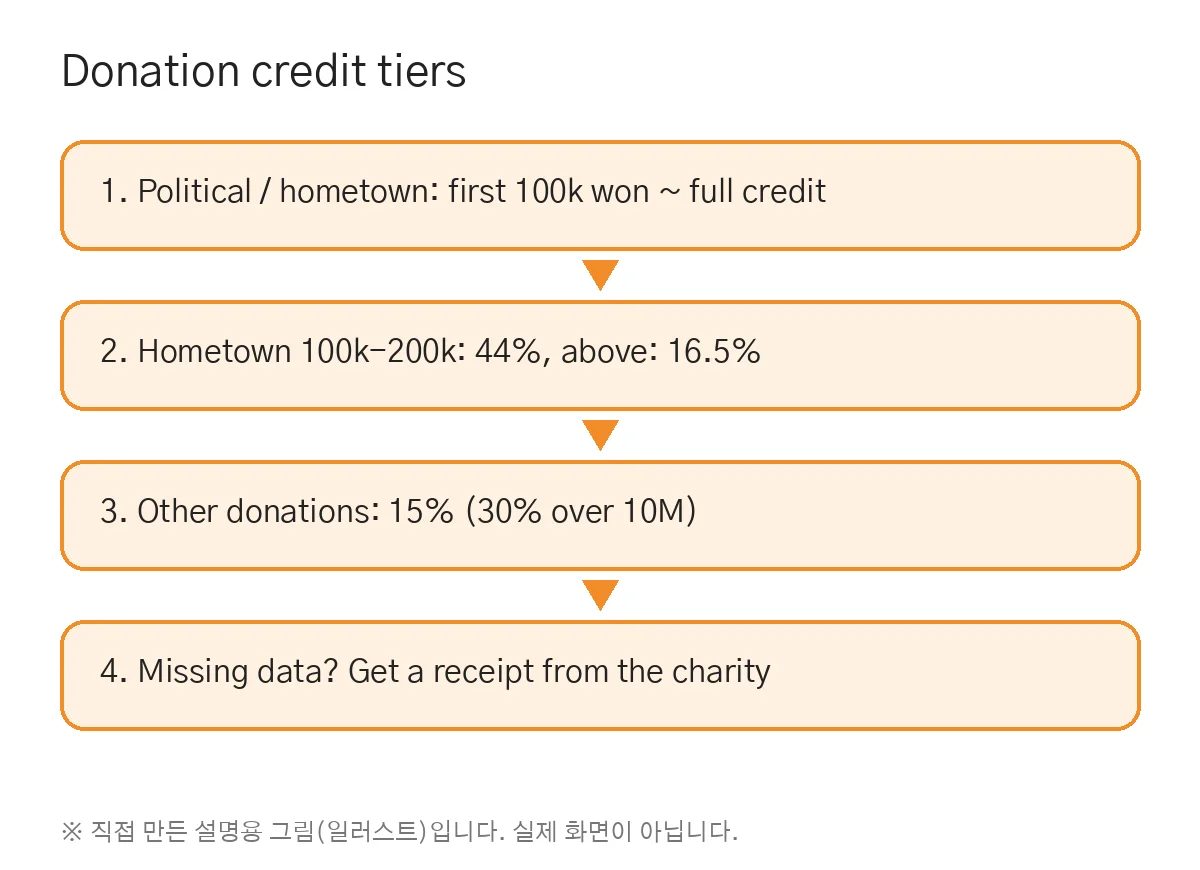
    donation tax credit korea: credit tiers (self-made illustration)

    Who this suits

    • Employees claiming donation credits in the year-end tax settlement
    • Anyone curious how the Hometown Love Donation credit is calculated
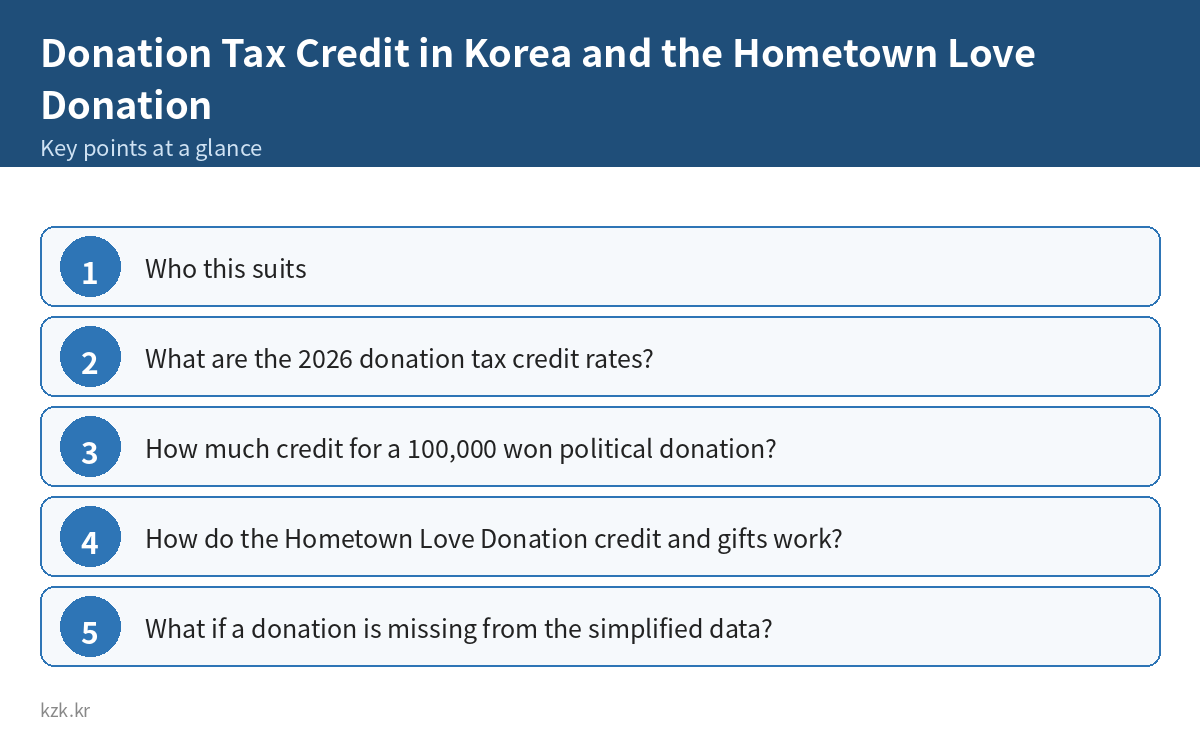
    Donation Tax Credit in Korea and the Hometown Love Donation: key points summary
    Donation Tax Credit in Korea and the Hometown Love Donation: key points summary

    1. What are the 2026 donation tax credit rates?

    • Special, general and employee stock ownership association donations: 15% up to 10 million won, 30% on the part above
    • Special and general donations by dependents count too (income test only, no age limit).
    • Unused special and general donation credits can be carried forward for 10 years.
    • Donations count regardless of how long you worked, even ones made before you started your job.

    2. How much credit for a 100,000 won political donation?

    • Up to 100,000 won: credit of 100/110 (per the National Tax Service; the National Election Commission says “full credit up to 100,000 won”, so check with each agency)
    • 15% on the part above 100,000 won, 25% on the part above 30 million won
    • Only your own donations count, not your spouse’s or parents’.
    • If your tax due is under 100,000 won, the difference is not refunded.
    • Example (illustrative numbers): a 1.2 million won donation gives 100,000 × 100/110 = 90,909 won plus 1.1 million × 15% = 165,000 won, for 255,909 won in total.

    3. How do the Hometown Love Donation credit and gifts work?

    • Who and where: individuals only. You can give to any local government except the metropolitan and basic ones where you are registered as living.
    • Limit: 20 million won per person a year
    • Credit rates: agencies state them differently, so check with each agency.

    – Gohyang Sarang e-eum: 100% up to 100,000 won, 44% from 100,000 to 200,000 won, 16.5% above 200,000 won (33% in special disaster areas)

    – Restriction of Special Taxation Act (national tax): 100/110 up to 100,000 won, 40% from 100,000 to 200,000 won, 15% above 200,000 won

    – The details below follow e-eum’s figures.

    – The 100,000 to 200,000 won tier is new for donations made from 2026, and the 33% disaster-area rate applies within 3 months of the declaration.

    – Example (illustrative numbers): a 1 million won donation gives 100,000 + 44,000 + 800,000 × 16.5% = 276,000 won.

    • Only the donor can claim it, and it can’t be carried forward.
    • Thank-you gifts: you get donation points worth up to 30% of the donation. They last 5 years and can only be spent on gifts from the area you donated to.
    • Where to donate: the official Gohyang Sarang e-eum platform, some banks and other private platforms, or any NH NongHyup Bank branch
    • Note: the government has proposed region-based rates for the part above 100,000 won from 2027. The National Assembly has not reviewed it yet.
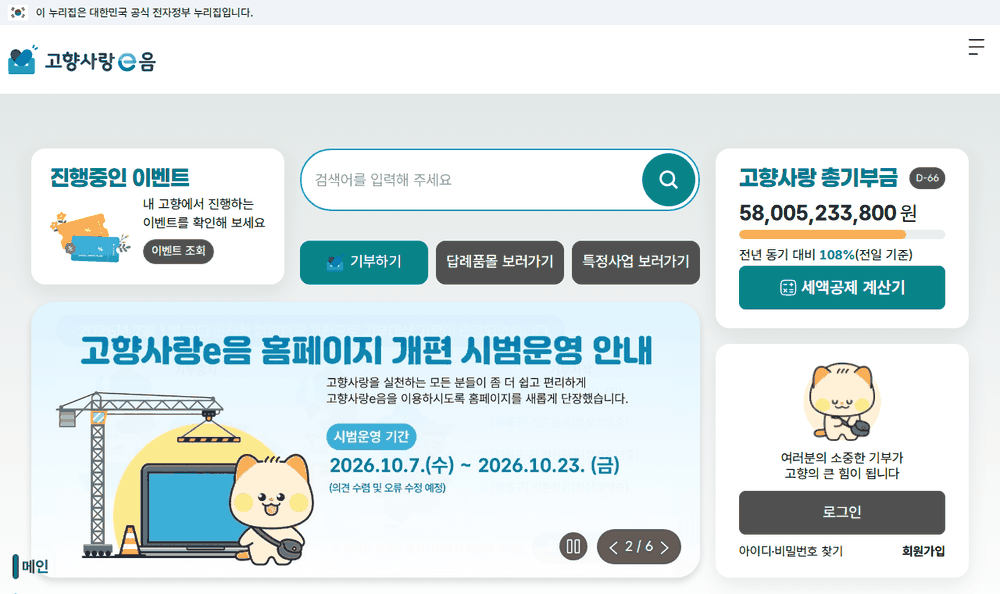
    Gohyang Sarang e-Eum front page with the donate button and tax credit calculator
    Real public page: Gohyang Sarang e-Eum (captured 2026-10-26)

    4. What if a donation is missing from the simplified data?

    • If a donation doesn’t show up in the year-end tax simplified service, get a donation receipt directly from the charity and give it to your employer.
    • For political donations, submit the NEC-issued receipt from the supporters’ association, or an electronic receipt from the NEC or its political donation center.
    • Past donation credits, including amounts carried forward, can be checked on Hometax after login.

    Common mistakes

    • Adding a spouse’s political donation to your own claim
    • Trying to give a Hometown Love Donation to the area where you live
    • Forgetting donations that are missing from the simplified data

    Checklist

    • ☐ All donations show in the simplified data
    • ☐ Receipts obtained for any that are missing
    • ☐ Political and hometown donations are in your own name
    • ☐ Hometown donation is not to your registered area
    • ☐ Any carried-forward donations checked

    Related guides

    FAQ

    Ordinary donation credit rate?

    15% up to 10 million won and 30% above that, for special and general donations.

    Do family members’ donations count?

    Special and general donations by dependents (income test only, no age limit) do. Political and Hometown Love donations count only for the donor.

    Rate above 100,000 won for Hometown Love?

    The Gohyang Sarang e-Eum site says 44% up to 200,000 won and 16.5% above; the tax law text says 40% and 15%. Check with each agency.

    Can I donate to where I live?

    No. Any local government except the ones of your registered address.

    Can unused credit carry over?

    Special and general donations: 10 years. Hometown Love: no.

    Read next


    We also have a $3.49 PDF guide that collects more everyday money-saving tips. Take a look if it’s useful → See the $3.49 PDF guide

  • Culture Nuri Card in Korea: Where to Use It, Deadlines and the Sports Voucher (2026)

    Culture Nuri Card in Korea: Where to Use It, Deadlines and the Sports Voucher (2026)

    Written on 2026-10-26 after checking public pages from the Ministry of Culture, Sports and Tourism, the Culture Nuri card site, the sports voucher site and Gov24. No card was issued and no logged-in screens were viewed. Budgets can run out early in some areas. The only image is a self-made illustration. Nothing here promises income.

    The diagram below is a self-made illustration, not a real screen.

    This guide covers where to use the Culture Nuri card and when it must be topped up and spent in 2026. It also covers the sports lesson voucher for basic livelihood recipients, near-poverty households and others. Heating and cooling support is in a separate guide.

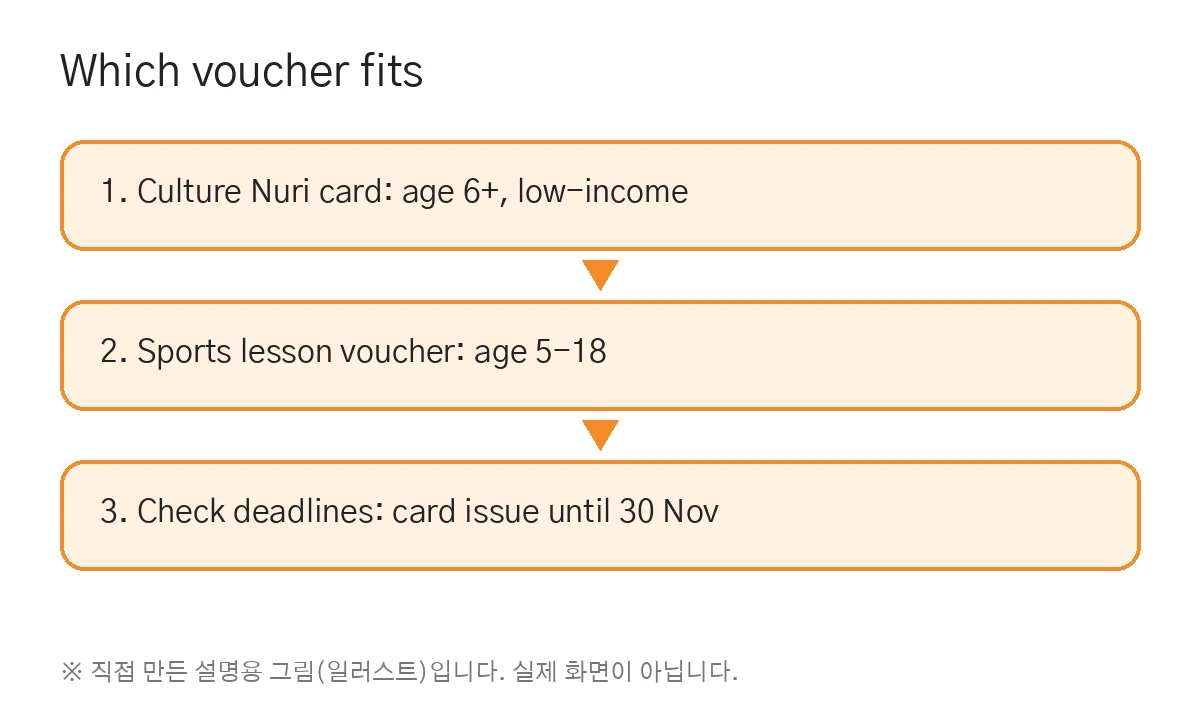
    culture nuri card: which voucher fits (self-made illustration)

    Who this suits

    • Basic livelihood recipients or near-poverty households
    • Families who find sports lesson fees for children aged 5 to 18 a burden
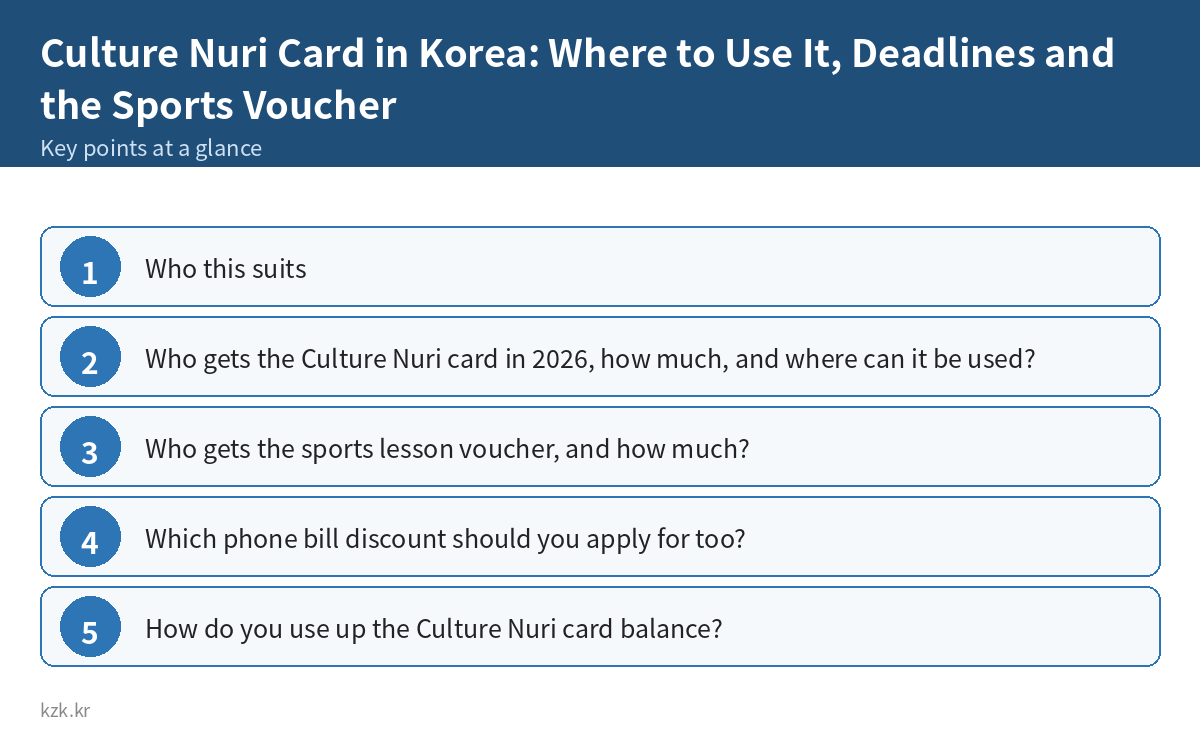
    Culture Nuri Card in Korea: Where to Use It, Deadlines and the Sports Voucher: key points summary
    Culture Nuri Card in Korea: Where to Use It, Deadlines and the Sports Voucher: key points summary

    1. Who gets the Culture Nuri card in 2026, how much, and where can it be used?

    • Who: basic livelihood recipients and near-poverty households aged 6 or older (born on or before 31 December 2020)
    • Amount: 150,000 won per person a year. Ages 13 to 18 and 60 to 64 get 10,000 won more, for 160,000 won.
    • Issue and top-up period: 2 February to 30 November 2026, 18:00. It can close early if the local budget runs out.
    • Use by: 31 December, counted from the issue date. Any balance left goes back to the state.
    • Where to use it: about 35,000 partner shops nationwide for culture (films, shows, exhibitions, books, music), domestic travel (attractions, lodging, trains) and sports (games, sports goods, facilities)
    • How to apply: at any community service center (it doesn’t have to be in your area), or on the Culture Nuri website or app (identity verification, age 14 or older). Top-ups alone can also be done by phone on 1544-3412.
    • A card issued online must be registered as received before you can use it.
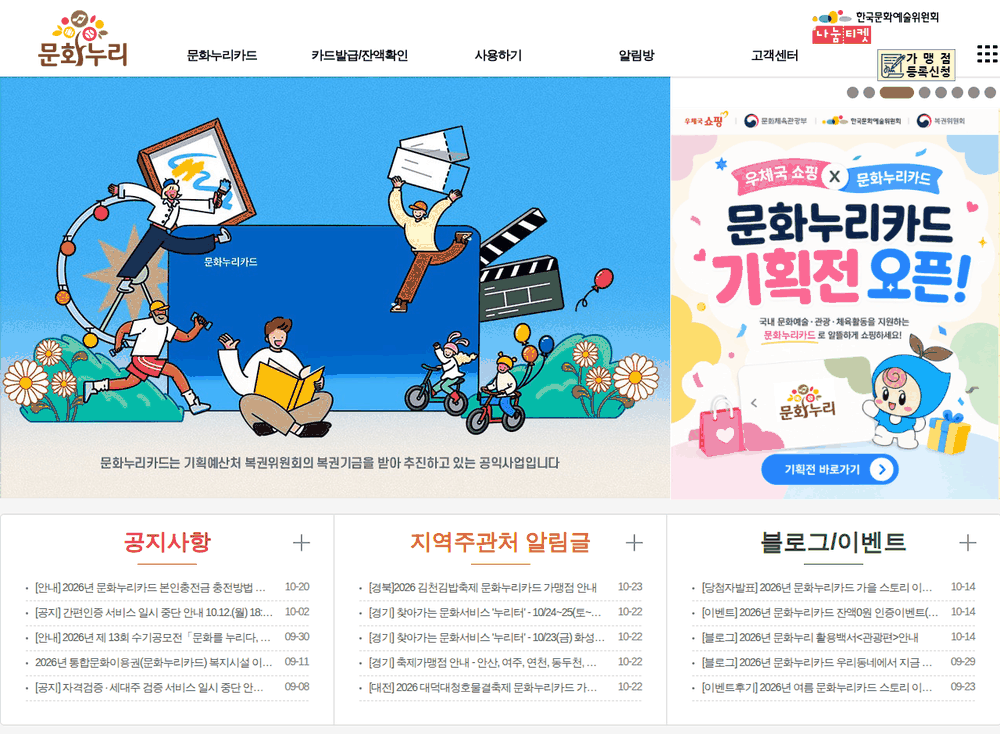
    Culture Nuri Card website front page with the card issue / balance menu
    Real public page: Culture Nuri Card website (captured 2026-10-26)

    2. Who gets the sports lesson voucher, and how much?

    • Who: ages 5 to 18 (born 1 January 2008 to 31 December 2021) in basic livelihood households, near-poverty households, legal single-parent families and similar
    • Amount: up to 105,000 won a month toward sports lesson fees
    • Support can stop if the voucher goes unused for 3 months in a row.
    • How to apply: the nationwide application round (November 2025) is over. After that, you can apply when your city or district opens extra rounds, on the sports voucher website (after login) or at the community center.

    3. Which phone bill discount should you apply for too?

    • Basic livelihood recipients, near-poverty households, people with disabilities, national merit recipients and others can get mobile bill discounts. The size depends on the group (for example, up to 21,500 won a month for housing or education benefit recipients and near-poverty households).
    • Apply any time via ARS 1523, a carrier store, the community center or Bokjiro. For basic pension recipients, see the basic pension guide.

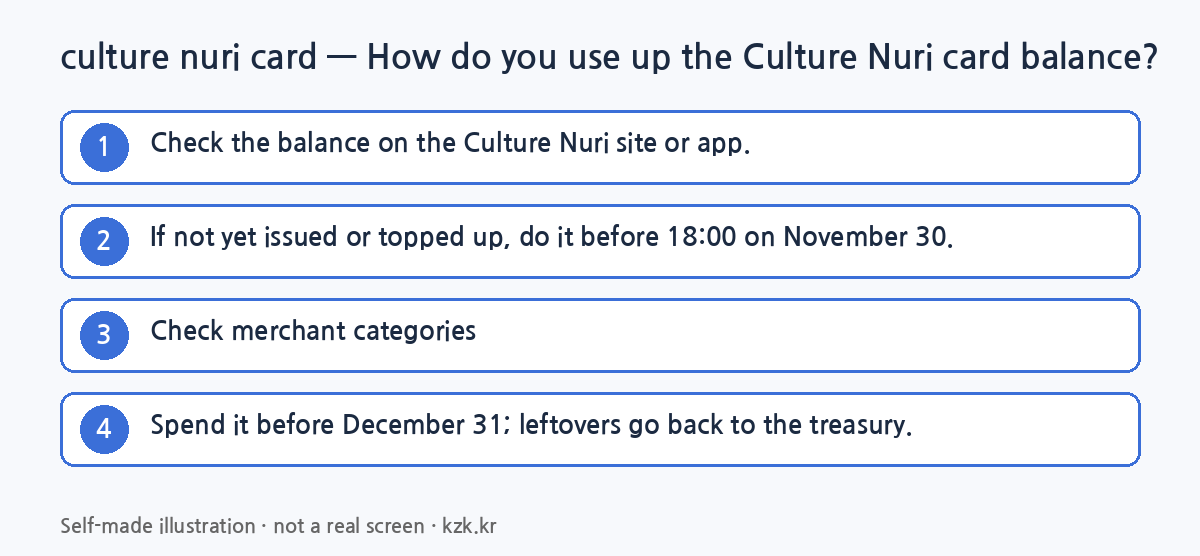
    4. How do you use up the Culture Nuri card balance?

    1. Check the balance on the Culture Nuri site or app.
    2. If not yet issued or topped up, do it before 18:00 on November 30.
    3. Check merchant categories: movies, shows, books, domestic travel, sports goods.
    4. Spend it before December 31; leftovers go back to the treasury.
    culture nuri card step by step: How do you use up the Culture Nuri card balance? (self-made illustration)
    culture nuri card step by step: How do you use up the Culture Nuri card balance? (self-made illustration)

    Example (illustrative numbers): a 15-year-old gets 160,000 won and a 40-year-old parent 150,000 won.

    Common mistakes

    • Trying to top up the Culture Nuri card after 30 November
    • Not spending it all by 31 December, so the balance is lost
    • Leaving the sports voucher unused for more than 3 months

    Checklist

    • ☐ Culture Nuri card issued or topped up before 30 November, 18:00
    • ☐ Balance checked and spent before 31 December
    • ☐ Extra sports voucher rounds checked
    • ☐ Phone bill discount applied for

    Related guides

    FAQ

    How much in 2026?

    150,000 won a year per person; 160,000 won for ages 13–18 and 60–64.

    Where can it be used?

    About 35,000 merchants nationwide in arts (movies, shows, exhibitions, books, music), domestic travel (sights, lodging, rail) and sports (games, sports goods, facilities).

    Deadline to apply or top up?

    18:00 on November 30, 2026; it may close earlier if local budgets run out.

    Does the balance carry over?

    No. Use it by December 31; the rest returns to the treasury.

    Can I top up by phone?

    Top-ups only, at 1544-3412.

    Read next


    We also have a $3.49 PDF guide that collects more everyday money-saving tips. Take a look if it’s useful → See the $3.49 PDF guide

  • Jeonse Deposit Insurance in Korea: HUG and HF Eligibility and Fees (2026)

    Jeonse Deposit Insurance in Korea: HUG and HF Eligibility and Fees (2026)

    Written on 2026-10-26 after checking public pages from HUG (including its mobile product page), HF and the Seoul housing portal. Application availability was as of that date and can change. This is not a recommendation of any institution or product. No application was made and no logged-in screens were viewed. The only image is a self-made illustration. Nothing here promises income.

    The diagram below is a self-made illustration, not a real screen.

    Jeonse deposit insurance pays your deposit back if your lease ends and the landlord does not. This guide covers jeonse deposit insurance eligibility, limits and fees using official information from the Korea Housing & Urban Guarantee Corporation (HUG) and the Korea Housing Finance Corporation (HF). It does not point you to either one.

    HUG website front page, where jeonse deposit insurance starts
    Real public page: HUG (Korea Housing & Urban Guarantee Corp.) website (captured 2026-10-26)

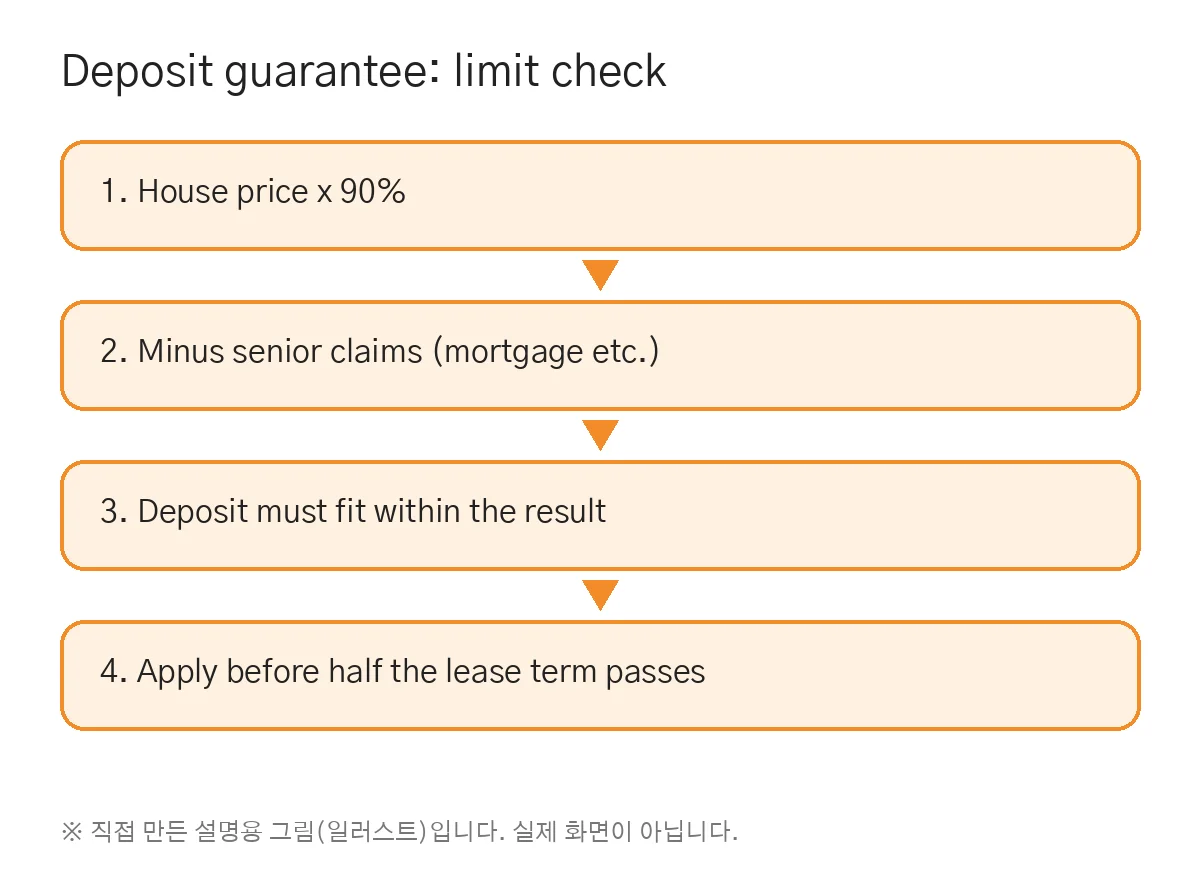
    jeonse deposit insurance: limit check (self-made illustration)

    Who this suits

    • People who have signed, or are about to sign, a jeonse lease
    • People worried that their deposit is high compared with the house price
    Jeonse Deposit Insurance in Korea: HUG and HF Eligibility and Fees: key points summary
    Jeonse Deposit Insurance in Korea: HUG and HF Eligibility and Fees: key points summary

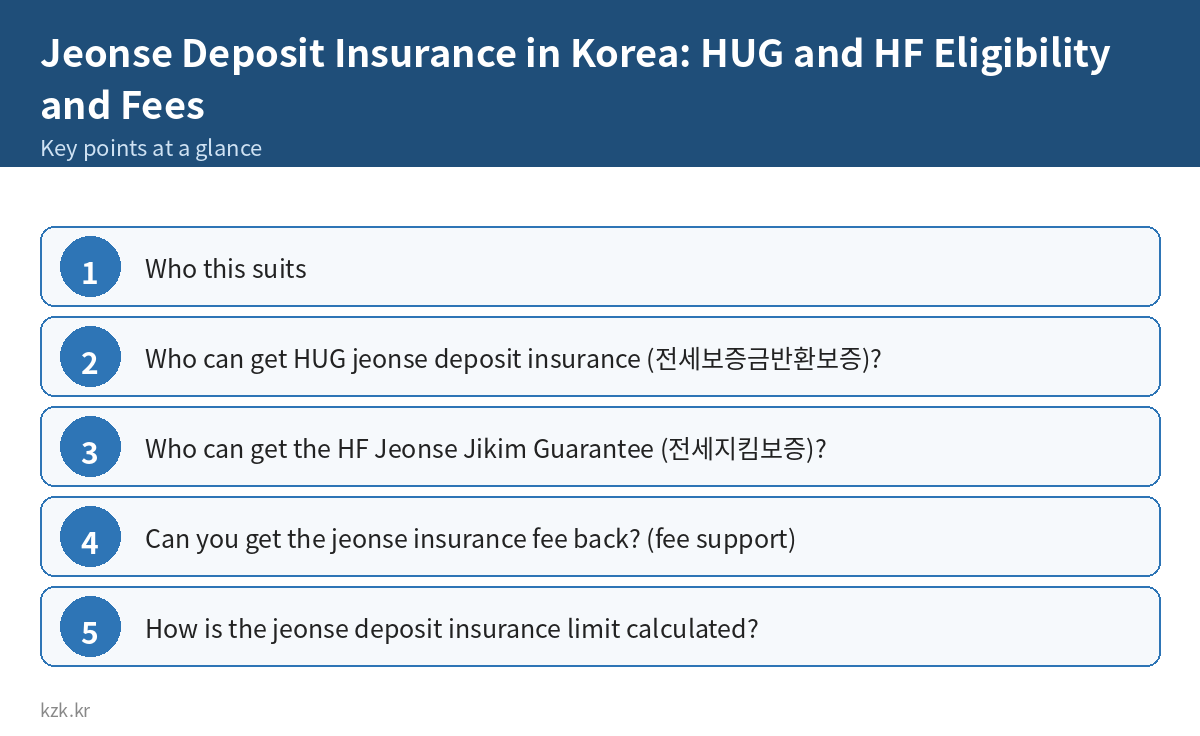
    1. Who can get HUG jeonse deposit insurance (전세보증금반환보증)?

    • Eligible housing: apartments, detached and multi-household houses, row houses and multiplexes, senior welfare housing, and residential officetels. For an officetel, the lease or broker’s property description must say “residential”. Neighborhood commercial facilities are not eligible.
    • Guarantee limit: house price × 90% − senior claims

    – Example (illustrative numbers): for a 100 million won house, a 90 million won deposit qualifies, but 95 million won does not.

    • Deposit cap: 700 million won in the capital area, 500 million won elsewhere
    • Main conditions

    – You live there and have a move-in report and a fixed-date stamp

    – Senior claims are within 60% of the house value

    – No auction, seizure or similar claims on the title, and the landlord owns both the building and the land

    – The lease runs 1 year or more and was made through a licensed broker

    – The building is not listed as an illegal building (apartments excepted)

    • Application deadline

    – New lease: before half the lease term has passed, counted from the later of the final payment date and the move-in report date

    – Renewal: from 1 month before the old lease ends until half the renewed term has passed

    • Fee: covered amount × fee rate × lease days / 365. The rate depends on the deposit, the housing type and the debt ratio (0.115% to 0.154% a year on the mobile page). Applying on mobile and paying in one go each give a 3% discount.
    • Guarantee period: from the issue date until 1 month after the lease ends
    • Documents (mobile): lease with a fixed-date stamp (plus the original lease for renewals), a move-in household record issued within 1 month, proof of deposit payment (receipts or transfers), and a resident registration copy
    • Where to apply: HUG branches, partner banks, or the HUG mobile app. On the check date, the app said apartment and officetel applications were temporarily unavailable.
    • Contact: HUG 1566-9009

    2. Who can get the HF Jeonse Jikim Guarantee (전세지킴보증)?

    • Only for tenants who already use an HF Jeonse Loan Guarantee (전세자금보증) at the handling bank, or who apply for one at the same time. You apply at that bank.
    • The house price, as HF calculates it, must be 1.2 billion won or less.
    • Limit: the lower of house price × 90% − total senior claims, and the regional cap (700 million won in Seoul, Gyeonggi and Incheon; 500 million won elsewhere)
    • Senior claim limits: for detached and multi-household houses, total senior claims within 80% of the house value and senior mortgages within 60%; for other housing, within 60%
    • Fee rate: 0.04% to 0.18% a year (LTV up to 70%: 0.04%; 70 to 80%: 0.11%; 80 to 90%: 0.18%). Qualifying households get 0.02 percentage points off.

    3. Can you get the jeonse insurance fee back? (fee support)

    • Under a Ministry of Land program, the local government refunds HUG fees you have already paid to your own account.
    • Young adults and newlyweds (married within 7 years): the full fee paid, up to 400,000 won
    • Other tenants: 90% of the fee paid, up to 400,000 won
    • These amounts apply to policies taken out from 31 March 2025 (up to 300,000 won for earlier ones). The age that counts as “young” depends on local rules.

    4. How is the jeonse deposit insurance limit calculated?

    Example (illustrative numbers): a house priced at 200 million won with a 30 million won senior mortgage

    1. House price × 90% = 180 million won
    2. Minus senior claims: 180 − 30 = 150 million won
    3. A deposit of 150 million won or less fits within the HUG limit. Other conditions still apply, such as senior claims being within 60% of the house value.

    Common mistakes

    • Trying to apply after half the lease term has passed
    • Signing without checking senior mortgages
    • Signing directly with the landlord, without a broker, and missing the conditions

    Checklist

    • ☐ Move-in report and fixed-date stamp
    • ☐ Mortgages and seizures checked on the title record
    • ☐ Deposit within house price × 90% − senior claims
    • ☐ Deadline (half the lease term) noted
    • ☐ Local notice checked for fee support

    Related guides

    FAQ

    When must I apply?

    For HUG, a new lease must apply before half the lease term has passed, counted from the later of the final payment date and the move-in report date. For renewals, from 1 month before the old lease ends until half the renewed term has passed.

    How much does it cost?

    HUG: deposit × fee rate × days/365, with the rate depending on deposit, housing type and debt ratio. HF Jeonse Jikim: 0.04%–0.18% a year.

    Are officetels eligible?

    For HUG, yes, if the contract or the broker’s property disclosure marks it as residential.

    Is a direct deal without a broker OK?

    No. HUG requires a lease made through a licensed real estate agent.

    How much fee support is there?

    For sign-ups on or after March 31, 2025: young adults and newlyweds get the full fee back, others 90%, each up to 400,000 won, paid by the local government.

    Read next


    We also have a $3.49 PDF guide that collects more everyday money-saving tips. Take a look if it’s useful → See the $3.49 PDF guide

  • Korea Basic Pension Eligibility and Amount (2026): Helping Your Parents Apply

    Korea Basic Pension Eligibility and Amount (2026): Helping Your Parents Apply

    Written on 2026-10-26 after checking current Gov24, National Pension Service and Ministry of Health and Welfare pages and the official proxy form. No application was made and no logged-in screens were viewed. Eligibility is decided by the local government. The only image is a self-made illustration. Nothing here promises income.

    The diagram below is a self-made illustration, not a real screen.

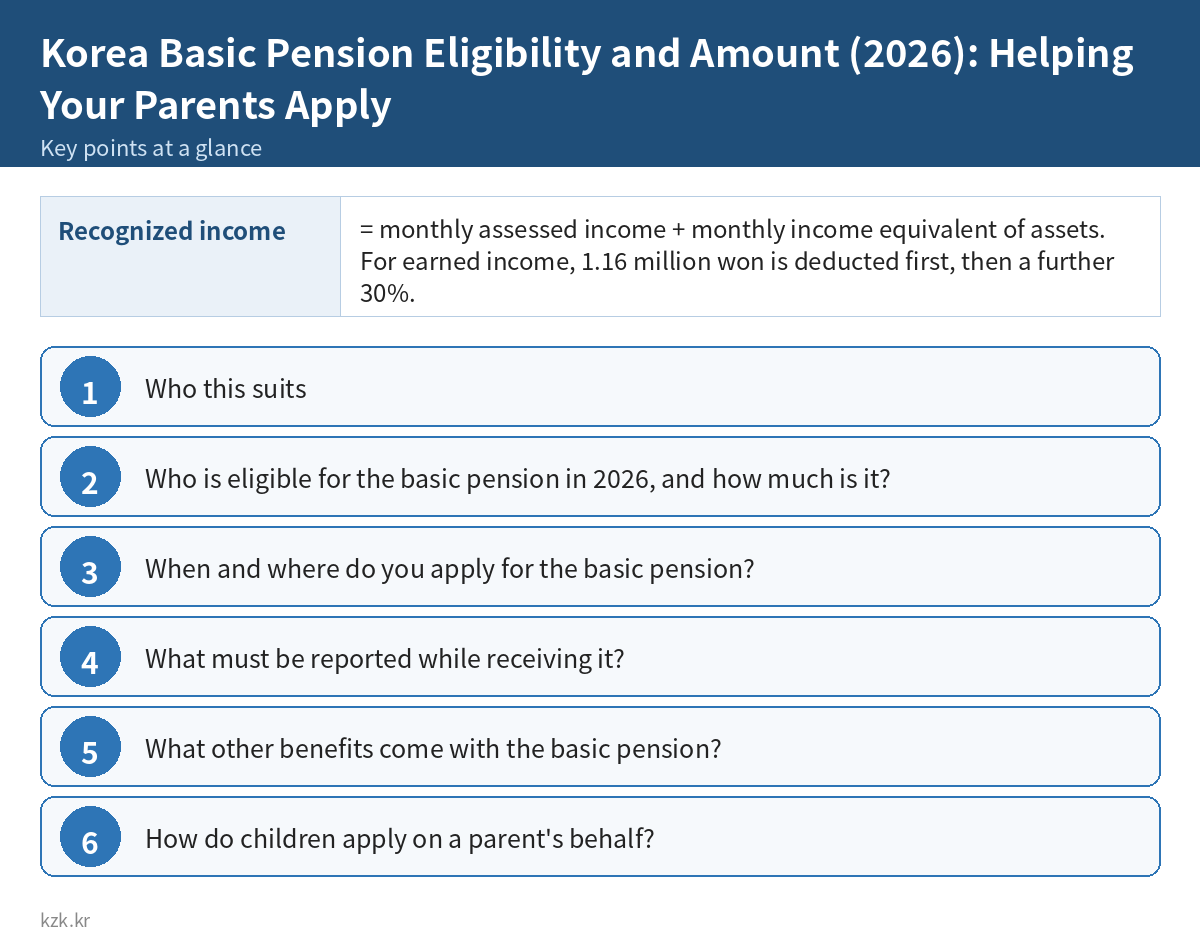
    This guide covers Korea basic pension eligibility, the 2026 basic pension amount, and how children can help parents aged 65 or older apply. It also briefly lists official benefits basic pension recipients can get too.

    korea basic pension: helping parents apply (self-made illustration)

    Who this suits

    • People whose parents are about to turn 65
    • People whose parents find it hard to visit the community center
    Korea Basic Pension Eligibility and Amount (2026): Helping Your Parents Apply: key points summary
    Korea Basic Pension Eligibility and Amount (2026): Helping Your Parents Apply: key points summary

    1. Who is eligible for the basic pension in 2026, and how much is it?

    • Age: 65 or older
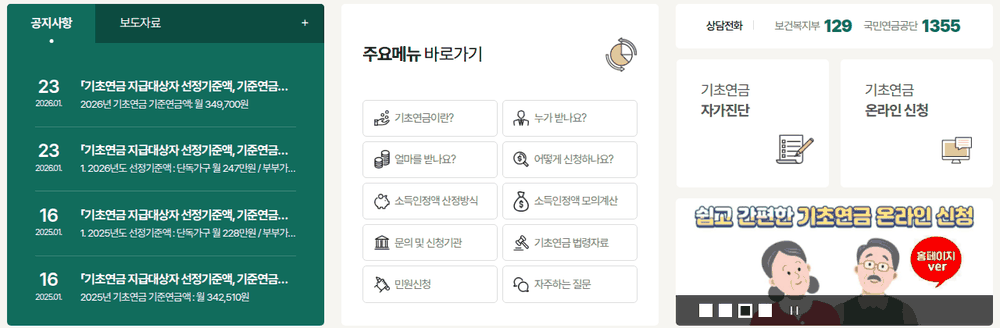
    • Selection threshold (monthly recognized income): 2.47 million won or less for a single household, 3.952 million won or less for a couple
    • Recognized income = monthly assessed income + monthly income equivalent of assets. For earned income, 1.16 million won is deducted first, then a further 30%.
    • Standard pension: up to 349,700 won a month for a single person, 559,520 won for a couple
    • It can be reduced depending on National Pension income, household type and recognized income. If the National Pension amount is over 150% of the standard pension, it can be cut by up to 50%.
    • People entitled to civil servant, private school, military or special post office pensions, and their spouses, are generally excluded (with some exceptions).

    2. When and where do you apply for the basic pension?

    • When: from 1 month before the month of the 65th birthday. The NPS sends a notice from 2 months before.
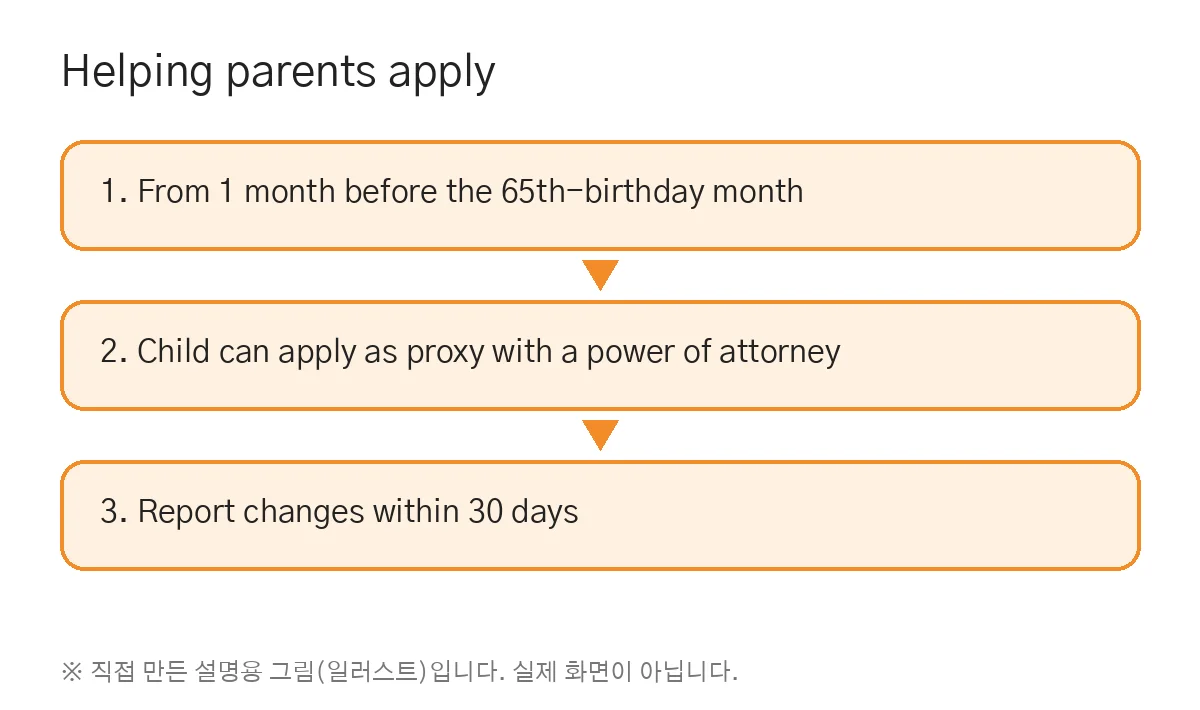
    • Where: the community center, an NPS branch, or Bokjiro online (identity verification needed)
    • Documents: ID, the social welfare service and benefit application form, an income and asset report, financial information consent forms (applicant and spouse), and a bankbook copy
    • Child as proxy: parents should apply themselves in principle. If they can’t, a spouse, child, sibling or other relative can apply for them. Bring the proxy’s ID and a power of attorney.
    • Home visit service: if a parent has limited mobility or lives far away, NPS staff can visit to help them apply (call 1355).
    • Applying is free. If a stranger offers to apply for a fee, refuse and report it to the police.
    Basic pension website main menu with self-check and online application links
    Real public page: Ministry of Health and Welfare basic pension website (captured 2026-10-26)

    3. What must be reported while receiving it?

    • Report within 30 days to the community center or an NPS branch: marriage or divorce, death of the recipient or spouse, a long stay abroad, starting or leaving a job, changes in earned income, business registration or closure, or a change of bank account. A proxy with a power of attorney can report too.

    4. What other benefits come with the basic pension?

    • Phone bill discount: basic pension recipients get 50% off their mobile bill (base fee and usage), up to 11,000 won a month. Apply any time via ARS 1523, a carrier store, the community center or Bokjiro.
    • Customized senior care service: for people who need care, such as those living alone, grandparents raising grandchildren, or elderly couples, among basic pension recipients aged 65 or older and others. People already getting similar services such as long-term care are excluded. Apply at the community center.

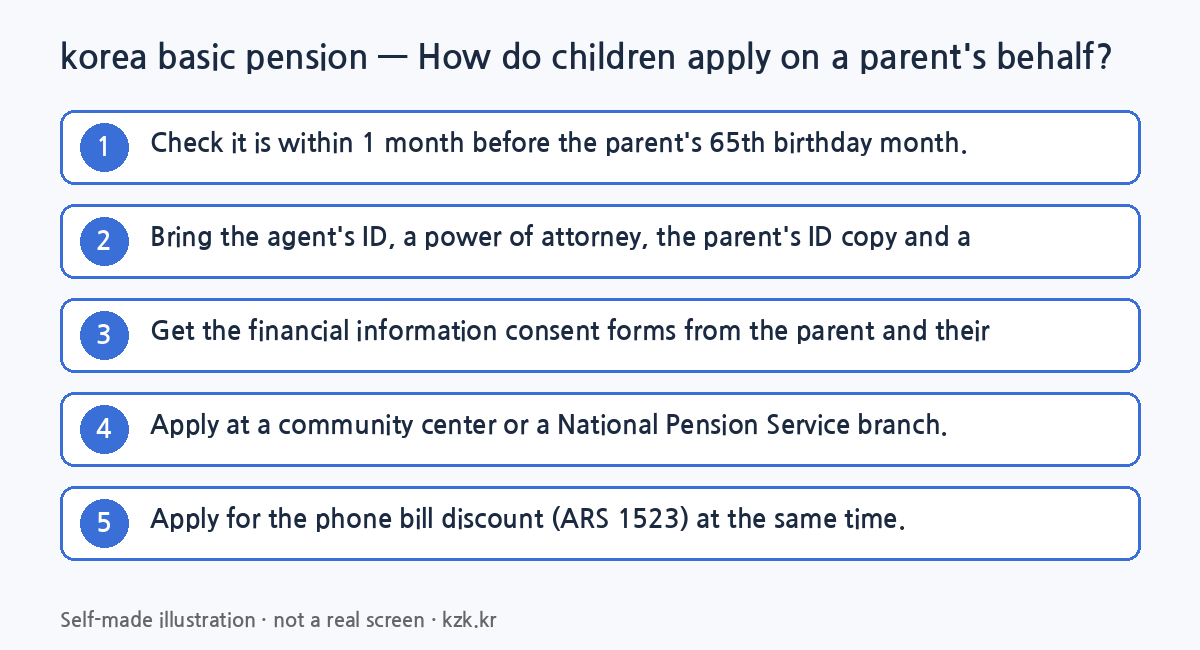
    5. How do children apply on a parent’s behalf?

    1. Check it is within 1 month before the parent’s 65th birthday month.
    2. Bring the agent’s ID, a power of attorney, the parent’s ID copy and a bankbook copy.
    3. Get the financial information consent forms from the parent and their spouse.
    4. Apply at a community center or a National Pension Service branch. If visiting is hard, ask about the home visit service at 1355.
    5. Apply for the phone bill discount (ARS 1523) at the same time.
    korea basic pension step by step: How do children apply on a parent's behalf? (self-made illustration)
    korea basic pension step by step: How do children apply on a parent's behalf? (self-made illustration)

    Common mistakes

    • Applying after the birthday month has passed. The pension is paid from the month you apply.
    • Not reporting a move or an account change
    • Not realizing the phone discount needs its own application

    Checklist

    • ☐ Applied 1 month before the birthday month
    • ☐ Power of attorney and proxy ID
    • ☐ Spouse’s financial information consent form
    • ☐ Phone bill discount applied for
    • ☐ Any change reported within 30 days

    Related guides

    FAQ

    From what age?

    65 or older, with recognized income at or below the threshold.

    What is the 2026 threshold?

    Monthly recognized income of 2,470,000 won for a single person or 3,952,000 won for a couple.

    How much is it?

    The standard amount is 349,700 won a month for a single person and 559,520 won for a couple (maximum). It can be reduced based on National Pension income or recognized income.

    Can a child apply for a parent?

    The person should apply, but if that is hard, a spouse, child, sibling or relative can apply with a power of attorney and their own ID.

    Is it paid back to before I applied?

    No. It is paid from the month you apply, so apply from 1 month before the birthday month.

    Read next


    We also have a $3.49 PDF guide that collects more everyday money-saving tips. Take a look if it’s useful → See the $3.49 PDF guide

  • Earned income and child tax credits, including late filing

    Earned income and child tax credits, including late filing

    Written on 2026-10-26 after checking the National Tax Service’s press release of 30 April 2026 and its public credit pages. No application was made and no logged-in screens were viewed. Final amounts depend on the NTS review. The only image is a self-made illustration. Nothing here promises income.

    The diagram below is a self-made illustration, not a real screen.

    The earned income tax credit (EITC) supports low-income working households, and the child tax credit (CTC) supports households with children under 18. These are the 2026 criteria (for 2025 income).

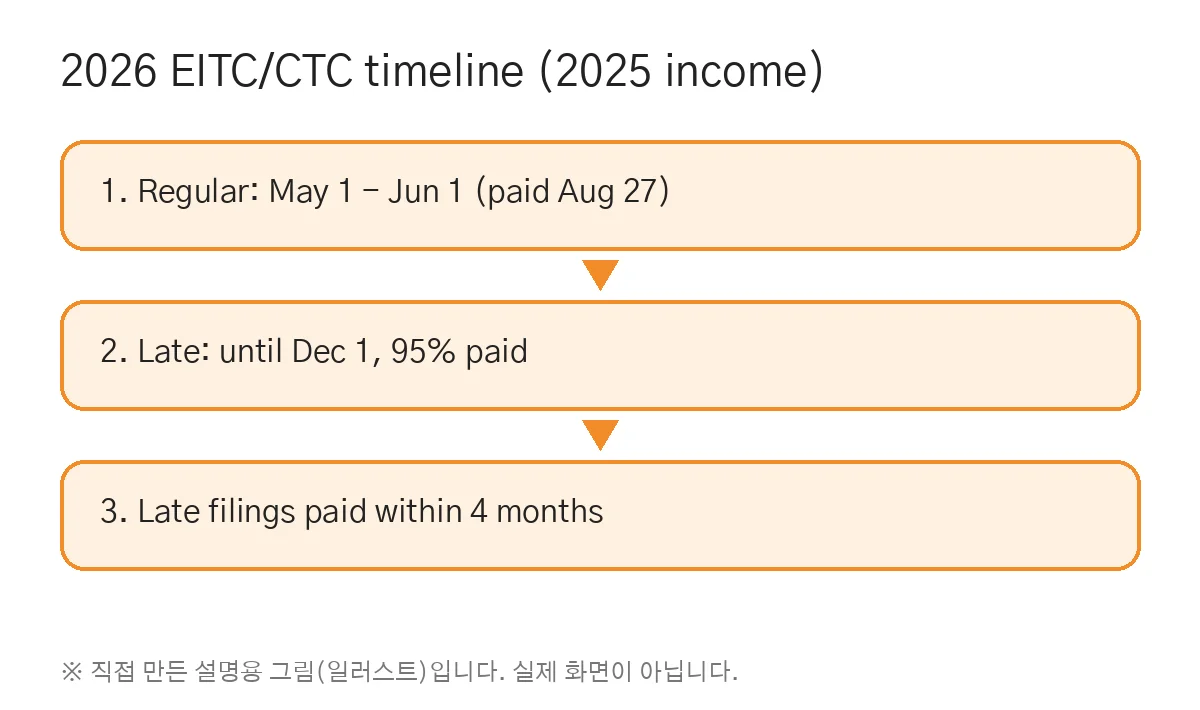
    2026 earned income and child tax credit timeline (self-made illustration, not a real screen)

    Who this suits

    • People with employment, business or religious income in 2025
    • People who missed the May regular filing period
    Earned income and child tax credits, including late filing: key points summary
    Earned income and child tax credits, including late filing: key points summary

    1. Income limits (2025 combined total income of the couple)

    | Household | EITC | CTC |
    |—|—|—|
    | Single (no spouse, no dependent child under 18, no parent 70+) | under 22 million won | not applicable |
    | Single-earner | under 32 million won | under 70 million won |
    | Dual-earner (each spouse earns 3 million won or more) | under 44 million won | under 70 million won |

    2. Asset limit

    • Total assets of all household members as of 1 June 2025 must be under 240 million won. Debts are not subtracted.
    • Assets of 170 million won or more but under 240 million won get 50% of the calculated amount.
    • Assets include real estate, cars, presale rights, jeonse deposits, savings, shares and club or resort usage rights (회원권).

    3. Amounts

    • EITC: from 30,000 won up to 1.65 million won (single), 2.85 million won (single-earner), 3.3 million won (dual-earner)
    • CTC: 500,000 to 1 million won per dependent child, minus any child tax credit you already received
    • After review, the amount may differ from your notice, or you may receive nothing.

    4. Deadlines

    • Regular filing: 1 May to 1 June 2026 (payment was planned for 27 August)
    • Late filing: until 1 December 2026. You get 95% of the calculated amount (a 5% cut). Payment comes within 4 months of filing.
    • Households with only employment income can also file half-yearly.

    5. How to file

    • If you got a notice, use its QR code, the mobile notice, or ARS 1544-9944.
    • Without a notice, you can still file on Hometax (after login) with proof if you think you qualify.
    • Help: credit call center 1566-3636 (weekdays 9:00 to 18:00)
    • If you agree to auto-filing when you apply, you won’t need to file again through the 2027 tax year, as long as you qualify.

    Common mistakes

    • Subtracting debts when counting assets
    • Missing the 1 December late filing deadline
    • Falling for fake NTS texts. The NTS never asks for fees, transfers or account passwords.

    Checklist

    • ☐ Household type checked
    • ☐ 2025 combined total income checked
    • ☐ Total assets as of 1 June 2025 checked
    • ☐ Late filing done before 1 December
    • ☐ Any text you get carries the NTS safety mark

    To claim missed deductions from past years, see our year-end tax correction claim guide.


    We also have a $3.49 PDF guide that collects more everyday money-saving tips. Take a look if it’s useful → See the $3.49 PDF guide

  • National Pension back payment and lump-sum repayment explained

    National Pension back payment and lump-sum repayment explained

    Written on 2026-10-26 after checking the National Pension Service’s public pages and the National Pension Act decree. This explains the programs only; it is not advice on whether to pay in. Ask the NPS about your own case. No application was made and no logged-in screens were viewed. The only image is a self-made illustration. Nothing here promises income.

    The diagram below is a self-made illustration, not a real screen.

    The National Pension has two programs for adding periods to your record later: periods when you couldn’t pay, and periods you were refunded as a lump sum. This guide only explains the programs. Whether to use them depends on your situation, so talk to the NPS before deciding.

    Two National Pension programs compared (self-made illustration, not a real screen)

    Who this suits

    • People who had an exemption period, for example after losing a job
    • People who were excluded as a spouse with no income
    • People who once got a lump-sum refund and are insured again now
    National Pension back payment and lump-sum repayment explained: key points summary
    National Pension back payment and lump-sum repayment explained: key points summary

    1. Back payment (chunap)

    • Who: insured people with an exemption or exclusion history who are paying contributions now
    • Eligible periods
    • Exemption periods when you couldn’t pay, for example after losing a job
    • Exclusion periods after at least 1 month of contributions, for reasons such as being a spouse with no income (exclusions for emigration do not count)
    • Military service from 1 January 1988 (service counted under another public pension does not count)

    • Limit: up to 119 months

    • Installments: monthly, within 60 installments. Interest at the 1-year term deposit rate is added when you split payments.
    • Documents: a detailed marriage certificate showing full resident numbers is required. Extra documents apply in some cases, such as a removed-register copy for a divorce or bereavement before 2008, or a military record for service periods.
    • The bill arrives around the 11th to 15th of the month after you apply, and is due by the end of that month.

    2. Lump-sum repayment

    • Who: people who received a lump-sum refund and are insured again (including exempted people, and those over 60 if still insured)
    • What: pay back the refund plus interest to restore your earlier insured period. It is optional.
    • Deadline: only while you keep your insured status
    • Installments (by earlier insured period): under 1 year, 3; 1 to under 5 years, 12; 5 years or more, 24. Term deposit interest is added.
    • If you miss a payment, the NPS sends one notice and does not take arrears action.

    3. How to apply (both programs)

    • At an NPS branch, by post, by fax, on Government24, on the NPS website (after login), in the mobile app, or by digital ARS
    • Submitting only registers the application. It is confirmed after the branch officer calls you to check.
    • For expected pension amounts, ask an NPS branch or the NPS call center on 1355 (charged).

    Common mistakes

    • Applying for back payment while not paying contributions now
    • Leaving out the marriage certificate, so the application can’t go ahead
    • Thinking you can apply for lump-sum repayment after losing insured status

    Checklist

    • ☐ Insured now?
    • ☐ Exemption, exclusion or military periods identified
    • ☐ Detailed marriage certificate ready
    • ☐ Lump-sum vs installments (interest added) understood
    • ☐ Officer’s confirmation call received

    To look for other money in your name, see our guide to finding hidden money.


    We also have a $3.49 PDF guide that collects more everyday money-saving tips. Take a look if it’s useful → See the $3.49 PDF guide

  • Job-seeking benefit (unemployment benefit), 2026 rules

    Job-seeking benefit (unemployment benefit), 2026 rules

    Written on 2026-10-26 after checking the Ministry of Employment and Labor’s 2026 employment insurance guide, its 1350 help answers and Work24’s public pages. No claim was made and no logged-in screens were viewed. Eligibility is decided by the job center. The only image is a self-made illustration. Nothing here promises income.

    The diagram below is a self-made illustration, not a real screen.

    The job-seeking benefit is paid to people covered by employment insurance who leave a job involuntarily and look for new work. These are the 2026 rules.

    Steps to claim job-seeking benefits (self-made illustration, not a real screen)

    Who this suits

    • People who recently left a job, for example because a contract ended or they were asked to resign
    • People about to leave who want to check the conditions first
    Job-seeking benefit (unemployment benefit), 2026 rules: key points summary
    Job-seeking benefit (unemployment benefit), 2026 rules: key points summary

    1. Eligibility

    • In the 18 months before leaving (24 months for very short-hour workers), you need at least 180 insured paid days in total. Days worked and paid days such as paid holidays count.
    • You must be willing and able to work but without a job, and actively looking for work.
    • Reason for leaving: you must have left involuntarily, for example for business reasons. Voluntary quitting, or dismissal for serious fault, is not eligible. However, voluntary leaving can be accepted for valid reasons, such as unpaid wages for a set period, pay below minimum wage, bankruptcy, or suspension or closure of the business.

    2. Daily amount (for people who left on or after 1 January 2026)

    • 60% of your average wage before leaving
    • Maximum: 68,100 won a day
    • Minimum: 66,048 won a day (based on 8 scheduled hours a day; it varies with your hours)
    • For people who left in 2025: maximum 66,000 won, minimum 64,192 won

    3. Duration (benefit days)

    | Insured period | Under 50 | 50+ or disabled |
    |—|—|—|
    | Under 1 year | 120 | 120 |
    | 1 to under 3 years | 150 | 180 |
    | 3 to under 5 years | 180 | 210 |
    | 5 to under 10 years | 210 | 240 |
    | 10 years or more | 240 | 270 |

    • After 12 months from the day after you leave, nothing more is paid, even if days remain. Apply right after you leave.
    • The first 7 days from your unemployment report are a waiting period and are not paid.

    4. Steps

    1. Register as a job seeker on Work24 (after login).
    2. Submit an eligibility application to the job center for your area.
    3. While job hunting, apply for unemployment recognition on the days the center sets (every 1 to 4 weeks), in person or online.
    4. After it is checked, the benefit is paid.

    5. Warning about fraudulent claims

    • These count as fraud: not reporting work or income, submitting false job-search activity, giving a false reason for leaving or false wages, or having someone else apply for recognition for you.
    • If caught, payments stop, you must repay everything you received, and up to 5 times the fraudulent amount can be collected on top. You can also face up to 5 years in prison or a fine of up to 50 million won.
    • If you worked or earned money during a recognition period, report it on your recognition day.
    • If you report it yourself, the extra collection can be waived (via Work24, the national e-petition site, or the local labor office).

    Common mistakes

    • Applying long after leaving, so you can’t use all your days within 12 months
    • Not reporting income from short part-time work
    • Missing a recognition day

    Checklist

    • ☐ 180 or more insured paid days
    • ☐ Reason for leaving checked
    • ☐ Job seeker registration on Work24 right after leaving
    • ☐ Recognition dates noted
    • ☐ Any work or income reported right away

    For job training support, see our Naeil learning card guide.


    We also have a $3.49 PDF guide that collects more everyday money-saving tips. Take a look if it’s useful → See the $3.49 PDF guide

  • Rent tax credit and youth rent support, separately

    Rent tax credit and youth rent support, separately

    Written on 2026-10-26 after checking the National Tax Service’s 2026 year-end tax guidance and Bokjiro’s 2026 youth rent support notice. No application was made and no logged-in screens were viewed. Tax and support rules can change; check the official sites before you rely on them. Nothing here promises income.

    The diagram below is a self-made illustration, not a real screen.

    If you pay monthly rent, you can look at two things separately: the rent tax credit at year-end tax settlement, and the Ministry of Land’s youth rent support. Our guide on claiming missed deductions already covers the basics (homeless household head, salary cap, rate and limit) and how to claim past years, so this guide goes one step further.

    Two paths for rent support (self-made illustration, not a real screen)

    Who this suits

    • People renting an officetel or gosiwon who aren’t sure they qualify
    • People on half-jeonse (deposit loan plus monthly rent)
    • Homeless young adults aged 19 to 34 living apart from their parents
    Rent tax credit and youth rent support, separately: key points summary
    Rent tax credit and youth rent support, separately: key points summary

    1. Rent tax credit: points to check

    • 2026 NTS guidance: total salary of 80 million won or less (global income of 70 million won or less), per the NTS press release of 23 January 2026. Some official FAQ pages may still show the old figure of 70 million won in total salary.
    • Household members can qualify if the household head takes no housing-related deduction.
    • Housing: national housing size (85㎡, 100㎡ in some areas) or smaller, or a standard price of 400 million won or less on the contract date. Officetels and gosiwon count.
    • Lease name: the lease must be in your name or a basic-deduction dependant’s.
    • Address match: your resident registration address must match the lease. A parent who lives elsewhere and pays rent on a child’s officetel cannot claim.
    • Half-jeonse: the deduction for jeonse-loan repayments and the rent credit can both apply.
    • Documents (give them to your employer at year-end settlement): resident registration copy, lease copy, and proof of payment (transfer receipts, deposit slips, cash receipts). The registration copy is free on Government24.
    • Contact: NTS 126

    2. Youth rent support: 2026 status

    • Application window: 30 March 2026, 09:00 to 29 May, 16:00. The 2026 national application window has closed. It is not open all year, so check the current status and the next notice on Bokjiro or at your local community center; some local governments run their own programs.
    • Age and residence: 19 to 34 (born 1991 to 2007), living apart from parents, homeless
    • Income and assets
    • Youth household: 60% of median income or less (about 1.54 million won a month for 1 person), assets of 122 million won or less
    • Parents’ household: 100% of median income or less (about 5.36 million won a month for 3 people), assets of 470 million won or less
    • If you are 30 or older, married, etc., only the youth household is checked.

    • Support: up to 200,000 won a month within actual rent (excluding deposit and maintenance fees), for up to 24 payments, once in a lifetime. For 2026 new recipients, payments run until December 2028. Payments go back to May rent, with results and payments planned from September. About 60,000 people nationwide are covered. It is paid in cash to the young person’s own account.

    • Not eligible:
    • Homeowners (including presale or move-in rights)
    • Renting from a relative within the second degree
    • Public rental tenants
    • Several people subletting one room
    • People getting other ministry or local rent support (they can apply after it ends)
    • Anyone who has already received all 24 payments

    • Payments stop for: military enlistment, 90 or more days abroad, moving back in with parents, moving without filing a change

    • How to apply: on Bokjiro online (after login) or at your local community service center.
    • Documents: application form, income and asset report, lease, the last 3 months of rent transfers, bankbook copy, family relation certificate.
    • Bokjiro and MyHome Portal offer a mock calculator.

    • Contacts: Ministry 1599-0001, Bokjiro 1566-0313

    Common mistakes

    • Not registering your move-in, so your address differs from the lease
    • Paying rent in cash with no proof
    • Moving while on youth support without filing a change
    • Assuming youth support is open all year

    Checklist

    • ☐ Registered address matches the lease address
    • ☐ Floor area or standard price checked
    • ☐ Rent transfer records saved
    • ☐ On half-jeonse? Check the loan repayment deduction too
    • ☐ Note when the next youth support notice comes out

    Basic conditions and claiming past years are in our year-end tax correction claim guide.


    We also have a $3.49 PDF guide that collects more everyday money-saving tips. Take a look if it’s useful → See the $3.49 PDF guide

  • Cutting Medical Costs: The Out-of-Pocket Cap and Catastrophic Medical Expense Support

    Cutting Medical Costs: The Out-of-Pocket Cap and Catastrophic Medical Expense Support

    Written on 2026-10-26 after checking public information from the National Health Insurance Service and Gov24. This is official program information only, not medical advice; talk to your medical team about care. No claim was filed and no logged-in screens were viewed. The only image is a self-made illustration. Nothing here promises income.

    The diagram below is a self-made illustration, not a real screen.

    If you paid a lot in hospital bills this year, check whether some of it can come back. Only information from official sources such as the National Health Insurance Service (NHIS) is included. For treatment decisions, talk to your doctor.

    Flow for reducing medical costs (self-made illustration, not a real screen)

    Who this suits

    • People (and families) with high inpatient or outpatient costs this year
    • People who received an NHIS refund notice
    • People whose medical costs are large relative to income
    Cutting Medical Costs: The Out-of-Pocket Cap and Catastrophic Medical Expense Support: key points summary
    Cutting Medical Costs: The Out-of-Pocket Cap and Catastrophic Medical Expense Support: key points summary

    Part 1: Out-of-pocket cap (본인부담상한제)

    If your covered out-of-pocket costs from Jan 1 to Dec 31 exceed the cap for your income bracket, NHIS pays the excess.

    2026 caps
    | Income bracket | Cap | Long-term care hospital, 120+ days |
    |—|—|—|
    | 1st | 0.90M won | 1.43M won |
    | 2nd–3rd | 1.12M | 1.81M |
    | 4th–5th | 1.73M | 2.45M |
    | 6th–7th | 3.26M | 4.04M |
    | 8th | 4.46M | 5.80M |
    | 9th | 5.36M | 6.98M |
    | 10th | 8.43M | 10.96M |

    Not counted: non-covered services, selective coverage, full self-pay items, implants, 2–3 bed room fees, Chuna therapy, minor outpatient care at tertiary hospitals, and the 90% self-pay portion for minor ER visits and outpatient visits over 365.

    How it’s paid

    • Advance: at a single hospital, once the year’s total exceeds the top cap (8.43 million won), the hospital bills NHIS for the rest. Long-term care hospitals excluded since 2020.
    • Refund: if totals across hospitals exceed your personal cap, NHIS sets the cap around August of the next year after premium settlement and pays you the excess.

    How to claim
    1. Check the notice NHIS mails you.
    2. Submit the claim via the NHIS website (after login), the 건강보험25시 app, phone 1577-1000, a branch, fax, or mail.
    3. Payment to a family member’s or another person’s account requires a branch visit with a power of attorney, both IDs, and a family relation certificate.
    4. Register a consent account so future refunds arrive automatically.

    Part 2: Catastrophic medical expense support (재난적의료비)

    Supports part of the costs for people who meet all criteria: illness, income, assets, and cost burden.

    | Group | Threshold (out-of-pocket) | Rate |
    |—|—|—|
    | Basic livelihood recipients / near-poor | over 800k won | 80% |
    | ≤50% of median income | over 1.2M (1 person) / 1.6M (2+) | 70% |
    | 50–100% of median income | over 10% of annual income | 60% |
    | 100–200% of median income | case review | case review |

    • Assets: 700 million won or less.
    • Limits: 180 days a year (inpatient + outpatient), up to 50 million won a year. Nothing is paid if the calculated amount is under 100k won.
    • Excluded: cosmetic procedures, private rooms, caregiver fees, etc. Government aid and private indemnity insurance payouts are deducted first.
    • For care from July 1, 2026: minor conditions (e.g., hypertension, diabetes, colds) excluded; 2–3 bed room fees excluded except for the 7 major severe diseases; managed-coverage items excluded; bills under 100k won excluded.

    How to apply
    1. Within 180 days after discharge (last treatment day), you or a proxy applies at an NHIS branch.
    2. For direct payment to the hospital while admitted, apply 7 days before discharge (3 days for recipients/near-poor).
    3. Documents: application, consent form, family relation certificate, private insurance papers, admission/discharge confirmation.
    4. Contact: 1577-1000, 129.

    Common mistakes

    • Ignoring the refund notice
    • Assuming non-covered costs count toward the cap
    • Missing the 180-day deadline
    • Forgetting to report private insurance payouts

    Checklist

    • ☐ Find your bracket’s cap
    • ☐ Check the NHIS notice and claim
    • ☐ Register a consent account
    • ☐ Large bills? Check catastrophic support criteria
    • ☐ Apply at a branch within 180 days with documents

    For more money you may be missing, see our guide to finding hidden money.


    We also have a $3.49 PDF guide that collects more everyday money-saving tips. Take a look if it’s useful → See the $3.49 PDF guide

  • Getting Help with Heating and Cooling Bills: Energy Voucher and KEPCO Welfare Discounts

    Getting Help with Heating and Cooling Bills: Energy Voucher and KEPCO Welfare Discounts

    Written on 2026-10-26 after checking public pages of the Korea Energy Agency, the energy voucher site, Gov24 (energy voucher and KEPCO welfare discount) and Bokjiro notices. No application was made and no logged-in screens were viewed. Amounts and periods are for 2026 and can change. The only image is a self-made illustration. Nothing here promises income.

    The diagram below is a self-made illustration, not a real screen.

    Unlike the energy cashback program (save, then get money back), these two programs directly pay or discount your bills if you qualify.

    Who this suits

    • Households receiving livelihood, medical, housing, or education benefits (Energy Voucher)
    • People with disabilities, basic livelihood recipients, near-poverty households, families with many children, large or new-birth households (KEPCO discount)

    Energy voucher application flow (self-made illustration, not a real screen)

    Getting Help with Heating and Cooling Bills: Energy Voucher and KEPCO Welfare Discounts: key points summary
    Getting Help with Heating and Cooling Bills: Energy Voucher and KEPCO Welfare Discounts: key points summary

    1. 2026 Energy Voucher

    Based on Korea Energy Agency, the Energy Voucher site, and Gov24.

    Eligibility: households meeting both

    • Income: receiving at least one of livelihood, medical, housing, or education benefits
    • Household trait: you or a household member is a senior (born on or before 1961-12-31), a preschool child (born 2019-01-01 or later), a registered person with a disability, pregnant or within 6 months after birth, a patient with a severe, rare, or severe intractable disease, a single-parent family, a child-headed household (incl. foster children), or a household with 2+ children under 19
    • Excluded: households where all members receive benefits inside a care facility

    Amount (2026 total, not monthly): 1 person 295,200 won / 2 people 407,500 / 3 people 532,700 / 4+ people 701,300 won.

    • If you take coal-briquette coupons, the briquette-conversion voucher, or emergency winter fuel aid, you get only a smaller summer amount.

    Apply: June 15 – December 31, 2026. Use: July 1, 2026 – May 31, 2027 (winter: virtual card from Oct 1, physical card from Oct 3).

    How it’s paid (choose one):

    • Bill deduction (virtual card): taken off electricity, city gas, or district heating bills
    • National Happiness Card (physical card): pay for electricity, city gas, kerosene, LPG, or briquettes

    How to apply:

    • At your local community service center (읍·면·동 행정복지센터)
    • Online via Bokjiro (after login)
    • Relatives can apply for someone with limited mobility, or an official can apply with consent
    • 2025 recipients with no change in status are re-registered automatically. Check with the center or the voucher helpline (1600-3190).

    Documents: application form (at the center). For bill deduction, a recent utility bill (or apartment management bill).

    New: briquette-conversion voucher: a flat 576,000 won for eligible households that switched from a briquette boiler after January 2026, usable Oct 3, 2026 – May 31, 2027.

    2. KEPCO electricity welfare discount

    Based on Gov24 (agency: KEPCO, updated 2026-08-14). Monthly caps for residential/general service.

    | Who | Monthly cap (summer) |
    |—|—|
    | Severe disability, wounded veterans grade 1–3, independence patriots | 16,000 won (20,000) |
    | Livelihood/medical benefit recipients | 16,000 won (20,000) |
    | Housing/education benefit recipients | 10,000 won (12,000) |
    | Near-poverty group | 8,000 won (10,000) |
    | 3+ children, 5+ household members, new-birth households (residential) | 30% off, capped at 16,000 won |
    | Households using life-support devices (residential) | 30% off |

    • Apply anytime: KEPCO ON (after sign-up and login), KEPCO call center 123, a KEPCO branch, or your community service center
    • If you consent to sharing your own records when applying through KEPCO, you don’t need to submit eligibility papers for veteran, disability, recipient, or near-poverty status.
    • The discount starts with the month you apply. It stops the month after you move or lose eligibility.

    Common mistakes

    • Assuming the voucher arrives on its own (new applicants must apply by December 31)
    • Wanting to save it all for winter but not asking to skip summer deductions
    • Forgetting the KEPCO discount, which is a separate program

    Checklist

    • ☐ Confirm benefit type and household traits
    • ☐ Apply for the voucher before December 31
    • ☐ Choose bill deduction or the card
    • ☐ Check the KEPCO discount (call 123)

    To get money back for saving energy, see our energy cashback and carbon points guide.


    We also have a $3.49 PDF guide that collects more everyday money-saving tips. Take a look if it’s useful → See the $3.49 PDF guide

  • Cutting transit costs: K-Pass (모두의카드), Ttareungyi bikes, Climate Pass

    Cutting transit costs: K-Pass (모두의카드), Ttareungyi bikes, Climate Pass

    Written on 2026-10-26 after checking public pages of the Korea Transportation Safety Authority (K-Pass/모두의카드) and the Seoul city government (Climate Pass FAQ, Ttareungyi fares). No card was registered and no logged-in screens were viewed. Payment dates differ by card issuer and are left out. The only image is a self-made illustration. Nothing here promises income.

    The diagram below is a self-made illustration, not a real screen.

    If you ride the bus or subway daily, refund programs give some of it back the next month. This focuses on what changed in 2026.

    Who this suits

    • Anyone using public transit 15+ times a month
    • Anyone biking short trips in Seoul
    Cutting transit costs: K-Pass (모두의카드), Ttareungyi bikes, Climate Pass: key points summary
    Cutting transit costs: K-Pass (모두의카드), Ttareungyi bikes, Climate Pass: key points summary

    1. K-Pass (모두의카드): what changed in 2026

    From 2026, K-Pass became “모두의카드” (Everyone’s Card). Each month the most favorable of three methods is applied automatically.

    • Basic (percentage): general 20%; youth (19–34), seniors, and parents of 2 kids 30%; 3+ kids 50%; low-income (basic livelihood recipients and near-poverty households) 53.3%
    • Standard / Plus (fixed threshold): spending above a monthly threshold is refunded. In the capital area: general ₩62,000 (Plus ₩100,000); youth/2 kids/seniors ₩55,000 (₩90,000); 3+ kids/low-income ₩45,000 (₩80,000). Standard counts only rides under ₩3,000 each; Plus counts all. Thresholds are lower outside the capital area.

    Eligibility: age 19+ registered in a participating local government, 15+ rides a month (the first month pays even under 15). Which modes count can differ, so check the official K-Pass site; Seoul’s FAQ lists buses, subways, 신분당선, metropolitan buses, GTX, 대경선 and 한강버스 as covered.

    How: get a 모두의카드 (K-Pass) card from a card company or bank → sign up on the K-Pass app or website and register the card (after login) → ride → refund the next month.

    K-Pass refund flow (self-made illustration, not a real screen)

    2. Seoul Climate Pass (기후동행패스)

    Seoul is moving its Climate Card into the “Climate Pass,” linked to 모두의카드. Seoul residents already on 모두의카드/K-Pass got the benefits automatically from Sept 1, 2026. Seoul adds a wider youth age range (19–39). A Ttareungyi bike discount is still under discussion. Non-Seoul residents aren’t eligible and should switch to their region’s 모두의카드 service (Gyeonggi: The Gyeonggi Pass).

    3. Ttareungyi (Seoul public bike) passes

    • Day pass: 1-hour ₩1,000 / 2-hour ₩2,000 / 3-hour ₩3,000
    • Season pass (members): 1-hour 7 days ₩3,000, 30 days ₩5,000, 180 days ₩15,000, 365 days ₩30,000; 2-hour 7 days ₩4,000, 30 days ₩7,000, 180 days ₩20,000, 365 days ₩40,000
    • Going over the base time costs ₩200 per 5 minutes. Return within the base time and re-rent to keep riding with no extra fee.

    Common mistakes

    • Getting the card but never registering it on the K-Pass app/site
    • Months with fewer than 15 rides
    • Riding past the base time and paying extra

    Checklist

    • ☐ Know your type (general, youth, senior, multi-child, low-income)
    • ☐ Register the card with K-Pass
    • ☐ 15+ rides a month
    • ☐ Return bikes within the base time

    For more money you may be missing, see our guide to finding hidden money.


    We also have a $3.49 PDF guide that collects more everyday money-saving tips. Take a look if it’s useful → See the $3.49 PDF guide

  • Finding Forgotten Insurance Money in Korea (내보험찾아줌)

    Finding Forgotten Insurance Money in Korea (내보험찾아줌)

    Written on 2026-10-26 after checking public pages of the life and non-life insurance associations’ 내보험찾아줌 service, the FSS and the FSC. No lookup or claim was made and no logged-in screens were viewed. The only image is a self-made illustration. Nothing here promises income.

    The diagram below is a self-made illustration, not a real screen.

    You may have insurance money that became payable but was never claimed. This guide covers only how to check it on 내보험찾아줌 (“Find My Insurance”), run by the Korea Life Insurance Association and the General Insurance Association of Korea.

    Who this suits

    • People who don’t remember how many policies they’ve had
    • People who had policies that pay money partway through (e.g. birthday or health-check benefits)
    • People who need to check a deceased family member’s policies

    Order for checking unclaimed insurance (self-made illustration, not a real screen)

    Finding Forgotten Insurance Money in Korea: key points summary
    Finding Forgotten Insurance Money in Korea: key points summary

    Step 1. Know what kind of money it is

    Per the Life Insurance Association, unclaimed insurance money comes in three types:

    • Interim benefits: paid at set points during the contract (health-check, celebration, education benefits, etc.)
    • Maturity benefits: the policy has matured but the claim period hasn’t run out
    • Dormant benefits: the claim period has run out and nobody collected it. The period is 2 years after maturity/lapse for contracts before March 2015, and 3 years after that.
    • 내보험찾아줌 says dormant benefits earn no interest, and interest on interim/maturity benefits drops as time passes after maturity. Checking early is better.

    Step 2. Look it up on 내보험찾아줌

    • Use 내보험찾아줌 on the Life Insurance Association or General Insurance Association website. Type the address yourself rather than tapping a text-message link.
    • You can check in real time, 24/7, with a joint certificate, i-PIN or phone verification. Results stay viewable for one month.
    • Per the official guide, life and non-life policies can be checked in one lookup.
    • Lookups and claims happen after login (identity verification).

    Step 3. Know what won’t show up

    • Mutual-aid products from Saemaul Geumgo, Korea Post, Shinhyup, Suhyup and similar are not included. Ask those organisations directly.
    • Per the FSS, policies more than 3 years past maturity drop off the list, and dormant money appears as its own item.
    • The service shows contract status only, not coverage details.

    Step 4. For a deceased relative or a proxy

    • Under-14s and deceased persons can only be checked in person at an association office, not online.
    • The Life Insurance Association head office (Jung-gu, Seoul) doesn’t handle lookups. In Seoul, go to its metropolitan office (Jongno-gu) or the General Insurance Association’s civil service centre (Geumcheon-gu).
    • A proxy needs their own ID, a power of attorney with the subject’s registered seal, and the seal certificate, all issued within the last 3 months.
    • Call the association before visiting to confirm documents.

    Common mistakes

    • Checking dormant bank deposits only and skipping insurance
    • Expecting mutual-aid products to show up
    • Using a text-message link or giving details to a “we’ll find your money” agent
    • Trying online only after a family death

    Checklist

    • ☐ Open 내보험찾아줌 via the official address
    • ☐ Check policies and unclaimed benefits
    • ☐ Ask mutual-aid providers separately
    • ☐ Claim through the insurer into your own account
    • ☐ For family lookups, confirm documents, then visit

    For more money you may be missing, see our guide to finding hidden money.


    We also have a $3.49 PDF guide that collects more everyday money-saving tips. Take a look if it’s useful → See the $3.49 PDF guide

  • Missed a Deduction at Year-End Tax Settlement? Claim It Within 5 Years

    Missed a Deduction at Year-End Tax Settlement? Claim It Within 5 Years

    Written on 2026-10-26 after checking public National Tax Service guidance. No claim was filed and no logged-in screens were viewed. Hometax menu names change, so no exact menu path is given. The only image is a self-made illustration. Nothing here promises income.

    The diagram below is a self-made illustration, not a real screen.

    Forgot to submit a document during your year-end tax settlement? You don’t have to give up on it.
    According to the National Tax Service (NTS), you can still add it later through the May income tax filing or a correction claim (경정청구).

    Who this is for

    • Employees who missed a deduction document at their company’s year-end settlement
    • Anyone unsure whether they claimed dependents, rent or medical costs correctly
    • Anyone who wants to review a settlement from past years
    Missed a Deduction at Year-End Tax Settlement? Claim It Within 5 Years: key points summary
    Missed a Deduction at Year-End Tax Settlement? Claim It Within 5 Years: key points summary

    Step 1. What’s the deadline?

    • May income tax filing period: the NTS says you can add missed deductions by filing a final income tax return then.
    • After that, a correction claim: under Article 45-2 of the Framework Act on National Taxes, you can file within 5 years after the statutory filing deadline.
    • For employees, the NTS gives the statutory deadline as May 31 of the following year.
    • This applies when your employer paid the settled tax and filed the payment statement on time.

    Order for adding missed deductions (self-made illustration, not a real screen)

    Step 2. Deductions worth rechecking (per the NTS)

    These requirements come from an NTS press release (January 23, 2026). Check both ways: did you miss something, or claim something you weren’t eligible for?

    • Basic deduction for dependents: ₩1.5M per person.
    • The dependent’s annual income must be ₩1M or less, or a total salary of ₩5M or less if wages are their only income.
    • Age rules: parents must be 60 or older and children 20 or younger. There is no age rule for dependents with a disability.

    • Medical expenses: the NTS says medical costs you paid for a dependent are deductible even if that dependent is over the income limit.

    • Glasses and contact lenses: up to ₩500,000 per person.
    • Postnatal care centers: up to ₩2M per birth.

    • Monthly rent tax credit: you must be a homeless head of household as of December 31, with a total salary of ₩80M or less.

    • You must register your move-in and actually live there.
    • The credit is 15–17%, on up to ₩10M of rent a year.

    • If you couldn’t get the rent credit: the NTS says you can apply on Hometax for a rent cash receipt (after login) and claim it under the credit-card deduction instead.

    • A spouse who died during the year: the NTS says the spouse deduction can still apply, based on the situation the day before the death.

    Step 3. Filing on Hometax

    This step happens after you log in to Hometax. After logging in, search for 경정청구 (correction claim) in Hometax to find the claim form. Menu names can change.

    • Choose the tax year, fix the missed deduction, and submit the claim.
    • Supporting documents are submitted separately. The NTS warns that if you don’t submit them, the change may not be applied properly.
    • If your employer’s payment statement is wrong, you can’t fix it yourself. It has to be corrected through your employer.
    • The auto-fill service isn’t available in some cases, for example if pay from two employers wasn’t combined, or if no refund results. In those cases, file on paper with your local tax office or use another filing method.

    Common mistakes

    • Forgetting to submit supporting documents
    • Two spouses or siblings both claiming the same family member (only one person can)
    • Claiming medical costs that insurance paid back (subtract the reimbursed amount)
    • Trying to file after the 5-year window has closed

    Checklist

    • ☐ Is the tax year within the 5-year window?
    • ☐ Do you have the documents for the missed deduction?
    • ☐ Did you check the dependent’s income and age requirements?
    • ☐ Has anyone else already claimed the same family member?
    • ☐ Did you check whether your employer’s payment statement itself has an error?

    For more questions, call the NTS counseling center at 126 (no area code).

    For more money you may be missing, see our guide to finding hidden money.


    We also have a $3.49 PDF guide that collects more everyday money-saving tips. Take a look if it’s useful → See the $3.49 PDF guide

  • Korea’s Government Savings Plans for Young People: Youth Leap Account, Youth Future Savings, Youth Tomorrow Savings

    Korea’s Government Savings Plans for Young People: Youth Leap Account, Youth Future Savings, Youth Tomorrow Savings

    Written on 2026-10-26 after checking public pages of the FSC, KINFA, the Ministry of Health and Welfare, Gov24 and Bokjiro. This is not a recommendation of any product. No account was opened and no logged-in screens were viewed. Terms and dates change, so check the official site for current status before applying. Nothing here promises income.

    The diagram below is a self-made illustration, not a real screen.

    The government adds money to young people’s savings through a few plans with similar names.
    This guide sums up the official notices as of 2026-10-26. It doesn’t recommend any plan. Use it to check whether you qualify.

    Who this is for

    • Workers or small business owners aged 19–34
    • Working young people aged 15–39 in low-income households
    • Anyone wondering whether the Youth Leap Account is still open

    Plan status (self-made illustration, not a real screen)

    Korea’s Government Savings Plans for Young People: Youth Leap Account, Youth Future Savings, Youth Tomorrow Savings: key points summary
    Korea’s Government Savings Plans for Young People: Youth Leap Account, Youth Future Savings, Youth Tomorrow Savings: key points summary

    1. Youth Leap Account (청년도약계좌, KINFA): closed to new sign-ups

    • KINFA’s official page lists it as a discontinued product. New sign-ups closed on December 31, 2025.
    • Existing account holders keep the government contribution and tax-free interest until the account matures (5 years).
    • Terms (for existing holders):
    • 5-year term, deposit up to ₩700,000 a month
    • Government contribution of up to ₩33,000 a month
    • Interest income is tax-free

    2. Youth Future Savings (청년미래적금, FSC/KINFA)

    • Who: ages 19–34. Military service time (up to 6 years) is not counted toward your age.
    • Income: total salary of ₩75M or less, or a small business with annual sales of ₩300M or less. Household income must be at or below 200% of the standard median income.
    • Deposits: ₩1,000–₩500,000 a month, as you choose, for 3 years.
    • Government contribution: a percentage of what you deposit each month.
    • Standard type: 6% (up to ₩30,000 a month)
    • Preferential type: 12% (up to ₩60,000 a month)
    • Your type depends on your income, whether you work at an SME, and similar factors.
    • Salaried applicants earning over ₩60M and up to ₩75M get no contribution, only the tax exemption.

    • Tax: interest income is tax-free.

    • No double sign-up: if you hold a Youth Leap Account or a Youth Hope Savings account, you can’t open one. Leap Account holders have a separate switch-over process (special early termination).
    • Round 2 schedule: applications ran October 7–16 and are now closed. If you passed screening, you must open the account in the provider’s app between November 16 and 27. You can’t open it after that.
    • Interest rates differ by provider. You can compare them on the Korea Federation of Banks consumer portal.

    3. Youth Tomorrow Savings Account (청년내일저축계좌, Ministry of Health and Welfare)

    • Who: ages 15–39, earning at least ₩100,000 a month from work or a business. Household recognized income must be at or below 50% of the standard median income.
    • Support: save at least ₩100,000 a month and the government adds ₩300,000 a month.
    • To receive the money, you must do all of these over 3 years:
    • Keep the account open
    • Keep working
    • Complete the required training
    • Submit a plan for how you’ll use the money

    • 2026 intake: applications ran May 4–20 through Bokjiro or a community center. They are now closed.

    • From 2026, the plan focuses on households at or below 50% of the standard median income (Ministry announcement).

    How do I apply?

    • Youth Future Savings: apply and open the account after logging in to a participating bank’s app.
    • Youth Tomorrow Savings: apply online after logging in to Bokjiro, or visit a community center.
    • This guide doesn’t describe the screens you see after logging in. Follow each agency’s official instructions.

    Common mistakes

    • Thinking you can still open a new Youth Leap Account
    • Passing screening but missing the account-opening window (Nov 16–27)
    • Assuming you can hold both a Leap Account and Future Savings
    • Guessing your contribution rate without checking the preferential-type conditions

    Checklist

    • ☐ Does your age fit? (Subtract military service time.)
    • ☐ Did you check both the personal and household income limits?
    • ☐ Do you already hold a government savings plan? (Double sign-ups aren’t allowed.)
    • ☐ Did you check the next intake and account-opening dates on the official page?
    • ☐ Did you read the conditions you must keep until maturity?

    For more money you may be missing, see our guide to finding hidden money.


    We also have a $3.49 PDF guide that collects more everyday money-saving tips. Take a look if it’s useful → See the $3.49 PDF guide

  • Returned an Overseas Online Purchase? Get the Customs Duty Back

    Returned an Overseas Online Purchase? Get the Customs Duty Back

    Written on 2026-10-26 after checking the Korea Customs Service’s public refund guide and FAQ and a government policy briefing. No refund was filed and no logged-in screens were viewed. The official sites could not be captured, so the only image is a self-made illustration. Processing times and refund amounts aren’t stated officially and are left out. Nothing here promises income.

    The diagram below is a self-made illustration, not a real screen.

    If you paid duty on an overseas order and returned it, you can apply for a refund when the conditions are met. Official Korea Customs Service rules only.

    Who this is for

    • People who paid duty on a direct overseas purchase and returned it
    • People who sent back an item that didn’t match the order

    Return refund flow (self-made illustration, not a real screen)

    Returned an Overseas Online Purchase? Get the Customs Duty Back: key points summary
    Returned an Overseas Online Purchase? Get the Customs Duty Back: key points summary

    1. Check if you qualify

    Personal-use item returns (Customs Act Art. 106-2)

    • Items bought for personal use, returned in the same condition as imported
    • Must be returned (exported) within 6 months of import clearance.

    Items different from the contract (Customs Act Art. 106)

    • The item differs from the contract and its nature/form hasn’t changed since import
    • Must be brought into a bonded area within 1 year of clearance and re-exported, with a breach-of-contract export declaration.

    2. Check if you need an export declaration

    | Return amount | Export declaration |
    |—|—|
    | 2,000,000 won or less, returned to the original seller | Not needed |
    | Over 2,000,000 won | Needed |
    | Returned to a forwarding address or elsewhere | Needed regardless of amount |

    3. Documents

    • All cases: refund application, import declaration certificate (ask your forwarding company), copy of your own bankbook
    • 2,000,000 won or less: invoice or purchase record, return waybill, buyer–seller return confirmation, credit card refund receipt
    • Over 2,000,000 won: export declaration certificate

    4. Apply

    • Directly on UNI-PASS (the e-customs system) — this step happens after login.
    • Or visit a nearby customs office, or apply by mail

    Common mistakes

    • Returning after 6 months
    • Returning to a forwarding address without an export declaration
    • Deleting the seller’s refund receipt or return confirmation
    • Returning used items (must be in the imported condition)

    Checklist

    • ☐ Checked import clearance date (6 months / 1 year for mismatched items)
    • ☐ Return amount 2,000,000 won or less, sent to original seller?
    • ☐ Kept waybill, return confirmation, refund receipt
    • ☐ Got the import declaration certificate
    • ☐ Applied via UNI-PASS or customs office

    Have unused vouchers too? See our gift card and voucher refund guide.


    We also have a $3.49 PDF guide that collects more everyday money-saving tips. Take a look if it’s useful → See the $3.49 PDF guide

  • Save Energy, Get Money Back: KEPCO Energy Cashback and Carbon Neutral Points

    Save Energy, Get Money Back: KEPCO Energy Cashback and Carbon Neutral Points

    Written on 2026-10-26 after checking government policy briefings on KEPCO’s Residential Energy Cashback, the official Carbon Neutral Point site and Gov24. No application was made and no logged-in screens were viewed. The official sites could not be captured, so the only image is a self-made illustration. Per-tier cashback rates not on official pages are left out, and amounts may change with budget. Nothing here promises income.

    The diagram below is a self-made illustration, not a real screen.

    Official programs reward you for using less. Here are KEPCO’s Residential Energy Cashback and the Carbon Neutral Point programs.

    Who this is for

    • Households worried about electricity bills
    • People who already use tumblers, e-receipts and similar habits

    Two programs at a glance (self-made illustration, not a real screen)

    Save Energy, Get Money Back: KEPCO Energy Cashback and Carbon Neutral Points: key points summary
    Save Energy, Get Money Back: KEPCO Energy Cashback and Carbon Neutral Points: key points summary

    1. KEPCO Residential Energy Cashback

    Based on government policy briefings (Ministry of Climate, Energy and Environment / KEPCO).

    • How: Use less electricity than the average for the same month over the previous 2 years, and cashback is deducted from next month’s bill.
    • Meter readings July–Dec 2026 (temporary): a 1% reduction qualifies (normally 3%). Up to 120 won/kWh by reduction tier, counted up to a 30% reduction.
    • Summer evening bonus (Jul–Aug, ended): smart-meter (AMI) homes, weekdays 17:00–20:00, 500 won/kWh, cap 10,000 won/month.
    • Smart appliance cashback (Sep–Oct, ended): 100 won/kWh for 4 Samsung/LG smart appliances (washer, dryer, dishwasher, clothing care) used on weekends/holidays 11:00–14:00.
    • Apply: online via the KEPCO ON app or Energy Marketplace, or at a KEPCO branch. Online applications happen after identity verification.

    2. Carbon Neutral Points (energy)

    Based on the official Carbon Neutral Point site and Gov24.

    • How: electricity, water and city gas use compared with the past 1–2 years’ monthly average; 5%+ reduction earns points twice a year
    • Individuals (electricity / water / gas):
    • 5–<10%: 5,000 / 750 / 3,000 P
    • 10–<15%: 10,000 / 1,500 / 6,000 P
    • 15%+: 15,000 / 2,000 / 8,000 P
    • 1 point = up to 2 won

    • Maintenance incentive: after 2+ consecutive payouts, maintaining the reduction earns 3,000 / 450 / 1,800 P

    • Payout form (cash, gift cards, waste bags, etc.) varies by local government.
    • Apply: online at the Carbon Point site, or at your city/district office

    3. Carbon Neutral Points (green living)

    Run by KEITI; join via the website. Up to 70,000 won per person per year, paid from the end of the following month.

    | Action | Amount |
    |—|—|
    | E-receipt | 10 won each |
    | Tumbler/reusable cup | 300 won each |
    | Disposable cup return | 100 won each |
    | Refill station / reusable container | 500 won each time |
    | High-quality recyclables | 300 won/kg |
    | Old phone return | 1,000 won each |
    | Reusable shopping bag | 50 won each time |

    • Only counts at participating companies. Amounts may change with budget.

    Common mistakes

    • Saving energy without applying (you must sign up to be counted)
    • Assuming the ended summer/fall promotions still run
    • Doing green actions at non-participating businesses

    Checklist

    • ☐ Applied for Energy Cashback
    • ☐ Joined Carbon Neutral Points (energy)
    • ☐ Joined the green-living site and checked participating companies

    For more money you may be missing, see our guide to finding hidden money.


    We also have a $3.49 PDF guide that collects more everyday money-saving tips. Take a look if it’s useful → See the $3.49 PDF guide

  • Finding Forgotten Money in Korea (Official Services Only)

    Finding Forgotten Money in Korea (Official Services Only)

    Written on 2026-10-26 after checking the public pages of AccountInfo (KFTC), the Korea Inclusive Finance Agency’s dormant-money service and the National Tax Service. No search or claim was made and no logged-in screens were viewed. How much you find depends on your own records, and there may be nothing to find. Nothing here promises income.

    All screenshots are public pages captured on 2026-10-26; diagrams are self-made illustrations.

    Old bank accounts, unclaimed tax refunds — you may have money you forgot about. You can check through official public and financial services.

    Who this is for

    • People who can’t remember all their old accounts
    • People who moved or changed accounts and may have missed a refund
    • Families checking an inheritance

    Search order (self-made illustration, not a real screen)

    Finding Forgotten Money in Korea: key points summary
    Finding Forgotten Money in Korea: key points summary

    Step 1. See all your accounts with AccountInfo

    Based on the Korea Financial Telecommunications & Clearings Institute’s official AccountInfo page.

    • See your bank accounts, cards and insurance in one place.
    • Small, inactive accounts can be closed or moved right away.
    • For Korean nationals aged 19+.
    • Checking and transfers happen after identity verification (login). Help: KFTC customer center 1577-5500.

    Step 2. Dormant money finder (Korea Inclusive Finance Agency)

    Based on the agency’s official page.

    • Money becomes “dormant” after: deposits 5 years, insurance payouts 3 years, cashier’s checks 5 years, unclaimed stock dividends 10 years.
    • You can apply online for up to 20 million won in your own name (the dormant-money website or the “서민금융 잇다” app).
    • You can also search via Gov24, AccountInfo, the insurance finder, and some bank apps.
    • Center visits need a reservation via 1397.
    • Heirs can search too.
    • Applying happens after identity verification (login) (official page: online applications up to 20 million won).

    Step 3. National Tax Service unclaimed refunds

    Based on the NTS official page.

    • Finds tax refunds you didn’t receive (e.g., due to account errors), within 5 years of the refund decision.
    • Search with your resident registration number and name.
    • Claim via Hometax/Sontax, ARS 1544-9944, or a tax office.

    Step 4. Receive it into your own account

    • Use only the official websites or apps (AccountInfo, the Korea Inclusive Finance Agency’s dormant-money service, NTS Hometax). Beware of phishing texts, calls and look-alike sites; no official service asks you to pay a fee or send money first.
    • Be suspicious of anyone offering to “find your money” for a fee or asking for personal details.

    Common mistakes

    • Checking only one service (each shows different money)
    • Using links from text messages — type the address or use the official app
    • Giving personal info to “money finder” agents

    Checklist

    • ☐ AccountInfo: accounts, cards, insurance
    • ☐ Dormant money finder: dormant deposits and insurance
    • ☐ NTS unclaimed refund check
    • ☐ Confirmed you’re on the official site
    • ☐ Money goes to your own account

    Forgotten card points can add up too — see our card points and airline miles guide.


    More everyday money tips are waiting if you’re curious → kzk.kr Premium

  • How to Make Money from Unused Gift Cards and Mobile Vouchers

    How to Make Money from Unused Gift Cards and Mobile Vouchers

    Written on 2026-10-26 after checking the Korea Fair Trade Commission’s standard terms, Lotte Department Store’s public voucher page, Kakao’s public help center and a Financial Supervisory Service consumer alert. No refund was requested and no logged-in screens were viewed. Rules can change; check the issuer’s official page before acting. Newer post-expiry refund rates reported only in news are left out. Nothing here promises income.

    All screenshots are public pages captured on 2026-10-26; diagrams are self-made illustrations.

    Got a half-used gift card or an expired KakaoTalk gift voucher? Korea has official refund rules you can use.

    Who this is for

    • People with partly used mobile gift cards
    • People with unused gifts from KakaoTalk Gift (선물하기)
    • Anyone tempted by “gift card cash-out” ads (read the warning section first)
    How to Make Money from Unused Gift Cards and Mobile Vouchers: key points summary
    How to Make Money from Unused Gift Cards and Mobile Vouchers: key points summary

    Step 1. Know the basic rules (FTC standard terms)

    The Korea Fair Trade Commission’s Standard Terms for New-Type Gift Certificates (revised 2024-09-27) say:

    • Within 7 days of purchase, you can ask for a full refund.
    • Before expiry, once you’ve used 60% or more of an amount-type voucher, you can get the balance back.
    • For vouchers of 10,000 won or less, the threshold is 80%.
    • Before expiry, you can ask for an extension (in 3-month units).

    Balance refund flow (self-made illustration, not a real screen)

    Step 2. Check the issuer’s own rules

    Each issuer posts its refund rules. For example, Lotte Department Store’s official page also states the 60% (80% for 10,000 won or less) rule.

    Lotte mobile voucher guide (public page, captured 2026-10-26)

    Step 3. KakaoTalk Gift refunds

    Based on Kakao’s official help center. These steps happen after you log in to KakaoTalk.

    • Before expiry: per the official help text, you can request a cancel/refund for an unused gift inside KakaoTalk.
    • After expiry: per the help text, most gifts are refundable. If you do nothing within 10 days, it’s paid automatically as “Refund Money.”
    • Event gifts and non-extendable gifts may not be refundable.
    • Initial validity is usually about 1 year (367 days) including the purchase date.
    • Rejecting a gift refunds the sender.

    ⚠️ Avoid: gift-card “tech” and quick-loan scams

    According to the Financial Supervisory Service consumer alert (No. 2026-24):

    • “Buy gift cards and you’ll get a loan” is always voice phishing.
    • Handing over your bank book or debit card can be punished (Electronic Financial Transactions Act: up to 5 years in prison or a 30 million won fine).
    • If it happens, call 112 and ask your bank for a payment stop.
    • The FSS also says card “kkang” (fake card sales for cash) is illegal and can lead to card suspension or lower limits.

    Scam signals (self-made illustration, not a real screen)

    Common mistakes

    • Throwing away an expired voucher without checking
    • Asking for a balance refund before reaching 60%
    • Sending PIN codes to strangers
    • Falling for “loans via gift cards”

    Checklist

    • ☐ Bought within 7 days?
    • ☐ Used 60% (80% for ≤10,000 won)?
    • ☐ Checked the issuer’s official refund rules?
    • ☐ Any expired gifts in your KakaoTalk Gift Box?
    • ☐ Ignored any gift-card loan or high-return offers?

    Points and miles are another place unused value hides — see our card points and airline miles guide.


    Want more everyday money tips? Take a look when you have a moment → kzk.kr Premium

  • Income Tax in Korea: Do You Still File After 3.3%?

    「Income tax ①」

    ✅ At a glance

    1. Yes. Repeated income is usually business income, filed every May.
    2. NTS example: 330,000 KRW withheld on 10M KRW, actual tax 220,000 KRW → 110,000 KRW refund.
    3. One-off income (8.8%) under 3M KRW of "other income" can be taxed separately.

    📢 Ad disclosure: this post has one link to a product sold by kzk.kr. No other affiliate links.
    🗓 Reference date 2026-10-30 · 13 public sources checked

    ✍️ Author: kzk.kr research team. We collect public data, news and reports and do the math ourselves. This is research, not a personal experience story.

    In the National Tax Service (NTS) example, a side earner makes 10,000,000 KRW with 330,000 KRW (3.3%) withheld. Their real tax is 220,000 KRW, so they get 110,000 KRW back. People who skip filing face penalties, and some have been hit with large back-tax bills.

    30-second summary (as of October 2026)

    • Regular, repeated side work is usually business income, with 3.3% withheld (3% national + 0.3% local)
    • One-off fees are usually other income, with 8.8% withheld. A payment of 125,000 KRW or less is not taxed
    • Filing runs May 1 – June 1, 2026
    • If other income (after expenses) is 3M KRW or less (about 7.5M KRW gross), you can choose separate taxation
    • You can claim missed refunds for up to 5 years
    • This is not tax advice. Confirm on Hometax or with your tax office.

    Contents

    1. Which income type? 2. Worked numbers 3. Three cases 4. Calendar 5. Top 5 mistakes 6. FAQ 7. Next 3 articles

    1. Which income type is yours?

    1. Which income type is yours?
    Key numbers at a glance
    Type Example Withholding Expenses Source
    Business income Ongoing freelance work, steady blog income 3.3% Actual or standard rate NTS
    Other income One-off writing or lecture fee 8.8% 60% deemed NTS
    Exempt Other income of 125,000 KRW or less per payment 0% — NTS

    Decision flow (Korean labels)
    Decision flow

    2. How much is left after tax on 10 million KRW?

    2. How much is left after tax on 10 million KRW?

    Tax = taxable base × rate − progressive deduction. The rate is 6% up to 14M KRW and 15% from 14M to 50M KRW, with a 1.26M KRW deduction (NTS).

    A — Business income (NTS example)
    | Item | KRW |
    |—|—|
    | Income | 10,000,000 |
    | Withheld 3.3% | −330,000 |
    | Received | 9,670,000 |
    | Final tax | 220,000 |
    | Refund | +110,000 |
    | Total net | 9,780,000 |

    B — Other income (korea.kr example)
    | Item | KRW |
    |—|—|
    | Fees | 10,000,000 |
    | Withheld 8.8% | −880,000 |
    | Other-income amount after 60% expenses | 4,000,000 |
    | Total received | 9,120,000 |
    | May settlement | Depends on your other income [check] |

    Example B is over the 3M KRW limit, so it must be taxed together with your other income.

    Withholding vs final tax
    Withholding vs final tax

    3. What happened in three real cases?

    3. What happened in three real cases?
    1. NTS example: 10M KRW income, 330,000 withheld, 220,000 real tax, 110,000 refunded.
    2. Writing fees (korea.kr reporter, 2026): 880,000 KRW (8.8%) was withheld from 10M KRW and settled in May.
    3. Failure: YouTubers audited (Economist, Jul 2025): 67 YouTubers were assessed 23.6B KRW from 2019 to 2024, about 350M KRW each. In 2024 alone, 21 were assessed 8.9B KRW. Donations count as taxable income.

    4. How do you start, step by step?

    Tax calendar (Korean labels)
    Tax calendar

    | When | Task | Cost | Time |
    |—|—|—|—|
    | Monthly | Log deposits and withholding receipts | 0 | 30 min |
    | Late April | Check payment statements on Hometax | 0 | 1 h |
    | May 1 – June 1 | File the pre-filled return yourself (no fee) | 0 | 1–2 h |
    | June–July | Refund arrives | 0 | — |

    5. Which 5 mistakes cost the most?

    5. Which 5 mistakes cost the most?
    Checklist before you start
    Sources (checked 2026-10-30)

    Thinking withholding means you are done; mixing up the income types; leaving out recurring income or donations; keeping no receipts; trusting refund-app estimates (a Sisa Journal report covers app fees and later clawbacks). The penalty for not filing is usually 20%, and 40% for fraud (Framework Act on National Taxes, Art. 47-2) [Source: Korea Law Information Center, in force 2026-10-02; NTS penalty-tax page, checked 2026-10-30].

    6. FAQ

    1. Do salaried workers file? Yes, if they have business income or other income above the threshold.
    2. Is a refund guaranteed? No. Combined income can raise your rate.
    3. What is the 3M KRW rule? It applies to the amount after expenses, about 7.5M KRW gross.
    4. Missed a refund? You can claim it within 5 years.
    5. Business registration? Ongoing creators usually need it. Ask your tax office.

    👉 Read next (another topic): AdPost income and the 8.8% withholding

    ☑️ Checklist before you start

    • ☐ I know if my income is business or other income
    • ☐ I checked my payment statements on Hometax
    • ☐ I put the May 1–June 1 filing window on my calendar

    💬 Question for you: Did you file your 3.3%-withheld income last year? Tell us in the comments.

    ※ Tax depends on your situation. This is not tax advice; check with the NTS (126) or a tax accountant.

    7. Next 3 articles to read

    1. November interim income tax prepayment
    2. Year-end tax correction claim
    3. Freelance writing: how to get paid

    Last updated: October 30, 2026. This is a summary of public sources, not tax advice.

    Sources (checked 2026-10-30)

How to Make Money
Add to Home Screen